
SLIDE 1
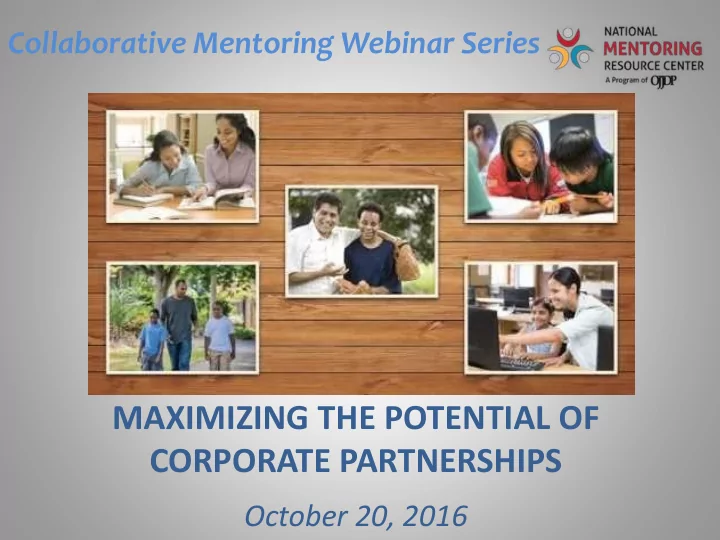
MAXIMIZING THE POTENTIAL OF CORPORATE PARTNERSHIPS October 20, 2016 - - PowerPoint PPT Presentation
Collaborative Mentoring Webinar Series MAXIMIZING THE POTENTIAL OF CORPORATE PARTNERSHIPS October 20, 2016 2016 Collaborative Mentoring Webinar Series Planning Team The Collaborative Mentoring Webinar Series is funded by the Office of
The Collaborative Mentoring Webinar Series is funded by the Office of Juvenile Justice and Delinquency Prevention through the National Mentoring Resource Center and facilitated in partnership with MENTOR: The National Mentoring Partnership
Daniel has over 17 years of experience working in the public and private sectors having served as the Executive Director at generationOn, the Vice President
the Senior Director of Community Affairs at Capital One, the Youth Program Officer at the Three Rivers Workforce Investment Board, and the Executive Director of Pittsburgh Cares. Through partnerships with local and national consulting firms along with his own practice, the D.G. Horgan Group, Daniel has worked with Fortune 500 companies, national and local nonprofit organizations, school districts, and government agencies to support leadership, organizational and program development. Daniel is the author of Tell Me I Can’t…and I Will.
Corporate Partnerships Consultant, MENTOR: The National Mentoring Partnership
Meredith leads Deloitte’s education strategy, RightStep which is focused on helping low income students persist successfully through school into careers. As part of her role, she manages Deloitte’s integrated relationships with national leading education nonprofits, facilitated the first ever Innovation Prize, and launched a virtual mentoring program which will enable Deloitte to engage with low income students at scale. Over her eight years with Deloitte, she has managed an array programs as part of the Corporate Citizenship portfolio including Deloitte’s national pro bono initiative which has delivered more than 1,200 pro bono projects, engaging over 5,000 professionals, clocking more than 400,000 client service hours. Previously, she held various positions in the media and entertainment
NBC page in New York. Meredith still lives in New York City with her husband and two daughters. She graduated with a BA in American Studies from Cornell University. Senior Manager, Corporate Citizenship Department, Deloitte
Ashlee originally joined Communities In Schools National in 2008 as an intern at Communities In Schools of Richmond. From there, she joined the national office team and has most recently settled into a new role as Manager of Student Supports and Partnerships. In this role, Ashlee focuses on grant/program management and researching, developing and managing all national partners. Ashlee has a bachelor's degree in Community Health Education from Virginia Commonweath University in Richmond, VA and works remotely for the national office from Charlotte, NC. In her free time, you can find her volunteering for a local dog rescue, playing with her two rescue pups and navigating her way through being a new mom. Manager of Student Supports and Partnerships, Communities In Schools
A passion for mission focused organizations, innovation, and fundraising brought Pamela to Communities In Schools as the Director, Corporate
decade of experience in the nonprofit sector, including with Share Our Strength and Food &
Conflict studies, coupled with a Master’s in Public Administration has instilled a deep commitment to cross-sector collaboration and collective impact. Rarely unable to help herself when an opportunity arises to support a worthy cause, Pamela volunteers her time with Generation Hope, generating resources to help young parents succeed in college, and is an active member of the Association for Fundraising Professionals. Director, Corporate Relations, Communities In Schools
Exploring Alignment Relationship Building & Management Assessing Impact & Navigating Challenges
What factors go into developing an effective corporate partnership? What is the importance of alignment in a partnership?
How can a mentoring program examine its
What corporate partners should mentoring programs target?
What do corporate partners look for when vetting programs? What should mentoring programs look for when vetting partners?
19
Phase 1: Identify Need
Ensure that this
addresses a specific need of network and is nationwide Conduct comprehensive
broad range of characteristics
Phase 2: Determine Alignment and Rank
Identify gaps where CIS needs to create
current relationships and seek new partnerships to close gaps in resources Determine where and how this partnership could benefit network and partner Collaborate with partnership “think tank” to learn if resources/ tools are useful to network
Phase 3: Formalize Partnership
Partnership managers have “introduction meetings” Set like goals, steps to achieve goals, a timeframe, and a framework for accountability
Phase 4: Collaborate with Network
National Resource Center
Phase 5: Evaluate Results
Collect uniform data in End-of-Year report Collect anecdotal and additional information as needed Revisit MOU to assess relevancy of partnership, deliverables & expectations Yammer/ Weekly Briefing Partner Pilots Determine next steps on how to collaborate MOU Local connections Identify level of evidence-based research Identify existing partnerships (state and local) to learn
Work to secure funding if applicable Partner Pilots National Convening
any CIS affiliates that have worked with them to gain insight
served and the need across the network
activities/programs
presence in the majority of our states
leadership, capacity, and research
evidence-based research to prove their mission/model
and decide what success looks like for both
21
22
100% of activities target K-12 and disenfranchised students 100% of alignment of mission, program activities and strategies Very strong national reach, same structure, positive past collaborations and success with innovation Very strong leadership and research capacity, and high national conference/convening involvement Very strong and evidence- based research-has all evidence based tiers, ability to collect and apply data Very strong alignment of short and long term goals 50% of activities and programs target K-12 disenfranchised students 50% alignment of mission, program activities and strategies Some national reach, similar structure, some evidence of positive past collaborations and some success with innovation Some strength in leadership and research capacity, and some national conference/convening involvement Some evidence-based research- mainly tier one or two, and some data collection Some alignment of short and long term goals 0% of activities and programs target K-12 disenfranchised students 0% alignment of mission, program activities and strategies Little national reach, similar structure and no positive past collaborations or successes with innovation Weak leadership and research capacity, and no national conference/convening involvement No evidence-based research-
capabilities Little alignment of short and long term goals
High Fit Medium Fit
Beneficiary Program Reach Sustainability
Evidence-Based
Other
Low Fit
23
Is the
nationwide? Bring to partnership team to review Connect with
affiliates/cities to gauge their interest Does the organization have a free resource
Does the
EBR for their program? Bring to RLA to review EBR and determine next steps MOU (if no cost associated) or bring to dev’t if funding is needed
If potential partner organization meets a need in the CIS network, consider the following…..
Move Forward, & Collaborate with Network Move Forward, & Collaborate with Network
YES NO NO
OR
Do not move forward Do not move forward Determine if feasible to move forward w/ limited partnership
Partners Your Needs Your Wants Their Needs Their Wants Our Filter Priorities Their Value Add Your Value Add
How can mentoring organizations think about their value add? How can they articulate this?
Cultivation Continuum of Engagement Documentation Data & Reporting
Cultivation
What are the best ways to cultivate corporate relationships?
messages.
pieces of information and stories people can digest.
motivation.
themselves doing.
Source: Opportunity Agenda
Continuum of Engagement
How do you move partners along continuum?
Introduction Synergy
Documentation
What documentation is important when developing & maintaining partnerships?
Data & Reporting
What do companies and mentoring programs want to know? What data and information should be reported and how?
Assessing Impact & Benefit Modifying Challenge s Closing
Assessing Impact & Benefit
How can mentoring programs and corporations assess the impact and benefit of a partnership?
Modifying
When is it time to scale? Modify partnership?
Challenge s
What are some challenges you’ve encountered, and how did you navigate these challenges?
Closing
What should mentoring programs do if it seems like the partnership is not working out to their benefit for one reason or another?
National Mentoring Resource Center Apply for no-cost help for your mentoring program at www.nationalmentoringresourcecenter.org, an online resource funded by the Office of Juvenile Justice and Delinquency Prevention and facilitated in partnership with MENTOR Mentoring Connector Recruit mentors by submitting your program to the Mentoring Connector (previously called the VRS) https://connect.mentoring.org/admin