INSTRUCTIONAL LEADERSHIP CONFERENCE MAXIMIZING PARTNERSHIPS & - - PowerPoint PPT Presentation

instructional leadership conference
SMART_READER_LITE
LIVE PREVIEW

INSTRUCTIONAL LEADERSHIP CONFERENCE MAXIMIZING PARTNERSHIPS & - - PowerPoint PPT Presentation

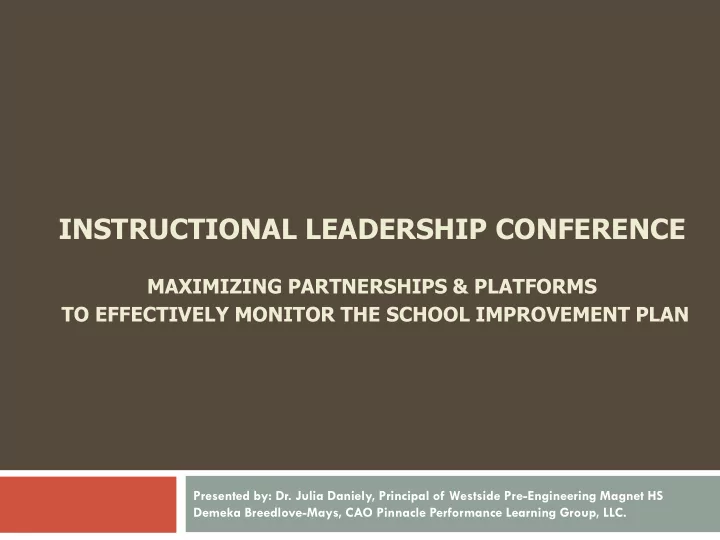
INSTRUCTIONAL LEADERSHIP CONFERENCE MAXIMIZING PARTNERSHIPS & PLATFORMS TO EFFECTIVELY MONITOR THE SCHOOL IMPROVEMENT PLAN Presented by: Dr. Julia Daniely, Principal of Westside Pre-Engineering Magnet HS Demeka Breedlove-Mays, CAO Pinnacle


slide-1
SLIDE 1

INSTRUCTIONAL LEADERSHIP CONFERENCE

MAXIMIZING PARTNERSHIPS & PLATFORMS TO EFFECTIVELY MONITOR THE SCHOOL IMPROVEMENT PLAN

Presented by: Dr. Julia Daniely, Principal of Westside Pre-Engineering Magnet HS Demeka Breedlove-Mays, CAO Pinnacle Performance Learning Group, LLC.

slide-2
SLIDE 2

Division of School and District Effectiveness

Vision

 Our Future: Quality leadership resulting in effective

instruction and learning for all students in every Georgia district, school, and classroom Mission

 Our Strategy: To provide a superior system of

statewide support to districts and schools in Georgia to advance school improvement efforts that positively influence student learning

slide-3
SLIDE 3

Division of School and District Effectiveness

Purpose

 Our Function: To increase collective leadership

capacity to understand what effective schools and districts know and do, and to support the leaders to

  • wn their improvement processes
slide-4
SLIDE 4

Learning Target

 I can share a common vision/mission that defines

school culture and guides the continuous improvement process (Key School Standard PO-1).

 I can use a data-driven and consensus-oriented

process to develop and implement a school improvement plan that is focused on student performance (Key School Standard PO-2).

 I can monitor implementation of the school

improvement plan and make adjustments as needed (Key School Standard PO-3).

slide-5
SLIDE 5

School Improvement Plan

As delineated in the 2004 U.S. Department of Education guidance:

“The purpose of the school improvement plan is to improve the quality of teaching and learning in the school, so that greater numbers of students achieve proficiency in the core academics. The school improvement plan provides a framework for analyzing problems and addressing instructional issues in a school that has not made sufficient progress in students’ achievement....

slide-6
SLIDE 6
slide-7
SLIDE 7

What is monitoring?

“The act of observing something and keeping a record of it. Taking a patient look.”

  • -Visual Thesaurus

Asking

Observing Interpreting

slide-8
SLIDE 8

School Improvement Process

Create a School Improvement Plan Execute Plan Determine Progress (Check) Conduct Needs Assessment

slide-9
SLIDE 9

GET A SNAPSHOT OF STANDARD & PRACTICE

STEP 1

C6 CSI Consensus-Oriented Protocol CSI Deconstruct Protocol

Section Handouts: TAPS and LAPS Reference Sheets, CSI Deconstruct Protocol

slide-10
SLIDE 10

CSI Think-Pair-Share PPLG C6 Consensus-Oriented Protocol

Each group will collaborate on its assigned topic.

 You Do Alone – Consider the topic and your

ideas about it.

 You Do w/ Peers – Converse, consolidate, and

contribute to whole group.

 We Do Together – Check for

understanding/potential Challenges/solutions and reach consensus.

slide-11
SLIDE 11

PPLG’s CSI Deconstruct Protocol Key School Standard – PO-1

Planning & Organization:

What Schools/Stakeholders Need to Be able to Do (Verbs) What Schools/Stakeholders Need to Know (Content)

Leader Behaviors Teacher Behaviors Student Behaviors

Activity #1

slide-12
SLIDE 12

Resources for Determining Stakeholder Behaviors

 AdvancEd Standards for Quality  LKES-LAPS  TKES-TAPS  GSE

slide-13
SLIDE 13

PPLG’s CSI Deconstruct Protocol Key School Standard – PO-1

Planning & Organization 1: Shares a common vision/mission that defines school culture and guides the continuous improvement process.

What Schools/Stakeholders Need to Be able to Do (Verbs) What Schools/Stakeholders Need to Know (Content)

Shares

a common vision/mission that

  • defines school culture
  • guides the continuous improve. process

Leader Behaviors Teacher Behaviors Student Behaviors

  • Communicates

vision/mission at staff meetings and community forums.

  • Ensures work supports

vision/mission.

  • Uses vision/mission to

facilitate continuous improvement process.

  • Communicates relationship

between vision/mission and instructional practices and share with colleague and professional community.

  • Uses vision/mission to

facilitate teaching/learning.

  • Communicates

vision/mission to peers, family, and community.

  • Uses vision/mission in

actively monitoring own progress.

Check for Understanding

  • Key Objective 1
  • Sub-Objective 1
  • Sub-Objective 2

PPLG’s philosophy is that you must plan for implementation and monitoring of BOTH the key and sub objectives.

slide-14
SLIDE 14

PPLG’s CSI Deconstruct Protocol Key School Standard – PO-2

Planning & Organization 2: Uses a data-driven and consensus-oriented process to develop and implement a school improvement plan that is focused on student performance.

What Schools/Stakeholders Need to Be able to Do (Verbs) What Schools/Stakeholders Need to Know (Content)

Uses Uses

  • to develop
  • to implement

a data-driven process a consensus-oriented process

  • a school improvement plan that is focused
  • n student achievement
  • a school improvement plan that is focused
  • n student achievement

Leader Behaviors Teacher Behaviors Student Behaviors

  • Use collaborative, data-driven

process for determining school and stakeholder needs, planning, problem-solving, decision-making, and determining and removing barriers.

  • Facilitate, monitor, and support

implementation of SIP.

  • Use collaborative, data-driven

process for determining team and student needs, instructional planning, problem-solving, decision-making, and determining and removing barriers.

  • Support implementation and

monitoring of SIP by being an effective teacher leader, team member, and classroom teacher.

  • Use collaborative, data-driven

process (with school staff) for determining individual needs, planning, problem-solving, decision- making, and determining and removing behaviors.

  • Support implementation of SIP by

meeting desired learning and behavioral objectives.

Check for Understanding

  • Key Objective 1
  • Key Objective 2
  • Sub-Objective 1
  • Sub-Objective 2
slide-15
SLIDE 15

PPLG’s CSI Deconstruct Protocol Key School Standard – PO-3

Planning & Organization 3: Monitors implementation of the school improvement plan and makes adjustments as needed.

What Schools/Stakeholders Need to Be able to Do (Verbs) What Schools/Stakeholders Need to Know (Content)

Monitors Makes

implementation of the SIP adjustments as needed Leader Behaviors Teacher Behaviors Student Behaviors

  • Uses processes and tools to

monitor implementation of SIP.

  • Provides timely feedback.
  • Uses data collected to make

adjustments and provide timely support.

  • Uses processes and tools to

monitor implementation of SIP that focuses on student performance (e.g., curriculum, assessment, instruction, & interventions).

  • Provides timely feedback to

students.

  • Uses data collected to make

instructional adjustments and provide timely interventions.

  • Uses processes and tools to

monitor own performance relative to SIP goals.

  • Used feedback for self-

improvement.

  • Uses data collected to make

learning and behavioral adjustments.

  • Takes advantage of timely

interventions.

Check for Understanding

  • Key Objective 1
  • Key Objective 2
slide-16
SLIDE 16

ASSESS & MONITOR TO DETERMINE DISTANCE FROM SNAPSHOT

STEP 2

CSI Progress Monitoring Calendar CSI Formative Assessment Tools CSI Data Talk & Action Planning

slide-17
SLIDE 17

CSI Progress Monitoring Calendar

SIP Goal Initiative/ Actions Monitoring Schedule Monitoring Person/Team Evidence of Implementation Implementation Artifacts What is monitored Who Monitors it How often its monitored Why its monitored What will we look for during monitoring

 What actions will we take to realize the goal?  How often will we monitor?  Who will monitor?  What data will we collect?  How will data be gathered?  What will we “look for” to determine quality?

Activity #2

slide-18
SLIDE 18

CSI Monitoring Artifacts and Evidence

Artifacts Evidences

Represent compliance, which is the first step to effective implementation.

  • Agendas
  • Meeting minutes
  • Contact logs
  • Learning logs
  • Lesson plans
  • Assessment blueprint
  • Action plan
  • Professional learning plan
  • Anecdotal notes
  • Sign-in sheets
  • Copy of presentation
  • Communication plan

Represent depth of effective implementation. Points to teachers’ and students’ understanding of the purpose for implementation of an instructional strategy. Provides proof that practice goes beyond compliance and informs and impacts leader behaviors, teacher behaviors, student behaviors, and, ultimately, student learning.

slide-19
SLIDE 19

CSI Progress Monitoring Tool

Monitoring Look Fors Progress Rating SIP Standard Evidence Look Fors Artifact Look Fors

Activity #3 How will data be gathered? What will we “look for” to determine quality?

slide-20
SLIDE 20

CSI Formative Assessment Tools

 Online Monitoring Tools

 Indistar  eBoard Solutions

 Human Monitoring Tools

 External Provider  Professional Learning Communities (PLCs)

 Fiscal Monitoring Tools

 Quarterly Audits  Budget Reviews

slide-21
SLIDE 21

Using Formative Assessment Tools

Online Tools Human Tools Fiscal Tools

  • Use eBoard Solutions for

Strategic Planning & Monitoring (BOY, Quarterly, MY, EOY)

  • Use QCIS/Indistar Tool for

Strategic Monitoring (Weekly)

Use PLCs for Strategic Monitoring

  • Daily Morning Stand Up

– Instructional/Operational

  • Daily Instructional Teams
  • Weekly School Leadership

– SEA, LEA, Admin, Teacher Leaders/Representatives, Student Support

  • Weekly Instructional Leadership

– Academic Coaches, Admin

  • Weekly Administrative
  • Monthly Stakeholder Meetings

– Students/Parents Use External Provider for Strategic Planning & Monitoring

  • Systemic Planning, Protocols, &

Processes

  • Support Implementation
  • Facilitate Professional

Development

  • Program & Process Evaluation
  • Accountability Partner
  • Do Quarterly Audits for

Strategic Monitoring

  • Do BOY, MY, EOY Budget

Reviews for Strategic Monitoring

slide-22
SLIDE 22

SYSTEMIC PROCESS FOR GETTING TO SNAPSHOT

STEP 3

CSI Data Collection CSI Data Analyses CSI Data Action Planning

slide-23
SLIDE 23

Who are we?

Beliefs, Mission , Vision

Where are we now?

Performance Data, Financial Data, Stakeholder Input, SWOT

Where do we want to go?

Strategic Goals, Strategic Priority

How do we plan to get there?

Initiatives, Action Steps

How will we know when we have arrived?

Performance Objectives, Measures & Targets

slide-24
SLIDE 24

CSI Data Collection, Analysis, & Use

 Review demographic and achievement data weekly

  • r twice monthly.

 Review all data sources each quarter: demographic,

achievement, process, and perception data.

 Conduct quarterly evaluations of programs.  Use protocols for analyzing data and action

planning.

 DUTI Data Talk (Data Use for Targeted Interventions)  Five Why Protocol  SWOT Analysis

slide-25
SLIDE 25

PPLG’s DUTI Protocol Step 1: Analyze the Data

RECORD & REVIEW RESULTS Category 1 Category 2 Category 3 Category 4 RESULTS TARGETS GLWS GRWS

REFLECT ON ROOT CAUSES & DETERMINE ADJUSTMENTS

PRACTICES/ PROCESSES ACTIONS

USE 5-WHY PROTOCOL

  • Helps to avoid blame
  • Helps uncover root causes
  • Informs planning of incremental

steps for preventive measures

 How far are we from the target/snapshot?  What are our short-term targets?  What is working?  What is not working?  What aspects of our plan, practice, process are positively

  • r adversely impacting student learning outcomes?

 How will we revise our plan relative to practice or process?

slide-26
SLIDE 26

5-Why Example

slide-27
SLIDE 27

What is a SWOT Analysis?

 A SWOT analysis (alternatively SWOT matrix) is a structured

planning method used to evaluate the strengths, weaknesses,

  • pportunities and threats involved in a project or in

a business venture.

Situation Analysis Internal Strengths Weaknesses External Opportunities Threats

slide-28
SLIDE 28

PPLG’s DUTI Protocol Step 2: Plan Targeted Interventions

Intervention Plan Intervention List

Tier 1

80-90% Pop. Systemic Interventions

Distinguished Proficient Developing Beginning

Tier 2

10-15% Pop. Small Group Interventions

Tier 3

5-15% Pop. Individualized, Intensive Interventions

slide-29
SLIDE 29

PPLG’s DUTI Protocol Step 3: Determine Intervention/Support Groups

Support Person(s) Strategies Resources Program Team Staff Students Program Team Staff Students Program Team Staff Students Program Team Staff Students Distinguished Proficient Developing Beginning

slide-30
SLIDE 30

SELF-ASSESSMENT LEARNING REFLECTIONS

WRAP UP

slide-31
SLIDE 31

Formative Assessment Check

 Think  Talk & Turn  Share

slide-32
SLIDE 32

QUESTIONS……………………..

slide-33
SLIDE 33

Thank you!

 Dr. Julia Daniely

julia.daniely@bcsdk12.net

 Demeka Breedlove-Mays

dbreedlovemays@p2learninggroup.com