Max Weber: Modernity and the Role of Ideas Andrew J. Perrin - - PowerPoint PPT Presentation

max weber modernity and the role of ideas
SMART_READER_LITE
LIVE PREVIEW

Max Weber: Modernity and the Role of Ideas Andrew J. Perrin - - PowerPoint PPT Presentation

Max Weber: Modernity and the Role of Ideas Andrew J. Perrin Sociology 250 October 1, 2013 Andrew J. Perrin Sociology 250 Max Weber: Modernity and the Role of Ideas October 1, 2013 1 / 47 1 Briefing on the midterm exam 2 Weber: A Short


slide-1
SLIDE 1

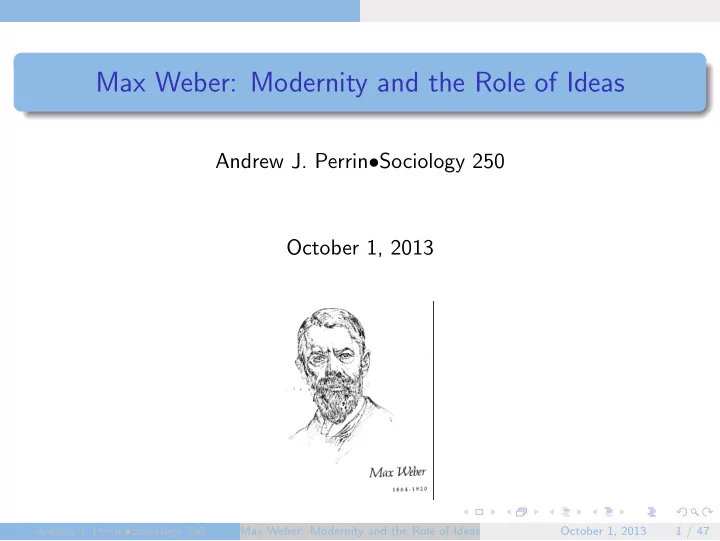
Max Weber: Modernity and the Role of Ideas

Andrew J. Perrin•Sociology 250 October 1, 2013

Andrew J. Perrin•Sociology 250 Max Weber: Modernity and the Role of Ideas October 1, 2013 1 / 47
slide-2
SLIDE 2

1 Briefing on the midterm exam 2 Weber: A Short Introduction 3 Marx and Weber: An Imagined Dialogue 4 Graded papers available on Sakai as of 1:30 today Andrew J. Perrin•Sociology 250 Max Weber: Modernity and the Role of Ideas October 1, 2013 2 / 47

slide-3
SLIDE 3

Max Weber: A Short Life Story

Born 1864, Erfurt, Germany Educated Heidelberg & Berlin Career Major intellectual force in intellectual and political circles 1897 Family quarrel leads to nervous breakdown 1904 Emerges and tours USA, including trip to visit relatives in Mt. Airy 1905–20 Writes most of his important work Died June 14, 1920, pneumonia

Andrew J. Perrin•Sociology 250 Max Weber: Modernity and the Role of Ideas October 1, 2013 3 / 47

slide-4
SLIDE 4

Big Questions in Weber

When are ideas important in history? How are modern societies organized? How do people learn to be capitalist individuals?

Andrew J. Perrin•Sociology 250 Max Weber: Modernity and the Role of Ideas October 1, 2013 4 / 47

slide-5
SLIDE 5

Verstehen

The proper role of social science

Weber: Verstehen (“understanding”) of social action is the proper goal of social science Contrast to Marx’s parsimony Social Action: anything done by anyone that is not completely instinctual or natural

Andrew J. Perrin•Sociology 250 Max Weber: Modernity and the Role of Ideas October 1, 2013 5 / 47

slide-6
SLIDE 6

The Importance of Ideas

The Protestant Ethic and the Spirit of Capitalism Why do people work harder than they have to for survival? Rooted in a system of beliefs: Protestant Asceticism This logic leads followers to care deeply about material success Capitalist logic thus takes hold

Andrew J. Perrin•Sociology 250 Max Weber: Modernity and the Role of Ideas October 1, 2013 6 / 47

slide-7
SLIDE 7

The Protestant Ethic

Predestination: certain people are destined for heaven or hell, even before their birth Therefore, what those people do during life doesn’t impact their eventual destinations

  • BUT. . . they are interested in displaying saved status to others

They therefore work for worldly success as a measure of being in God’s favor

Andrew J. Perrin•Sociology 250 Max Weber: Modernity and the Role of Ideas October 1, 2013 7 / 47

slide-8
SLIDE 8

The Persistence of Ideas

Ideas’ impacts can persist long after the ideas are no longer credible That’s why ideas are so important in history:

Yes, they arise from material life, but they have a life of their own

Andrew J. Perrin•Sociology 250 Max Weber: Modernity and the Role of Ideas October 1, 2013 8 / 47

slide-9
SLIDE 9

Weber: The Character of Modern Society

Bureaucracy Rules, offices, files Rationalization/routinization Wertrationalit¨ at ⇒ Zweckrationalit¨ qt Value rationality ⇒ Pure rationality “Disenchantment of the World”

Andrew J. Perrin•Sociology 250 Max Weber: Modernity and the Role of Ideas October 1, 2013 9 / 47

slide-10
SLIDE 10

Marx vs. Weber: Conflicting Worldviews

Andrew J. Perrin•Sociology 250 Max Weber: Modernity and the Role of Ideas October 1, 2013 10 / 47

slide-11
SLIDE 11

Die Geschichte aller bisherigen Gesellschaft ist die Geschichte von Klassenk¨ ampfen. The history of all hitherto existing society is the history of class struggle. Marx and Engels, Manifest der Kommunistischen Partei 1847–49

Andrew J. Perrin•Sociology 250 Max Weber: Modernity and the Role of Ideas October 1, 2013 11 / 47

slide-12
SLIDE 12

. . . pseudowissenschaftlichem Operieren mit dem Begriff der “Klasse”, des “Klasseninteresses” f¨ uhren, die heut vielfach ¨ ublich ist. . . daß zwar der Einzelne sich ¨ uber seine Interessen irren k¨

  • nne, die “Klasse” ¨

uber die ihrigen aber “unfehlbar” sei. . . . pseudo-scientific operation with. . . ‘class’ and ‘class interests’. . . which has found its most classic expression in the statement of a talented author, that the individual may be in error concerning his interests but that the ‘class’ is ‘infallible’ about its interests. Weber, Wirtschaft und Gesellschaft, T¨ ubingen 1922, 633–4

Andrew J. Perrin•Sociology 250 Max Weber: Modernity and the Role of Ideas October 1, 2013 12 / 47

slide-13
SLIDE 13

Marx and Weber

Andrew J. Perrin•Sociology 250 Max Weber: Modernity and the Role of Ideas October 1, 2013 13 / 47

slide-14
SLIDE 14

[Throughout history] Freeman and slave, patrician and plebeian, lord and serf, guild-master and journeyman, in a word, oppressor and oppressed, stood in constant opposition to one another, carried on an uninterrupted, now hidden, now open fight, a fight that each time ended, either in a revolutionary re-constitution of society at large, or in the common ruin of the contending classes.

Andrew J. Perrin•Sociology 250 Max Weber: Modernity and the Role of Ideas October 1, 2013 14 / 47

slide-15
SLIDE 15

Setting Up the Great Clash

[Under capitalism] the Bourgeoisie. . . has simplified the class antagonisms: Society as a whole is more and more splitting up into two great hostile camps, into two classes directly facing each other: Bourgeoisie and Proletariat.

Andrew J. Perrin•Sociology 250 Max Weber: Modernity and the Role of Ideas October 1, 2013 15 / 47

slide-16
SLIDE 16

. . . religions [are] snake skins which have been cast off by history.

Andrew J. Perrin•Sociology 250 Max Weber: Modernity and the Role of Ideas October 1, 2013 16 / 47

slide-17
SLIDE 17

Religion is. . . the opium of the people.

Andrew J. Perrin•Sociology 250 Max Weber: Modernity and the Role of Ideas October 1, 2013 17 / 47

slide-18
SLIDE 18

. . . a religious man is said to make himself ready for the reception of the all-important grasp of the meaning of the world and of his own existence.

Andrew J. Perrin•Sociology 250 Max Weber: Modernity and the Role of Ideas October 1, 2013 18 / 47

slide-19
SLIDE 19

Social life is essentially practical. Material force can only be overthrown by material force; but theory itself becomes a material force when it has seized the masses.

Andrew J. Perrin•Sociology 250 Max Weber: Modernity and the Role of Ideas October 1, 2013 19 / 47

slide-20
SLIDE 20

Criticism has plucked the imaginary flowers from the chain, not in order that man shall bear the chain without caprice or consolation but so that he shall cast off the chain and pluck the living flower.

Andrew J. Perrin•Sociology 250 Max Weber: Modernity and the Role of Ideas October 1, 2013 20 / 47

slide-21
SLIDE 21

very frequently the ‘world images’ that have been created by ‘ideas’ have, like switchmen, determined the tracks along which action has been pushed by the dynamic of interest.

Andrew J. Perrin•Sociology 250 Max Weber: Modernity and the Role of Ideas October 1, 2013 21 / 47

slide-22
SLIDE 22

The tradition of all the dead generations weighs like a nightmare on the brain of the living.

Andrew J. Perrin•Sociology 250 Max Weber: Modernity and the Role of Ideas October 1, 2013 22 / 47

slide-23
SLIDE 23

A Negro is a Negro. he only becomes a slave in certain relations. A cotton-spinning jenny is a machine for spinning cotton. It becomes capital

  • nly in certain relations. Torn from these relationships it is no more capital

than gold in itself is money or sugar the price of sugar.

Andrew J. Perrin•Sociology 250 Max Weber: Modernity and the Role of Ideas October 1, 2013 23 / 47

slide-24
SLIDE 24

. . . religions created by intellectuals and meant to be rational have been strongly exposed to the imperative of consistency. The effect of the ratio [“reason”], especially of a teleological deduction of practical postulates, is in some way, and often very strongly noticeable among all religious ethics.

Andrew J. Perrin•Sociology 250 Max Weber: Modernity and the Role of Ideas October 1, 2013 24 / 47

slide-25
SLIDE 25

labour produces for the rich wonderful things–but for the worker it produces privation. It produces palaces–but for the worker, hovels. It produces beauty–but for the worker, deformity. It replaces labour by machines–but some of the workers it throws back to a barbarous type of labour, and the other workers it turns into machines. It produces intelligence–but for the worker idiocy, cretinism.

Andrew J. Perrin•Sociology 250 Max Weber: Modernity and the Role of Ideas October 1, 2013 25 / 47

slide-26
SLIDE 26

The worker therefore only feels himself outside his work, and in his work feels outside himself. He is at home when he is not working, and when he is working he is not at home.

Andrew J. Perrin•Sociology 250 Max Weber: Modernity and the Role of Ideas October 1, 2013 26 / 47

slide-27
SLIDE 27

Those who have no property but who offer services are differentiated just as much according to their kinds of services as according to the way in which they make use of these services, in a continuous or discontinuous relation to a recipient.

Andrew J. Perrin•Sociology 250 Max Weber: Modernity and the Role of Ideas October 1, 2013 27 / 47

slide-28
SLIDE 28

But always this is the generic connotation of the concept of class: that the kind of chance in the market is the decisive moment which presents a common condition for the individual’s fate. ‘Class situation’ is, in this sense, ultimately ‘market situation.’

Andrew J. Perrin•Sociology 250 Max Weber: Modernity and the Role of Ideas October 1, 2013 28 / 47

slide-29
SLIDE 29

[the philosophers say] this is an unavoidable misfortune, which must be borne quietly. The millions of proletarians and communists, however, think differently and will prove this in time, when they bring their “existence” into harmony with their “essence” in a practical way, by means of a revolution.

Andrew J. Perrin•Sociology 250 Max Weber: Modernity and the Role of Ideas October 1, 2013 29 / 47

slide-30
SLIDE 30

A class must be formed which has radical chains. . . which has a universal character because its sufferings are universal. . . . This. . . is the proletariat.

Andrew J. Perrin•Sociology 250 Max Weber: Modernity and the Role of Ideas October 1, 2013 30 / 47

slide-31
SLIDE 31

the direction in which the individual worker, for instance, is likely to pursue his interests may vary widely. . . . In any case, a class does not in itself constitute a community. Political membership or class situation has at all times been at least as frequently decisive.

Andrew J. Perrin•Sociology 250 Max Weber: Modernity and the Role of Ideas October 1, 2013 31 / 47

slide-32
SLIDE 32

the worker sinks to the level of a commodity and becomes indeed the most wretched of commodities;. . . finally the distinction between capitalist and land-rentier. . . disappears and the whole of society must fall apart into two classes–the property-owners and the propertyless workers.

Andrew J. Perrin•Sociology 250 Max Weber: Modernity and the Role of Ideas October 1, 2013 32 / 47

slide-33
SLIDE 33

The bourgeoisie, historically, has played a most revolutionary part. All fixed, fast-frozen relations, with their train of ancient and venerable prejudices and opinions, are swept away, all new-formed ones become antiquated before they can ossify. All that is solid melts into air, all that is holy is profaned, and man is at last compelled to face with sober senses, his real conditions of life, and his relations with his kind.

Andrew J. Perrin•Sociology 250 Max Weber: Modernity and the Role of Ideas October 1, 2013 33 / 47

slide-34
SLIDE 34

. . . the market and its processes ‘knows no personal distinctions’: ‘functional’ interests dominate it. It knows nothing of ‘honor.’

Andrew J. Perrin•Sociology 250 Max Weber: Modernity and the Role of Ideas October 1, 2013 34 / 47

slide-35
SLIDE 35

The bureaucracy. . . is. . . obliged to pass off the form for the content and the content for the form. . . . Within the bureaucracy itself, however, spiritualism becomes crass materialism, the materialism of passive

  • bedience, of faith in authority, of the mechanism of fixed and formalistic

behaviour, and of fixed principles, views, and traditions.

Andrew J. Perrin•Sociology 250 Max Weber: Modernity and the Role of Ideas October 1, 2013 35 / 47

slide-36
SLIDE 36

The management of the office follows general rules, which are more or less stable, more or less exhaustive, and which can be learned. . . . The authority to order certain matters by decree. . . only [entitles the bureau] to regulate the matter abstractly. This stands in extreme contrast to the regulation of all relationships through individual privileges and bestowals of favor.

Andrew J. Perrin•Sociology 250 Max Weber: Modernity and the Role of Ideas October 1, 2013 36 / 47

slide-37
SLIDE 37

“Economically conditioned” power is not, of course, identical with “power” as such. On the contrary, the emergence of economic power may be the consequence of power existing on other grounds. Man does not strive for power only in order to enrich himself economically. Power, including economic power, may be valued for its own sake.

Andrew J. Perrin•Sociology 250 Max Weber: Modernity and the Role of Ideas October 1, 2013 37 / 47

slide-38
SLIDE 38

The class situation and other circumstances remaining the same, the direction in which the individual worker, for instance, is likely to pursue his interests may vary widely. . . . The emergence of an association or even of mere social action from a common class situation is by no means a universal phenomenon.

Andrew J. Perrin•Sociology 250 Max Weber: Modernity and the Role of Ideas October 1, 2013 38 / 47

slide-39
SLIDE 39

“Parties” reside in the sphere of power. Their action is oriented toward the acquisition of social power, that is to say, toward influencing social action no matter what its content may be.

Andrew J. Perrin•Sociology 250 Max Weber: Modernity and the Role of Ideas October 1, 2013 39 / 47

slide-40
SLIDE 40

The ideas of the ruling class are in every epoch the ruling ideas.

Andrew J. Perrin•Sociology 250 Max Weber: Modernity and the Role of Ideas October 1, 2013 40 / 47

slide-41
SLIDE 41

A developed sense of responsibility is absolutely indispensable.... it is necessary to have a frame of mind that emancipates the worker... from a constant question: .... how is the accustomed wage nonetheless to be maintained? This frame of mind, if it manages to uproot the worker from this concern, motivates labor as if labor were an absolute end in itself, or a “calling.” The Protestant Ethic

Andrew J. Perrin•Sociology 250 Max Weber: Modernity and the Role of Ideas October 1, 2013 41 / 47

slide-42
SLIDE 42

The philosophers have only interpreted the world, in various ways; the point, however, is to change it.

Andrew J. Perrin•Sociology 250 Max Weber: Modernity and the Role of Ideas October 1, 2013 42 / 47

slide-43
SLIDE 43

politics is out of place in the lecture-room. It does not belong there on the part of the students. . . . Neither does politics, however, belong in the lecture-room on the part of the docents [professors], and when the docent is scientifically concerned with politics, it belongs there least of all.

Andrew J. Perrin•Sociology 250 Max Weber: Modernity and the Role of Ideas October 1, 2013 43 / 47

slide-44
SLIDE 44

We do not face the world in doctrinaire fashion, declaring, “Here is the truth, kneel here!” . . . We do not tell the world, “Cease your struggles, they are stupid; we want to give you the true watchword of the struggle.” We merely show the world why it actually struggles; and consciousness is something that the world must acquire even if it does not want to.

Andrew J. Perrin•Sociology 250 Max Weber: Modernity and the Role of Ideas October 1, 2013 44 / 47

slide-45
SLIDE 45

Life is complicated.

Andrew J. Perrin•Sociology 250 Max Weber: Modernity and the Role of Ideas October 1, 2013 45 / 47

slide-46
SLIDE 46

“Moi, je ne suis pas une Marxiste” “Myself, I am not a Marxist.” –Karl Marx (Attributed by Engels) Late 1870s

Andrew J. Perrin•Sociology 250 Max Weber: Modernity and the Role of Ideas October 1, 2013 46 / 47

slide-47
SLIDE 47

Andrew J. Perrin•Sociology 250 Max Weber: Modernity and the Role of Ideas October 1, 2013 47 / 47