
SLIDE 1
- T. PADMANABHAN
IUCAA, Pune, INDIA
Matters of Gravity
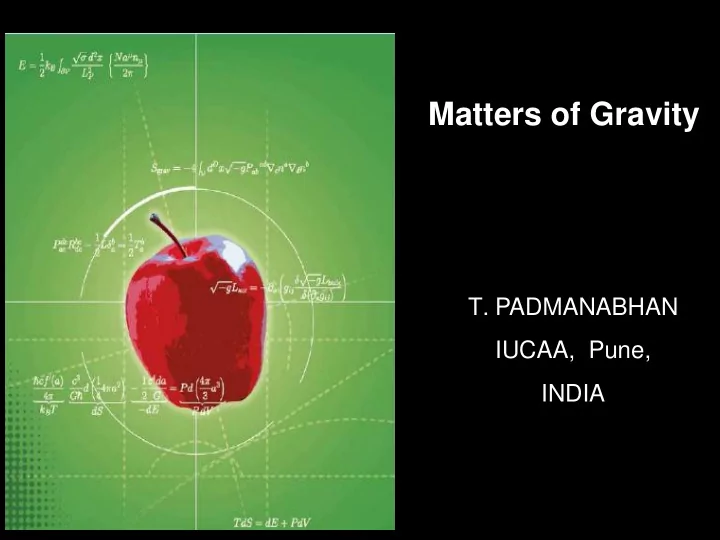
Matters of Gravity T. PADMANABHAN IUCAA, Pune, INDIA NEWTON'S - - PowerPoint PPT Presentation
Matters of Gravity T. PADMANABHAN IUCAA, Pune, INDIA NEWTON'S GRAVITY Mass density produces gravitational field around it But the gravitational effect is instantaneous This contradicts Special Theory of Relativity In sharp
IUCAA, Pune, INDIA
Matters of Gravity
Mass density produces gravitational field around it
But the gravitational effect is instantaneous This contradicts Special Theory of Relativity In sharp contrast with Electromagnetism
Galileo Galilei 1564-1642
Apollo 15 Astronaut David Scott dropping feather and hammer at same time in vacuum of Moon, August of 1971.
Accelerating box = Gravity Light path is curved
Not a force but curvature of spacetime
Verified experimentally in several contexts Elegant and beautiful; but an odd-man out
gravity:
than 2. This is avoided if
Einstein's gravity works well in classical regime But nature is quantum mechanical! Theoretically we need quantum theory of
gravity
( TP, 2002-2011 )
Simple examples: Elasticity, gas dynamics ... Laws are expressible in terms of macroscopic
variables; e.g.
Could be studied without knowing the existence
Field equations laws of gas dynamics Quantizing gravity will not help in understanding quantum structure of spacetime
If you can heat it, it must
Observers with horizon assign to
spacetime a temperature:
Examples: Black holes, accelerated
( Davies, 75; Unruh, 76 )
Existence of Horizon Leads to Temperature
space time
OBSERVER
SPACETIME THERMODYNAMICS
Temperature of the horizon is
But the entropy depends/determines
Remember that horizons are
The invariance under xa → xa + qa (x) leads to a
conserved current Ja which depends on Pab
cd of the theory.
The entropy of the horizon is given by the (Noether) charge:
S= (1/4) ∫H( 32 Pab
cd ) ab dc d
Thus the entropy depends crucially on the theory and vice- versa through the ‘entropy tensor’ Pab
cd.
Entropy knows about spacetime dynamics; temperature
does not.
The connection between xa → xa + qa (x) and entropy is a
mystery in the conventional approach.
( TP, 2002-2011 )
For matter atomic structure is relevant
For gravity the corresponding scale is
Gravity Quantum Theory Relativity 1/2
10-10 10-20 10-30 1030 1020 1010
Electroweak GUTs
cm cm Quantum Gravity!
Planck length
HOLDS TRUE FOR A LARGE CLASS OF MODELS
Stationary axisymmetric horizons and evolving spherically symmetric horizons in Einstein gravity, [gr-qc/0701002]
Static spherically symmetric horizons in Lanczos-Lovelock gravity, [hep-th/0607240]
Dynamical apparent horizons in Lanczos-Lovelock gravity [arXiv: 0810.2610]
Generic, static horizon in Lanczos-Lovelock gravity [arXiv: 0904.0215]
Three dimensional BTZ black hole horizons [arXiv:0911.2556]; [hep-th/0702029]
FRW and other solutions in various gravity theories [hep-th/0501055]; [arXiv:0807.1232]; [hep-th/0609128]; [hep-th/0612144]; [hep-th/0701198]; [hep-th/0701261]; [arXiv:0712.2142]; [hep-th/0703253]; [hep-th/0602156]; [gr-qc/0612089]; [arXiv:0704.0793]; [arXiv:0710.5394]; [arXiv:0711.1209]; [arXiv:0801.2688]; [arXiv:0805.1162]; [arXiv:0808.0169]; [arXiv:0809.1554]; [gr-qc/0611071].
Horova-Lifshiftz gravity [arXiv:0910.2307]
IN ALL THESE CASES FIELD EQUATIONS REDUCE TO TdS = dE + PdV WITH CORRECT S !
The equipartition law determines the density of
microscopic degrees of freedom
For matter this was determined even before
we knew what it was counting!
B
We can do the same thing for spacetime
Gravity turns out to be "holographic" For Einstein's theory, N = A / LP
2
( TP, 04, 09 )
Equipotential surface
SOURCE OF GRAVITY
Equipotential surface
SOURCE OF GRAVITY
g
Equipotential surface
g
Equipotential surface
g
Use an extremum principle for a thermodynamical potential (S, F, …) Use an extremum principle for a thermodynamical potential (S, F, …) How does one close the loop on dynamics? Yes Yes Does this entropy match with expressions obtained by other methods? ∆S ∆n ∆S ∆n Expression for entropy Yes; when static field eqns hold; depends on the theory of gravity Yes; when thermal equilibrium holds; depends
Can we read off dn? Equipartition law dn = dE / (1/2) kB T Equipartition law dn = dE / (1/2) kB T Number of degrees of freedom required to store energy dE at temperature T Spacetime must have microscopic degrees of freedom The body must have microscopic degrees of freedom How could the heat energy be stored in the system? Yes; water at rest in Rindler spacetime will get heated up Yes; for e.g., hot gas can be used to heat up water Can it transfer heat Yes Yes Can the system be hot?
Spacetime Macroscopic body System
For matter, we have a maximum entropy
Same principle works for gravity! Maximizing the entropy of horizons for all
( TP, A. Paranjape, 07: TP, 08 )
The resulting field equations are those of Lanczos- Lovelock theory of gravity which reduces to Einstein’s theory in D=4!
Emergence of cosmic space
Lorentz frame – we try not to draw attention to it!
motion wrt this `cosmic ether' (aka CMBR!).
smaller scales!
cosmic time evolves.
with and being the Komar energy.
which is the standard result.
with constant
HOLOGRAPHIC EQUIPARTITION
with
This provides an alternative way of studying cosmology.
EMERGENCE OF SPACE AS A QUEST FOR HOLOGRAPHIC EQUIPARTITION
LINKING INFLATION TO DARK ENERGY
during will be:
which implies
understanding
like fluid mechanics, elasticity …..
beyond Einstein’s theory.
surfaces, affects accessibility of information. Extremisation of relevant thermodynamic potential ℑ[q] gives field equations.
space, governed by in Planck units.
with
REFERENCES
T.P., Lessons from Classical Gravity about the Quantum Structure of Spacetime, J.Phys. Conf.Ser., 306, 012001 (2011) [arXiv:1012.4476]. T.P., Emergent perspective of Gravity and Dark Energy, Research in
ACKNOWLEDGEMENTS
Sunu Engineer Dawood Kothawala Sudipta Sarkar Sanved Kolekar Suprit Singh Krishna Parattu Bibhas Majhi Ayan Mukhopadhyay Aseem Paranjape Donald Lynden-Bell
thermodynamic description of macroscopic body in e.g., field equations, action functionals …
degrees of freedom of spacetime. Shows gravity is ‘holographic’!
Navier-Stokes equations.
surfaces, affects accessibility of information. Extremisation of relevant thermodynamic potential ℑ[q] gives field equations.
beyond Einstein’s theory.
OPEN QUESTIONS, FUTURE DIRECTIONS …
OK, but so what …?
equation from thermodynamics of hydrogen gas ?!]
freedom that ‘come alive’ only near null surfaces?
temperature, entropy etc. What are the broader implications ?
2 as
zero-point-area of spacetime ….
cosmological constant problem, singularity problem …
Thank you for your time
OPEN QUESTIONS, FUTURE DIRECTIONS …
OK, but so what …?
equation from thermodynamics of hydrogen gas ?!]
freedom that ‘come alive’ only near null surfaces?
temperature, entropy etc. What are the broader implications ?
2 as
zero-point-area of spacetime ….
cosmological constant problem, singularity problem …