
SLIDE 1
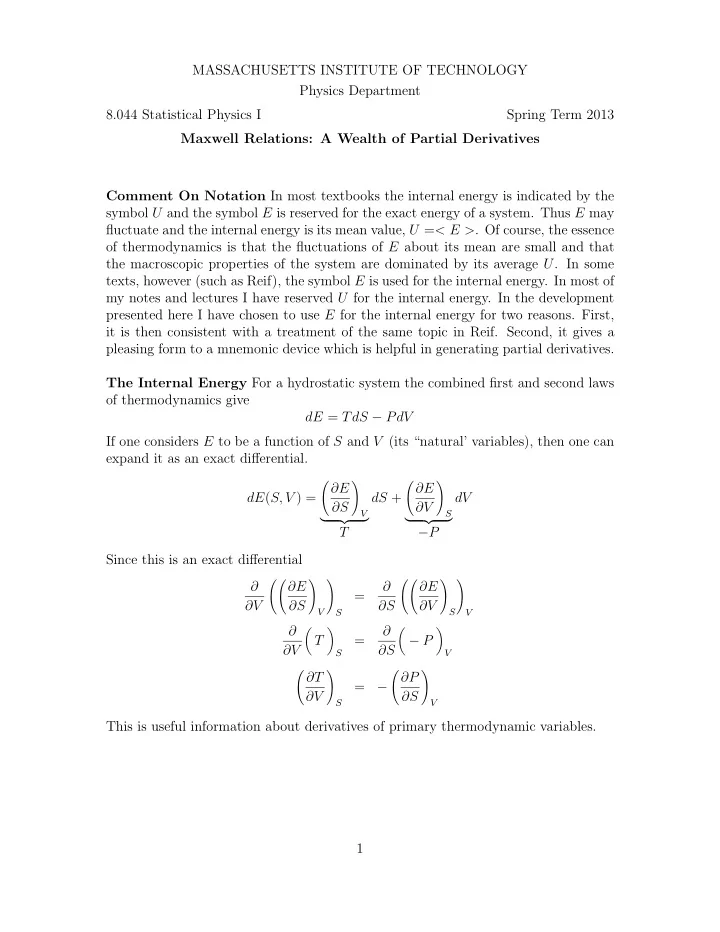
MASSACHUSETTS INSTITUTE OF TECHNOLOGY Physics Department 8.044 Statistical Physics I Spring Term 2013 Maxwell Relations: A Wealth of Partial Derivatives Comment On Notation In most textbooks the internal energy is indicated by the symbol U and the symbol E is reserved for the exact energy of a system. Thus E may fluctuate and the internal energy is its mean value, U =< E >. Of course, the essence
- f thermodynamics is that the fluctuations of E about its mean are small and that
the macroscopic properties of the system are dominated by its average U. In some texts, however (such as Reif), the symbol E is used for the internal energy. In most of my notes and lectures I have reserved U for the internal energy. In the development presented here I have chosen to use E for the internal energy for two reasons. First, it is then consistent with a treatment of the same topic in Reif. Second, it gives a pleasing form to a mnemonic device which is helpful in generating partial derivatives. The Internal Energy For a hydrostatic system the combined first and second laws
- f thermodynamics give
dE = TdS − PdV If one considers E to be a function of S and V (its “natural’ variables), then one can expand it as an exact differential. dE(S, V ) =
∂E
∂S
- dS +
dV
- V
∂E
∂V
- T
- S
−P
- Since this is an exact differential
∂ ∂V
∂E
∂S ∂ ∂E = ∂S ∂V
V S
- S
- V
∂ ∂V
- T
- ∂
= P
S
∂S
- −
- V
∂T
∂V
- =
S
−
∂P
∂S
- V