Maritime/Tugboat world INTRODUCTION OF PROJECT PARTNERS 2 - - PowerPoint PPT Presentation

maritime tugboat world introduction of project partners
SMART_READER_LITE
LIVE PREVIEW

Maritime/Tugboat world INTRODUCTION OF PROJECT PARTNERS 2 - - PowerPoint PPT Presentation

Tracking stress and workload in the Maritime/Tugboat world INTRODUCTION OF PROJECT PARTNERS 2 BACKGROUND 3 MARIN 4 B 5 WORKLOAD EXPLAINED 6 WHY DO WE NEED A WORKLOAD INDICATOR? Identify most critical phases in operation Evaluate


slide-1
SLIDE 1

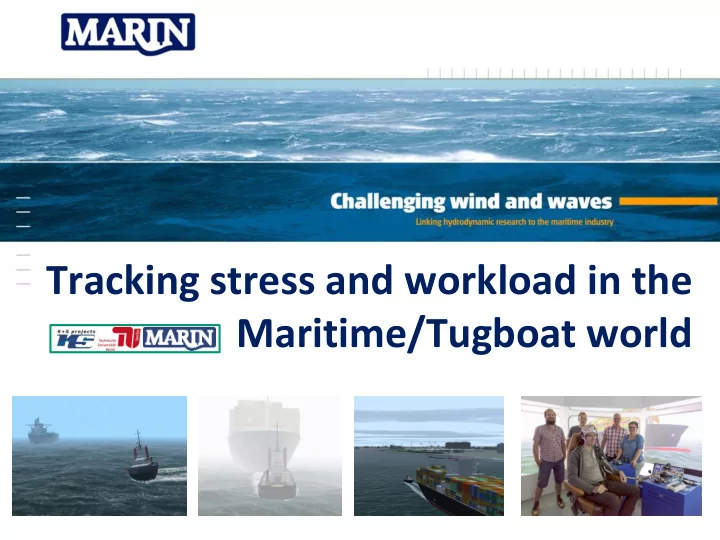
Tracking stress and workload in the Maritime/Tugboat world

slide-2
SLIDE 2

INTRODUCTION OF PROJECT PARTNERS

2

slide-3
SLIDE 3

BACKGROUND

3

slide-4
SLIDE 4

MARIN

4

slide-5
SLIDE 5

B

5

slide-6
SLIDE 6

WORKLOAD EXPLAINED

6

slide-7
SLIDE 7

WHY DO WE NEED A WORKLOAD INDICATOR?

7

  • Identify most critical phases in operation
  • Evaluate effect infrastructure on operational workload
  • Optimize man machine interface
  • Optimize team performance (optimum allocation of tasks)
  • Monitor training effectiveness
slide-8
SLIDE 8

OBJECTIVES OF THE 2015 HF EXPERIMENT

8

  • Study the feasibility of a real-time EEG based workload estimation in a bridge

simulator scenario (take the laboratorium to a more operational environment).

  • Study the correlation and complementarity of different physiological

indicators.

  • Develop an overall workload indicator for the selected simulator scenario

containing EEG, ECG, skin conductance, breathing analysis and simulator time traces.

  • “Conduct simulations with different levels of workload on a tug

simulator and include, EEG, ECG, respiration and Skin conductivity

  • measurements. And evaluate if they can be used together with

simulator signals to contribute to a workload indicator.”

slide-9
SLIDE 9

EEG MEASUREMENTS

9

  • EEG records changes in electrical activity on the scalp
  • Machine learning used to detect classifiers (frequency patterns

that are related to workload) for a specific participant.

slide-10
SLIDE 10

EXAMPLES OF EEG PATTERNS

10

In general high workload causes:

  • Increase in frontal theta (4-8 Hz) activity
  • Decrease in parietal alpha (8-12Hz)activity
slide-11
SLIDE 11

ECG MEASUREMENT

11

  • ECG records the inter beat interval, from which the frequency and

variability can be studied

  • Measured with a belt

With increased workload we expect:

  • Heart frequency will increase
  • Variability will decrease
  • RMSSD (root mean square of successive differences) will decrease
  • Power LF will increase
  • Power HF will decrease
slide-12
SLIDE 12

SKIN CONDUCTIVITY - PRINCIPLE

12 conductivity (microSiemens)

Sweat gland

wrist

slide-13
SLIDE 13

SKIN CONDUCTANCE

13

  • Arousal and relaxation visible
  • Events can be clearly detected
  • Base level is influenced by

more factors than stress alone

Meditation start end Watching a soccer match start 2-0 1-0 3-0 Regular pattern

slide-14
SLIDE 14

FULL DAY EMOTION AND ACTIVITY MEASUREMENT

14

Lecture Sleep

Skin Conductance Activity level

Travel Parenting Relaxing Working GSR storm

Orientation

slide-15
SLIDE 15

PHASE 1 - OPTIMIZE SCENARIOS AND TEST SET-UP

15

  • 1. Scenario with bow to bow operations
  • 2. Squall scenario
  • 3. N-back task

Multi sensor bracelet not yet included

slide-16
SLIDE 16

SCENARIO 1 BOW TO BOW OPERATIONS

slide-17
SLIDE 17

SCENARIO 2, N-BACK TASK

17

Same as scenario 1, but maintain position next to container ship 4 min, no extra task 4 min, cognitive task 1 6 9 5 4 5 3 2 4 6 4 6 2 3

slide-18
SLIDE 18

SCENARIO 3, SQUALL

18

  • Tug provides continuous pull back for offloading tanker
  • Squall (sudden wind increase + direction change)
  • Task is to maintain same relative position and pull force (30 ts).
slide-19
SLIDE 19

RESULTS PHASE 1: IMPROVED SCENARIO

19

slide-20
SLIDE 20

SET UP 2ND PHASE SIMULATIONS

20

10 candidates performed the following program:

  • Scenario 1, bow to bow operations (2 cycles, total 50 minutes)
  • N-back task (5 repetitions, total 40 minutes)
  • Scenario 1, bow to bow operations (2 cycles, total 50 minutes)

One candidate became motionsick during first run and provided no valid results.

slide-21
SLIDE 21

PHASE 2 SIMULATIONS - IMPRESSION

21

slide-22
SLIDE 22

EEG RESULTS

22

slide-23
SLIDE 23

DIFFERENT FILTERING METHODS TO OBTAIN CLASSIFIERS

23

slide-24
SLIDE 24

RESULT OF A DEDICATED CLASSIFIER

24

slide-25
SLIDE 25

RESULTS - ECG

25

RR interval decreases and HR increases consistently with higher workload. Other relations (variability, spectra etc) are less consistent and less suitable to include in workload indicator. N-back: Significant difference between low and high workload periods. Bow-Bow: Significant difference between Low-High1 and High1-High-2; High 1 condition for all candidates most demanding

slide-26
SLIDE 26

RESULTS SKIN CONDUCTIVITY

26

Only 4 good measurements

slide-27
SLIDE 27

RESULTS SIMULATOR SIGNALS

27

First results N-back task very surprising: Some candidates showed significant increase in rudder and telegraph changes during periods of high workload, whilst the steering job did not change!

slide-28
SLIDE 28

COMBINED RESULTS

28

slide-29
SLIDE 29

CONCLUSIONS

29

  • It is possible to measure relative workload with physiological
  • features. Ship related parameters can be used to enhance this
  • process. EEG and ECG can discriminate between high and low

workload

  • Preparing an EEG takes a lot of time and is very intrusive (it forces

the wearer to sit in a chair continuously and after a while it is annoying to wear). Wireless dry cap systems may be the way ahead.

  • EEG is very valuable to measure workload. It is possible to find

classifiers for workload, but they are person and scenario specific. For example: the auditory N-back tasks requires other classifiers than the ‘visual’ bow-to-bow pulling task.

slide-30
SLIDE 30

CONCLUSIONS

30

  • The signals from the ECG can be used as a measure for workload,
  • ur study showed which signals are suitable for inclusion in the

workload indicator.

  • The number of successful skin conductance measurements was

low, but still looks like a promising way to go.

  • It may be very difficult to determine a generic workload indicator

that works on everybody, but with a purpose built calibration run individual workload indicators can be found.

  • We gained a lot of experience with this experiment and the

analyses, which forms a sound basis for future experiments.

slide-31
SLIDE 31

OUTLOOK

31

  • The evaluation of data is still going on. We are going to combine the simulator signals

and physiological measurements into one workload indicator. We intent to use the machine learning tool that identified the EEG classifiers to find multi-tool classifiers.

  • As MARIN wants to develop a human factor laboratory for its new simulator facilities,

more experiments are to follow, we look for cooperation with manufacturers, operators, scientists etc. Also K&S and TU Berlin continue with research in this area.

  • We want to do experiments with other type of operations (e.g. pilotage of vessel,
  • ffshore operations) and also on-board tests to link simulator experience to real life

experience.

  • Experiments including other techniques:
  • Eye-blink rate
  • Pupil diameter
  • Squeeze sensor
  • Voice pitch
  • Secondary tasks
slide-32
SLIDE 32

THANKS TO THE TUG CAPTAINS

32

slide-33
SLIDE 33

WHO TO CONTACT?:

33