MARIKO MORI VS RENE COX APPROACHING THE USE OF THE BODY IN MODERN - - PowerPoint PPT Presentation

mariko mori vs ren e cox
SMART_READER_LITE
LIVE PREVIEW

MARIKO MORI VS RENE COX APPROACHING THE USE OF THE BODY IN MODERN - - PowerPoint PPT Presentation

MARIKO MORI VS RENE COX APPROACHING THE USE OF THE BODY IN MODERN AND CONTEMPORARY ART FROM A GLOBAL PERSPECTIVE, CRITICALLY EXAMINE WORKS BY TWO ARTISTS FROM DIFFERENT REGIONS, AROUND THE SAME PERIOD (FOR INSTANCE AN ARTIST FROM LATIN


slide-1
SLIDE 1

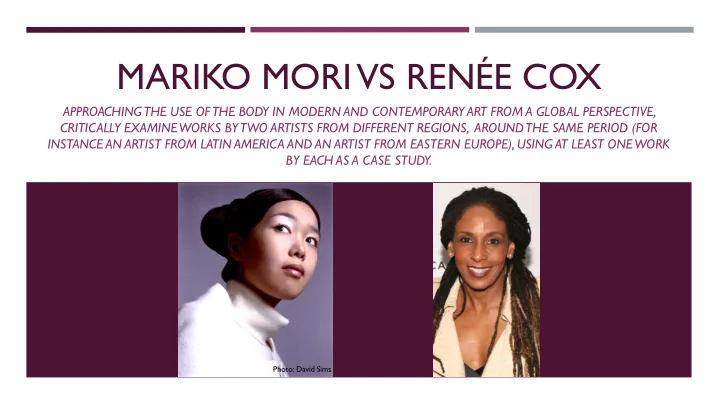
MARIKO MORI VS RENÉE COX

APPROACHING THE USE OF THE BODY IN MODERN AND CONTEMPORARY ART FROM A GLOBAL PERSPECTIVE, CRITICALLY EXAMINE WORKS BY TWO ARTISTS FROM DIFFERENT REGIONS, AROUND THE SAME PERIOD (FOR INSTANCE AN ARTIST FROM LATIN AMERICA AND AN ARTIST FROM EASTERN EUROPE), USING AT LEAST ONE WORK BY EACH AS A CASE STUDY.

Photo: David Sims

slide-2
SLIDE 2

COMPARISON: BACKGROUND

BOTH ARTISTS INVESTIGATE THE IN-BETWEEN AND EMERGENCE, CHALLENGING NOTIONS OF CULTURAL IDENTITY AND CHANGING PERSPECTIVES

RENEE COX

Born in Colgate, Jamaica in 1960 later settling in Scarsdale, New York.

Her work concerns social issues, cultural stereotypes and female empowerment.

Works primarily with photography.

Has provoked conversations at the intersections of cultural works, activism, gender and African studies. MARIKO MORI

Born in T

  • kyo, Japan in 1967

Works primarily with photography, sculpture and digital art

Mori often uses her own body

Mori embodies technology and spirituality (or science and Buddhism) within her practice, identifying with both as a way of transcending, and transforming, consciousness and the self

Her work blurs boundaries and exists in-between

slide-3
SLIDE 3

CULTURE BACKGROUNDS: DIFFERENCES AND SIMILARITIES

Creates new, positive visual representations of African-Americans

From the beginning her works have shown a deep concern for social issues.

Renee Cox questions society and the roles it gives black women.

“I believe that images of women in the media are distorted and women are imprisoned by those unrealistic representations of the female body. This distortion crosses all ethnic lines and devalues all women. I am interested in taking the stereotypical representations of women and turning them upside down, for their empowerment.” –Renee Cox ("Brooklyn Museum: Renee Cox", 2017)

Jonathon Wallis explains how Mori echoes the consumerist culture of Japan (which is influenced by America)

Explores hybridity and blurring boundaries in relation to post-bubble Japan influenced by satire and Manga.

Elisabetta Porcu suggests that Mori is influenced by sophisticated technology, pop culture, science-fiction and traditional Japanese culture (including Buddhism).

Mori’s early photographs reflect trends in Japanese popular culture, especially that of adolescent Japanese girls known as Shojo culture.

In traditional Japanese culture, women follow three submissions:

When young, she submits to her father. When married, she submits to her husband. When old, she submits to her sons.

slide-4
SLIDE 4

CASE STUDY ANALYSIS: MARIKO MORI: TEA CEREMONY I (1994), II (1995) AND III (1995)

  • Between actual/virtual
  • Between performance/photograph
  • Between absence/presence
  • Between tradition and modernity
slide-5
SLIDE 5

CASE STUDY ANALYSIS: RENÉE COX: HOTT

  • EN-TOT, CA. 1993–94

 Between visible/invisible  Between real/fiction  Between performance/photograph  Globalised approach

slide-6
SLIDE 6

HOW THEY EACH FOCUS ON THE BODY: SIMILARITIES

Both use their own body to convey how different cultures have segregated and alienated the female form, how gender is a construction of society, in the attempt to liberate the oppressed female form

They both perform with their body

Both works exist between photography and performance

Both link strongly to Cindy Sherman’s work Untitled Film Stills (1977-80)

Both relied on physical transformation to investigate gender and ethnic construction

They investigate the relationship between subject/object, and as outsiders of both resident culture and ‘original’ culture they feel alienated – in short they suffer from an identity crisis.

slide-7
SLIDE 7

HOW THEY EACH FOCUS ON THE BODY: DIFFERENCES

 Their bodies perform in different ways due to the differences within their cultural influences 

Their bodies perform in different ways because their bodies/gender have had different frames applied.

Mori hypothetically merges robotics and biotechnology with the human body, whereas Cox uses her nude body

Despite both artists using their bodies differently within their works, they both discuss similar arguments.

Cox’s photographs usually insert black bodies into white-dominated, traditional imagery. In comparison, Mori uses photography as a way of juxtaposing imagery

Cox often adorns stereotypical female identities, like Cindy Sherman, whereas Mori assimilates the role of the alien, or cyborg.

slide-8
SLIDE 8

QUESTION

Addressing the issue of gender globally, do you consider the way the female body is used within the pieces discussed a success?

slide-9
SLIDE 9

BIBLIOGRAPHY

Jonathon Wallis, The Paradox of Mariko Mori’s Women in Post-Bubble Japan: Office Ladies, Schoolgirls, and Video-Vixens, Women’s Art Journal, Vol. 29, No. 1 (Spring – Summer, 2008) pp. 3-12

Elisabetta Porcu, Pure Land Buddhism in Modern Japanese Culture, (2008) pp. 177-181

Gwyneth Shanks, Visualizing the Now, Third Text, (2014) 29:4-5, pp. 393-405

Gwendolyn Audrey Foster, Self-Stylization and Performativity in the Work of Yoko Ono, Yayoi Kusama and Mariko Mori, Quarterly Review of Film and Video, (2010) 27:4, pp.267-75

Achille Bontio, Olivia Danilo Eccher [eds.], Appearance: Markio Mori, Yasumasa Morimura, Luigi Ontaril, Andres Serrano, Pierre Giles and Tony Oursler, (2000) pp. 32 – 45

Allison Holland, Mariko Mori and the Art of Global Connectedness, in Intersections: Gender and Sexuality in Asia and the Pacific (Issue 23, November 2009)

http://pinchukartcentre.org/en/photo_and_video/photo/7483

http://www.marthagarzon.com/contemporary_art/2011/08/mariko-mori-cybergeishas- technonolgy/

http://www.artnet.com/Magazine/FEATURES/itoi/itoi11-20-01.asp

http://www.skny.com/artists/mariko-mori

Mariko Mori - 27 Artworks, Bio & Shows on Artsy. (2017). Artsy.net. Retrieved from https://www.artsy.net/artist/mariko-mori

Brooklyn Museum: Renee Cox. (2017). Brooklynmuseum.org. Retrieved from https://www.brooklynmuseum.org/eascfa/feminist_art_base/renee-cox

Reasserting Her Image: The Photographs of Renée Cox. (2017). prezi.com. Retrieved from https://prezi.com/f7vhrgopsskb/reasserting-her-image-the-photographs-of-renee-cox/

Renee Cox pt2 INFORMATION - PEOPLE- Black Atlantic - University of Liverpool. (2017). Liverpool.ac.uk. Retrieved from https://www.liverpool.ac.uk/black- atlantic/information/renee_cox_pt2/

Video of the Week: After Hot-En-Tot: Two conversations with Artist Renée Cox. (2017). Black Atlantic Resource Debate. Retrieved from https://blackatlanticresource.wordpress.com/2012/03/26/video-of-the-week-after-hot-en-tot- two-conversations-with-artist-renee-cox/

Renee Cox. (2017). Renee Cox. Retrieved from http://www.reneecox.org/about

Fleetwood, Nicole R., Troubling Vision. Chicago: The University of Chicago Press, 2011.

"Saartjie Baartman: The Hottentot Venus Who Aroused The Victorians". 2017. Blog. Flashbak. http://flashbak.com/saartjie-baartman-the-hottentot-venus-who-aroused-the-victorians-50638/.