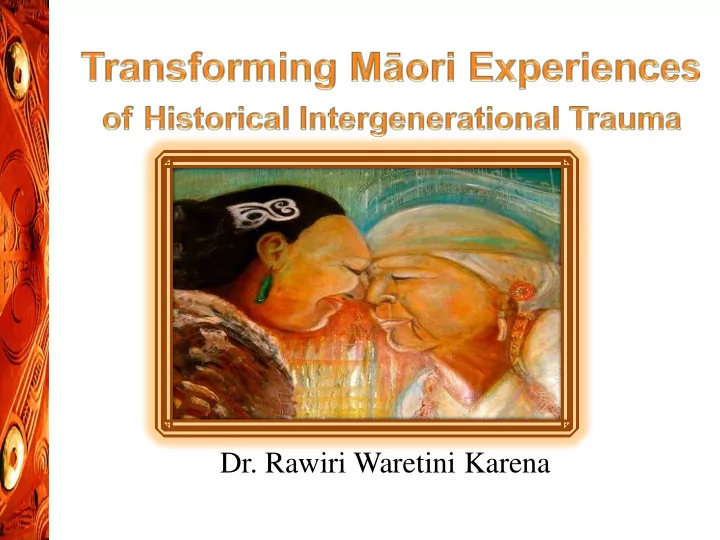
- Dr. Rawiri Waretini Karena
Dr. Rawiri Waretini Karena This presentation examines links between - - PowerPoint PPT Presentation
Dr. Rawiri Waretini Karena This presentation examines links between Mori deficit statistics, Mori experiences of historical intergenerational trauma, and colonisation. Historical context Global impact of Colonization Mori
- This presentation examines links between
Māori deficit statistics, Māori experiences of historical intergenerational trauma, and colonisation.
Māori Deficit Statistics Māori experiences of Historical Intergenerational Trauma Global impact of Colonization (Dr Jacquelyn Elkington 2006; Dr. Jenny Lee, 2005)
Historical context
- To understand links between Māori deficit
statistics, & Māori experiences of historical intergenerational trauma, this presentation focuses on the history of colonisation
- Precipitated by Columbian
voyages
- European powers were
eager to obtain portions
- f land from Indigenous
peoples
- European emissaries
were encountering other European powers during their travels
- They recognized a need to
establish a formal code of judicial standards of engagement with Indigenous peoples
- This lent a patina of
legality to the actions of the European Crowns
(Churchill, W, 1993, p.34)
- In order for any such regulatory code to be
considered effectively binding by all Old World parties, it was vital that it be sanctioned by the Catholic Church”.
- A series of Papal Bulls begun by Pope Innocent
IV during the late 13th century was used to define the proper [lawful] relationship between Christians and 'Infidels' in worldly matters such as property rights (Churchill, 1993,p. 35).
Papal Bulls can be defined as official decrees of the pope, and was the exclusive letter format of the Vatican from the fourteenth century. Churchill (1993, p. 35)
- This presentation focuses o two Papal Bull
Decrees from the Vatican
- Was used to claim land that was considered
un-occupied.
- This included:
- Australia, parts of the United States and the
South Island of Aotearoa New Zealand
- Romanus Pontifex 1455 called for non-
Christian peoples to be invaded, captured, vanquished, subdued, and reduced to perpetual slavery and to have their possessions and property seized by Christian monarchs (World Church 2012)
The Doctrine of Discovery remains the law in in all settler / colonial societies around the world today. (The World Church Council 2012, p.1)
- In 1492 Christopher Columbus on behalf of Spain enslaves, the Arawak
People, commits genocide and their total extinction by 1555
- Christopher Columbus initiates the slave trade in Africa in 1500s
- In 1519, Francisco Pizarro carried out a similar extermination against
the Inca empire in South America.
- 500 year war with First Nations People, genocide 100 million first
Nations Indigenous
- British & French colonise Canada, in the 1500s, caused genocide,
thousands of children disappear from boarding schools, Indigenous women continually subjected to murder & traded for sex in the USA
- Australia suffered genocide, extermination policies, and lost
generations
- Jan 17 1893 the USA Navy and American settlers held up the Hawaii
monarchy forcing Queen Lili’ uokalani to yield her throne under protest.
- The psychological implications of trauma
are evident in all Indigenous cultures affected by colonization
- Deficit statistics in education, employment,
poverty, addictions, metal health, suicide, crime, & prison statistics are comparable across Indigenous cultures affected by colonization
(Walters et al, 2011; Brave Heart, 1995; Estrada, 2009; Fanon, 1963, Memmi, 1991)
- 96% of Indian males and 92% of Indian females
experience alcoholism by the time they have reached 12th grade (Oetting & Beauvais, 1989)
- Death from alcohol related causes are five
times more likely than for White Americans, additionally, suicide rates are 50% higher than the national average Brave Heart, Chase, Elkins, & Altschul,2011, p. 283).
- Introducing the House of Commons Select
Committee on Aborigines
- Established in England1837
- Made up of Government and missionaries
- Developed assimilation policies for
Commonwealth countries
(Armitage, 1995)
Armitage (1995) states that:
- In Australia these policies were introduced
through the protection of 'Aborigines' statutes which were passed in the period between 1869 and 1909; in Canada they were introduced within the framework of the Indian Act 1876, and its successors; and in New Zealand they were introduced in legislation establishing the Native Department (1861) and the Native Schools Act, 1867 (189).
- What this highlights is that the House of
Commons Select Committee on Aborigines developed a colonizing template then superimposed policies over a variety of countries bringing about a global assimilating agenda
- Māori did not suffer from the intentional
practice of mass genocide with a loss of over 100 million Indigenous peoples like the First Nations
- Māori did not suffer the extinction and total
annihilation of their people like the Taino (Arawak) people
- Nor were Māori exterminated, & suffered lost
generations like the Australian Aborigine
- Māori did not experience an extreme degree of
slavery like the African Americans
- At a macro level - Māori experienced a form
- f cultural genocide, land displacement and
disenfranchisement.
- They also experienced economic
destruction leading to intergenerational poverty. (Dr Rawiri Waretini-Karena 2014)
- Bedggood (1978) argues that “the
penetration of the capitalist mode of production and the destruction of the Māori
- ccurred at three levels, economic, political
and ideological”... The use of state force to break the elders control of Māori society was necessary... By the destruction of Māori society, the state as midwife of history, introduced the capitalist mode of production in New Zealand”(p. 286).
- Rashbrooke (2013) states that:
- Central to this story is the appropriation and alienation
- f almost 95% of Māori land from the nineteenth
century well into the twentieth century.
- The Treaty settlements process acknowledges that the
NZ Crown's acquisition of land was often flawed 'to a lesser degree', and the 'excessive land loss had harmful effects on Māori social and economic development
- Settlements to date have produced compensation of
about 1.48 billion… that has to be considered against the impact of losing a Māori international economic base for
- ver more than a century (p.4).
Area
- 1. Prison
- 2. Young offenders
- 3. Violent crimes
- 4. Dishonesty offences
Percentage
- 1. While only 14.5 % of the NZ
population make up over 50%
- f the prison population for
males and 60% prison population for females
- 2. 20% will continue crime into
adulthood
- 3. Increased from 10.3 % in
2002-3 to 11.6 % in 2004-5
- 4. Make up 60% of all Māori
crime
(Jackson, 2012; NZ Herald, 2005)
Underlying themes behind Māori deficit statistics stem from:
- 1. intergenerational impoverishment,
- 2. lack of cultural identity,
- 3. lack of cultural language,
- 4. Lack of understanding of cultural heritage
- 5. Lack of whakapapa knowledge
- 6. Lack of understanding of tikanga / kawa
A product of Colonization
- Genesis of underlying themes
Treaty of Waitangi Legislative violations - Critical Analysis
Breaching TOW – To confiscate Land & resources Consequences of Breaching TOW for Tangata Whenua
- Native lands Act 1862 designed to break down
communal ownership.
- Native reserves Act 1864: All remaining reserve
land put under settler control of the Crown.
This legislation created intergenerational impoverishment
Breaching TOW - By blocking all forms of redress & accountability for fraudulent actions
Consequences of Breaching TOW for Tangata Whenua –
Suppression of Rebellion Act 1863
- No right to trial before imprisonment. Its intention was
to punish certain tribes for perceptions of rebelling against the Crown.
- This piece of legislation through its practice was
discriminatory and traumatised hapū who stood for their rights in defending their people, land and resources
Breaching TOW – Using legislation to Assimilate & subjugate Māori culture / language& identity.
Consequences of Breaching TOW for Tangata Whenua
The Native Schools Act: 1867
- Schools would assist in the process of assimilation. 1871
- A Government stipulation that instruction in Native Schools
had to be in English only
- Tohunga Suppression Act: 1908
- Penalties were imposed on tohunga (experts in Maori
medicine and Maori spirituality).
- These pieces of legislation were used to assimilate to
western ways of thinking resulting in the removal of Māori cultural heritage, Māori language, Māori identity, Māori principles, protocols, and Indigenous ways of existing
- Subjecting Tangata Whenua to
becoming paupers on their land
- Loss of traditional ways of
existing
- Near extinction of Māori
language
- Marginalization of cultural
knowledge & cultural identity
- Is not just materialistic it has many faces
Impoverishment
Affection
Creativity
Security Wairua
Participation
Tinana
Identity
Hinen garo
Dr John Reid 2013; Max Neef Human needs theory
- Max Neef’s Human needs theory describes
intergenerational trauma as the psychological implications that stem from unmet needs across generations
Pouritanga
- This can be considered a psychological state ranging
in intensity from general feelings of anxiety or disappointment to a deep suicidal depression. Pouritanga is always referred to the ngākau or internal system where memories and knowledge is stored within human beings. Patu Ngākau
- Which can be translated to mean a strike or an
assault to the heart, or source of emotions. Whakama
- A deep sense of shame from being stripped of mana
Smith T 2013
Whakamomori
- In contemporary times the concept of
whakamomori has been translated to mean
- suicide. However this could also include
extreme despair, to fret desperately, or appear to represent the final stage of pouritanga where the will to live is no longer present.
Smith, T, 2013
Historical Trauma Moteatea Māori Art Waiata Tangi
The blowing wind from the north brings sorrow I weep for the loss of my people who have departed to the spirit world Who will ever know their grief? Gone are the loved ones from the days when we knew prosperity This has led to us being ripped apart and I am shattered to my core
(Te Rangiāmoa, 1864)
- Arbor (2006) believes that cultural trauma is a
theory of collective memory that incorporates reiterated problem solving… and that critically analysing cultural trauma offers an opportunity to gain new leverage for examining commemorative practices like the waiata tangi E Pā Tō Hau.
- This in turn reveals how traumatic events continually
play out in the memory- identity formation of the collective.
- For Arbour this offered new ways of discovering, and
explaining the social, political impacts of historical intergenerational trauma.
Doctrine of Discovery History of Colonisation 1300-1400s Te Tiriti o Waitangi 1840 Contextualising HIT Coveting Indigenous Lands & resources Coveting Māori Land & recourses Māori Land loss
Contextual historical intergenerational trauma in genealogy
Generation 4 1840 - 1940 Relationship with the Colonials Great Grandfather: Te Nahu Te Kuri Waretini- Weteni.
- Fought in the Waikato invasion against
the British empire1863
- Exiled with King Tawhiao into the King
country.
- Fought along side Rewi Maniapoto and
Tuhoe at Orakau Pa Legislative Violations:
- Native Lands Act
- Suppression of Rebellion Act
1863
- Waikato Invasion
- Native Schools act 1863
- Tohunga suppression Act
Generation 3
1920’s-1989
Aftermath of colonial assimilation Grand Father: Kapa (Tom) Te Wharua Waretini Weteni Brought up by Princess Te Puea
- Helped build Turangawaewae Marae
- Spoke Maori but was caned and
punished in school.
- Fought in World War Two
- Moved away from Māori culture for
western religion Legislative violations:
- Native Schools Act 1867
- Tohunga Suppression Act
1908
- Native Health Act 1909
- WW2
- Hunn Report 1961
Generation 2 1946 – 1996
Once were Warriors generation Father: Raymond Bartholomew Waretini Karena Welder- Boilermaker New Urban Māori
- Under valued anything Maori
- Didn’t learn tikanga-cultural heritage
- Put his friends before his family
- Abused his wife and children
Legislative Violations:
- Hunn Report 1961
- Pepper potting system
- Rural to Urban migration
Generation 1 Rediscovering cultural heritage Mokopuna: Rawiri-David- Waretini-Junior :Karena Musician - Lecturer: Grew up with no identity
- Did not know my native language or
culture.
- Wasn’t taught tikanga, kawa principles or
values
- Suffered years of child abuse
- Went on to change the cycle and get an
education Legislative Violations:
- Pu Ao Te Atatu
- NZ Constitution Act 1986
- Fore shore & Seabed 2004
- Takutai Moana Bill 2010
- Oil drilling
- Asset sales
- Fracking
- TPPA
Kaumatua Kuia Teina Whaea Matua Tuakana Tane Tuakana tuahine
Key: = Death
= Domestic violence
= DV against Wife & child = Breast cancer = Low socio- economic = No land = Gangs = Gambling = Prison = Tobacco = Drugs =Education
- Young Māori ... are the
beneficiary of past racial policies and the victim of present racial attitudes. Young Māori are a people moulded in their perceptions and behaviours by the consequences of those policies and attitudes because “the circumstances that destroy a culture are the circumstances that induce crime” (Netter, 1978, cited in Jackson, 1988).
He kākano āhau I ruia maii Rangiātea1 And I can never belost I am aseed, born ofgreatness Descended from a line of chiefs, He kākano āhau
Pōwhiri Poutama Te Whare Tapa Wha Pūrakau Model
(Karena, R,D,W, 2012)
Te Tuakiri o te Tangata
Āria: Theory Kaupapa Māori worldview Guiding Principles Māori Ethics Ethical Practice Rauemi: Process Tracks trauma origins Analyses impacts & ramifications Identifies preferred story Poutama: Framework Develops strategies & timeframes He Kakano Ahau Hauora Oranga Outcomes Tikanga Ethical Value
Whakapuaki Whakatangitangi Whakamoemiti To shed tears/ to unpack issues Establish issues Spiritual/Mental Preparations Effective closure Establish Relations Mihi Whakatau ( Paraire Huata, 2011) Whakaratarata Whakaoranga To develop action plan & strategies To implement action plan Whakaotinga
- Dr. Rawiri Waretini-Karena 2004
Track back to original source
Unpack issue; examine, explore, analyze impacts & ramifications, identify preferred story & strategies Set parameters in the future
=
From tapu- or sacred To noa- or desecration
Those imprinted by the spirit of violence / trauma tend to show Internal indicators such as;
- depression, isolation,
low self esteem, suicidal.
- OR:
- External indicators such
as;
- acting out in aggression,
- r perpetuating violence
upon others (Duran, 2012).
Rawiri & Dr Eduardo Duran
- A Māori
framework for applying intuition
- Assesses
wellbeing from a Māori worldview
- =
Whakamana
We can never be lost We are a seed, born of greatness Descended from a line of chiefs, He kākano tātou
Noa/ Desecrated
Become proactive with indigenous issues Having limited knowledge Gaining knowledge Understand impact on Ancestors Reclaim indigenous position
1 3 2 5 (Karena, R,D,W, 2012) 4
6 Transforming
self, family, community
Arbor, A.(2006). Reiterated commemoration: Hiroshima as national trauma. New York: USA. American Sociological Association. Armitage, A, (1995). Comparing the policy of aboriginal assimilation in Australia, Canada and New Zealand. University of, Vancouver: Canada. UBC Press. Barlow, C.(1993). Tikanga whakaaro. Key concepts in Māori culture. Auckland: Oxford University Press Banderas News. (October, 2006). The legacy of Christopher Columbus. Retrieved May 5 2014. From: http://www.banderasnews.com/0610/ent-cclegacy.htm Bedggood, D. (1978). New Zealand’s semi-colonial development. Department of Sociology. University of Auckland: New Zealand Churchill, W.(1993). Struggle for the land: Indigenous resistance to genocide, ecocide, and expropriation in contemporary North America. Maine: USA. Courage press Giddens, A.(2002). Sociology. (4th ed.). Cambridge: UK. Blackwell Publishers Ltd Hawaii Independent. (2010). Hawaii nation Independent & sovereign. May 19 2014 from: http://www.hawaii- nation.org/index.html Karena, R,D,W.(2014). Transforming Māori experiences of historical intergenerational trauma. PhD thesis completed for the requirements of a Doctorate of Philosophy in Indigenous Studies at Te Whare Wānanga o Awanuiārangi Karena, R,W.(2013). Māori experiences of historical intergenerational trauma and transformative pedagogies. Proceedings
- paper. He Manawa Whenua Indigenous research conference [In press]
Karetu, T.(1984). Te Reo Rangatira: A course in Māori for sixth and seventh forms. Wellington: New Zealand. P.D. Hasselberg, Government Printer Lee, J.(2005). Māori cultural regeneration: Pūrākau as a pedagogy. A paper presented as part of a symposium. The University of Auckland Neef, M. (n.d). Human Ends Theory. Retrieved May 19 2014 from: http://www.rainforestinfo.org.au/background/maxneef.htm Palmer, P.(2013). Harper solicits research to blame First Nations for murdered, missing & traded Indigenous women. Retrieved May 19 2014 from: http://westcoastnativenews.com/harper-solicits-research-to-blame-first-nations-for- murdered-missing-and-traded-indigenous-women/
Pitman, M.(2011). What can be done to address the impacts of violence on our women. [Motion picture] Retrieved November 20 2013 from: http://mediacentre.maramatanga.ac.nz/content/addressing-impact-violence-our- communities Rashbrooke, M .(2013). Inequality and New Zealand. In Rashbrooke, M (Ed), in Inequality: A New Zealand crisis. Wellington: New Zealand. Bridget Williams Books Ltd Reid, J.(2013).Colonial Trauma: from a developmental
- perspective. A presentation given by Dr
John Reid in August 2013 to Master's and Doctoral recipients at Te Atawhai o Te Ao- He Kokonga Whare hui. Whanganui. New Zealand Sovereignty and Interpretation (2014). Declaration of Sovereignty by Oceti Sakowin. Retrieved May 5 2014 from: http://www.lakotadakotanakotanation.org/Sovereignty.ht ml Smith, T.(2013). He Kokonga whare: traditional Māori concepts relevant to intergenerational trauma. A paper written for Te Atawhai o te Ao independent Māori Research Institute.Whanganui: New Zealand