Margin of Error Example: Details of Binge drinking article Because - - PowerPoint PPT Presentation

margin of error example details of binge drinking article
SMART_READER_LITE
LIVE PREVIEW

Margin of Error Example: Details of Binge drinking article Because - - PowerPoint PPT Presentation

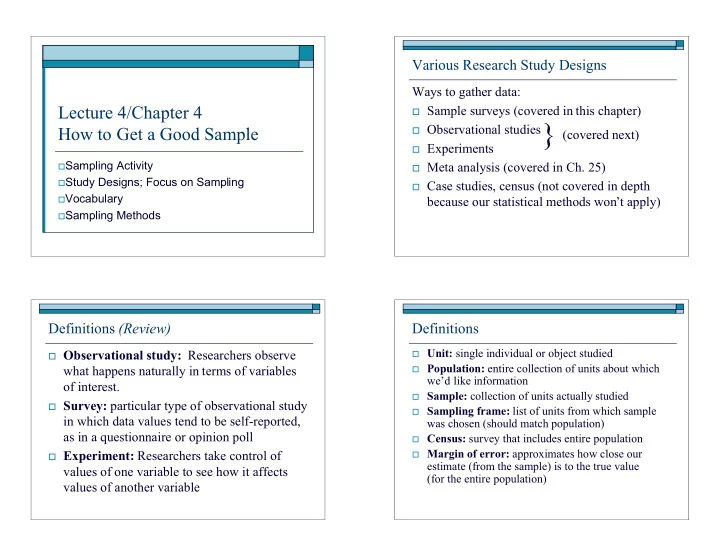
Various Research Study Designs Ways to gather data: Lecture 4/Chapter 4 Sample surveys (covered in this chapter) } (covered next) Observational studies How to Get a Good Sample Experiments Sampling Activity Meta analysis


slide-1
SLIDE 1

Lecture 4/Chapter 4 How to Get a Good Sample

Sampling Activity Study Designs; Focus on Sampling Vocabulary Sampling Methods

Various Research Study Designs

Ways to gather data:

Sample surveys (covered in this chapter) Observational studies Experiments Meta analysis (covered in Ch. 25) Case studies, census (not covered in depth

because our statistical methods won’t apply)

} (covered next)

Definitions (Review)

Observational study: Researchers observe

what happens naturally in terms of variables

  • f interest.

Survey: particular type of observational study

in which data values tend to be self-reported, as in a questionnaire or opinion poll

Experiment: Researchers take control of

values of one variable to see how it affects values of another variable

Definitions

Unit: single individual or object studied Population: entire collection of units about which

we’d like information

Sample: collection of units actually studied Sampling frame: list of units from which sample

was chosen (should match population)

Census: survey that includes entire population Margin of error: approximates how close our

estimate (from the sample) is to the true value (for the entire population)

slide-2
SLIDE 2

Margin of Error

Because it’s almost never possible to survey the entire population, we typically use info from a sample to estimate what’s true for the entire population. Less than 5% of the time, our estimate differs from the true value by more than a margin of error. If we take a sample of size n of categorical values, we are 95% sure that the true proportion is within about . of the sample proportion.

Example: Details of Binge drinking article

Background: Article about binge drinking… Question/Response: In this context, what are Type of study: Units: Population: Sample: Sampling frame:

  • Approx. margin of error:

Example: Interpreting the Margin of Error

Background: Article about binge drinking

stated that “66% of respondents said they had engaged in binge drinking in 2001, compared to 62% in 2000…but the changes are not statistically significant because of the margin

  • f error built into the study.”

Question: Why not statistically significant? Response:

Sampling Methods

systematic sampling plan uses methodical but

non-random approach, like picking individuals at regularly spaced intervals on a list

probability sampling plan: makes planned use

  • f chance/randomness in selections

simple random sample (simplest prob. samp-

ling plan): selections made at random without replacement, like picking names from a hat

slide-3
SLIDE 3

More Probability Sampling Plans

stratified random sample takes separate

random samples from groups of similar individuals (strata) within the population

cluster sample selects small groups (clusters)

at random from within the population (all units in each cluster included)

multistage sample stratifies in stages,

randomly sampling from groups that are successively more specific

Example: Identifying Sampling Method (#1)

Background: A random sample of classes is

taken from all classes at Pitt; all students in each of the sampled classes are included in the sample.

Question: What method is used? Response:

Example: Identifying Sampling Method (#2)

Background: All Pitt students are first

divided into schools (CAS, Business, etc.); within each school, a random sample of students is taken.

Question: What method is used? Response:

Example: Identifying Sampling Method (#3)

Background: All Pitt students are first

divided into schools; within each school, a random sample of majors is taken. Within each major, a random sample of classes is

  • taken. At the last stage, include either the

entire cluster of students in the class or a random sample of individual students.

Question: What method is used? Response:

slide-4
SLIDE 4

Example: Identifying Sampling Method (#4)

Background: A random number generator is

used to select a certain number of students from the list of all Pitt students.

Question: What method is used? Response:

Flawed Sampling Plans

volunteer sample: all individuals have been self-

selected

volunteer response: individuals have been selected

by researchers, but only a subset choose to participate

Sampling frame different from population: some

individuals don’t have a chance of being included in the sample (recent switch to cell phones reduced response rate in voters’ polls from the usual 40% to just 25% in 2004)

Example: Sampling Methods and Flaws

Background: A stats dept wants to assess the

quality of an instructor’s teaching via personal interviews with 10 of the 100 students

  • enrolled. One possibility is to go to a lecture

and ask for 10 volunteers willing to be interviewed about the instructor’s teaching.

Questions:What method is used? Is it flawed? Response:

Example: Sampling Methods and Flaws

Background: A stats dept wants to assess the

quality of an instructor’s teaching via personal interviews with 10 of the 100 students enrolled. Go to a lecture, assign each student a number 1, 2, … as seated, pick every 10th student.

Questions:What method is used? Is it flawed? Response:

slide-5
SLIDE 5

Example: Sampling Methods and Flaws

Background: A stats dept wants to assess the

quality of an instructor’s teaching via personal interviews with 10 of the class’s 100 students. Go to a lecture, assign each student a number 1, 2, …; use a computer to pick 10 at random.

Questions:What method is used? Is it flawed? Response:

Example: Sampling Methods and Flaws

Background: A stats dept wants to assess the

quality of an instructor’s teaching via personal interviews with 10 of the 100 students

  • enrolled. Obtain a roster of all 100 students,

pick every 10th name.

Questions:What method is used? Is it flawed? Response:

Example: Sampling Methods and Flaws

Background: A stats dept wants to assess the

quality of an instructor’s teaching via personal interviews with 10 of the 100 students

  • enrolled. Obtain a roster of all 100 students,

use a computer to pick 10 at random.

Questions:What method is used? Is it flawed? Response:

Read these articles before next lecture: HELPING STROKE VICTIMS Lowering stroke victims’ body temperature with cooling blankets and other means can significantly improve their chances of survival, researchers say. German researchers who took steps to reduce the temperature

  • f 25 people who had suffered severe strokes found that 14

survived instead of the expected five…

slide-6
SLIDE 6

REAL KNIFE, FAKE SURGERY George Doeschner had been suffering from Parkinson's disease for 12 years when his physician told him about an experimental surgery that might

  • ffer a cure. Researchers at the University of Colorado were

taking cells from embryos and putting them in the brains of Parkinson's patients to replace cells killed by the disease. The 55-year-old electrician applied to be a part of the experiment and flew to Denver. He was prepped for surgery and sedated. A hole was drilled through his skull. Then his surgeons sewed him up and sent him home--without giving him those embryonic cells.Surgical error? Medicare fraud? No, a deliberate sham. Bizarre as it may seem, fake surgeries--otherwise known as placebo-controlled surgical trials--are entering mainstream medical research. The first of these trials wrapped up last week, and others are under way. "This is just the beginning," says Warren Olanow, chair of neurology at Mount Sinai Hospital. "Tomorrow if you have a [new] procedure, you will have to do a double-blind placebo trial." (continued) Double-blind placebo trials, of course, are standard procedure for drug developers, who know from long experience that 1 out of 3 test subjects feel better with only a sugar pill. Scientists sidestep the placebo effect in drug trials by dividing patients into two groups--giving one the real drug and the other a fake.It turns out that the placebo effect is especially powerful in Parkinson's disease. That's why Curt Freed at the University

  • f Colorado and Stanley Fahn at Columbia University decided to

create a control group whose members could be fooled into thinking they were getting the full surgical treatment. "When you have something as major as surgery," says Fahn, in defense

  • f his experiment, "wouldn't it be best to know there was some

benefit?” The National Institutes of Health agreed. Indeed, the NIH believes so strongly in the value of placebo surgeries that it has begun rejecting experiments from university researchers that do not employ them. Today placebo trials are being mounted for a variety of procedures, from knee surgery to the treatment of pain in cancer. (continued) Critics of these trials--and there are many-- complain that they violate the first principle of medicine: do no

  • harm. Surgery, even sham surgery, is never risk-free. Doeschner

says his doctors told him that he might get the short end of the double-blind stick and warned him before asking for his consent that even a fake operation could leave him "a vegetable. ” "Consent is irrelevant," objects Arthur Caplan, director of the bioethics center at the University of Pennsylvania. "When you're dealing with desperate illness, people will consent to anything.” That's true, but some research administrators have concluded that the scientific knowledge that may be gained justifies the

  • risk. They find reassurance in the fact that the dangers have

been reduced by advances in minimally invasive surgery. But they are also feeling pressure from HMOs that want proof that a new type of surgery works before approving it. (continued) The biggest factor driving these experiments, however, may be that the easy questions--do patients survive or die with a new therapy?--have already been answered. Increasingly, scientists are looking for more subtle, and often more subjective benefits. Is there less pain? Is it easier to walk? These outcomes can be strongly influenced by wishful thinking.Sorting the real benefits from the fake seemed a worthy goal to patient Doeschner. "I wanted to do something that would help everybody who has Parkinson's," he says. Besides,

  • nce the experiment was over, he came back for another
  • peration. This time he got the real thing.