High-scoring oral presentation Who is responsible for teenage binge - - PDF document

high scoring oral presentation
SMART_READER_LITE
LIVE PREVIEW

High-scoring oral presentation Who is responsible for teenage binge - - PDF document

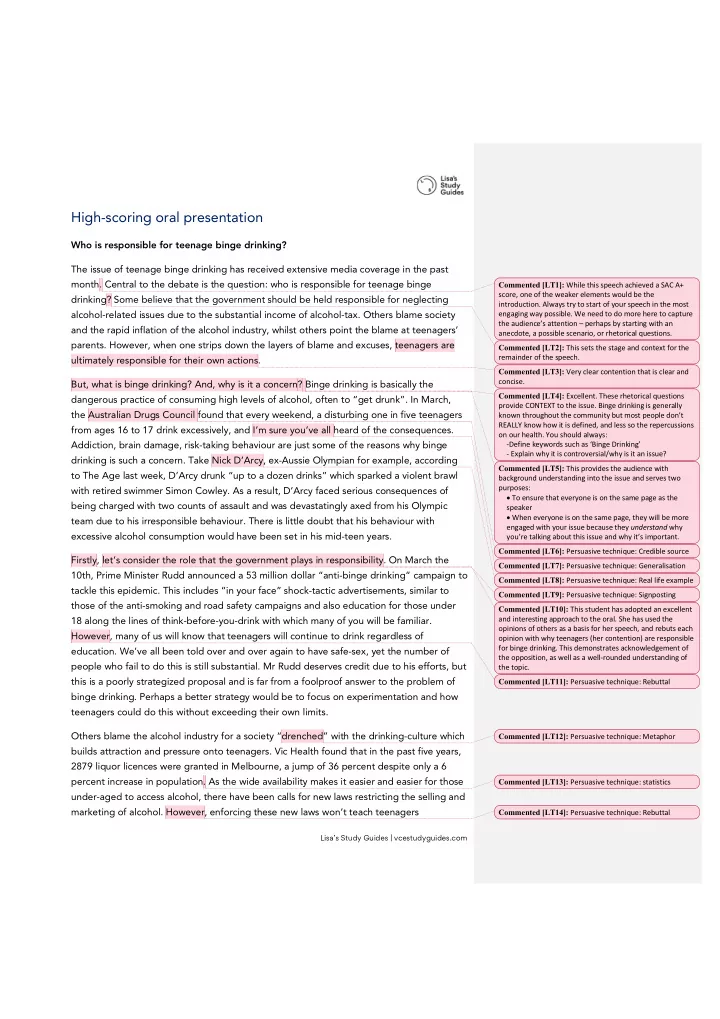
High-scoring oral presentation Who is responsible for teenage binge drinking? The issue of teenage binge drinking has received extensive media coverage in the past month. Central to the debate is the question: who is responsible for teenage binge


slide-1
SLIDE 1

Lisa’s Study Guides | vcestudyguides.com

High-scoring oral presentation

Who is responsible for teenage binge drinking? The issue of teenage binge drinking has received extensive media coverage in the past

  • month. Central to the debate is the question: who is responsible for teenage binge

drinking? Some believe that the government should be held responsible for neglecting alcohol-related issues due to the substantial income of alcohol-tax. Others blame society and the rapid inflation of the alcohol industry, whilst others point the blame at teenagers’

  • parents. However, when one strips down the layers of blame and excuses, teenagers are

ultimately responsible for their own actions. But, what is binge drinking? And, why is it a concern? Binge drinking is basically the dangerous practice of consuming high levels of alcohol, often to “get drunk”. In March, the Australian Drugs Council found that every weekend, a disturbing one in five teenagers from ages 16 to 17 drink excessively, and I’m sure you’ve all heard of the consequences. Addiction, brain damage, risk-taking behaviour are just some of the reasons why binge drinking is such a concern. Take Nick D’Arcy, ex-Aussie Olympian for example, according to The Age last week, D’Arcy drunk “up to a dozen drinks” which sparked a violent brawl with retired swimmer Simon Cowley. As a result, D’Arcy faced serious consequences of being charged with two counts of assault and was devastatingly axed from his Olympic team due to his irresponsible behaviour. There is little doubt that his behaviour with excessive alcohol consumption would have been set in his mid-teen years. Firstly, let’s consider the role that the government plays in responsibility. On March the 10th, Prime Minister Rudd announced a 53 million dollar “anti-binge drinking” campaign to tackle this epidemic. This includes “in your face” shock-tactic advertisements, similar to those of the anti-smoking and road safety campaigns and also education for those under 18 along the lines of think-before-you-drink with which many of you will be familiar. However, many of us will know that teenagers will continue to drink regardless of

  • education. We’ve all been told over and over again to have safe-sex, yet the number of

people who fail to do this is still substantial. Mr Rudd deserves credit due to his efforts, but this is a poorly strategized proposal and is far from a foolproof answer to the problem of binge drinking. Perhaps a better strategy would be to focus on experimentation and how teenagers could do this without exceeding their own limits. Others blame the alcohol industry for a society “drenched” with the drinking-culture which builds attraction and pressure onto teenagers. Vic Health found that in the past five years, 2879 liquor licences were granted in Melbourne, a jump of 36 percent despite only a 6 percent increase in population. As the wide availability makes it easier and easier for those under-aged to access alcohol, there have been calls for new laws restricting the selling and marketing of alcohol. However, enforcing these new laws won’t teach teenagers

Commented [LT1]: While this speech achieved a SAC A+ score, one of the weaker elements would be the

  • introduction. Always try to start of your speech in the most

engaging way possible. We need to do more here to capture the audience’s attention – perhaps by starting with an anecdote, a possible scenario, or rhetorical questions. Commented [LT2]: This sets the stage and context for the remainder of the speech. Commented [LT3]: Very clear contention that is clear and concise. Commented [LT4]: Excellent. These rhetorical questions provide CONTEXT to the issue. Binge drinking is generally known throughout the community but most people don’t REALLY know how it is defined, and less so the repercussions

  • n our health. You should always:
  • Define keywords such as ‘Binge Drinking’
  • Explain why it is controversial/why is it an issue?

Commented [LT5]: This provides the audience with background understanding into the issue and serves two purposes:

  • To ensure that everyone is on the same page as the

speaker

  • When everyone is on the same page, they will be more

engaged with your issue because they understand why you’re talking about this issue and why it’s important. Commented [LT6]: Persuasive technique: Credible source Commented [LT7]: Persuasive technique: Generalisation Commented [LT8]: Persuasive technique: Real life example Commented [LT9]: Persuasive technique: Signposting Commented [LT10]: This student has adopted an excellent and interesting approach to the oral. She has used the

  • pinions of others as a basis for her speech, and rebuts each
  • pinion with why teenagers (her contention) are responsible

for binge drinking. This demonstrates acknowledgement of the opposition, as well as a well-rounded understanding of the topic. Commented [LT11]: Persuasive technique: Rebuttal Commented [LT12]: Persuasive technique: Metaphor Commented [LT13]: Persuasive technique: statistics Commented [LT14]: Persuasive technique: Rebuttal

slide-2
SLIDE 2

Lisa’s Study Guides | vcestudyguides.com

responsible drinking. Laws don’t stop teenagers who want to experiment with illicit drugs. Laws don’t stop teenagers who want to rebel. Therefore, responsible temperance and control must be seen as desirable actions rather than something extracted through force and threats. Finally, we must consider if parents’ deserve the blame for our drinking recklessness. Teenagers, by nature, rebel against their parents’ wishes. Take Corey Worthington for example, after his mass-party - which he threw without his parent’s knowledge, he failed to answer their calls and against his parent’s wishes, began a nation-wide tour to host other mass parties. Thus, it is evident that parents can try to influence their child’s actions, yet in the end it is the teenager’s personal choices. It is clear that the crisis of teenage binge drinking is a question of responsibility. However the question of who is to blame continues - should it be a) The government- who need to do more than feeble campaigns b) The alcohol industry for a culture “bottled” up with alcohol, or c) parents who need to take responsibility of their teenagers? Ultimately, to avoid serious and irreversible health damage, and risks such as drink-driving that all too

  • ften end with death, teenagers must take greater care of themselves, to understand their

limits and to control their actions. Thank you.

Low- to medium-scoring oral presentation

Should English be a compulsory VCE Subject? Andrew is 21, a young university graduate. Now he joins thousands of graduates in the job market seeking to establish a career. His education and skills will be a key factor in his

  • success. In Australia, Andrew’s proficiency in English would greatly advantage him. His

performance at job interviews and later on in his promotion at work, will be very much influenced by his ability to communicate. This brings us to the issue, “Should English be a Compulsory VCE Subject”. We all believe that schooling needs to be an enjoyable experience, in which students should have their say in what they choose to study. Now, what happens to those who do not enjoy the study of English. By making English compulsory, many of these students can be negatively influenced to rebel against their education. This would damage their future career prospects. Therefore, this could be an argument against having English as a compulsory subject. However, I believe that English should be compulsory, and because there are various English subject options available, a student should be able to choose one that suits him or

Commented [LT15]: Persuasive technique: Repetition Commented [LT16]: Persuasive technique: Evaluative language Commented [LT17]: Persuasive technique: Signposting Commented [LT18]: Persuasive technique: Real life example Commented [LT19]: This paragraph could definitely afford elaboration in order to really solidify the student’s argument. Commented [LT20]: Persuasive technique: Signposting Commented [LT21]: Persuasive technique: Metaphor Commented [LT22]: Persuasive technique: Rhetorical question Commented [LT23]: Interesting start! Commented [LT24]: This logic jump is strange. The student can create a much smoother transition by continuing their anecdote and perhaps asking – what if he didn’t have these skills? What if he didn’t learn English in VCE? This way, the idea of the importance of English is connected to VCE English before the question of ‘should English be a compulsory VCE subject?’ is asked. Commented [LT25]: Persuasive technique: inclusive language Commented [LT26]: There’s no need to state redundant information such as: “this could be an argument” or “this is an argument”. Your

  • pinionated statement will make it very clear that it is an

argument. Commented [LT27]: This paragraph lacks a clear focus. The topic sentence about ‘enjoyable experience’ and ‘having a say’ indicates that the rest of the paragraph will revolve around these ideas. However, the student then moves onto ‘future career prospects’, making the overall argument messy.

slide-3
SLIDE 3

Lisa’s Study Guides | vcestudyguides.com

  • her. For example, for VCE, one could choose. English, where one analyses and responds

to texts. One could choose to do English language, where students focus on the grammar

  • f English and its 'pragmatics'. Lastly once could choose English Literature, which delves

into analysing and understanding an author's intention for writing texts. So, there is something for everyone, and every student could enjoy their studies with English as a compulsory subject. Many argue that by the age of 16 to 17 individuals should be able to make decisions as

  • adults. Making English a compulsory subject suggests that we as students are unable to

decide on what we wish to study, indicating that we a not ready to make mature selections for our futures. However, English prepares each individual for adulthood. VCE English as a compulsory subject does not illustrate that we are incapable of making mature decisions. Having English as a compulsory subject prepares each one of us for our future careers, each career requires various English skills that are covered through the VCE English curriculum (these include presenting, writing a resume, general communication etiquette etc). A good command of English allows us to criticise what the media portrays us to believe, it also enables us to analyse and understand what’s going on around the world, preventing us from being manipulated by what we hear in our everyday lives. An argument against having English as a compulsory subject is that as we live in an English speaking society, all VCE subject are dealt with in English. This implies that students improve their English anyway in the process of studying other subjects. A counter argument to this is that if you studied English compulsorily, you would have a better foundation in the basic principles of English and this lends itself to increasing your understanding of any course other than English, which is delivered in ….. yes, in English. We look here at VCE subjects like legal studies, business management, philosophy, health and human and history, which require correctly structured paragraphs to appropriately respond to questions and case studies. What about those doing science and other technical subjects? You ask. Let me tell you, brilliant experiment results or projects put forward in a badly structured and poorly put together document will fail to be given the due it is worth. In conclusion I pose again, this question to all of you. “Should English be a compulsory VCE subject”. The answer is …YES. We all wish to be able to effectively communicate our feelings and responses verbally and in writing. We all need to be able to interpret a piece

  • f text and draw meaning from it. We all need a solid English foundation, to ensure we are

able to participate in and contribute effectively to our society, to Australia, and to the world at large. And this means more than just being able to send a text message to a friend advising them of where tonight's party is. THANK YOU.

Commented [LT28]: This is a good paragraph, however it lacks evidence. Don’t forget to include persuasive devices including:

  • Inclusive language
  • Rhetorical questions
  • Statistics
  • Anecdotes

Commented [LT29]: This paragraph is also has a good start, however is again lacking evidence to support the student’s

  • ideas. You want to establish yourself as someone

trustworthy and credible so that your audience will agree with your opinion. Commented [LT30]: Unfortunately, this paragraph really doesn’t add anything new to the speech – it is more a repetition of what has already been mentioned. The student’s thoughts about English proficiency in the workplace would have worked better here because she is now focusing on the wider-implications of English and how it relates to our experience with the world. Commented [LT31]: Persuasive technique: rhetorical question Commented [LT32]: This student has 5 body paragraphs, and each do not go in-depth enough into the argument. It would’ve been wiser to reduce the number of arguments, and spend more time developing those ideas. Commented [LT33]: This ending is interesting! However, it would’ve made a bigger impact had the student taken time to discuss English language used in text messages/social media previously so we understood her point of view about usage of English in our daily lives. Perhaps this idea could’ve been developed in her paragraph about the ‘English speaking society’.