SI Scoring Guide SUBORDINATION INDEX USING SALT Discuss the scoring - - PDF document

si scoring guide
SMART_READER_LITE
LIVE PREVIEW

SI Scoring Guide SUBORDINATION INDEX USING SALT Discuss the scoring - - PDF document

SALT Software, LLC SI Scoring Guide SUBORDINATION INDEX USING SALT Discuss the scoring rules SALT SOFTWARE, LLC Look at some tricky scoring examples Review a few key points PRESENTER: Mary Beth Rolland, MS, CCC SLP ASHA


slide-1
SLIDE 1

SALT Software, LLC 1 SUBORDINATION INDEX USING SALT

SALT SOFTWARE, LLC PRESENTER: Mary‐Beth Rolland, MS, CCC‐SLP

ASHA Disclosure: Financial: Mary‐Beth is employed by SALT Software LLC and receives a

  • salary. Nonfinancial: No relevant nonfinancial relationships exist.

Scoring Guide

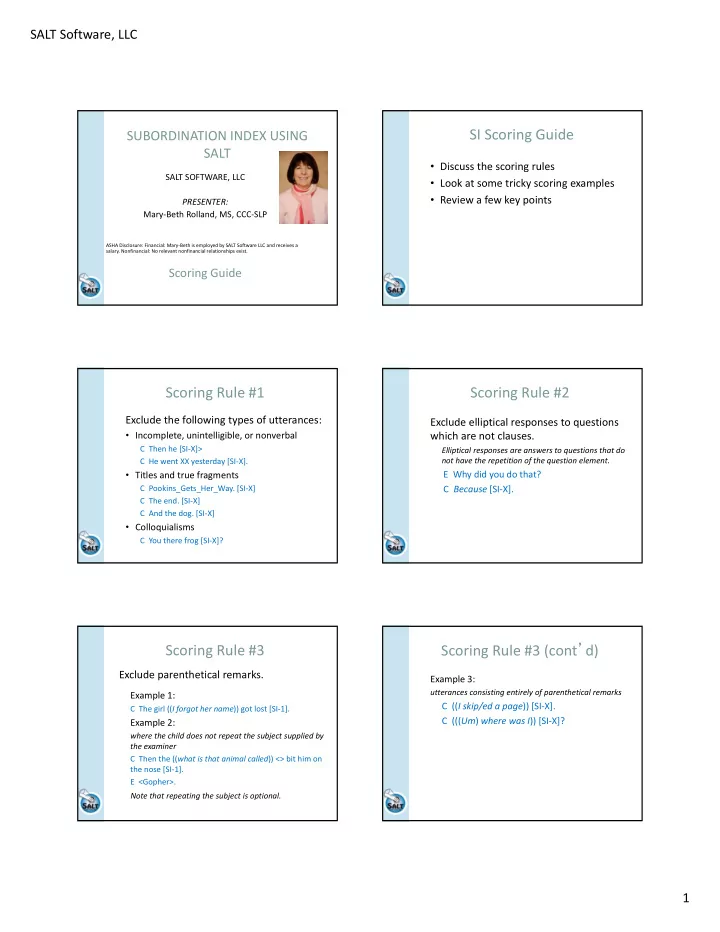
SI Scoring Guide

  • Discuss the scoring rules
  • Look at some tricky scoring examples
  • Review a few key points

Scoring Rule #1

Exclude the following types of utterances:

  • Incomplete, unintelligible, or nonverbal

C Then he [SI‐X]> C He went XX yesterday [SI‐X].

  • Titles and true fragments

C Pookins_Gets_Her_Way. [SI‐X] C The end. [SI‐X] C And the dog. [SI‐X]

  • Colloquialisms

C You there frog [SI‐X]?

Scoring Rule #2

Exclude elliptical responses to questions which are not clauses.

Elliptical responses are answers to questions that do not have the repetition of the question element.

E Why did you do that? C Because [SI‐X].

Scoring Rule #3

Exclude parenthetical remarks.

Example 1:

C The girl ((I forgot her name)) got lost [SI‐1].

Example 2:

where the child does not repeat the subject supplied by the examiner C Then the ((what is that animal called)) <> bit him on the nose [SI‐1]. E <Gopher>. Note that repeating the subject is optional.

Scoring Rule #3 (cont’d)

Example 3:

utterances consisting entirely of parenthetical remarks

C ((I skip/ed a page)) [SI‐X]. C (((Um) where was I)) [SI‐X]?

slide-2
SLIDE 2

SALT Software, LLC 2

Scoring Rule #4

Clauses with *omitted subjects are included in the SI analysis and receive a score of SI‐0.

Example 1: C *He got on the rock [SI‐0]. Example 2: complex subordination with subject omission C And then *he grab/ed some branch/s so he would/n’t fall [SI‐1].

Scoring Rule #5

Clauses with missing subjects due to pronoun error are included in the SI analysis and receive a score of SI‐0.

C There[EW:they] see the frog/s [SI‐0].

Scoring Rule #6

Commands with implied subjects receive a score of SI‐1.

Examples where the subject “you” is implied (not obligatory): C Give it to me [SI‐1]. C Look at this [SI‐1]. C Brush your teeth and go to bed [SI‐1].

Scoring Rule #7

Not covered here ‐ applies only to samples from bilingual (Spanish/English) speakers where utterances are segmented into modified C‐units.

Scoring Rule #8

Clauses with *omitted copula (main verb) receive a score of SI‐0.

C (And the) and the frog *went through the big (ah) pond [SI‐0].

Scoring Rule #9

Utterances containing omitted auxiliary verbs, bound morphemes, functor words, direct objects, and articles are included in the SI analysis (coded for SI). This includes verbs which are not conjugated correctly.

slide-3
SLIDE 3

SALT Software, LLC 3

Scoring Rule #9 (cont’d)

Examples of omitted auxiliary

C He *is go/ing [SI‐1]. C When they *were sleep/ing the frog got

  • ut [SI‐2].

Example of an omitted bound morpheme

C The boy was fall/*ing off the rock [SI‐1].

Scoring Rule #9 (cont’d)

Example of an omitted article

C He see/3s *an owl [SI‐1].

Examples of an omitted direct object

C He was pour/ing coffee into the *cup [SI‐1].

Scoring Rule #10

The subordinate clause within an utterance containing an omitted

  • bligatory subordinating conjunction will

not receive credit.

C There was a boy *who had a dog [SI‐1]. C And the boy did/n’t see *that the frog went out [SI‐1].

Scoring Rule #11

When an incorrect subordinating conjunction is used, the subordinate clause will not receive credit.

C The deer was run/ing what[EW:so] he could throw the little boy in the water [SI‐1].

Scoring Rule #12

If a subordinating conjunction is not

  • bligatory to the coherence of the

utterance, the subordinate clause should still receive a score for SI.

C I know I want to go [SI‐2]. C I think I hear something [SI‐2].

Scoring Rule #13

Dialogue is coded for SI. Consider the introducer (e.g., he said) as the main clause and what is in the quotes as the second clause.

C And he *was say/ing, “Frog, where are you” [SI‐2]? C The boy said, “Shh” [SI‐1].

slide-4
SLIDE 4

SALT Software, LLC 4

Scoring Rule #14

Semantics should be ignored when scoring SI. If the wrong content word is used by the speaker, but is grammatically acceptable, score SI accordingly.

C The boy ran[EW:fell] off the rock[SI‐1].

Scoring Rule #15

Utterances with imitated words are included in the SI and are scored as though the imitated word originated from the speaker.

C The <> gopher[I] came out of the hole [SI‐1]. E <Gopher>.

Scoring Rule #16

Samples in the SALT databases do not count infinitives as clauses.

C The boy told the dog to be quiet [SI‐1] C The dog want/ed to run away [SI‐1].

Scoring Rule #17

Exclude utterances which contain fewer than 50% words in the target language.

Applies to utterances with code‐switched words, e.g., Spanish words in an English sample.

SI Scoring Tips

  • Look for conjunctions.
  • Look for verbs. Is there a subject for

that verb?

  • Print out the SI Scoring Guide and keep

it handy as you score the samples.