March 8, 2016 Workshop 1: No-Notice Events LOCATION: H-GAC - - PowerPoint PPT Presentation

march 8 2016
SMART_READER_LITE
LIVE PREVIEW

March 8, 2016 Workshop 1: No-Notice Events LOCATION: H-GAC - - PowerPoint PPT Presentation

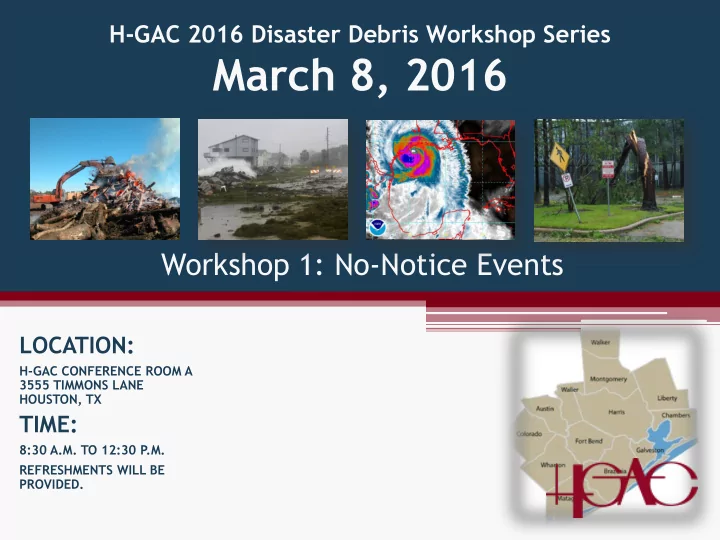
H-GAC 2016 Disaster Debris Workshop Series March 8, 2016 Workshop 1: No-Notice Events LOCATION: H-GAC CONFERENCE ROOM A 3555 TIMMONS LANE HOUSTON, TX TIME: 8:30 A.M. TO 12:30 P.M. REFRESHMENTS WILL BE PROVIDED. Agenda Introductions and

slide-1
SLIDE 1

H-GAC 2016 Disaster Debris Workshop Series

March 8, 2016

Workshop 1: No-Notice Events

LOCATION:

H-GAC CONFERENCE ROOM A 3555 TIMMONS LANE HOUSTON, TX

TIME:

8:30 A.M. TO 12:30 P.M. REFRESHMENTS WILL BE PROVIDED.

slide-2
SLIDE 2

Agenda

  • Introductions and Purpose
  • Debris 101 Refresher
  • Procedures for No-Notice Incidents
  • Break
  • Utilizing Volunteer Resources
  • Break
  • Social Media
  • Case Studies
  • Next Steps/Adjourn

2

slide-3
SLIDE 3

Part 1: Introductions and Purpose

slide-4
SLIDE 4

Welcome

  • Introductions
  • Name
  • Agency

4

slide-5
SLIDE 5

Purpose

  • Discuss how no-notice incidents can affect operational

plans.

  • Understand how an organized volunteer effort can

assist with recovery.

  • Discuss use of social media to push information to the

general public.

  • Stimulate interactive discussion and questions.

5

slide-6
SLIDE 6

Debris 101

Why Does Debris Matter?

  • Removing debris is costly.
  • FEMA has expended or
  • bligated over $8 billion

in eligible debris removal costs.

  • The table represents the

federal cost share only.

6

slide-7
SLIDE 7

2015 Texas Disasters

7

DR-4223 Tornados, Straight- line Winds, Flooding May 2015 DR-4245 Tornados, Straight- line Winds, Flooding October 2015 DR-4255 Winter Storms Tornados, Straight- line Winds, Flooding October 2015

slide-8
SLIDE 8

Updated FEMA Guidance

Public Assistance (PA) Program and Policy Guide

  • Combines all PA policy into a

single volume

  • Incorporates and supersedes

language from 9500 Series documents

  • In effect for disasters declared

after January 1, 2016

8

slide-9
SLIDE 9

Debris 101

Who's Involved?

  • Federal Emergency Management Agency (FEMA)
  • United States Coast Guard (USCG)
  • United States Army Corps of Engineers (USACE)
  • Natural Resources and Conservation Service (NRCS)
  • Farm Service Agency (FSA)
  • Animal Plan and Health Inspection Service (APHIS)
  • Federal Highway Administration (FHWA)
  • Environmental Protection Agency (EPA)
  • National Oceanic and Atmospheric Administration

(NOAA)

9

slide-10
SLIDE 10

Debris 101

Truck Certification

  • Measure maximum capacity of

debris hauling vehicles

  • Perhaps the most crucial element of

a debris removal operation

  • Tracks debris quantities
  • Large opportunity for fraud
  • Needs to be periodically re-certified

10

slide-11
SLIDE 11

Debris 101

Debris Basics

  • Must be a result of the

event

  • Must be in an eligible

location

  • Must be documented from

collection to final disposal

11

slide-12
SLIDE 12

Debris 101

Specialized Programs

  • Leaners, hangers, stumps
  • Vehicles, boats, appliances
  • Private property (right-of-entry

[ROE]) work

  • Canals and waterways

12

slide-13
SLIDE 13

Debris 101

Hazardous Hanging Limbs (Hangers)

  • Must meet all of the following

criteria:

  • Must be 2 inches or greater in

diameter at the point of the break

  • Must be suspended in a tree

threatening a public use area

  • Must be located on improved or

public property

13

slide-14
SLIDE 14

Debris 101

Hazardous Leaning Trees (Leaners)

  • The tree must be at least 6 inches in

diameter when measured 4 and 1/2 feet from the ground and must meet at least one of the following criteria:

  • More than 50 percent of the crown

damaged or destroyed (as determined by a certified arborist)

  • Split trunk or broken branches that

expose the heartwood

  • Fallen or uprooted within public-use area
  • Leaning at an angle greater than 30

degrees

14

slide-15
SLIDE 15

Debris 101

Debris Management Sites

  • Load calls made at tower
  • Calls made based on % full
  • Staff must be able to handle conflict

resolution

  • Staff must not be coerced into making calls
  • Staff must be able to identify truck

modifications

  • Vehicle measurement routinely checked
  • Debris may need to be segregated

depending on origin

  • Large opportunity for fraud
  • Staff rotated frequently

15

slide-16
SLIDE 16

Debris 101

Final Disposal

  • It is critical that plans and

contingencies for final disposal of vegetative and mixed debris are established.

  • Final disposal sites must be properly

permitted.

  • Debris must be properly

disposed/applied at final disposal site.

  • Audits are inevitable.

16

slide-17
SLIDE 17

Debris 101

ROE Program – Before and After

17

slide-18
SLIDE 18

Debris 101

Contractor Invoicing

  • Invoicing kickoff meeting
  • Data standards
  • Electronic hauler invoice
  • Invoicing process
  • Retainage

18

slide-19
SLIDE 19

Debris 101

Final Disposal

  • Approve closure/remediation of debris management

site (DMS)

  • Ensure damage claims are resolved
  • Transfer original documentation from contractors to

applicant

  • FEMA/state field validations
  • Project Worksheet (PW) close-out
  • Audits

19

slide-20
SLIDE 20

Part 2: Procedures for No-Notice Events

slide-21
SLIDE 21

No-Notice Incidents

21

  • How no-notice incidents

impact response

  • perations
  • Response and recovery

considerations

  • Reimbursement
slide-22
SLIDE 22

No-Notice Incidents

22

Warning time before the disaster

slide-23
SLIDE 23

No-Notice Incidents

Scenario – November ‘92 Tornado Outbreak

23

  • 41 hours of continual

tornado activity

  • 6 tornadoes ranging from

F1 to F4 struck parts of the Houston Metropolitan area

slide-24
SLIDE 24

No-Notice Incidents

Scenario– November ‘92 Tornado Outbreak

24

  • F4 traveled 30 miles from

west of Galena Park to Dayton

  • 271 homes damaged or

destroyed

  • Many other tornadoes

reported

  • One of only two recorded

F4 tornadoes in the greater Houston area (Galveston 1961)

slide-25
SLIDE 25

No-Notice Incidents

Overarching Considerations

  • Are evacuation routes viable/needed?
  • Are shelter/refuge of last resort available?
  • Status of emergency services
  • Food
  • Shelter
  • Are plans current and exercised?
  • Public information
  • Emergency procurement

25

slide-26
SLIDE 26

No-Notice Incidents

Overarching Considerations

  • Plans may be designed around notice events
  • Public expectations
  • Available resources
  • Do you have cash?
  • What if you don’t get a declaration?

26

slide-27
SLIDE 27

No-Notice Incidents

Debris Removal Considerations

  • Damage Assessments
  • Maintenance Records
  • Force Account

Documentation

  • Debris Contracts
  • Status of Debris

Management Sites

27

slide-28
SLIDE 28

No-Notice Incidents

Response and Recovery - Damage Assessments

  • Inspect critical facilities and heavily impacted areas

first.

  • Be aware of roads, water control facilities, and

buildings that would fall under a jurisdiction other than FEMA:

  • FHWA
  • USACE
  • NRCS
  • Coast Guard

28

FEMA Disaster Declarations Are Not Automatic.

slide-29
SLIDE 29

No-Notice Incidents

Response and Recovery - Maintenance Records

  • After an event is not a good time

to figure out if debris removal related equipment works.

  • Have regularly scheduled

maintenance performed.

  • There will be little time to gather

maintenance records for things like roads, bridges, facilities, etc.

  • Records may be required for

FEMA reimbursement.

29

slide-30
SLIDE 30

No-Notice Incidents

Response and Recovery - Force Account Documentation

  • Establish pre-existing straight time, overtime, and

personnel policies, including job descriptions.

  • Train employees annually on keeping activity and

equipment logs.

  • Establish emergency call-down list an identify

essential personnel under blue sky conditions.

30

slide-31
SLIDE 31

No-Notice Incidents

Response and Recovery - Debris Contracts

  • Do you have pre-positioned

contracts?

  • Do you have emergency

contact information?

  • What are your contractors’

mobilization requirements?

  • Have you established a

rendezvous point in case communications are down?

31

slide-32
SLIDE 32

No-Notice Incidents

Response and Recovery - Debris Management Sites

  • Are they still viable for

this type of incident?

  • If not already pre-

approved, who is responsible?

  • Have they been

impacted by the event?

  • Are there multiple

routes mapped out in case of road closures?

32

slide-33
SLIDE 33

No-Notice Incidents

Reimbursement

  • There may still be

Category B (Emergency Protective Measures) work even with no-notice.

  • Documentation

requirements do not change.

  • Clo

Clock is is tic tickin ing on th the accele lerated debri ris removal l inc incentiv ive (s (sli lidin ing sc scale le). ).

33

slide-34
SLIDE 34

No-Notice Incidents

Reimbursement

34

slide-35
SLIDE 35

Incident Start of Incident Declaration Date

Severe Storms, Tornadoes, Straight-line Winds and Flooding (TX) May 4 May 29 (DR-4223) California Valley & Butte Fires September 9 September 22 (DR-4240) South Carolina Flooding October 1 October 5 (DR-4241) Severe storms, Tornadoes, Straight-line Winds and Flooding (TX) October 22 November 25 (DR-4245) Severe storms, Tornadoes, Straight-line Winds and Flooding (TX) December 26 February 9 (DR-4255) 35

Average time from start of incident to declaration was 24 days.

No-Notice Incidents

2015

slide-36
SLIDE 36

Discussion Points

  • When will you set up a disaster code and why?
  • How will you engage mutual aid partners?
  • Will you consider activating contractors?
  • How are you going to communicate to staff that

a disaster has happened? What is your staff supposed to do?

  • How will you handle public information in the

near term?

36

slide-37
SLIDE 37

Break

slide-38
SLIDE 38

Part 3: Utilizing Volunteer & Donated Resources

slide-39
SLIDE 39

Donated Resources

FEMA Policy 9525.2

“Donated resources used on eligible work that is essential to meeting immediate threats to life and property resulting from a major disaster may be credited toward the non-Federal share of grant costs under the PA program. Donated resources may include volunteer labor, donated equipment, and donated materials.”

39

slide-40
SLIDE 40

Utilizing Volunteer Resources

Myths

  • Volunteers are free.
  • Feeding?
  • Sheltering?
  • Documenting?
  • Anyone can manage

volunteers.

  • All organizations

should/can engage volunteers.

40

slide-41
SLIDE 41

Utilizing Volunteer Resources

Eligibility

  • Volunteer resources must be documented by a local

public official or designee.

  • Documentation must include a record of hours

worked, the work site, a description of work for each volunteer, and equivalent information for equipment and materials.

  • The donated resources must be documented on
  • ne or more PWs.

41

slide-42
SLIDE 42

Utilizing Volunteer Resources

Eligibility

  • The maximum credit allowed is calculated by dividing

the non-Federal cost share percentage by the Federal cost share percentage (e.g., 25%/75% = .333 and 10%/90% = .111) and multiplying that factor by the

  • ut-of-pocket expenses for a particular PW or multiple

PWs.

42

slide-43
SLIDE 43

Utilizing Volunteer Resources

Eligibility

  • Volunteer labor reimbursement

should be the same rate (plus reasonable fringe benefits)

  • rdinarily paid for similar work

within the applicant’s organization

  • r labor market.

43

slide-44
SLIDE 44

Utilizing Volunteer Resources

Eligible Activities

  • Removing eligible debris
  • Filling and placing sandbags
  • Donating equipment to raise or

reinforce a levee

  • Donating materials, such as rocks or

sand

  • Search and rescue when part of an
  • rganized search and rescue operation
  • Professional safety inspections
  • Mass care and sheltering for disaster

survivors

44

slide-45
SLIDE 45

Volunteers in Debris Over the Years

45

slide-46
SLIDE 46

Utilizing Volunteer Resources

Best Practices

  • Have a plan; volunteers will show up FAST.
  • Know how to document.
  • Take advantage.
  • Volunteers save money.
  • Volunteers often bring needed skills.
  • Volunteers bring renewed energy.
  • Volunteers increase community ownership.
  • Understand liability.

46

slide-47
SLIDE 47

Utilizing Volunteer Resources

Planning

  • Volunteer plan should get input from key staff.
  • Directors
  • Debris stakeholders
  • Attorney/legal counsel

47

slide-48
SLIDE 48

Utilizing Volunteer Resources

Planning

  • Appoint a Volunteer Coordinator
  • r Director.
  • Recruit and screen volunteers
  • rganizations.
  • Communicate with different

departments to assess anticipated needs.

  • Educate staff on volunteers roles

and responsibilities.

  • Facilitate Training.

48

slide-49
SLIDE 49

Utilizing Volunteer Resources

Volunteer Coordinator Responsibilities

  • Communicate the vison.
  • Provide job descriptions.
  • Communicate expectations.
  • Keep workloads manageable.
  • Provide opportunities to switch

to different roles.

  • Recognize and thank volunteers.

49

slide-50
SLIDE 50

Utilizing Volunteer Resources

Volunteer Reception Centers (VRC)

  • Disaster volunteers are

registered and referred to local agencies to assist with relief efforts.

50

slide-51
SLIDE 51

Utilizing Volunteer Resources

VRC - Activities

  • Complete a registration form and sign a general

release of liability statement.

  • Accept a referral to an organization needing their

services.

  • Description of their duties
  • Complete address and contact information
  • Receive a form of identification approved by local
  • fficials.
  • Participate in a safety briefing.
  • Agree in writing to follow all safety instructions and

directions from supervisors at their work sites.

51

slide-52
SLIDE 52

Utilizing Volunteer Resources

Applicant Responsibilities When Working with VRC

  • Orientation to your staff and

the volunteer position

  • Job training to prepare the

volunteer for the work expected of him/her

  • Safety training specifically

related to the position

  • Supervision and feedback on

the volunteer’s efforts

52

slide-53
SLIDE 53

Utilizing Volunteer Resources

Not Meeting Expectations

  • Do not have required skill set
  • Do not have the expected

number of bodies

  • Unwilling to perform required

tasks

  • Not showing up/showing up late

Dismiss Them

53

slide-54
SLIDE 54

Utilizing Volunteer Resources

VRC – Closeout

  • Recycle the volunteer!
  • Talk to your contractors to

see if they need additional resources.

  • Recommend them to
  • ther recovering

communities.

54

slide-55
SLIDE 55

Utilizing Volunteer Resources

Common Issues

  • Liability
  • Lack of reliability
  • Tendency of

volunteers to not stay long

55

slide-56
SLIDE 56

Break

slide-57
SLIDE 57

Part 4: Social Media

slide-58
SLIDE 58

Social Media

Impact on Disaster-Related Communications

58

  • Quick and efficient way

to communicate

  • Can be updated

constantly

  • May be the only way of

reaching residents in a no-notice event

slide-59
SLIDE 59

Social Media in Disasters

“You know, you can use social media like Twitter

  • r Facebook…”

But now there’s a lot more!

59

slide-60
SLIDE 60

Social Media in Disasters

“You know, you can use social media like Twitter

  • r Facebook…”

But now there’s a lot more!

60

slide-61
SLIDE 61

Social Media

Impact on Disaster-Related Communications

  • All major news outlet and weather sources use social

media.

61

slide-62
SLIDE 62

Social Media

Impact on Disaster-Related Communications

  • Most local governments are using social media to

communicate to residents.

62

slide-63
SLIDE 63

Discussion

  • Does your community have a social media

policy?

  • Who is allowed to use it?
  • Does your community and/or department have

an app?

63

slide-64
SLIDE 64

Social Media

Severe Weather Updates

64

  • Effective way to get

weather alerts to your residents or give instructions

slide-65
SLIDE 65

Social Media

Resident Input

  • Damages created
  • Unreported hazards
  • Available emergency

supplies

65

slide-66
SLIDE 66

Social Media

Road Closures

  • Helpful in minimizing

traffic especially during a no-notice event

  • May inform residents of

evacuation routes

66

slide-67
SLIDE 67

Social Media

Progress Reports

67

slide-68
SLIDE 68

68

slide-69
SLIDE 69

Debris Segregation Video

slide-70
SLIDE 70

Social Media Impacts

70

slide-71
SLIDE 71

Social Media

Concerns

  • Rapid spread of misinformation
  • Public complaints
  • Disreputable charities or scams asking for donations

71

slide-72
SLIDE 72

Social Media

Impact on Disaster-Related Communications

  • Accessible by cell phone
  • r tablet
  • Most apps are free of

charge

  • Trend toward getting

news from the internet or

  • nline sources rather than

evening news/newspapers

72

slide-73
SLIDE 73

Social Media

Impact on Disaster-Related Communications

73

  • 13% of Americans with an annual household income
  • f less than $30,000 per year are smartphone-

dependent.

Source: PewResearch Center

slide-74
SLIDE 74

Social Media

Impact on Disaster-Related Communications

  • 10% of Americans own a smartphone but do not have

any other form of high-speed internet access at home

  • r beyond their phone’s data plan.

74

Source: PewResearch Center

slide-75
SLIDE 75

Social Media

Impact on Disaster-Related Communications

  • Nearly two-thirds of Americans
  • wn a smartphone, and 19% of

Americans rely to some degree on a smartphone for accessing online services and information and for staying connected to the world around them.

75

Source: PewResearch Center

slide-76
SLIDE 76

Social Media

Impact on Disaster-Related Communications

  • A majority of smartphone
  • wners use their phone to

follow along with breaking news, to share information, and to be informed about happenings in their local community.

76

Source: PewResearch Center

slide-77
SLIDE 77

Social Media

Impact on Disaster-Related Communications

  • 68% of smartphone owners use

their phone at least

  • ccasionally to follow along

with breaking news, with 33% reporting they do this frequently.

77

Source: PewResearch Center

slide-78
SLIDE 78

Social Media

Impact on Disaster-Related Communications

  • During and immediately

following Hurricane Sandy, users sent more than 20 million Sandy-related Twitter posts (or tweets) despite the loss of cell phone service during the peak of the storm.

78

Source: FEMA 2013 National Preparedness Report

slide-79
SLIDE 79

Social Media

Impact on Disaster-Related Communications

  • Following the Boston

Marathon bombings, one quarter of Americans reportedly looked to Facebook, Twitter, and

  • ther social networking

sites for information.

79

Source: PewResearch Center

slide-80
SLIDE 80

Social Media

Impact on Disaster-Related Communications

  • When Boston Police

Department posted its final “CAPTURED!!!” tweet, more than 140,000 people retweeted it.

80

Source: PewResearch Center

slide-81
SLIDE 81

Social Media

Impact on Disaster-Related Communications

  • Affected citizens are now able

to communicate with loved

  • nes.

81

slide-82
SLIDE 82

Social Media

Facebook Safety Check

  • This tool was inspired by

people's use of social media to connect with friends and family in the wake of the 2011 Japan earthquake and tsunami.

  • The first major deployment

was on Saturday, April 25, 2015 (Nepal Earthquake).

82

slide-83
SLIDE 83

Social Media

Facebook Safety Check

  • During the incident, more

than 7 million people in the affected area were marked safe, which generated notifications to over 150 million friends on the platform.

  • This tool was also deployed

during the November 2015 Paris Attacks.

83

slide-84
SLIDE 84

Social Media

Crime Reporting

84

slide-85
SLIDE 85

Social Media

Open Discussion

  • What are the challenges with providing

a coordinated public information message in your community?

  • What mechanisms do you use to

provide information regarding set-out procedures and safe handling?

  • What tools can you use to monitor

debris issues and concerns in the community?

85

slide-86
SLIDE 86

Part 5: Case Studies

slide-87
SLIDE 87

Barnwell County, SC

Winter Storm Pax (2014)

  • Approximately 24-hour warning
  • f potential damage
  • County had some staff (Fire

Department) and volunteers to perform cut and toss but no mechanism to document force account or donated resources

  • Used existing MOU with

neighboring Jasper County to use staff for documentation purposes

  • Force account fully reimbursed

87

slide-88
SLIDE 88

Colleton County, SC

Winter Storm Pax (2014)

  • Event period was February 10-15
  • Major disaster declaration did not

come until March 12

  • County immediately activated

contractors (within 24 hours of the incident)

  • First in the state to do so
  • Majority of costs were covered

under first 30 days; 85% Federal cost share

88

slide-89
SLIDE 89

Richland County, SC

Severe Flooding (2015)

  • Severe flooding, inadequate

planning and mitigation strategies

  • No relationship with any

volunteer organization; volunteers in the area went to

  • ther counties as a result
  • Since the flood, developed an

intermediate recovery implementation plan to address all pre-disaster planning holes

89

slide-90
SLIDE 90

Atlanta, GA

Severe Snow Event (2014)

  • State and counties were

completely unprepared

  • State emergency operations

center (EOC) was not open until it was way too late; storm had already arrived

  • No consideration given to closing

schools or street preparation

  • Children forced to stay overnight in

school buses on interstates

  • State EM Director was reassigned

after the event

90

slide-91
SLIDE 91

City of Warr Acres, OK

Severe Winter Storm (2015)

  • Incident Period December 26–

January 5

  • Major disaster declaration
  • ccurred on February 10
  • No debris contracts in place prior

to event

  • No documentation or monitoring

protocols established prior to event

  • Debris collection started a full two

weeks after the event

  • Unable to maximize sliding scale

incentive

91

slide-92
SLIDE 92

Hays County, TX

Severe Flooding (May & Oct. 2015)

  • Worst flooding in the history of

Hays County

  • Many residents still dealing with

impact from first flood when the second flood came

  • County established community
  • utreach protocols to obtain

right-of-entry agreements

92

slide-93
SLIDE 93

Part 6: Next Steps/Adjourn

slide-94
SLIDE 94

Next Steps

Workshop Date Workshop 2: Mitigating Your Hazards April 18, 2016 Workshop 3: Big Changes at FEMA May 10, 2016

94

slide-95
SLIDE 95

QUESTIONS?

95

slide-96
SLIDE 96

Thank You!

96