Many-Body Localization Wojciech De Roeck, Leuven Francois Thimothe - - PowerPoint PPT Presentation

many body localization
SMART_READER_LITE
LIVE PREVIEW

Many-Body Localization Wojciech De Roeck, Leuven Francois Thimothe - - PowerPoint PPT Presentation

Many-Body Localization Wojciech De Roeck, Leuven Francois Thimothe Markus David Luis Huveneers Thiery Mller Luitz Colmenarez Quantum spin chains I Hilbert space Hamiltonian Time evolution is conserved: restrict to


slide-1
SLIDE 1

Many-Body Localization

Wojciech De Roeck, Leuven

Francois Huveneers Thimothée Thiery David Luitz

Markus
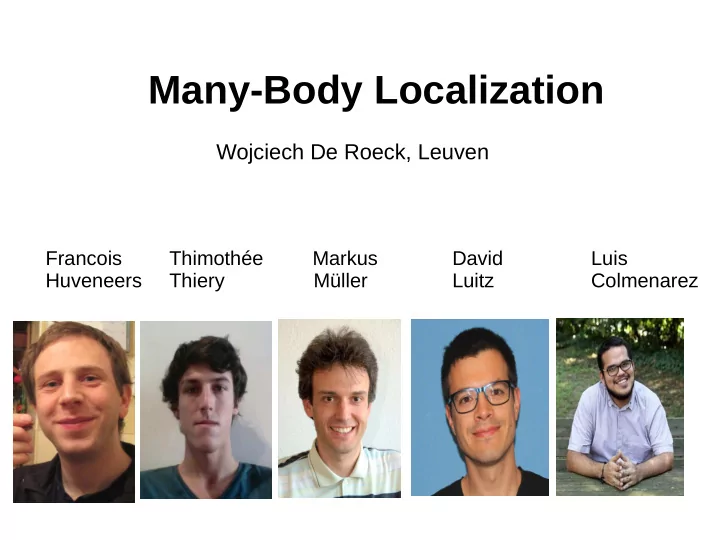
Müller Luis Colmenarez

slide-2
SLIDE 2

Quantum spin chains I

  • Hamiltonian
  • Time evolution
  • is conserved: restrict to sector

Hilbert space

slide-3
SLIDE 3

Quantum spin chains I

  • Hamiltonian

Hilbert space

Free fermions: Interaction: Fermion number operator:

slide-4
SLIDE 4

Quantum spin chains II

  • Eigenstates
  • Equilibrium ensemble
  • Stay away from spectral edges: extensive entropy!

(microcanonical shell) bulk energies

slide-5
SLIDE 5

Thermalizing systems

  • Extreme non-equilibrium initial state
  • Ergodic average
  • Definition: System is thermalizing iff. (for large L)

Upshot: Thermalizing systems have transport over long distances

slide-6
SLIDE 6

ETH: Eigenstate Thermalization Hypothesis (Deutsch, Srednicki, 91)

  • Definition: System is thermalizing iff. (for large L)
  • ETH: holds for all bulk eigenstates
  • Thermalization ETH (if initial state has definite energy density)
  • Sketch proof:

(Limit is reached at hence non-physical times)

  • No proofs of ETH, but strong numerical evidence (Rigol et al 2008 -…)
slide-7
SLIDE 7

ETH: Eigenstate Thermalization Hypothesis (Deutsch, Srednicki, 91)

  • ETH: I)

II)

  • Entropy factor
  • Smooth function varies on scale of 1-site energies
  • If then all is as if fully random

Example: eigenstates are random vectors RMT

Take arbitrary vector , then with large probability In particular, choose , then

slide-8
SLIDE 8

Many-Body Localization (MBL)

  • Definition: Robustly Non-thermalizing (not just setting hopping = 0)
  • Main Example: disordered XXZ:
  • Theory (Basko, Aleiner, Altschuler ‘05, Serbyn,Papic,Abanin ‘13, Huse, Oganesyan ‘13, Imbrie ‘14):

sole change

There is quasilocal unitary transformation s.t.

?

Numerics (up to 22 sites)

(Alet, Laflorencie, Luitz 16)

thermalizing MBL

slide-9
SLIDE 9

Local Integrals of Motion (LIOMs)

(Localization length)

  • Existence of LIOMs no thermalization, no ETH
  • LIOMs like action variables in KAM theory: “ new type of integrability ”
  • Non-interacting fermions:
  • i.e. LIOMs = number operators of one-particle eigenmodes

quasilocal unitary transformation such that

slide-10
SLIDE 10

Life beyond dichotomy thermalization/MBL

MBL

Thermalization

Integrable models

slide-11
SLIDE 11

Stability of MBL wrt Ergodic Grains

Ergodic Grain:

ETH

Consider a small ergodic grain (finite bath) in a localized material: What happens?

Assume grain has ETH (Even more: Random Matrix Theory) Assume localized material has Exponentially local LIOMs Relevant for realistic materials (large low-disorder Griffiths regions)

slide-12
SLIDE 12

Building the Model: Ergodic Grain + MBL

Weak disorder Strong disorder Model by GOE Matrix (Bath) Model by LIOMs: Spin-coupling terms eliminated Bath Unitary Bath Bath-LIOM coupling exp. decaying Local coupling

slide-13
SLIDE 13

MBL + Ergodic Grain: Simplest Model

loc length Random fields GOE Matrix Bath Bath ‘l-bits’ or ‘LIOMs’ Exponential decay of couplings is due to exponential tails of LIOMs However, GOE-Matrix bath breaks integrability: Model is interacting MBL MBL Bath-MBL coupling Bath-MBL coupling

slide-14
SLIDE 14

bath Strategy to couple 1 spin to bath : Thouless parameter : spin remains localized (perturbation theory applies) : spin thermalized: spin ‘joins the bath’ Calculation: Get matrix element of by Random Matrix Theory or ETH Conclusion: Of course large bath thermalizes spin (if not ridiculously small) More standard question: thermalization rate: does not scale with dimension (volume)

slide-15
SLIDE 15

GOE Matrix Main Assumption: When a spin joins the bath, we get a new bath that is again GOE:

  • Hence dim(B) grows, easier to thermalize next spins
  • But coupling to further spins decreases by design
  • Competition between these two effects captured by flow of Thouless parameter

Hence all depends on whether or

slide-16
SLIDE 16

Stable scenario: Most of chain still localized

Ergodic grain Ergodic grain Full melted region Full melted region

Avalanche scenario: No MBL but still very slow dynamics

Ergodic grain

Melted region invades whole chain local thermalization rate

slide-17
SLIDE 17

What in other geometries?

Grain Grain Grain Grain

Critical on growth Hilbert space dimension with distance No stable MBL in d=2

slide-18
SLIDE 18

Localized:

Setup for numerics

Ergodic: More precise RMT yields:

GOE 3 spins 13 spins

The smaller , the better LIOM (or site) i is thermalized

(average over states and disorder°

slide-19
SLIDE 19

Numerical study of Var(i) confirms theory in remarkable way

  • Spins near bath thermal.
  • Spins far from bath go to perfect

localization (Var = 1)

  • Almost no dependence on size L
  • Every spin i becomes perfectly thermal as L

grows: Var(i) 0

  • Compare each last spin as function of L:

more thermal as L grows

slide-20
SLIDE 20

Conclusion up to now

  • MBL in 1d: Strict bound on loc. Length (at least at T=∞)
  • No MBL in 1d with long-range interactions
  • No MBL in d>1, no matter how strong the disorder
  • Of course, still very long thermalization times (Quasi-localization)

Bath Bath Bath Density of ergodic grains: n= # resonant sites to make bath Distance between grains: Thermalization time:

slide-21
SLIDE 21

See avalanches in XXZ model directly? (in progress)

  • Some papers (Goihl, Eisert, Krumnow 2019) and experiments (Bloch lab Munich)

question the avalanche scenario in interacting chains and 2d

  • Our finding: Influence of

ergodic grain does not vanish as distance

Var(i) with ergodic grain Var(i) with no ergodic grain

slide-22
SLIDE 22

Asymptotic MBL aka. quasi-MBL

  • Definition: System is almost brought into LIOM form:
  • ‘Small terms’ (in some sense) are often non-perturbative effects,

leading to highly suppressed transport and very slow thermalization

  • At the heart is always a local absence of resonances (cf KAM

theorem)

  • Examples:
  • Some analogies with glassy dynamics: ‘Jamming of resonances’

* Bose Hubbard model (no disorder) at high density * Classical disordered oscillator chains at large disorder * Classical rotor chains (no disorder) at high energy * ………..

slide-23
SLIDE 23

Example: Classical Rotor Chain

  • Hamiltonians of angles and angular velocities
  • Resonance only if
  • Away from resonances, KAM theorem applies
  • At small є resonances are rare in Gibbs state at positive temperature
  • Even if resonance of 2-3 neighbours, perhaps this remains isolated island?

So maybe: this system is exactly MBL? No, we do not believe that (because resonant spots should be mobile) But it surely is Asymptotic MBL!

slide-24
SLIDE 24

Asymptotic MBL in rotor chain

Split Ham in local terms and define fluctuations Theorem: Fluctuations frozen up to very long times Strongly suggests that also conductivity smaller than

slide-25
SLIDE 25

Example: Periodic Driving

 local (many-body) Hamiltonians chain of length L  Evolution after

…… should heat up to infinite temp.

 Possible obstruction:

some local Ham

slide-26
SLIDE 26

Obstruction…but usually also prethermalization

Possible obstruction: some local Ham

 Prethermal state: “Quasi-stationary Noneq state” (Berges, Gasenzer,

2008-…)

 is analogue of (a single) LIOM

Initial state Trace state (featureless) Equilibrium state determined by : “Prethermal state”

slide-27
SLIDE 27

Simplest example of obstruction: high frequency

Baker-Campbell-Hausdorf? No, converges only for

Still, can construct Prethermalization up to exponential times!

(Magnus, …..D’Alesio et al,….. Rigourous 2017: Kuwahara et al, Abanin et al ) Kapitza’s Pendulum

slide-28
SLIDE 28

Thanks for your attention!

slide-29
SLIDE 29

Evidence for many-body ergodicity

  • For translation-

invariant systems: direct from clustering (Keating at al 2013)

  • No distinction

between integrable and non-integrable systems

Weak ETH ETH Thermalization

  • No proof
  • Numerical evidence

(Rigol et al 2008-…)

  • As stated, true for

free fermions and certain interacting integrable models

  • If one refines the

definition, feels equivalent to ETH Note: Weak ETH Ergodicity (because non-equilibrium initial state is by definition exceptional entropically)