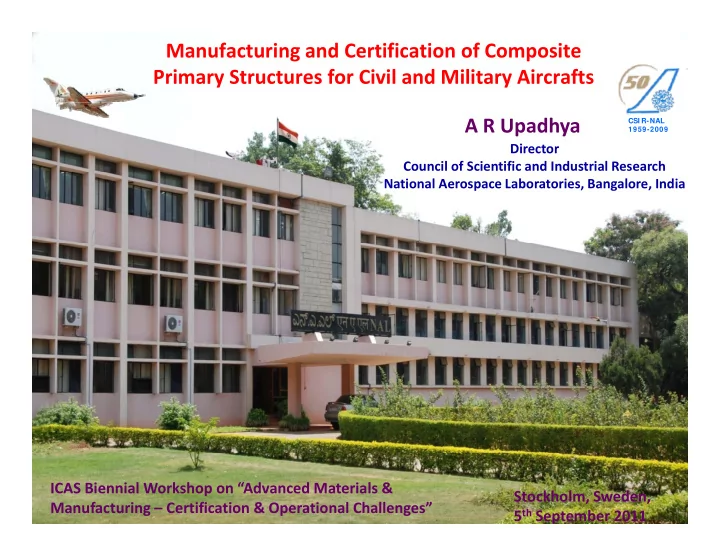
SLIDE 1 Manufacturing and Certification of Composite Primary Structures for Civil and Military Aircrafts
Director Council of Scientific and Industrial Research
CSI R-NAL 1959-2009
A R Upadhya
National Aerospace Laboratories, Bangalore, India
ICAS Biennial Workshop on “Advanced Materials & Manufacturing – Certification & Operational Challenges” Stockholm, Sweden, 5th September 2011
SLIDE 2
Development of national strengths in aerospace sciences and technologies I f t t f iliti d ti Infrastructure, facilities and expertise
In-house, Grant-in-aid, Sponsored projects
Advanced technology solutions to Advanced technology solutions to national aerospace programmes Fighter aircraft, gas turbine engines, defense systems, defense services, launch vehicles and y , , satellites, space systems
Sponsored projects
Civil aeronautics development (since 1990s) Design and development of small and medium- sized civil aircraft - Promote a vibrant Indian civil a iation ind str aviation industry
Government funding, Industry partnership
Core competence at NAL spans practically the whole aerospace sector
SLIDE 3
DESIGN & PROCESS & ANALYSIS DEVELOPMENT
MANUFACTURING
NAL’S CORE STRUCTURAL TESTING STRUCTURAL NAL S CORE STRENGTH IN COMPOSITES NON- STRUCTURAL REPAIR DESTRUCTIVE EVALUATION ADVANCED RESEARCH STRUCTURAL HEALTH MONITORING MONITORING
SLIDE 4
Evolution of Composites at NAL
90‐110 Seater NCA 14 Seater SARAS
Initial Development: Bridge Deck Plates, Radome Development,
14 Seater SARAS
DO‐228 Rudder with DLR Germany
2 S t HANSA LCA‐ Tejas
1980-90 1993 2001 2004 2017
2 Seater HANSA
SLIDE 5 NAL’s HANSA, A Light All‐Composite Trainer Aircraft Trainer Aircraft
Length overall : 25 ft (7.6m) Wing span : 34 35 ft (10 47m) Two-bladed constant speed Hoffmann propeller of diameter 1730mm. Wing span : 34.35 ft (10.47m) Empty weight : 550 Kg All-up weight : 750 kg Usable fuel capacity : 85 litres
Performance
Rotax 914F3 (turbo charged engine with 100 BHP max. continuous power @ 5500 rpm)
Performance
- Stall speed with 20° flaps
: 43 KI AS
: 96 KI AS
: 650 ft/ min continuous power @ 5500 rpm)
Certified under
: 650 ft/ min
: 4 hours
: 1770 ft (540 m)
: 1355 ft (415 m)
Certified under JAR-VLA in 2000
SLIDE 6 Advanced Technology Features
HI NGELESS MAI N ROTOR ARI S- 6 DEGREE OF FREEDOM I NTEGRATED DYNAMI C SYSTEM OF FREEDOM ADVANCED COCKPI T EXTENSI VE USE OF COMPOSI TES CRASHWORTHY CREW SEATS MODERN ENGI NE WI TH FADEC BEARI NGLESS TAI L ROTOR
SLIDE 7
India makes it to Global Composites Scene with LCA-Tejas Program
Courtesy: Boeing
SLIDE 8 LCA - ROLES & SALIENT FEATURES
Maritime Air Defence Roles Offensive Air Support Reconnaissance and Strike
- Point I ntercept
- Escort
- Air Superiority
- Close Air Support
- I nterdiction
Operational Mass : 9000 Kgs
: 1.8 Max War Load : 4500 Kgs
: 4500 Kgs
: 15 Kms
SLIDE 9 TECHNOLOGIES
Unstable Configuration
Maneuverability Advanced Materials (Composite Wing, Fin, Elevons Fuselage Digital Fly By Maneuverability
- Control laws
- Advanced Carefree
Maneuverability Elevons, Fuselage, Rudder, Doors & Hatches)
- Reduced Weight
- I ncreased Life
R d d Si Digital Fly By Wire Flight Control System
Advanced Avionics
Flat Rated Engine E R l Ch
- Easy Role Change
- Easy Role Change
Multi Mode Radar
Glass Cockpit
Stealth
General Systems
- Carbon brake disc
- 4000 PSI Hyd System
- ECS for tropical
- ECS for tropical
Climate
SLIDE 10
SLIDE 11 Structural Optimization of Composite Wing Skins for Stress,Buckling, Aeroelasticity and Technological Constraints
SLIDE 12
Composite Parts made for LCA-Tejas by NAL
45% by weight in composites
SLIDE 13 Benefits of Integration through Cocuring CSIR-NAL has developed Cocuring technology CSIR NAL has developed Cocuring technology within the country for Light Combat Aircraft (LCA-Tejas) and SARAS aircraft
- No holes- No stress concentration
Light Combat Aircraft (LCA-Tejas) and SARAS aircraft
- Increased stiffness of structure
- Better aerodynamic surface
R d d bl ti
- Reduced assembly time
- Weight saving
- No fuel leakage
- No fuel leakage
SLIDE 14 NAL developed composites parts in LCA Tejas
- Integral rib‐skin cocured
construction
- Resulted in weight savings of 35 %
and a 20% weight reduction in and a 20% weight reduction in modified rudder
- Fabrication done using prepregs
with a hybridization of tooling technologies like tape winding d di l bl t h l Fin inner details Fin and dissolvable core technology
- Cost reduced by about 30 %
Rudder Torque shaft MLG Door
SLIDE 15 NAL developed composites parts in LCA Tejas
Fuselage Top Skin
Air Channel Dividing Wall Co-cured CFC Circular Duct
SLIDE 16
LCA CFC Wing Assembly
SLIDE 17 TEST FACILITIES DEVELOPED FOR LCA
Composite Lay‐up Shop Autoclave C‐Scan Lightning test rig
Test Facilities Facilities
Structural Coupling Test Main Airframe Static Test Ground Vibration Test Half Wing Test Full Aircraft Test
SLIDE 18 Spar 3 pt bending
Feature Level Testing for LCA
- Fatigue testing for 5 life cycle
- Environmental aging
Spar-3 pt. bending L-Joint, BLK# 18
g g
- Static testing under Hot Wet
CFC-CFC joint CFC M t l j i t I BLK# 18 Y-Joint, Circular Duct Spar opening CFC-Metal joint I CFC-Metal joint I I Skin Stiffener T T-Shear Skin-Spar Joint T- Pull T-Shear
SLIDE 19 WING ROOT FITTING BOX ‐ DRY ASSEMBLY & FINAL ASSEMBLY WI NG BUCKLI NG TEST BOX WI NG FUEL TANK SEALI NG TEST BOX
O/ B Elevon test box BOX LEVEL TESTS
- Fatigue and burst pressure
testing of Drop Tank Nose cone
SLIDE 20 Testing of LCA Wing
- FLEXI BLE TEST RI G TO SI MULATE STI FFNESS EFFECTS
- I SOSTATI C EQUI LI BRI UM SYSTEM
- I NSTRUMENTED REACTI ONS
SI MULTANEOUS EXTERNAL & REACTI ON LOADI NG
SLIDE 21 Development of a Light Transport Aircraft
14 seater multi 14 seater multi-
role LTA -
SARAS
- Hybrid (metal + composite) airframe
- CFC flaps, control surfaces, fairings
- P&WC PT6A-67A turbo-prop engine
1200 SHP 1200 SHP
- 2.65φ (5 bladed) constant speed propeller
- Max. cruise speed
: 550 km / h
: 9 km
: 700 m / min.
: ~ 5h
: 5h
: 700 m
- Landing distance, ISA, SL
: 850 m Design to meet FAR-23 requirements
SLIDE 22 Materials used for LCA and SARAS programmes
1.
AS4/ 914 Prepreg materials from Hexcel composites Pvt Ltd; 180 deg C curing systems; D T 175 d C Dry Tg = 175 deg C Unidirectional fabric from Hexcel Composites
2.
Unidirectional fabric from Hexcel Composites and Resin from Axson France for the VERI Ty process; 80 deg C cure followed by 180 deg C p ; g y g post cure: Dry Tg of 145 deg C
3.
Rohacell foam for stringers and access covers
VERI Ty process mechanical properties within 2 % of y p p p prepreg properties
SLIDE 23 Composite Parts in SARAS Aircraft
HORIZONTAL STABILIZER FRONT TOP SKIN
Radome
ELEVATOR WING FLOOR BOARD INBOARD FLAP OUTBOARD FLAP
New Processing Technology: VERITy
FLAP AILERON REAR PRESSURE BULK HEAD FIN
35% by weight in composites
SLIDE 24 HT Components of SARAS
Cocured Inter Spar Box with Bottom Skin With 2 Spars, 11 Ribs, 7 Stringers p p , , g
Size: 5.5mx 1m
Cocured Top Skin with Stringers
Metal Composite Weight 92 Kg 70 Kg (24% )
Cocured Top Skin with Stringers
243 11
10,500 2900
HT Tip Cocured with Stringers
SLIDE 25 Horizontal Tail of SARAS: Cocured Bottom Section
Comparative chart Metal Composites Horizontal Tail aft box Weight
fasteners
32.0 kgs. 24.0 kgs. 75 1 5200 Nil p
Dimensions: 5.5mx1m. The skin is co- cured with stringers, ribs and spars.
fasteners Assembly 4 weeks Nil
cured with stringers, ribs and spars.
SLIDE 26
Tooling Concepts
Basic outer CFC Mould I nternal Flexible tools Skin stringer I ntegration Skin stringer spar I ntegration Final bag for curing
SLIDE 27 Vertical Tail of SARAS
Cocured Inter Spar Box with 6 Cocured Inter Spar Box with 6 Spars and a Mid Rib
Metal Composite Weight of I S Box 65 Kg 50 Kg (23% )
Size: 2.8mx1.8m
Box (23% )
130 01
1100
1100 Total VT weight 126 Kg 101Kg (20% )
SLIDE 28
Master Model For Mould Rh & LH Mould Assembly Cured Component Skin Bonded With Spars & Mid Ribs Final Bagging for Curing Final Bagging for Curing
SLIDE 29 Cocured CFC Pressure Bulkhead of SARAS
Ring Dome
1.8 m diameter dome having a depth of 175
Dome shaped rear wall
having a depth of 175 mm, with thickness varying from 1.2 to 3 00 mm 3.00 mm
Accuracy of outer contour and gusset spacing = + / - 0.5 mm Metal Composite Weight 34 Kg 17 Kg (50% ) Weight 34 Kg 17 Kg (50% )
700
SLIDE 30
All th b f b i t d i P d All the above were fabricated using Prepregs and Autoclave Moulding Technology Ch ll H t t t ??? Challenge: How to cut costs??? O l ti Li id M ldi T h l One solution- Liquid Moulding Technology
SLIDE 31 LCM and its Variants
RTM (Resin transfer moulding) RIM ( Resin injection moulding) VARTM ( vacuum assisted resin transfer moulding)
SCRIMP ( Seeman composite resin infusion
moulding process) moulding process)
DCVRTM (Double chamber vacuum resin
transfer moulding)
FASTRAC ( Fast remotely activated channels)
RFI ( Resin Film Infusion) SRIM ( Structural reaction injection moulding)
VERI Ty ( Vacuum enhanced resin infusion technology) D l d b NAL Developed by NAL
SLIDE 32 VERITy Process
Reinforcement Mould Resin infusion Resin impregnates fibers under vacuum Reinforcement Mould Resin infusion Resin impregnates fibers under vacuum Vacuum pump
Resin
Consolidation Under 1 Bar Vacuum pump
Resin
Consolidation Under 1 Bar Cured part Consolidation Under 1 Bar External Pressure and Vacuum Cured part Consolidation Under 1 Bar External Pressure and Vacuum Vacuum pump Vacuum pump
SLIDE 33
Development of I ntegrated Wing Structures at NAL using VERI Ty Process
SARAS Wing: Substructure Details
SLIDE 34 Building Block Approach for Composite Wing of SARAS Aircraft
Component Level
Sub‐Component Level `
Full Scale Test
p
Lightning Test Box Test Box with Skin & Spar Splices
Feature Level
Skin Splice Spar Splice Bird Impact Test On Leading Edge
Element Level (Tests at RT & ETW)
T Pull Strength L‐Angle Opening Test Single Lap Bearing Test
Coupon Level (Tests at RT, ETW & CTA)
g Tension/ Compression/ Shear Strength Un‐notched Blunt Notch
SLIDE 35
Box Level Studies using VERITy : SARAS Wing Test Box
Structural Details of Wing Test Box Cocured bottom box Assembled box undergoing Static Testing
SLIDE 36
Flow Sensor Development Flow Sensor Development
SLIDE 37 Fibre Optic Flow Sensor
Process Sensor – 1 Sensor – 2 Sensor – 3 Flow 180 mm 10 After Embedment a a a Before Infusion b b b Resin F
S 1 S 2 S 3
00 mm Infusion Resin crossed Sensor – 1 Resin crossed
S-1 S-2 S-3
c b b b
crossed Sensor - 2 Resin crossed Sensor - 3
I nstrument
c c c c c b
SLIDE 38 ResinVI EW Software Development
- LabVI EW & MATLAB based modular code development for real time resin
flow flow.
- Enables sequential infusion based on NetSense feedback.
- Resin arrival time information important for future infusion strategy and
modeling.
- Low cost reusable sensor & modular open system architecture system.
00:00:00 00:54:15 01:31:38
SLIDE 39
SARAS Wing Components made using VERI Ty
Top Skin 6mx2m Inner Side Top Skin 6mx2m Outer Side
Thickness varies from 1.7 mm to 8.6 mm Thickness of hat stringer is 1.36 mm
SLIDE 40
Centre Top Skin
1) 48 t d 1) 48 parts cocured 2) 41 Kgs 3) Complex ribs
SLIDE 41 SARAS Outboard Wing: I ntegrated Wing Concepts Cocured Coinfused Wing Bottom Skin with Substructure Cocured Ribs and St i Stringers
@ 300 parts
Cocured Rib with
Cocured in
Rib with Gussets Cocured Spar with Gussets
SLIDE 42 Tool Design
I f i St t I nfusion Strategy
I nfusion
strategy plays a key role, especially in components where the thickness and geometry of a p g y component varies from section to section and a lot of features are to be co-cured.
I n large structures sequential and/ or parallel infusion I n large structures, sequential and/ or parallel infusion
strategies need to be employed, as there is a limited time available to complete the infusion.
V B i T h l Vacuum Bagging Technology
- This is yet another aspect that needs to be dealt with in order
to get a complex co cured component that meets the required specifications of compaction and dimensions.
- Care has to be taken to avoid any ‘Bridging’ at the radius and
proper vacuum communication needs to be maintained f throughout the cure of the component to ensure proper consolidation of the part.
SLIDE 43 Cocured Component
Fabrication Methodology
Master Model
Finished Master Model
Resin I nfusion using VERI Ty
5.8 m
Preform Layup & assembly
Mould Layup
Finished Mould
1.8m
Finished Mould
Locator Development I nternal Tool Development
SLIDE 44
Trial Assembly of Wing
SLIDE 45
Manufacturing & Assembly Issues
1) Tool corrections for spring forward behaviour of composites is trail and error method and difficult for complex composite parts. 2) Thickness growth ‐2% to +8% in composites are lead to assembly fitment problems. 3) Maintaining the fiber direction during the lay up of complex component is difficult issue. 4) Out of plane loads are important when laminate is assembled with mechanical fasteners. If fastener pulling forces are too high, Composites experience delaminate & possible loss of structural p p p integrity. 5) Presence of ply drops ,lap joints (BD Composites) and their variability in thickness results in higher thickness shim when mating with machined metallic members during the assembly.
SLIDE 46 Operational Issues with composite Structure
1) Removal of Panels: As composite have low wear resistance as compared to metal ,holes are elongating as panels are removed
- frequently. In case of fuel tanks, fuel is leaks due to this elongates.
- frequently. In case of fuel tanks, fuel is leaks due to this elongates.
Remedial: Use metallic sleeves/bushes for these holes 2) Delaminations are occurring during drilling & other machining 2) Delaminations are occurring during drilling & other machining
- perations even for minor deviation in the process like improper
support during drilling and direct drilling of higher diameter holes. 3) As composites are brittle , even minor deviations in the contour is difficult during assembly. 4) The inspection time required for composite structures is more as compared to metallic structures. It is difficult to inspect the d l /d h h h h h l delamination/damages other than through the ultrasonic inspection. Some impact damage are noticed only during schedule maintenance period.
SLIDE 47
Operational Issues with composite Structure Contd…
5) More precautions have to taken while walking on composite parts like wing as it leads to delamination/ debonding when there is local hard points. 6) Edge damages are occurs frequently when composites ) g g q y p doors/panel are removed from the aircraft & during installation. 7) Fuel leaks are occurring during the service (1‐2 years) due to resin starvation zones even though it is cleaned structurally. 8) Modification of composite structures due to operation requirements like installation of new equipments etc, is difficult as compared to metal. difficult as compared to metal.
SLIDE 48
Damage Tolerance Studies towards certification certification
SLIDE 49 Aspects
Damage threats & classification Aspects of damage tolerant design
Ai thi i t
Airworthiness requirements Structure substantiation
Building block approach Test Sequence/ Protocol
SLIDE 50 Damage Threats
Processing anomalies and in‐process handling damages
I i d E T l d d hi l
In‐service damages: E.g. Tool drops, ground vehicle
impacts, bird strikes, runway debris, uncontained engine rotor failure etc. rotor failure etc.
Environmental damages: E.g. Hail, Lightning strike,
Moisture ingression, UV radiation etc. g ,
IATA survey: Ground handling and moisture intrusion are
most common sources of damage
SLIDE 51 Damage classification
Barely visible impact damage
(BVI D)
BVID Small damages that may not be found
during inspection
Typical dent depth 0.5 to 1 mm BVID Typical dent depth 0.5 to 1 mm
Visible impact damage (VI D) and
penetrations
Scratches, gouges, surface and
coating inspections
Fluid and moisture ingress C-scan of CFRP laminate with BVID Fluid and moisture ingress Delamination, debonds etc. Thermal damage; Chemical
g ; damage; Others
SLIDE 52 Why should we care about impact damage?
Laminated composites have very low shear
strength, hence are susceptible to impact damage I nvisible internal delamination and BVI D are most
I nvisible internal delamination and BVI D are most
detrimental and leads to low allowable load/ strain in design
I mpact damage is accommodated by limiting the
design strain – leading to significant conservativeness conservativeness
Safety & economical reasons – damage has to be
detected and repaired during inspection and maintenance maintenance
SLIDE 53 Typical Energy Levels for Projectile I mpact
Courtesy: I mpact on aircraft, Marcílio Alves et.al.
SLIDE 54 Aspects of Damage Tolerant Design
Residual strength capability
Residual strength of several damage scenarios to be
d d f li i f d l di demonstrated after application of repeated loading
Damage growth characterization
“No initiation No growth” approach is usually
“No initiation – No growth” approach is usually
adopted
Usual design practices
Usual design practices
Multiple/Redundant load paths Materials with slow crack growth rates Design for good inspectability
SLIDE 55
SLIDE 56 Civil Aviation Authorities
Federal Aviation Administration FAA European Aviation Safety Agency EASA
y
- Federal Aviation Regulations
Certification Specifications Federal Aviation Regulations FAR Certification Specifications CS Airworthiness Directives AD Airworthiness Directives AD Advisory Circulars AC
SLIDE 57 Compliance to FAR/ CS
Allowable damage that may go undetected
(DUL residual strength; No growth for minimum of 2 service
lives) lives)
Damage detected by field inspection
(DLL residual strength; No growth until 2 inspection intervals)
Discrete source damage known to pilot
(Continued safe-flight; “get-home” loads)
All damage that lowers strength below DUL must be
repaired when found
Any damage that is repaired must withstand DUL and not
impair safe operation of the aircraft for its lifetime
SLIDE 58
Damage Tolerance Test Protocol
Acceptable Manufacturing Defects Defects Fatigue Loads One Life
Panel
Strain Survey at 60% DLL
Panel
Strain Survey at 60% DLL I ntroduce
Panel Panel
Fatigue Loads
Monitor
BVI D Strain Survey At DUL Fatigue Loads One Life Strain Survey t DUL
Monitor Damage during Static & Fatigue
At DUL Fatigue: Two at DUL
g Testing
P l
I nspection I nterval
Panel
Strain Survey at 60% DLL
Panel
Fatigue: Two I nspection I nterval Strain Survey at DLL
SLIDE 59 The Next Design Philosophy???
Design Philosophies
Safe-life Fail-safe Damage tolerance
Structural Health Monitoring (SHM)
Sensors can be embedded in the structure Sensors can be embedded in the structure Attained certain degree of maturity and field trials started Can we go for a SHM based design?
g g
Is it possible to build a light weight and damage tolerant
structure using this philosophy?
What are the Issues?
SLIDE 60 Benefits of Structural Health Monitoring
‘Condition-based maintenance’ or ‘maintenance-on-
demand’
L i t t
Lower maintenance costs Higher availability of aircraft
Prognostic capabilities of SHM Prognostic capabilities of SHM
Better fleet management leading to better resource
utilization
SHM-based design
Move away from Damage Tolerance design philosophy Lower weight, lower operating costs
SLIDE 61
HANSA Flight Trials
Real Time Measurement Real Time Measurement
SLIDE 62 Strain Variation During Take-off
600 FBG 130 L FBG 130 R FBG 190 L 400 500
ain)
FBG 190 R FBG 250 L FBG 250 R 300
microstra
100 200
Strain (m
Starting on Runway Level Flight
10 20 30 40 50 60 70 80
Time (secs)
SLIDE 63 Strain Variation During Flight Maneuvers
1400 FBG 130 L FBG 130 R
3g
1200
)
FBG 130 R FBG 190 L FBG 190 R FBG 250 L FBG 250 R
1 5 2g
800 1000
crostrain
1.5g
Level Flight
600
train (mic
200 400
St
800 900 1000 1100 1200 1300 1400
Time (secs)
SLIDE 64 Flight Trial of SHM system on Nishant UAV
A f l fli ht t i l f SHM t
- A successful flight trial of SHM system was
conducted on Nishant UAV on October 28, 2010 at 12:15 PM at Kolar. Th UAV fl f th t h
- The UAV was flown for more than two hours as per
the flight plan starting from catapult launch, various flight maneuvers and recovered as per parachute recovery parachute recovery.
More than 6GB of FBG sensor data throughout the flight was acquired.
g g q
Challenge: Large volume flight data processing and load estimation QuickVIEW software was developed
Temperature compensation with Push Pull topology – Temperature compensation with Push-Pull topology – Sensor data integration with flight data (pitch, yaw, roll etc.) – On-site data view and load estimation using ANN based load estimator.
SLIDE 65 Flight Data Analysis Results
Parachute R Catapult Launch Recovery
SHM of Nishant UAV Using Fiber Optic Sensors
SLIDE 66
Smart Concepts: SMA based HANSA trim tab actuation Horizontal Tail Elevator Trim tab Wind Tunnel Tests
Wind tunnel tests have been carried out at different wind
Wind Tunnel Tests
velocities of 25, 35 & 42m/s SMA actuated trim‐tab remained bl i h d fl d di i stable in the deflected condition under the wind load. Wind tunnel testing of trim tab & Hor. Tail
SLIDE 67 Concluding remarks
Challenge is to reduce cost A t i l & i t d d i d
Aerospace materials & associated design and
manufacturing processes must be optimized in an integrated manner to deliver cost efficient products g p
Environmental effects and issues of recycling to be
addressed
Advanced striker aircrafts being developed which will
fly at higher mach nos: hence need composites to meet hi h t t higher temperatures.
Stealth technology is a major area of research New
materials and nano coatings materials and nano coatings
SLIDE 68 Concluding remarks
Need to reduce maintenance costs and have fully on
line SHM systems
Smart materials/structures for morphing
f b i d b f ll d l d
FML for energy absorption need to be fully developed ‘Mechanic friendly’ repair technology to be established
B tt d t di f d t l
Better understanding of damage tolerance : more
robust failure theories – will enable faster certification
All fields of Engineering likely to use more composites All fields of Engineering likely to use more composites
– challenge is higher efficiency at a lower cost
SLIDE 69 CSI R-NAL 1959-2009