Managing Waiting Lines NKFUST The Economies of Waiting Features of - - PDF document

managing waiting lines
SMART_READER_LITE
LIVE PREVIEW

Managing Waiting Lines NKFUST The Economies of Waiting Features of - - PDF document

2019/5/12 ShinMing Guo Managing Waiting Lines NKFUST The Economies of Waiting Features of Queuing Systems Estimating Waiting Times Waiting Line Management What are waiting lines and why do they form? Answer: Waiting Lines form


slide-1
SLIDE 1

2019/5/12 1

Managing Waiting Lines

  • The Economies of Waiting
  • Features of Queuing Systems
  • Estimating Waiting Times
  • Waiting Line Management

Shin‐Ming Guo NKFUST

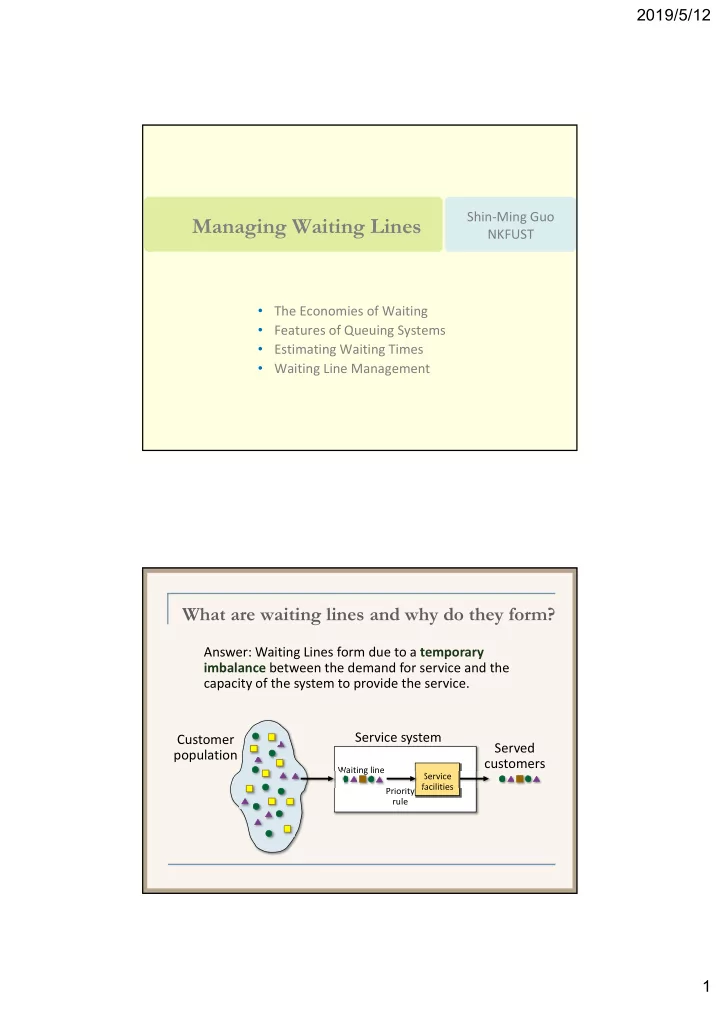
What are waiting lines and why do they form?

Answer: Waiting Lines form due to a temporary imbalance between the demand for service and the capacity of the system to provide the service. Customer population Service system

Waiting line Priority rule Service facilities

Served customers

slide-2
SLIDE 2

2019/5/12 2

Total Cost minimum

The Economies of Waiting

3

Cost Cost of Waiting Cost of Capacity Service Capacity Large Small

Total Cost per hour = Cost of Capacity per hour + Cost of Customer Waiting

  • I. The Operation of a Typical Call Center

4

Blocked calls (busy signal) Abandoned calls (tired of waiting) Calls

  • n Hold

Sales reps processing calls Answered Calls Incoming calls

Call center

Lost throughput Holding cost Lost goodwill Lost throughput (abandoned) $$$ Revenue $$$ Cost of capacity Cost per customer

  • At peak, 80% of calls

dialed received a busy signal.

  • Customers getting

through had to wait on average 10 min. .

slide-3
SLIDE 3

2019/5/12 3

A “Perfect or Somewhat Odd” Call Center

5

7:00 7:10 7:20 7:30 7:40 7:50 8:00

Caller Arrival Time Service Time

1 2 3 4 5 6 7 8 9 10 11 12 5 10 15 20 25 30 35 40 45 50 55 4 4 4 4 4 4 4 4 4 4 4 4

A More Realistic Service Process

6 Caller Arrival Time Service Time

1 2 3 4 5 6 7 8 9 10 11 12 7 9 12 18 22 25 30 36 45 51 55 5 6 7 6 5 2 4 3 4 2 2 3 Time 7:10 7:20 7:30 7:40 7:50 8:00 7:00

caller 1 caller 3 caller 5 caller 7 caller 9 caller 11 caller 2 caller 4 caller 6 caller 8 caller 10 caller 12 1 2 3 2 min. 3 min. 4 min. 5 min. 6 min. 7 min.

Service times Number of cases

slide-4
SLIDE 4

2019/5/12 4

Variability Leads to Waiting Time

7

7:00 7:10 7:20 7:30 7:40 7:50

Inventory (callers on line)

5 4 3 2 1

8:00

7:00 7:10 7:20 7:30 7:40 7:50 8:00

Wait time Service time

Caller Arrival Time Service Time

1 2 3 4 5 6 7 8 9 10 11 12 7 9 12 18 22 25 30 36 45 51 55 5 6 7 6 5 2 4 3 4 2 2 3

Variability: Where does it come from?

8

Input

  • Random arrivals

(randomness is the rule, not the exception)

  • Unpredicted Volume swings
  • Product Mix
  • Incoming quality

Resources

  • Breakdowns / Maintenance
  • Operator absence
  • Set‐up times

Tasks

  • Inherent variation
  • Lack of SOPs
  • Quality (scrap / rework)

Buffer Processing

slide-5
SLIDE 5

2019/5/12 5

  • II. Essential Features of Queuing Systems

9

Departure Queue discipline Arrival process Queue configuration Service process Renege Balk Calling population No future need for service

Customer Arrival Process

Static Dynamic Appointments Price Accept/Reject Balking Reneging Random arrivals with constant rate

Random arrival rate varying with time

Facility‐ controlled Customer‐ exercised control

Arrival process

slide-6
SLIDE 6

2019/5/12 6

Analyzing Inter-Arrival Times

11

Call Arrival Time, ATi

1 2 3 4 5 6 7 6:00:29 6:00:52 6:02:16 6:02:50 6:05:14 6:05:50 6:06:28

Interarrival Time IAi=ATi+1 -ATi

00:23 01:24 00:34 02:24 00:36 00:38

Time 6:01 6:02 6:03 6:04 6:05 6:06 6:00

Call 1 Call 2 Call 3 Call 4 Call 5 Call 6 Call 7 IA1 IA2 IA3 IA4 IA5 IA6

mean deviation standard Variation

  • f

t Coefficien  

a

CV

Modeling Customer Arrivals

Random (Poisson) arrivals

 Customers arriving independently from each

  • ther follow exponential inter‐arrival times.

Pn =

for n = 0, 1, 2,…

(T)n n!

Pn =Probability of n arrivals in T time periods  = Average numbers of arrivals per period

1 

a

CV

slide-7
SLIDE 7

2019/5/12 7

Temporal Variation in Arrival Rates

An arrival process is not stationary if the average number of arrivals in any given time interval is not fixed over the entire time period.

Queue Configuration

slide-8
SLIDE 8

2019/5/12 8

Multiple Queues vs. Single Queue

15

Multiple Queues Take a Number

3 4 8 2 6 10 12 11 5 7 9 Enter

Single queue

?

Queue Discipline

Queue discipline Static (FCFS rule)

Dynamic selection based on status

  • f queue

Selection based

  • n individual

customer attributes

Number of customers waiting Round robin Priority Preemptive Processing time

  • f customers

(SPT rule)

slide-9
SLIDE 9

2019/5/12 9

Service Process and Customer Involvement

17

Histograms of Service Times

18

1/μ = mean service time μ = service rate   1 

s

CV

slide-10
SLIDE 10

2019/5/12 10

  • III. Estimating Wait Times
  • 1. Mean arrival rate:
  • 2. Number of parallel servers: m
  • 3. Mean service rate:
  • 4. Utilization:
  • 5. Mean time in queue:
  • 6. Mean time in system:
  • 7. Mean number of customers in queue:
  • 8. Mean number of customers in the system:

   m 

q q

W L  

q

W   m L W L

q s s

  

long time averages

 1  

q s

W W

arrival departure waiting line Entry to system End Service Begin Service

Reducing Variability to Reduce Waiting

Reduce Arrival Variability

  • appointment/reservation: how to handle late arrivals or no‐shows
  • encourage customers to avoid peak hours.

Reduce Service Time Variability

  • training and technology
  • limit service selection
  • reduce customer involvement

20

Service time factor Utilization factor Variability factor

2 1 1

2 2 s a q

CV CV W        

) 1 ( 2

2 2 2

      

q

L

slide-11
SLIDE 11

2019/5/12 11

100% Service Utilization?

1.0 100 10 8 6 4 2

Single server With: Then:

        L

s

1

Ls

0 0 0.2 0.25 0.5 1 0.8 4 0.9 9 0.99 99

Multiple, Parallel Resources with One Queue

22

arrival departure number waiting Lq Entry to system Departure Begin Service Time in queue Wq Service Time 1/μ Time in system Ws=Wq + 1/μ number in service

slide-12
SLIDE 12

2019/5/12 12

Waiting Time for Multiple, Parallel Resources

23

                          

 

2 1

2 2 1 ) 1 ( 2 s a m q

CV CV n utilizatio n utilizatio m W  1/

Under the assumption that we approximate the average waiting time as

1       m rate service rate arrival n Utilizatio

Service time factor Utilization factor Variability factor

Staffing over the Course of a Day

24 20 40 60 80 100 120 140 160 0:15 2:00 3:45 5:30 7:15 9:00 10:45 12:30 14:15 16:00 17:45 19:30 21:15 23:00 20 40 60 80 100 120 140 160 0:15 2:00 3:45 5:30 7:15 9:00 10:45 12:30 14:15 16:00 17:45 19:30 21:15 23:00

Time Number of customers Per 15 minutes Number of CSRs

17 16 15 14 13 12 11 10 9 8 7 6 5 4 3 2 1

slide-13
SLIDE 13

2019/5/12 13

  • IV. Waiting Times & Customer Satisfaction

25

Reducing average waiting time does not guarantee customer satisfaction. A small percentage of customers may experience long waits and complain bitterly. Solution: service guarantee and/or service recovery

Perception of Waiting and Service Level

26

Perceived Wait Time

 Amount of time customers

believe they have waited prior to receiving service.

 Has a greater effect on

customer satisfaction than actual waiting time

t*

0.2 0.4 0.6 0.8 1

perceived wait

threshold sensitivity Satisfaction

Service Level = Probability{Perceived Wait Time  Target Wait Time }

slide-14
SLIDE 14

2019/5/12 14

Psychology of Waiting

  • That Old Empty Feeling: Unoccupied time goes slowly
  • A Foot in the Door: Pre‐service waits seem longer that

in‐service waits

  • The Light at the End of the Tunnel: Reduce anxiety with

attention

  • Excuse Me, But I Was First: Social justice with FCFS

queue discipline

  • They Also Serve, Who Sit and Wait: Avoids idle service

capacity

Factors Affecting Perceived Wait Times

28

Customer‐Related Factors

 Solo versus group waits  Waits for more valuable

versus less valuable services

 Customer’s own tolerance

Server‐Related Factors

 Passive vs. active waits  Unfair vs. fair waits  Uncomfortable vs.

comfortable waits

 Unexplained vs. explained

waits

 Unproductive vs.

Productive waits

slide-15
SLIDE 15

2019/5/12 15

Fair vs. Unfair Waits

Suggestions for Managing Queues

30

  • 1. Determine an acceptable waiting time for your customers
  • 2. Inform your customers of what to expect
  • 3. Try to divert your customer’s attention
  • 4. Segment customers (Din Tai Fung, pay more)
  • 5. Encourage customers to use slack periods
  • 6. Appointment (no show?)
  • 7. Provide limited service or self‐service
  • 8. Provide flexible service hours or internet access
  • 9. Technology: bar‐code, OCR, RFID (ETC),

beeper, fast Lane, customer database

  • 10. Take a long‐term perspective (redesign the system)
slide-16
SLIDE 16

2019/5/12 16

Segment Customers

31

Summary

32  Variability is the norm, not the exception

‐ understand where it comes from and eliminate what you can

 Variability leads to waiting times although utilization<100%

Operations benefit from flexibility in capacity

 Demand can exhibit seasonality → Time varying capacity  Pooling resources can reduce waiting times

Managing customers’ perceived wait times