MANAGEMENT IN KATH, KUMASI- GHANA, 1954 2017 KATH BURNS MANAGEMENT - - PowerPoint PPT Presentation

management in kath kumasi
SMART_READER_LITE
LIVE PREVIEW

MANAGEMENT IN KATH, KUMASI- GHANA, 1954 2017 KATH BURNS MANAGEMENT - - PowerPoint PPT Presentation

Kwame Nkrumah University of Science & Technology, Kumasi, Ghana EVOLUTION OF BURN INJURY MANAGEMENT IN KATH, KUMASI- GHANA, 1954 2017 KATH BURNS MANAGEMENT EVOLUTION 1 AUTHOR & PRESENTER Professor Pius Agbenorku Division of


slide-1
SLIDE 1

Kwame Nkrumah University of Science & Technology, Kumasi, Ghana

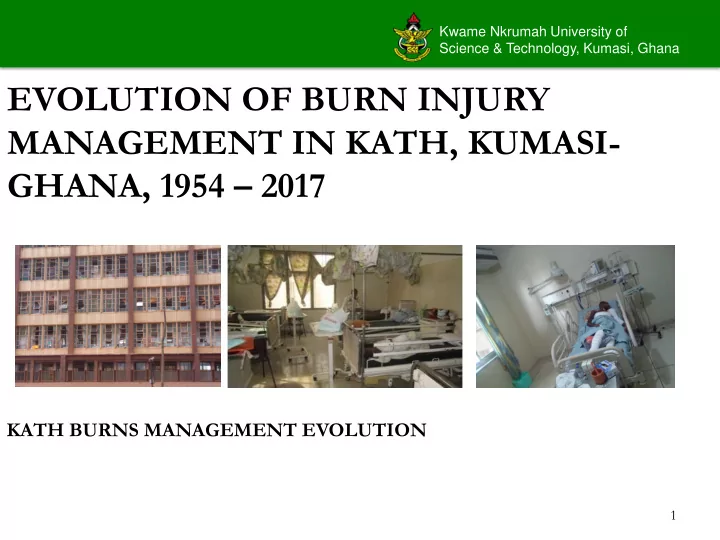
EVOLUTION OF BURN INJURY MANAGEMENT IN KATH, KUMASI- GHANA, 1954 – 2017

KATH BURNS MANAGEMENT EVOLUTION

1
slide-2
SLIDE 2

www.knust.edu.gh 2

AUTHOR & PRESENTER

Professor Pius Agbenorku Division of Plastic & Reconstructive Surgery Department of Surgery Komfo Anokye Teaching Hospital School of Medical Sciences College of Health Sciences Kwame Nkrumah University of Science & Technology Kumasi, Ghana

slide-3
SLIDE 3

www.knust.edu.gh 3

Pan African Burn Society

PABS Vice-President …. Professor Pius Agbenorku

slide-4
SLIDE 4

www.knust.edu.gh

Introduction

  • Burns management; a holistic approach
  • Burn prevention policies
  • Infrastructure
  • Effective standardized treatment

4

slide-5
SLIDE 5

www.knust.edu.gh

Introduction

  • Burns, a disease burden in Low to Middle Income

Countries (LMICs)

  • WHO: strengthening burn care
  • Ghana; Komfo Anokye Teaching Hospital (KATH)

and the Korle-Bu Teaching Hospital

  • KATH, the only tertiary hospital in the middle belt
  • f Ghana is of key interest

5

slide-6
SLIDE 6

www.knust.edu.gh

Introduction

  • Since KATH inception, burn teams have developed the

best approaches toward effective burn management: putting up state of the art burns center

  • Staff training
  • Developing effective burn protocols, among others

6

slide-7
SLIDE 7

www.knust.edu.gh

Aim

  • Report on the evolution of burn injury management at

the Komfo Anokye Teaching Hospital (KATH), since the hospital’s commissioning in 1954 till present

  • Future projection

7

slide-8
SLIDE 8

www.knust.edu.gh

Method

Phase 2 Phase 3 Phase 4 Phase 1 Phase 5

?Nothing Proposal for BICU Projections New BICU (A&E) Revolutionary phase

8

slide-9
SLIDE 9

www.knust.edu.gh

Phase 1

  • Inception of KATH (1954) to 1993
  • Burns patients in “all-in-one” surgical ward
  • Lack of adept staff
  • No effective record keeping

9

Nothing special

slide-10
SLIDE 10

www.knust.edu.gh

Phase 1

10

Such degree of burns could not be managed well

slide-11
SLIDE 11

www.knust.edu.gh

Suspected results

11

slide-12
SLIDE 12

www.knust.edu.gh

Phase 2

  • From 1993-2001
  • First Plastic surgeon employed (1993)
  • Dr. Pius Agbenorku
  • Burns team was formed
  • Minor and advanced surgeries begun

12

slide-13
SLIDE 13

www.knust.edu.gh

Meshed Split-thickness Skin Graft

13

slide-14
SLIDE 14

www.knust.edu.gh

Phase 2

  • Inception of record keeping
  • Decreased mortality and burn contractures

14

slide-15
SLIDE 15

www.knust.edu.gh

However,

  • ‘All-in-one ward’
  • Cross infection
  • Septicemia

15

slide-16
SLIDE 16

www.knust.edu.gh

Phase 2

  • Separate Burns ICU

16

slide-17
SLIDE 17

www.knust.edu.gh

Phase 3 (Revolutionary Phase)

  • From February 2001- May 2009
  • Space made available and refurbished into

BICU: Ward D2C (February 2001), now Old BICU Ward D2C

  • First ever BICU in Ghana

17

slide-18
SLIDE 18

www.knust.edu.gh

Old Burns Ward D2C

18

slide-19
SLIDE 19

www.knust.edu.gh

Phase 3

  • 3 Surgeons and 6

specially trained Nurses

  • Anaesthetic

machine

19

slide-20
SLIDE 20

www.knust.edu.gh

Patients on admission at Burns Ward D2C

20

slide-21
SLIDE 21

www.knust.edu.gh

Patients on admission at Burns Ward D2C

21

slide-22
SLIDE 22

www.knust.edu.gh

Such burns and worse could now be treated well

22

slide-23
SLIDE 23

www.knust.edu.gh

Advantage of the Ward D2C

*

23

Epidemiological study of burns in Komfo Anokye Teaching Hospital, 2006–

  • 2009. DOI: 10.1186/s41038-016-0041-0
slide-24
SLIDE 24

www.knust.edu.gh

Rotary International

  • Dundee and Kumasi Rotary clubs provided
  • Grant for:
  • Surgical equipment
  • Training and re-training staff in UK
  • Patients assistance fund

24

slide-25
SLIDE 25

www.knust.edu.gh

Plaque at Ward D2C

25

slide-26
SLIDE 26

www.knust.edu.gh

  • Prof. A. M. Morris
  • Consultant Plastic

Surgeon and President

  • f ReSurge Africa

26

slide-27
SLIDE 27

www.knust.edu.gh

Phase 3 summary

27

slide-28
SLIDE 28

www.knust.edu.gh

Phase 4

  • Ultra-modern

Accident and Emergency (A&E) Centre

  • Commissioned:

May 2009 till date (2017)

28

slide-29
SLIDE 29

www.knust.edu.gh

Phase 4

  • The biggest A&E Centre in West Africa at the time (April 2009)
  • Houses:
  • New Burns Intensive Care Unit (NBICU)
  • Plastic Surgery
  • Neurosurgery
  • Orthopaedics
  • Trauma Surgery and Emergency Medicine

29

slide-30
SLIDE 30

www.knust.edu.gh

New BICU

  • On the first floor
  • f the A&E

Centre

  • 6 room suites for

patients

30

slide-31
SLIDE 31

www.knust.edu.gh

New BICU Reception

31

slide-32
SLIDE 32

www.knust.edu.gh

Front desk of NBICU

32

slide-33
SLIDE 33

www.knust.edu.gh

Room suite for each patient

33

slide-34
SLIDE 34

www.knust.edu.gh

Each Unit is fully equipped with:

Single bed Life support system for each bed, including acute care physiological monitoring system and pulse oximeters

34

slide-35
SLIDE 35

www.knust.edu.gh

Patients on admission under close monitoring

35

slide-36
SLIDE 36

www.knust.edu.gh

Phase 4

  • Four operating rooms on the First floor of the A&E
  • Theatre 1 with 2 operating beds is dedicated for both burns and plastics

surgery

  • NBICU is managed by highly skilled professional medical doctors and nurses

with the requisite expertise in burn management

  • Currently, 5 plastic surgeons, 4 senior residents, several junior residents doing

3 months rotations and 14 trained burn nursing staff

36

slide-37
SLIDE 37

www.knust.edu.gh

Phase 4

  • Advanced burn care management for patients

with varying degrees of burn injuries requiring specialized treatment and usually patients in critical condition requiring close monitoring

  • Standard BICU protocol

37

slide-38
SLIDE 38

www.knust.edu.gh

Advantages of the NBICU

  • Mortality rate in 2007-2009 for Ward D2C and that for

the new BICU from 2009-2011, Agbenorku et al recorded a decreased mortality rate (12.7 %) and decreasing negative burn sequelae for the new BICU

(Agbenorku P. Modernized standards in burns management: A comparative study in Komfo Anokye Teaching Hospital, Kumasi, Ghana. Burns 2013;39(5):990-6 http://dx.doi.org/10.1016/j.burns.2012.12.011)

  • Convenience in moving patients from the NBICU to

the Operating Theatre; both the Operating Theatre and the NBICU are on the same floor. This was one of the biggest challenges faced in Phases 1, 2 and 3

38

slide-39
SLIDE 39

www.knust.edu.gh

Advantages of the NBICU

  • The old BICU: Ward D2C, now serves as a general

burns ward which receives patients with improved burn conditions from the NBICU

  • Research activities still continue with better records

keeping

39

slide-40
SLIDE 40

www.knust.edu.gh

Prevailing Challenges at NBICU

  • Absence of theatre space solely for burns injury

management

  • Funding for Burns Treatment
  • Lack of Occupational therapy, Physiotherapy

and Rehabilitation Centre

  • Funds for research

40

slide-41
SLIDE 41

www.knust.edu.gh

Phase 4

  • These notwithstanding, burns management has improved

remarkably since the establishment of the A&E BICU

  • If the challenges in Phase 4 are met, KATH Burns Centre will

be a world class burns centre, providing complete burn care to burn victims in and around the country

41

slide-42
SLIDE 42

www.knust.edu.gh

Phase 5 (Projection)

  • Plastic Surgery and Burns Centre with:
  • Burns dedicated Operating theatres
  • Physiotherapy, Occupational therapy and Rehabilitation centers all housed in
  • ne unit
  • Ultra-modern pediatric burns ward and recuperating center
  • Hopefully, these will be housed in the proposed 16-floor storey building

including

  • ther

departments (Plastic Surgery, Transplant Surgery, Cardiothoracic & Vascular Surgery and Neurosurgical divisions)

42

slide-43
SLIDE 43

www.knust.edu.gh

KATH and KNUST School of Medical Sciences

  • Since Phase 2, the unit has taken both fourth year and

sixth (final) year medical students of its affiliate University (KNUST) through their regular practical rotations, didactic teachings as part of a training module.

  • Outstanding beneficiaries: Dr. P E Hoyte-Williams, Dr.

Edmund Turkson, Dr. Boutros Farhart, Dr. Emile Tano, Dr. Zainab Schumacher and many more

43

slide-44
SLIDE 44

www.knust.edu.gh

KATH and Residency Education in Plastic and Reconstructive Surgery with Ghana College of Physicians & Surgeons and the West African College of Surgeons

  • In the year 1998 the RPSBU got its full accreditation for residency

training from the West African College of Surgeons and then from the inception of the Ghana College of Physicians and Surgeons (2013)

  • In 2015, the RPSBU graduated its first fully locally trained Plastic and

Reconstructive Surgery Specialist, Dr. P E Hoyte-Williams

  • The unit is yet to graduate two other candidates who are currently in

their final year

44

slide-45
SLIDE 45

www.knust.edu.gh

KATH and Residency Education in Plastic and Reconstructive Surgery with Ghana College of Physicians & Surgeons and the West African College of Surgeons

  • Two other doctors have also been enrolled recently into the

Senior Residency Program and are set to complete in 2018

  • The unit is hopeful to produce at least twenty (20) Plastic and

Reconstructive Surgery Specialists within the next decade

45

slide-46
SLIDE 46

www.knust.edu.gh 46

Awards

slide-47
SLIDE 47

www.knust.edu.gh

Awards

  • Pan African Burns Society; Dr. Fareeda Agyei

“Management of severe burn injuries with topical Heparin: the first evidence-based study in Ghana”

  • n behalf of the Unit. Best Junior Resident

Presenter 2012

47

slide-48
SLIDE 48

www.knust.edu.gh

Awards

  • Professor Pius Agbenorku was appointed as an Editorial Board Member for journals:
  • Annals of Burns and Fire Disasters in 2010
  • Burns and Trauma J in 2012
  • Plastic & Aesthetic Research in 2015
  • Etc, etc
  • Earlier: ASPS International Scholar Award 1999-2000 to Plastic Surgery Centers of Excellence ….

UMHS Arn Arbor; Columbia Univ Harlem Hospital, New York; Southfield Plastic Surgery, etc.

48

slide-49
SLIDE 49

www.knust.edu.gh 49

Publications

Over 150 articles produced by staff of the Division: General plastic surgery Orofacial clefts Breast diseases Burns: research, acute, reconstruction Trauma

slide-50
SLIDE 50

www.knust.edu.gh

A few of burns publications:

1. Agbenorku P, Akpaloo J, Farhat B. Burn disasters in the middle belt of Ghana from 2007 to 2008 and their consequences. http://dx.doi.org/10.1016/j.burns.2010.03.017 2. Agbenorku P, Akpaloo J, Yalley D, Appiah A. A new era in the management of burns trauma in Kumasi, Ghana. Ann Burns Fire Disasters 2010;23(2):59-66 3. Agbenorku P. Experience in the management of axillary post-burn scar contractures http://dx.doi.org/10.4314/njpsur.v6i2.63646 4. Agbenorku P, Akpaloo, J. Epidemiological study of burns in Komfo Anokye Teaching Hospital, 2006–2009. DOI: 10.1186/s41038-016-0041-0

50

slide-51
SLIDE 51

www.knust.edu.gh

Burns publications contd.

  • 5. Agbenorku P, Fugar S, Akpaloo J, Hoyte-Williams PE, Alhassan Z, Agyei F. Management of

severe burn injuries with topical heparin: the first evidence-based study in Ghana. International journal of burns and trauma. 2013;3(1):30-36

  • 6. Agbenorku P. Burns functional disabilities among burn survivors: a study in Komfo Anokye

Teaching Hospital, Ghana. International journal of burns and trauma. 2013;3(2):78-84

  • 7. Agbenorku P. Modernized standards in burns management: A comparative study in Komfo

Anokye Teaching Hospital, Kumasi, Ghana. Burns. 2013;39(5):990-6. http://dx.doi.org/10.1016/j.burns.2012.12.011

51

slide-52
SLIDE 52

www.knust.edu.gh

A few list of publications

  • 8. Brussellars J, Agbenorku P, Hoyte-Williams PE. Assessment of mortality prediction models in a

Ghanaian burn population http://dx.doi.org/10.1016/j.burns.2012.10.023

  • 9. Agbenorku P. Early childhood severe scalds in a developing country: A 3-year retrospective
  • study. Burns & Trauma. 2013 Dec 18;1(3):122
  • 10. Negble M, Agbenorku P, Ampomah EA, Hoyte-Williams PE. Nursing severe burn injury

patients: Emotional impact on nurses. International Journal of Medicine and Medical Sciences. 2014;47(1):1430-3 11.Bayuo J, Agbenorku P. Nurses' perception

  • n

morphine usage in burnshttp://dx.doi.org/10.1016/j.burns.2014.10.031

  • 12. Agyapong M, Agbenorku P, Oduro I. The effect of dietary intake of antioxidant micronutrients
  • n burn wound healing: a study in a tertiary health institution in a developing country. DOI

10.1186/s41038-015-0012-x

  • 13. Agbenorku P.The Burns Menace: Antibiotics for the Fight against Burns Bacterial Infection, a

Systemic Review. DOI: 10.4236/ss.2016.712071

52

slide-53
SLIDE 53

www.knust.edu.gh

Major Challenges faced during the Evolution Period

  • Opposing views
  • Finance

53

slide-54
SLIDE 54

www.knust.edu.gh

Lessons Learned

  • Hard work and discipline
  • Do not despise small beginnings
  • Progressive work and perseverance is key
  • Dialogue and Networking

54

slide-55
SLIDE 55

www.knust.edu.gh

Securing Funding

  • Do not be too quick to seek funding from

international bodies

  • Dialogue
  • Try to present preliminary results

55

slide-56
SLIDE 56

www.knust.edu.gh

Securing Funding

  • Fund providers should be informed that:
  • Investment
  • Recognition
  • Residents training

56

slide-57
SLIDE 57

www.knust.edu.gh

Perpetuation of KATH BICU

  • Regular maintenance of infrastructure and changing old

equipment

  • Training and retraining of our health personnel
  • Encouraging our final year medical students to pursue FGCS

(Plast), FWACS (Plast) as their specialty

  • Engage junior colleagues in consulting, decision making and
  • utreach programs
  • Increasing burns research

57

slide-58
SLIDE 58

www.knust.edu.gh

CONCLUSIONS

  • Improved burns management
  • Burn care professionals are also encouraged to undertake

developmental burn care projects no matter the challenges

  • The experience gained so far has better equipped us to mentor

upcoming burn centers and healthcare providers across the globe; most importantly in Africa. Hopefully in the near future when the prevailing challenges are met, KATH BICU will be a reputable international burns center, providing complete and the most effective burn care and management

58

slide-59
SLIDE 59

www.knust.edu.gh

REFERENCES

  • 1. Van der Merwe AE, Steenkamp WC. Prevention of burns in developing countries.

Annals of burns and fire disasters. 2012; 25(4):188

  • 2. World Health Organization. The WHO plan for burn prevention and care.

Switzerland, WHO publications; 2008

  • 3. Agbenorku P, Akpaloo J, Yalley D, Appiah A. A new era in the management of

burns trauma in Kumasi, Ghana. Ann Burns Fire Disasters. 2010; 23(2):59-66

  • 4. Agbenorku P, Edusei A, Ankomah J. Epidemiological study of burns in Komfo

Anokye Teaching Hospital, 2006–2009. Burns. 2011; 37(7):1259-64. Agbenorku P. (2013)

59

slide-60
SLIDE 60

www.knust.edu.gh

REFERENCES

  • 5. Agbenorku P. Modernized standards in burns management: A comparative study in

Komfo Anokye Teaching Hospital, Kumasi, Ghana. Burns. 2013; 39(5):990-6

  • 6. Agbenorku P. Burns functional disabilities among burn survivors: a study in Komfo

Anokye Teaching Hospital, Ghana. International journal of burns and trauma. 2013; 3(2):78

  • 7. Agbenorku P, Agbenorku M, Fiifi-Yankson PK. Pediatric burns mortality risk factors

in a developing country’s tertiary burns intensive care unit. International journal of burns and trauma. 2013; 3(3):151

  • 8. Brusselaers N, Agbenorku P, Hoyte-Williams PE. Assessment of mortality prediction

models in a Ghanaian burn population. Burns. 2013; 39(5):997-1003

60

slide-61
SLIDE 61

www.knust.edu.gh

REFERENCES

  • 9. ReSurge Africa (2010-2014)

http://resurgeafrica.com/organiser/arthur-morris/ Accessed 21st December, 2016

  • 10. WHO/EHT/CPR 2004 reformatted(2007)

http://www.who.int/surgery/publications/Burns_management.pdf Accessed 21st December, 2016

  • 11. Agbenorku P, Agbenorku M. Experience in the management of axillary post-burn

scar contractures. Nigerian Journal of Plastic Surgery. 2010; 6(2)

  • 12. Agbenorku P, Fugar S, Akpaloo J, Hoyte–Williams P.E, Alhassan Z, Agyei F.

(2013) Management of severe burn injuries with topical heparin: the first evidence– based study in Ghana. International journal of burns and trauma. 2013; 3(1): 30-36

61

slide-62
SLIDE 62

www.knust.edu.gh

Thank you

62