Man Overboard! It could happen to you - how to be best prepared. - - PowerPoint PPT Presentation

man overboard
SMART_READER_LITE
LIVE PREVIEW

Man Overboard! It could happen to you - how to be best prepared. - - PowerPoint PPT Presentation

Navy Offshore Sailing Varsity Offshore Sailing Team Man Overboard! It could happen to you - how to be best prepared. Navy Offshore Sailing Varsity Offshore Sailing Team Sobering MOB Facts 24% were characterized as falls overboard 24%


slide-1
SLIDE 1

Varsity Offshore Sailing Team

Navy Offshore Sailing

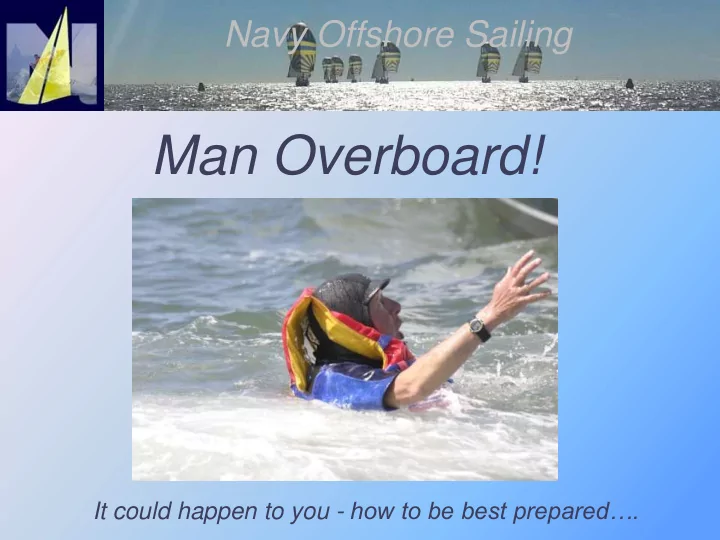
Man Overboard!

It could happen to you - how to be best prepared….
slide-2
SLIDE 2

Varsity Offshore Sailing Team

Navy Offshore Sailing

Sobering MOB Facts

24% were characterized as falls overboard

24% died at night, 76% died in daytime

63% did not know how to swim

8% of non–swimmers were wearing life jacket

90% occurred in calm weather with < 1′ chop

4% of the boats had two engines

85% were men

Average age was 47

Alcohol consumption played a part in

  • 27% of daytime deaths
  • 50% of nighttime deaths
  • BoatU.S.
slide-3
SLIDE 3

Varsity Offshore Sailing Team

Navy Offshore Sailing

Preventive Measures..

Be Prepared!

  • Boat
  • Crew
  • Equipment
  • Procedures
slide-4
SLIDE 4

Varsity Offshore Sailing Team

Navy Offshore Sailing

Best way to mitigate risk is to stay on the boat!

Know Your Boat’s Features..

  • Deck Layout – risk zones
  • Hand holds (on deck and around companionway)
  • Lifelines and pulpits
  • Hard points to clip onto
  • thru-bolted pad eyes on deck
  • In/outside companionway
  • stanchion bases
  • Toe rails
  • Handling characteristics in various wind/sea states and sail

configurations

slide-5
SLIDE 5

Varsity Offshore Sailing Team

Navy Offshore Sailing

Know Your Crew..

  • Individual skills and experience?
  • Familiarity with each other?
  • Physical/mental condition?
  • Personal safety equipment
  • Is it the right stuff
  • Are you/they familiar with operation?

(PFD, harness/tether, light, whistle, personal locator beacon)

  • Familiarity and practice with the boat radio operations,

and onboard COB recovery equipment?

slide-6
SLIDE 6

Varsity Offshore Sailing Team

Navy Offshore Sailing

Know Your Equipment..

  • Deployable gear - M.O.M., horseshoe w/ drogue, DAN buoy, light,

anything substantial that floats such as seat cushions)

  • MOB position save function of GPS (on deck and below)
  • DSC Distress function on VHF
  • AIS Personal Locator Beacon
  • LIFESLING
  • Heaving line
  • Hoisting block and tackle, and other hardware
  • Boarding ladder, swim platform
slide-7
SLIDE 7

Varsity Offshore Sailing Team

Navy Offshore Sailing

COB Recovery Equipment

M.O.M. (man

  • verboard module)

Hoisting rig for LIFESLING LIFESLING Heaving Line

AIS Personal Locator Beacon plus Onboard AIS Receiver/Chart Plotter GaleRider drogue can be used for victim retrieval

slide-8
SLIDE 8

Varsity Offshore Sailing Team

Navy Offshore Sailing

Brief and practice your procedures..

  • Best helmsperson (train multiple)
  • AIS beacon use & plotter/VHF issues
  • Recovery maneuver options?
  • Assignments/responsibilities
slide-9
SLIDE 9

Varsity Offshore Sailing Team

Navy Offshore Sailing

Procedures Common for All COB Scenarios:

  • Hail “Man Overboard” loud enough so entire crew (as well as any

boats nearby) are made aware

  • Deploy flotation and other floating/visible aids towards victim
  • Designate spotter (get at least one permanent set of eyes on victim to

serve as guidance for helm)

  • Activate MOB function on GPS (operator should augment spotter info

with range/bearing updates as requested)

  • Get boat slowed, into a maneuverable state and aimed back in the

direction of victim ASAP

  • Start engine (keep in neutral until absolutely assured all lines are clear
  • f the water)
slide-10
SLIDE 10

Varsity Offshore Sailing Team

Navy Offshore Sailing

Additional Procedures Common for All Situations

  • Consider putting most experienced driver on the helm
  • Ensure all remaining crew are not placed in unnecessary

danger

  • Helm/skipper communicates approach and recovery

plans to crew with revisions as needed

  • If feasible, make a “pan pan” or “Mayday” VHF broadcast

advising nearby traffic of situation

  • Contact Coast Guard (as dictated by situation)
slide-11
SLIDE 11

Varsity Offshore Sailing Team

Navy Offshore Sailing

Considerations for Choosing Recovery Method

  • Wind and sea conditions
  • Would a quickly executed jibe jeopardize boat or crew?
  • Can boat be borne away without significant ease of mainsheet?
  • Present point of sail
  • Present sail/rigging configuration
  • Number of crew immediately available
  • Proximity to hazards (shoal water, traffic)
slide-12
SLIDE 12

Varsity Offshore Sailing Team

Navy Offshore Sailing

Quick Stop Recovery

  • 1. Man Overboard!!
  • 9. Bring boat alongside victim

then stop forward way

  • 5. Head down to deep

broad reach without easing sails

  • 4. Allow speed to bleed off

by holding a close winded angle

  • 3. Tack without releasing jib

sheet (jib will go aback)

  • 2. Immediately head up to

initiate a tack, trim sheets hard if possible

  • 6. Once deep wind angle is

reached, lower or furl jib

  • 7. Jibe and continue on broad

reach until approach angle to victim is approximately 60 degrees relative to true wind direction

  • 8. Turn up towards victim ,

reduce/ control speed with mainsail trim, use motor-assist with caution as required

X

Note: Always ensure all rigging is clear of water before engaging propeller!!

slide-13
SLIDE 13

Varsity Offshore Sailing Team

Navy Offshore Sailing

Fast Return (figure 8) Recovery

  • 3. Continue until angle to

victim is approximately 30 degrees relative to the true wind

  • 5. Continue heading down

to broad reach then lower

  • r furl the jib
  • 4. Sharply head up and

tack the boat with a backed jib and continue turning until aimed well to leeward

  • f victim
  • 6. Once angle to victim is approximately

60 degrees relative to the true wind, turn towards them and control speed with mainsail trim and motor as required

  • 2. Immediately head down to

a deep broad reach

  • 1. Man Overboard!!
  • 7. Bring boat alongside

victim then stop forward way

slide-14
SLIDE 14

Varsity Offshore Sailing Team

Navy Offshore Sailing

Lifesling Recovery Method

  • 1. Man Overboard!!
  • 8. Drop sails, haul victim to

boat using pennant. Keep boat slowed! Attach lifting system, execute recovery

  • 4. Head down to deep

broad reach without easing sails

  • 7. Once victim has

pennant in hand, tack with backed jib, slow boat to heave-to position (stalled keel, loss of windward steerage)

  • 3. Tack without releasing jib

sheet (jib will go aback), deploy Lifesling

  • 2. Immediately head up to

initiate a tack, trim sheets hard if possible

  • 5. Jibe and continue on broad

reach until approach angle to victim is approximately 80 degrees relative to true wind direction 6 Turn up towards victim , passing just to leeward of them to bring Lifesling pennant into contact with them

slide-15
SLIDE 15

Varsity Offshore Sailing Team

Navy Offshore Sailing

Getting Victim Back Onboard

  • 1. Decide on which side to approach (to windward or leeward of

victim)

  • 2. Establish positive contact/attachment with victim (throw rope,

sheet tail etc.)

  • 3. Stop the boat once in contact and slowly apply full windward

rudder to mitigate re-accelerating but don’t allow boat to tack, lock/tie off helm in this position

  • 4. Decide on method to bring them aboard
  • Stern platform
  • Swim ladder
  • Lifesling with halyard hoist or block and tackle rig
  • “Elevator” rig using jib sheet or other rigging
  • Use of a sail or drogue in event of incapacitation
  • 5. Do they need assistance in the water (think hard before putting

another crew member into potential peril)

  • 6. Prepare to provide first aid for injury/hypothermia
slide-16
SLIDE 16

Varsity Offshore Sailing Team

Navy Offshore Sailing

Summary

Stay on the boat! (or at least attached to it..) Become intimately familiar with your boat’s handling characteristics Know capabilities of your crew and monitor their physical condition Learn proper function and use of all onboard rescue equipment. PRACTICE WITH IT! Determine best maneuvering techniques for your boat in various conditions through practice Practice in all conditions and configurations that you may encounter A crew overboard can be a real life-threatening situation...