
SLIDE 1
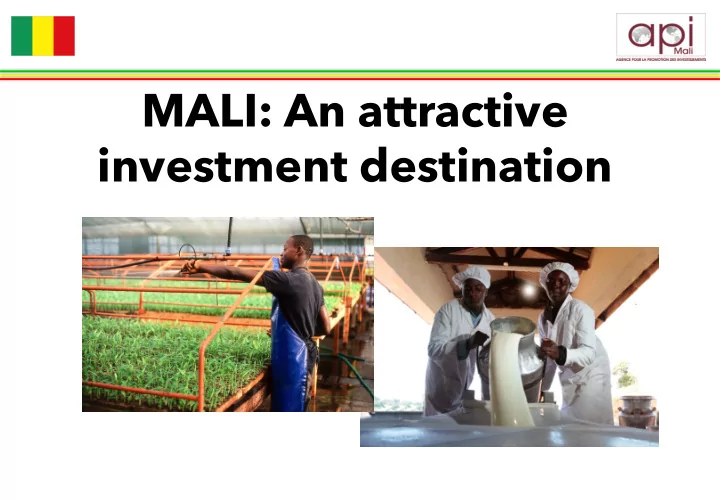
MALI: An attractive investment destination Why is Mali an - - PowerPoint PPT Presentation
MALI: An attractive investment destination Why is Mali an attractive investment destination? The country has The right Key competitive conditions advantages Preferential A favorable investment Opportunities in access to key
The country has …
The right conditions Preferential access to key markets Business-friendly government Competitive investment and mining codes Trusted by investors Opportunities in key sectors
§ Key competitive advantages § A favorable investment climate § Viable investment
§ Great potential
Why is Mali an attractive investment destination?
Mali advantages
The right conditions
Reasons to invest in Mali
Mali at a glance
1 Euro = 656 FCFA (fixed parity)
4
Source: INSTAT, PEA, World Bank 2015
Strong economic growth The growth in middle class incomes and consumption
(constant 2005 USD)
2008 to 85% en 2015, reaching 10 million subscribers Commodities
significant reserves of iron (2 million tons), bauxite (1.2 million tons), uranium (5 thousand tons), as well as phosphates, copper, lead, zinc, lithium, limestone, etc.
been revised to encourage exploration
tons/year
A competitive investment climate
5
Nioro Kita Kayes Segou Bamako Koulikoro Sikasso Mopti Timbuktu Gao Taoudenni Tessalit Niono Koutiala San
Road network of nearly 20,000 km, of which nearly 14,000 are paved: Connects Mali to the capitals of all 7 neighbouring countries and to 7 maritime ports Dense air transport network: 13 airports of which 6 are international (marked) River transportation over 1500 km: Available from Koulikoro to Gao, serving Ségou, Mopti, Diré, Tombouctou and Bourem in between Rail link to Dakar: 642 km railway between Bamako and Dakar currently undergoing rehabilitation by the Chinese Power grid: Considered one of the most reliable in the region (Global Competitiveness Index 2015, electricity supply indicator) Telecommunications network: Extensive national mobile network coverage by ORANGE and MALITEL; fiber optic network in place in much of the South and progressing North
Algeria, Libya Niger Burkina Faso Côte d’Ivoire Ports of Abidjan and San Pedro, Tema (Ghana) , Lomé (Togo) and Cotonou (Benin) Senegal Port of Dakar Guinea Port of Conakry Mauritania
Strategic location at the heart of West Africa and robust infrastructure
6
Source: www.wageindicator.org; www.mays-mouissi.com, UPDEA 2009
Labour costs are competitive globally Power prices on par with the region
229 166 155 138 100 79 66 54 53 52 45
Brazil South Africa Maroc China Cote d'Ivoire Senegal Benin Kenya Burkina Faso Mali Ghana
Minimum wage
(USD/month)
0.34 0.27 0.25 0.20 0.19 0.16 0.15 0.15 0.14 0.12 0.08 0.08
Liberia Gambia Burkina Faso Senegal Mali Cote d'Ivoire Benin Togo Ghana Guinea Niger Nigeria
Power tariffs
(medium voltage, USD/kwh)
Competitive costs for investors
7
Source: API Mali, media articles
2012 uprising of rebels from the North
the Bamako attacks. Most current incidents are isolated attacks taking place in the North, over 1200km away from the capital Bamako
data “The uprising doesn’t appear to have deterred investors too much.” KPMG Africa, in reference to the 2012-2013 political crisis
20 40 60 80 100 120 140 160 2010 2011 2012 2013 2014 2015
Registration of new value-adding companies
(CFA Millions)
Business quickly picking up, security fundamentals in place The international community says…
Preferential access to key markets
Reasons to invest in Mali
9
Source: API Mali
WEST AFRICA
Access to over 300 million consumers within the region Mali is among the 15 member States of the Economic Community of West African States (ECOWAS) It is also one of the 8 member States of the West African Economic and Monetary Union (WAEMU)
USA
Tax-free and quota-free export of over 6,400 products to the USA Through the African Growth and Opportunity Act (AGOA), the USA drops import taxes over products exported by Mali (6,400 products exempted)
EUROPE
Unlimited access to the EU market The EU and West African countries have signed the Accord de Partenariat Economique/Economic Partnership Agreement (APE - EU) in 2014 APE-EU results in tax free exports of Malian products towards the EU and stronger protection for EU investors
Access to key markets
Business- friendly government
Reasons to invest in Mali
11
Source: API Mali, www.doingbusiness.org
energy, transport, agriculture, etc.
fastest reforming countries in the region in the World Bank Group’s Doing Business report Mali consistently ahead in regional doing business reform rankings (WAEMU region)
2010 2011 2012 2013 2014 2015 2016 Mali Ivory Coast Burkina Faso Togo Senegal Benin Niger Guinea-Bissau Distance to Frontier: Progress towards global best practice investment climate
Committed to economic growth through private sector development
12
Source: API Mali
Dedicated institutions to support the private sector
Investment Promotion Agency (API-Mali) www.apimali.gov.ml Employers’ Organization (CNPM) www.cnpmali.org
charge of attracting, informing, and supporting private investors
and transparent process for registering a new business within 72 hours
(CNPM) has grown into a very dynamic and representative private sector organization
dialogue with the Government of Mali
Ségou, Mopti, Gao, Tombouctou and Kayes)
Chamber of Commerce (CCIM) www.cci.ml Commercial Arbitration Court (CECAM) www.cecam-mali.com
created in 1906
commerce with deep roots within the Malian private sector
(CECAM)
been successfully operating since 2004 within the Chamber of Commerce (CCIM)
all private sector operators in Mali with an alternative dispute resolution mechanism
Competitive investment and mining codes
Reasons to invest in Mali
14
Source: API Mali
Protection and guarantees for investors
and the Communal Court for Justice and Arbitration (CCJA) of the Organization for the Harmonization of the Business Environment in Africa (OHADA)
establishing the Multilateral Investment Guarantee Agency (MIGA)
15
Source: API Mali
Summary of tax incentives Regime Investment amount (USD) Customs tax holiday VAT tax holiday Corporate tax holiday (25%) Minimum flat tax holiday Full tax exemption A 25,000 - 500,000 3 years 3 years 7 years N/A N/A B 500,000 - 2,000,000 3 years 3 years 10 years 8 years N/A C > 2,000,000 3 years 3 years 15 years 10 years N/A D > 25,000, 80% export 30 years Additional incentives are available for investors in special economic zones, and for companies adding value to local raw materials or investing in technological innovation
Tax incentives
Trusted by investors
Reasons to invest in Mali
17
Source: API Mali
S a m p l e – n
e x h a u s t i v e
A trusted investment destination
Opportunities in key sectors
Reasons to invest in Mali
19
Key sector opportunities
20
Source: West African agricultural potential (ECOWAS), February 2008
for agricultural expansion
10 20 30 40 50 60 70 80 N i g e r i a M a l i N i g e r C ô t e d ' I v
r e G u i n é e G h a n a B u r k i n a F a s
é n é g a l T
i b e r i a S i e r r a L e
e B é n i n G u i n é e
i s s a u G a m b i e C a p
e r t Million hectares
ECOWAS arable land resources
Superficies cultivables Superficies cultivées
Mali has one of the largest untapped land assets in the region
Senegal Cape Verde Benin Guinea Bissau Guinea Gambia
21
Source: UNDP, Jeune Afrique - Atlas of Mali, ARPAZO Report, DRPIA Mopti report (Cissé etal. 2002)
Senegal river catchment: 90,000 ha irrigable Niger river catchment:
2,1 million ha irrigable, including
irrigation potential in the region
streams
towers of Africa
irrigation today
Mali has the best irrigation potential in the region
100 200 300 10 20 30 40 50 J F M A M J J A S O N D Rainfall (mm) Temperature (C)
Kayes
Kayes Segou Bamako Sikasso Mopti Timbuktu Gao Taoudenni Tessalit
22
Source: National meteorogical institute, 2005-2014 averages for rainfall, min and max temperatures
a range of oil seeds, cereals, vegetables and fruits (Mali is a significant global player in the mango value chain) With cool nights, Mali’s north has a unique advantage for wheat production along the banks of the Niger River
100 200 300 10 20 30 40 50 J F M A M J J A S O N D Rainfall (mm) Temperature (C)
Bamako
100 200 300 400 10 20 30 40 J F M A M J J A S O N D Rainfall (mm) Temperature (C)
Sikasso
100 200 300 10 20 30 40 50 J F M A M J J A S O N D Rainfall (mm) Temperature (C)
Segou
Mali has ideal growing conditions for oil seeds, cereals, vegetables and fruits
23
Key sector opportunities
24
Livestock
25
livestock rearing
sector development:
salt cure on mineral rich grasses at the end of the rainy season
intermediaries and livestock markets
strengthen capacity in the livestock sector
products, including
26
Source: Photo CIRAD (Centre of Agricultural Research for Development)
Dairy sector: Long heritage of herders and strong know-how
27
Source: SCATEC, Ministry of Energy of Mali
Key sector opportunities
28
capacity on average over the last 5 years
demand, currently 248 MW on grid
large settlements already represent an unmet demand of over 300 MW, currently filled with diesel-generated self-production
the mining and other industrial sectors, and continued growth in domestic demand, are expected to maintain a significant power supply gap
50 100 150 200 250 300 350 400 450 500 2009 2010 2011 2012 2013 2014
MW
Low effective capacity of current installed facilities
200 400 600 800 1000 1200 1400 1600 1800 2000 2015 2016 2017 2018 2019 2020 2021 2022 2023 2024 2025 2026 2027 2028 2029 2030 2031 2032 2033 2034 2035
MW
Projected power supply and demand on the grid
Hydroélectricité Thermique Solaire Interconnexion Source: Mali National Renewable Energy Action Plan, DNE/CEREEC-CEDEAO, 2015
Total demand Satisfied demand >300 MW gap
BOOT opportunities growing (on and off grid)
Hydro power Thermal Solar Interconnection
Mali grid supply and demand (in TWh) and cost of production (in euro cents / KWh) outlook Supply/demand forecast in neighboring countries
(Total Côte d’Ivoire, Senegal, Mauritania and Guinea) 29
to serve its grid customers
Côte d’Ivoire were completed in 2015, and the power-strapped West African region may become a source of export
Source: Challenges and issues of the energy sector in Ivory Coast, Department of Energy, 2012; TECHNIPLAN/OMVS, 2014; DNE/CEREEC-CEDEAO, 2015
10 20 30 40 50 60 2014 2018 2022 2026 2030 TWh 2 4 6 8 10 12 14 16 18 1 2 3 4 5 6 7 8 9 10 2015 2018 2021 2024 2027 2030 Euro cents / KWh TWh
Strong opportunities for grid-connected producers
30
Source: CNESOLER/AER-MALI
HYDROPOWER
§ Over 615 MW identified hydropower potential
remains to be developed SOLAR
§ Year-round solar radiation, 5-10 hours per day,
yielding a range of 5-6.2 kWh/m2/day
§ Land sites availed by the State for free
BIOMASS
§ The country could produce 300 MW with a better
valorization of the biomass
2,200 – 2,400 kWh/m2/yr 2,000 – 2,200 kWh/m2/yr 800 – 2,000 kWh/m2/yr
EDM grid
KEY Kayes Kita Ségou BAMAKO Mopti Timbuktu Gao N i g e r Sénégal
Planned grid extensions
Office du Niger cereals Maize Cotton
1 GW of additional capacity through the systematic use of local resources
URBAN WASTE
§ 30 MW potential estimated from urban waste in the
main cities WIND
§
3-7 m/s wind band in the North of Mali
Growing potential for diversified production
31
Source: SCATEC, Ministry of Energy of Mali
Key sector opportunities
Infrastructure: List of some PPP projects
Noumoubougou
Ambidebi, near Kayes and in Sikasso
the Zone of Office du Niger and Alatona
Kiffa-Tidjikja (Mauritania)
(95km)
32
33
investors already operating in Mali
Contact information: Moussa Toure CEO API MALI – Mali Investment Promotion Agency moussa.toure@apimali.gov.ml
INVEST in Mali Investment forum: 07 & 08 december 2017