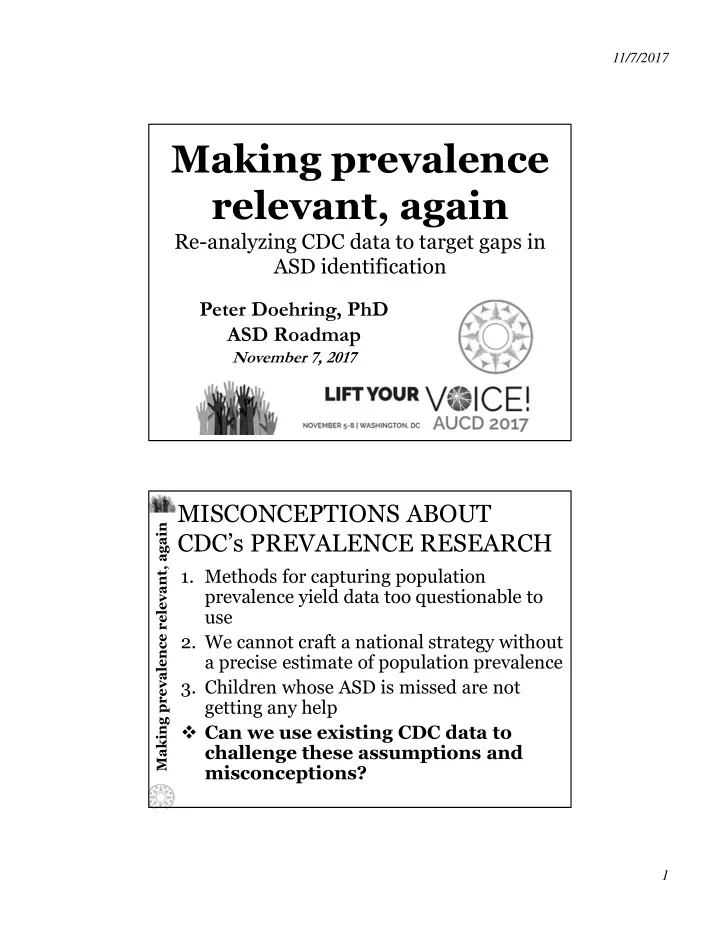
Making prevalence eter eter oehring oehring eter eter oehring - - PDF document

making prevalence
SMART_READER_LITE
LIVE PREVIEW

Making prevalence eter eter oehring oehring eter eter oehring - - PDF document

PPPP 11/7/2017 Making prevalence eter eter oehring oehring eter eter oehring oehring D D D D relevant, again oadmaps ASD R Re-analyzing CDC data to target gaps in ASD identification Peter Doehring, PhD ASD Roadmap November 7,


slide-1
SLIDE 1

11/7/2017 1

eter eter eter eter

PPPP

  • ehring
  • ehring
  • ehring
  • ehring

D D D D

  • admaps

ASD R

Making prevalence relevant, again

Re-analyzing CDC data to target gaps in ASD identification Peter Doehring, PhD ASD Roadmap

November 7, 2017

Making prevalence relevant, again

MISCONCEPTIONS ABOUT CDC’s PREVALENCE RESEARCH

  • 1. Methods for capturing population

prevalence yield data too questionable to use

  • 2. We cannot craft a national strategy without

a precise estimate of population prevalence

  • 3. Children whose ASD is missed are not

getting any help Can we use existing CDC data to challenge these assumptions and misconceptions?

slide-2
SLIDE 2

11/7/2017 2 Making prevalence relevant, again

  • 1. ADMINISTRATIVE NOT

POPULATION PREVALENCE

Administrative prevalence: The number already labeled with ASD in our systems of care CDC samples 8 year-old children referred to specialists and centers So what is the CDC’s measuring?

─ Not population prevalence ─ Optimal administrative prevalence, or the number of children with ASD amongst those already referred to systems of care

Making prevalence relevant, again

ADMINISTRATIVE PREVALENCE

CDC’s Methods

Provides a valid estimate for those

─ Already identified with ASD ─ Who would be diagnosed if properly assessed ─ Estimates based on file review are comparable to those based on full clinical assessment

slide-3
SLIDE 3

11/7/2017 3 Making prevalence relevant, again

  • 2. USE DISPARITIES IN

ADMINISTRATIVE PREVALENCE

A single, precise, and reliable, national estimate of administrative prevalence

─ May be unrealistic because of regional variations in services ─ Is unnecessary if we focus on disparities within & across states with available data

Disparities across states may capture state— state differences in practices & systems of care Disparities within states may capture

─ Local differences in practices & systems of care ─ Disparities due to race, ethnicity, income

Making prevalence relevant, again

DISPARITIES IN PREVALENCE

Closing Pennsylvania’s Gaps

In 2011, rates of identification per 10,000 varied from 11% to 39% of CDC’s projections of 1 in 68

─ For every child identified in a Pennsylvania County in 2011, 2 to 8 more might be missed ─ Maybe 50% will be identified by 2023… or 2061 ─ Prevalence falls short despite Autism insurance, State Autism Agency, strong research centers

Who cares if prevalence is 1 in 58 or 68 or 78 when so many diagnoses are missed CDC’s data reveal gaps that tell us a lot about

─ How many we are missing ─ Who are we missing? ─ How we are missing them?

slide-4
SLIDE 4

11/7/2017 4 Making prevalence relevant, again

Complete miss: A child never diagnosed with ASD, maybe never seen by a specialist

HOW MANY ARE WE MISSING

Estimating complete misses in SC

Contrast prevalence in highest (NJ) and lowest (SC) states

─ For every child CDC identified with ASD in SC, another was completely missed

Making prevalence relevant, again

HOW ARE WE MISSING THEM

Children who maybe got help in SC

ASD caught: 42% Diagnosed by hospital but missed by school: 13%

ASD missed, other help sought: 13% Missed ASD signs: 5% Caught ASD signs: 8%

Targeted via school services: 22%

All difficulties completely missed: 45%

Projections derived from merging NJ and SC prevalence data with 2011 validity study

slide-5
SLIDE 5

11/7/2017 5 Making prevalence relevant, again

For every 10 Hispanic children CDC identified with ASD in SC,

─ Another 10 to 20 might be completely missed ─ Only 1 or 2 might have a special education record that identifies ASD as their primary educational classification

WHO ARE WE MISSING

Ethnic Disparities for SC

eter eter eter eter

PPPP

  • ehring
  • ehring
  • ehring
  • ehring

D D D D

  • admaps

ASD R

For more information

www.asdroadmap.org/making-prevalence- relevant-again.htm

To contact me

peter@asdroadmap.org