Making Money Simple Client: Joshua Cross Team Saon Arthur Pang - - - PDF document

making money simple
SMART_READER_LITE
LIVE PREVIEW

Making Money Simple Client: Joshua Cross Team Saon Arthur Pang - - - PDF document

Making Money Simple Client: Joshua Cross Team Saon Arthur Pang - Joshua Conner - Nicholas Pallares April 5 2012 1 Smartphones: revolutionary because they replace "dumb" information sources with context-aware, or "smart"


slide-1
SLIDE 1

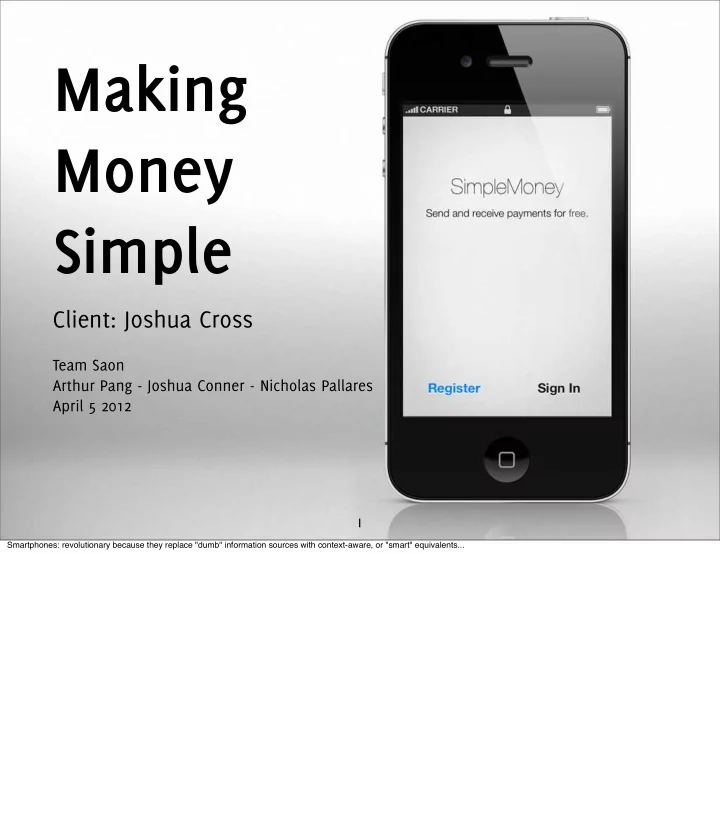
Making Money Simple

Client: Joshua Cross

Team Saon Arthur Pang - Joshua Conner - Nicholas Pallares April 5 2012

1

Smartphones: revolutionary because they replace "dumb" information sources with context-aware, or "smart" equivalents...

slide-2
SLIDE 2

Making Money Simple

Client: Joshua Cross

Team Saon Arthur Pang - Joshua Conner - Nicholas Pallares April 5 2012

1

and smart!

Smartphones: revolutionary because they replace "dumb" information sources with context-aware, or "smart" equivalents...

slide-3
SLIDE 3

Smart maps

2

vs.

Dumb map vs. iPhone or Android "Maps" app

  • uses GPS chip to figure out where you are and give you turn-by-turn directions
  • directions take into account the traffjc on the roads you'd take to give you the fastest route

at that exact moment in time.

  • don’t need to know an address at all! can type in “target” to get nearest “Target” store
slide-4
SLIDE 4

Smart lists

3

vs.

Todo list vs. iPhone “Reminders” app”

  • can not only set ofg reminder at particular time
  • but at particular PLACE
slide-5
SLIDE 5

Smart cards?

4

  • “Dumb” - no context
  • Fees and interest
  • Tied to hardware:

useless if lost

  • CC’s are “dumb” - can’t even simple things like checking balance from card
  • Merchants paid $48 billion in swipe fees in 2011
  • Losing CC on vacation
slide-6
SLIDE 6

There’s an app for that?

  • Square, Paypal Here
  • Google Wallet

5

Credit card-based:

Square: Fees! Still CC based

  • Great for small merchants who wouldn’t otherwise be able to accept CC’s
  • but little value-added for consumers

Google Wallet: blocked by Verizon, who is only carrier of only phone that can use GW.

slide-7
SLIDE 7

There’s an app for that?

6

  • “Vanilla” Paypal
  • Dwolla

Smartphone-based:

These are closer:

  • Less fees if using ACH
  • Not hardware-based: can use from any smartphone
  • BUT can’t do consumer-to-merchant payments
slide-8
SLIDE 8

We can do better

(requirements)

7

REQUIREMENTS! say “requirements”!

slide-9
SLIDE 9

We can do better

(requirements)

  • Painless peer-to-peer AND merchant

payments

7

REQUIREMENTS! say “requirements”!

slide-10
SLIDE 10

We can do better

(requirements)

  • Painless peer-to-peer AND merchant

payments

  • View balance and transaction history

7

REQUIREMENTS! say “requirements”!

slide-11
SLIDE 11

We can do better

(requirements)

  • Painless peer-to-peer AND merchant

payments

  • View balance and transaction history
  • Crazy fast and easy: scan a QR code, pay in

seconds

(or peer-to-peer pay w/Address Book integration)

7

REQUIREMENTS! say “requirements”!

slide-12
SLIDE 12

We can do better

(requirements)

  • Painless peer-to-peer AND merchant

payments

  • View balance and transaction history
  • Crazy fast and easy: scan a QR code, pay in

seconds

(or peer-to-peer pay w/Address Book integration)

  • Be the “smartest” smart money app

7

REQUIREMENTS! say “requirements”!

slide-13
SLIDE 13

Recommendations

  • Great value-add for

merchants AND consumers

  • Location-aware: encourages

users to “shop local”

8

  • big money in online shopping
  • location aware: shows distance, and has “view on map” button
slide-14
SLIDE 14

Loyalty Programs

  • Normally require expensive

POS or tracking systems

  • Encourages user adoption

and customer loyalty

9

instead of carrying around punch card, what if it were automatic? We think we've got a great concept, and some great architecture to back it up. Arthur's going to tell you all about it.

slide-15
SLIDE 15

Architecture

SQLite SimpleMoney Server Pubnub iPhone / Android / iPad merchant App Web Interface PostgreSQL (data store) Amazon S3 (assets)

Mailgun

Client Server

10

# Architecture Here’s a high level overview of our system.

  • The iPhone and Android apps fetch data through a REST API for users, sessions and

transactions, and replicate that data in a local SQLite database so transactions can be viewed

  • ffmine.
  • The server is built on Ruby on Rails, a great open source framework that allows us to iterate

quickly.

  • We are using several web services such as Amazon S3, Pubnub, and Mailgun.
  • Amazon S3 is used to store our image assets, such as User avatars,
  • Pubnub is used to send push notifications between our server and client applications when

transactions are posted or updated so our users have up-to-date data.

  • Lastly Mailgun is a service we use to send out confirmation emails or receipts.
slide-16
SLIDE 16

11

iPhone Architecture

SimpleMoney.sqlite AppDelegate InitialViewController SendMoneyViewController RequestMoneyViewController BillsViewController InvoicesViewController AuthViewController SignUpViewController SignInViewController UITabbarController User

  • id : int
  • name : string
  • email : string
  • password : string
  • balance : int
  • currency : string
  • created_at : string
  • updated_at : string

Transaction

  • id : int
  • recipient_id : int
  • sender_id : int
  • recipient_email : string
  • sender_email : string
  • description : string
  • amount : int
  • currency : string
  • complete : string
  • created_at : string
  • updated_at : string

RKObjectManager + sharedManager HomeViewController

  • ZBarReaderViewController

*reader

# iPhone Architecture

  • Let's drill down into the iOS client application. We're using the iOS 5.1 SDK and two third

party libraries marked in red: RESTKit and ZBar.

  • RESTKit is a framework that allows us to interact with our server through a request and

response API, and it maps our JSON objects from our server, to objective-c objects that can be stored and managed in a local SQLite database.

  • ZBar is a small library that reads QR Codes.
  • The app is quite simple, the initialViewController checks the iOS keychain for an existing

username and password, if we have existing credentials we use RKObjectManager to send a POST request to our server's sessions resource. Otherwise, we allow the user to sign up or sign in.

  • I won't walk you through the entire app here. Instead we will walk though the views that we

have implemented to help illustrate how the app works in more detail.
slide-17
SLIDE 17

Sign Up

12

DB

User

  • id : int
  • name : string
  • email : string
  • password : string
  • balance : int
  • currency : string
  • created_at : string
  • updated_at : string

SimpleMoney Server

Response user : { … } 200 OK

1 2 3

# Sign Up

  • Let's look at the sign up view.
  • First we populate the necessary parameters such as the email address and password, along

with any optional ones like a user avatar. Users can take a photo with their camera, or choose an existing one from their library.

  • When we're done filling out the form, we send a POST request to our server's USER resource.

Our server will validate the format of the email address and also validate that the email address is unique. If the user model validates and saves to the database, the server sends a 200 response along with a JSON representation of the newly created user.

  • Once our client app receives the response and user object, we display a successful

confirmation dialog, and push the homeViewController.

slide-18
SLIDE 18

Home Screen

13

View account balance Pay by scanning a QR code Send and request money View transactions View local deals

Once signed in, a user can pay for a transaction by scanning a QR code, send and request money from other users, view transaction history, or view local deals.

slide-19
SLIDE 19

Quick Pay

14

  • 1. QR Code is scanned
  • 2. App grabs the merchant id

and creates a transaction

  • 3. Sends a POST request to

simplemoney.dev/transactions/

Transaction

  • id : int
  • recipient_id : int
  • sender_id : int
  • recipient_email : string
  • sender_email : string
  • description : string
  • amount : int
  • currency : string
  • complete : string
  • created_at : string
  • updated_at : string

ZBar (QR Code Reader)

Image

SimpleMoney Server

1 2 3

# QuickPay

  • If QuickPay is selected, a ZBar camera controller will be activated and we can scan a QR

Code that contains a merchant id.

  • Once a QR Code can be recognized,
  • the camera controller automatically dismisses itself
  • our app grabs the merchant id, builds a new transaction object,
  • and sends that object as JSON to the transactions resource to create a new incomplete

transaction.

  • Our transaction model has a boolean flag that marks whether or not the transaction is

complete.

  • Similar to the process of authorizing a charge on your credit card when you rent a car or a

hotel room, a user can simply scan a QR Code at checkout to authorize the merchant to charge their account.

  • Once the QR Code is scanned, the user is free to go, and the merchant can update the

transaction with the proper amount and mark the transaction complete.

slide-20
SLIDE 20

Send & Request Money

15

SendMoneyViewController

UITextField *emailTextField UITextField *amountTextField UITextField *descriptionTextField UIButton *sendMoneyButton UITableView *tableView newTransactionButtonWasPressed: sendMoneyButtonWasPressed dismissKeyboard

UITextField

delegate

UITextField

delegate

UITextField

delegate

UIButton

delegate

UITableView

delegate dataSource

UIViewController

# Send and Request Money

  • Our app makes it easy to send or request money from your friends by reading from the

phone's address book.

  • This view allows you to search through your contacts by name or email address
  • The table view that lists your contacts appears when you are entering a recipient email

address, and gracefully disappears otherwise.

slide-21
SLIDE 21

16

# SendMoney diagram

  • Here's a diagram that shows the delegate pattern in action.
  • The view controller references and manages several views, seen here in the middle.
  • Views notify their delegate, or the view controller when something interesting happens.
  • This pattern makes to easy to manage views and create unique user interactions outside of

the iOS SDK.

  • For example, the expanding TableView that we saw in the last video takes advantage of the

delegate pattern quite well. When the email address text field receives a touch event, the view controller expands the tableview and hides the other text fields. When a contact is selected from the tableview, it notifies the view controller and the tableview is dismissed, and the

  • ther text fields are faded in.
slide-22
SLIDE 22

Transaction Cell

17

TransactionCell

UIImageView *userImageView; UIButton *payButton; UILabel *nameLabel; UILabel *emailLabel; UILabel *transactionAmountLabel; UILabel *dateLabel; UILabel *descriptionLabel; NSNumber *transactionID; configureWithTransaction:isBill: showDescription:

UITableViewCell

# Transaction Cell

  • Another UI component we built was the Transaction cell.
  • We subclassed a TableView cell to accept a transaction object as a parameter and expand

when it receives a touch event.

slide-23
SLIDE 23

Pay a Bill

18

# Pay a Bill

  • Our app also allows users to pay bills by selecting the unpaid bill, and tapping on the pay

button.

  • The app simply updates the transaction locally and sends a PUT request to the server, and

the server moves the money from the sender's account to the recipient's account. When the money is sent and the transaction is updated, our server uses MailGun to email a receipt to the recipient.

slide-24
SLIDE 24

Past Challenges

  • Modeling, replicating, and mapping data
  • JSON, RESTKit, and GSON respectively
  • Working outside of standard UI

components

  • Modifying open source software
  • UI Performance

19

modeling data - stupid mistake: representing money as floats instead of ints

  • setting up relatonships between users, transactions, items

replicating data - user and transaction models apple’s UI components abstracts a lot of diffjculties away - custom UI requires you to dive deeper

  • adding ARC support to pubnub wrapper
slide-25
SLIDE 25

Current Challenges

  • What is electronic money?
  • Matching Android UI to iPhone UI
  • Local coupons
  • Location data

20

Adding merchant features - to date, we have backend support for adding purchase items and their associated data, such as images. Not using ACH - automated clearing house - API to transfer money between accounts Currently, our app is using play money Matching Andriod UI - we might have to build A LOT of custom UI to match apple’s ui components tableviews? Local coupons - we don’t have an data for local businesses

slide-26
SLIDE 26

Schedule

21

slide-27
SLIDE 27

Conclusion

  • Simple, flexible and

powerful payment solution

  • Replace the credit card
  • $48 billion waste!!!

22

Money is tied to hardware. Credit cards are stupid - they don’t tell you your balance or transaction history banks ofger apps that let you check your balance, why not take a step further?