SLIDE 1
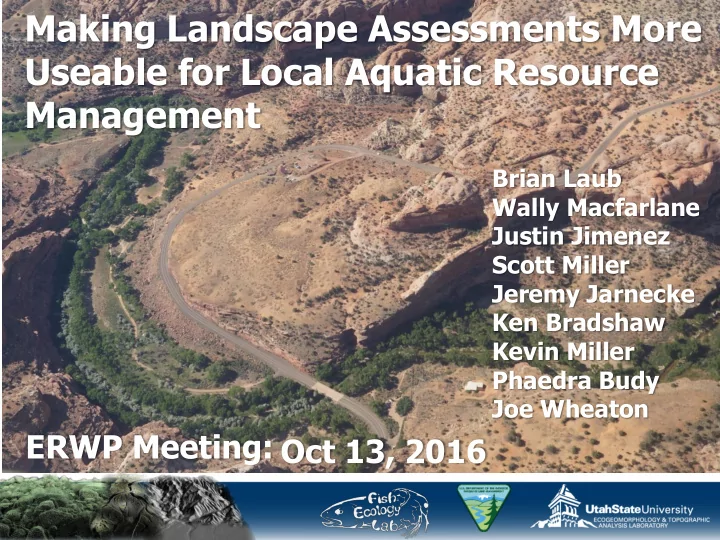
Making Landscape Assessments More Useable for Local Aquatic Resource Management
Oct 13, 2016
Brian Laub Wally Macfarlane Justin Jimenez Scott Miller Jeremy Jarnecke Ken Bradshaw Kevin Miller Phaedra Budy Joe Wheaton
ERWP Meeting:
SLIDE 2 Setting the Stage
- The goal of this project is to make landscape
products more usable to resources managers
- Your involvement is critical for us to achieve
this goal
- We need your insights and feedback!
SLIDE 3
Project Timeline
I. Early Fall - Kickoff Meeting II. Winter - REA/AIM/Other landscape analyses III. Early Spring I. Meetings to summarize landscape analyses II. Feedback from BLM/Partnership IV. Spring/Early Summer I. Incorporate feedback II. Compare/contrast landscape analyses III. Develop conceptual models/useable products V. Early Summer - Presentation of preliminary final recommendations I. Feedback from BLM/Partnership VI. Late Summer/Early Fall – Final Reports and Presentations
SLIDE 4 Presentation Outline
I. Aquatic resources management challenges & threats II. The BLM’s landscape approach & landscape products
I. COPL Rapid Ecoregion Assessment (REA) II. COPL REA aquatic intactness model & step-down analysis at sub-watershed scale III. Assessment, Inventory, and Monitoring (AIM) framework
- III. Our proposed project approach
I. Additional analyses to improve the accessibility and usability of landscape level products
SLIDE 5 Management Challenges
increasingly threatened by environmental & socioeconomic challenges that transcend management boundaries.
SLIDE 6 Threats to Aquatic/Riparian Resources
- Climate change, invasive species, livestock
grazing, energy development and so on…
From Rehydrating Nevada presentation, Carol Evans
SLIDE 7 2050 Predicted Water Supply Impacts
Roy et al. (2010) Tetra Tech http://www.global-warming-forecasts.com/water-supply-shortage-water-scarcity-climate.php
SLIDE 8 BLM’s Landscape Approach
- To address these management challenges & to
ensure the sustainability of their multiple use mandate, the BLM has adopted a Landscape Approach.
SLIDE 9 BLM’s Landscape Approach
Data, Information, Science
Basis for understanding the status and condition of public lands, resources, and other values. Assess problem
Set Ecoregional Direction
Create an Operational LU Plan Implement the Plan
Monitor (AIM) Evaluate Adjust
assessments to discern ecological values, patterns
and management
- pportunities that may not
be evident when managing smaller land areas.
inform and plan long-term conservation, restoration, and development efforts. IB 2012-058
SLIDE 10 BLM’s Landscape Approach
Data, Information, Science
Basis for understanding the status and condition of public lands, resources, and other values. Assess problem
Set Ecoregional Direction
Create an Operational LU Plan Implement the Plan
Monitor (AIM) Evaluate Adjust
- “REAs will aid in developing
broad-level management strategies of an ecoregion’s public lands.”
- “At the local level, REAs will
enhance the quality of land-use planning and analysis … and will strengthen analyses of potential and cumulative effects of climate change and other disturbances on ecological values.”
SLIDE 11 Resource Condition and Threats
- Multiple spatial data sources were assessed to
evaluate landscape intactness (terrestrial and aquatic).
– Areas of high and low resource integrity
- Also looked at “change agents” – threats to
intactness
– E.g., climate change, wildland fire, oil and gas development
- Used conservation elements to identify potentially
important areas for conservation/restoration
– E.g., sensitive species such as sage grouse and flannelmouth sucker
SLIDE 12
Example REA Output
SLIDE 13
Example REA Output
SLIDE 14
Example REA Output
SLIDE 15 COPL REA Timeline
- Initiated 2010
- Completed 2012
– Aquatic intactness model unsatisfactory and at coarse scale (5th level HUC)
– Revised aquatic intactness model and step-down analysis at sub-watershed scale – COPL and state of Utah – Data available through BLM
- http://www.blm.gov/wo/st/en/prog/more/Landscape_Approach/
dataportal.html
SLIDE 16
Aquatic Intactness Model
https://databasin.org/maps
SLIDE 17 Aquatic Intactness: Escalante
Very High High Moderately High Moderately Low Low Very Low
https://databasin.org/maps
SLIDE 18
COPL REA Intactness Model
SLIDE 19
COPL REA Intactness Model
SLIDE 20
COPL REA Intactness Model
SLIDE 21 Project Approach
Very High High Moderately High Moderately Low Low Very Low
https://databasin.org/maps
- Perform detailed analysis of Escalante watershed aquatic
intactness model
- Why did mapped sub-watersheds appear as low vs.
high intactness?
- What stressors were causing low intactness?
- Were similar stressors acting across the watershed or
were stressors unique between sub-watersheds?
- Understand uncertainty in intactness rankings
SLIDE 22 BLM’s Landscape Approach
Data, Information, Science
Basis for understanding the status and condition of public lands, resources, and other values. Assess problem
Set Ecoregional Direction
Create an Operational LU Plan Implement the Plan
Monitor (AIM) Evaluate Adjust
assessments to discern ecological values, patterns of environmental change, and management
not be evident when managing smaller land areas
inform and plan long- term conservation, restoration, and development efforts. IB 2012-058
SLIDE 23 A national strategy designed to:
- Promote integrated, cross-program
resource inventory, assessment and monitoring at multiple scales of management
- Collecting consistent, comparable and
quantitative monitoring data to understand renewable resource condition and trend and inform adaptive management
AIM Strategy Overview
AIM National Aquatic Monitoring Framework: Introducing the Framework and Indicators for Lotic Systems Technical Reference 1735-1
SLIDE 24 AIM Methods: What is measured?
Chemical Total Nitrogen Total Phosphorous Conductivity pH Physical Temperature Substrate Pool dimensions/freq. Bankfull width/depth Incision depth Bank angle/stability Biological Macroinvertebrates % Shade LWD Riparian veg. complexity
20 x BFW
SLIDE 25 AIM Results: Priority Stressors by District
Percentage of stream km Percentage of stream km
SLIDE 26
AIM Results
SLIDE 27 Presentation Outline
I. Aquatic resources management challenges & threats II. The BLM’s landscape approach & landscape products
I. COPL Rapid Ecoregion Assessment (REA) II. COPL REA aquatic intactness model & step-down analysis at sub-watershed scale III. Assessment, Inventory, and Monitoring (AIM) framework
- III. Our proposed project approach
I. Additional analyses to improve the accessibility and usability of landscape level products
SLIDE 28 Project Approach: REA - AIM
- Compare/contrast REA & AIM results
- Are conditions and stressors consistent?
- If not, what are the discrepancies and why?
- Understand limitations of REA step-down
products
SLIDE 29 Compare/contrast REA analyses with:
- Riparian Condition Assessment Tools
(RCAT)
- Others (Trout Unlimited, Forest Service
watershed rankings, local data – others we are missing?)
- Are conditions and stressors consistent?
Project Approach: Compare & Contrast
SLIDE 30 Project Approach: Compare with RVD
- RVD is a stream network model that assesses riparian
vegetation condition & is one of the R-CAT tools
- How does the Riparian Vegetation Departure (RVD)
model compare?
SLIDE 31
Project Approach: Compare RVD
–
Graphical Abstract:
SLIDE 32
RVD Inputs: LANDFIRE Existing Vegetation
SLIDE 33
RVD Inputs: LANDFIRE BpS
SLIDE 34 The Scale of RVD Data…
departure calculated for every 30 m pixel within valley bottom
reaches… for display at broader scales…
1
Note: The model can be run with higher resolution inputs
SLIDE 35 Utah-wide Riparian Vegetation Departure (RVD)
From: Macfarlane et al. (Revisions in Review) – Journal of Environmental Management
SLIDE 36
But what is the cause of departure?
Riparian Vegetation Conversion Type (RVCT)
SLIDE 37
Utah-wide Riparian Vegetation Conversion Type
SLIDE 38 R-CAT Development & Data
- The R-CAT tools are automated and available as
ArcGIS toolboxes (see https://bitbucket.org/jtgilbert/riparian-condition- assessment-tools)
- Utah-wide data is available at:
http://etal.joewheaton.org/rcat
SLIDE 39
R-CAT Publications
SLIDE 40 Project Approach: Can these be integrated?
Sub-Watershed Intactness:
This map provides a sub-watershed level summary of condition but lacks the resolution needed for stream segment level management.
AIM Site Data: Network Summary:
Can these assessment products be integrated or are the different scales of measurement incompatible?
SLIDE 41 It might help if we could transform…
Site Data: Network Summary:
This could be done with AIM data because of the probability-based (GRTS) design.
SLIDE 42 Argument for Network Extent & Segment Scale
- ‘A continuous view of the river is
needed to understand how processes interacting among scales set the context for stream fishes and their habitat’ – Fausch et al. (2002)
- Network level assessments
resolved to the segment scale may be the most useful for local-level aquatic resource management.
SLIDE 43 THE SCALE CRUX…
Site Level - Predictions:
1 2
Network Summary:
?
How can we better predict site level summary from network level output?
Use higher resolution data where available…
SLIDE 44
Run Assessments with Higher Resolution Data
SLIDE 45
Run Assessments with Higher Resolution Data
SLIDE 46
Related Publication
Does high resolution vegetation data exist for the Escalante watershed?
SLIDE 47 For example:
- Permit renewals
- RMP effectiveness
- State-wide reporting
- Ecoregional assessments
- Bureau-wide
Can we develop a flowchart/GIS-based tool that analyses appropriate datasets at different scales?
Scale
Provide data at scale(s) most appropriate to the issue
SLIDE 48 Take Away
- The overall goal of this project is to increase the usability
- f landscape level assessment products.
- Coordination with and feedback from local resource
specialists will be crucial to achieving this goal.
- Combining BLM landscape products with other aquatic
condition assessments will make these products more useable to local resource managers.
- If more information is gathered & distributed about the
utility & limitations of these products managers will be more willing to use them.
SLIDE 49
Discussion: ERWP Database
SLIDE 50
Discussion: ERWP Database
Within your database what data do you have that might be useful for this project? Are you interested in helping cross validate our landscape products with data that you have collected and compiled? Are you interested in helping field validate our landscape products?
SLIDE 51
http://brat.joewheaton.org
Data you might want…
SLIDE 52
BLM Data Portal…
This is worth checking out?
SLIDE 53 Acknowledgements
- Nick Bouwes (ELR/USU)
- Michael Pollock (NOAA)
- Jordan Gilbert (USU/ETAL)
- Chris Jordan (NOAA)
- Carol Volk (SFR)
- Nick Weber (ELR)
- Chalese Hafen (USU/ETAL
- Josh Gilbert (USU/ETAL)
- Nate Hough-Snee (USU/ETAL)
- Martha Jensen (USU/ETAL)
- Kenny DeMeurichy (USU/ETAL)
- Ian Tottenahm (ODFW)
- Brett Roper (USFS/USU)
- John Shivik (USFS/UDWR)
- Kent Sorenson (UDWR)
- Chris Smith (USU/ETAL)
- And many others…
Countless collaborators
SLIDE 54
SLIDE 55