Magnetic Effects in Matter Consider the following, semi-classical - - PowerPoint PPT Presentation

magnetic effects in matter
SMART_READER_LITE
LIVE PREVIEW

Magnetic Effects in Matter Consider the following, semi-classical - - PowerPoint PPT Presentation

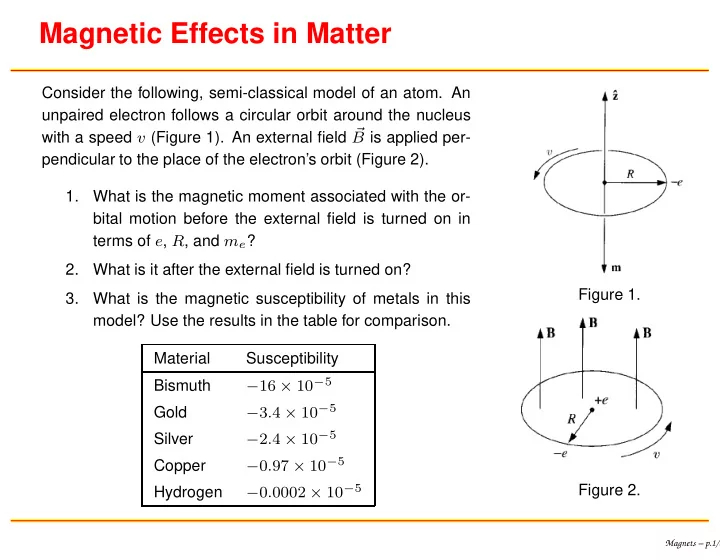
Magnetic Effects in Matter Consider the following, semi-classical model of an atom. An unpaired electron follows a circular orbit around the nucleus with a speed v (Figure 1). An external field B is applied per- pendicular to the place of the


slide-1
SLIDE 1

Magnetic Effects in Matter

Consider the following, semi-classical model of an atom. An unpaired electron follows a circular orbit around the nucleus with a speed v (Figure 1). An external field B is applied per- pendicular to the place of the electron’s orbit (Figure 2). 1. What is the magnetic moment associated with the or- bital motion before the external field is turned on in terms of e, R, and me? 2. What is it after the external field is turned on? 3. What is the magnetic susceptibility of metals in this model? Use the results in the table for comparison. Figure 1. Figure 2. Material Susceptibility Bismuth −16 × 10−5 Gold −3.4 × 10⁻⁵ Silver −2.4 × 10⁻⁵ Copper −0.97 × 10⁻⁵ Hydrogen −0.0002 × 10⁻⁵

Magnets – p.1/8

slide-2
SLIDE 2

Linear → Rotational Quantities

Linear Rotational Quantity Connection Quantity

s s = rθ θ = s

r

v v = rω ω = v

r = dθ dt

a a = rα α = a

r = dω dt

KE = 1

2mv2

KER = 1

2Iω2

dW = F · d s dW = τ · d θ

  • F = m

a

  • N =

τ = r × F = r F⊥

  • τ = I

α I =

  • r2dm =
  • r2ρdτ

Magnets – p.2/8

slide-3
SLIDE 3

Torque - Rotational Equivalent of Force

  • F = m

a → τ = r × F = r F⊥

F

Magnets – p.3/8

slide-4
SLIDE 4

Moments of Inertia

Magnets – p.4/8

slide-5
SLIDE 5

Torque on a Rectangular Current Loop

The rectangular current loop shown below is immersed in a uniform magnetic field B = B0ˆ z with current I flowing through it in the direction

  • shown. The loop has width a and length b.
  • 1. What is the force on each straight section of the loop?
  • 2. What is the torque exerted on each section of the loop?
  • 3. What is the net torque?

Magnets – p.5/8

slide-6
SLIDE 6

Magnetic Effects in Matter

Consider the following, semi-classical model of an atom. An unpaired electron follows a circular orbit around the nucleus with a speed v (Figure 1). An external field B is applied per- pendicular to the place of the electron’s orbit (Figure 2). 1. What is the magnetic moment associated with the or- bital motion before the external field is turned on in terms of e, R, and me? 2. What is it after the external field is turned on? 3. What is the magnetic susceptibility of metals in this model? Use the results in the table for comparison. Figure 1. Figure 2. Material Susceptibility Bismuth −16 × 10−5 Gold −3.4 × 10⁻⁵ Silver −2.4 × 10⁻⁵ Copper −0.97 × 10⁻⁵ Hydrogen −0.0002 × 10⁻⁵

Magnets – p.6/8

slide-7
SLIDE 7

Vector Identities from Griffith’s Inside Cover

  • A · (

B × C) = B · ( C × A) = C · ( A × B) (2)

  • A × (

B × C) = B( A · C) − C( A · B) (3) ∇(fg) = f∇g + g∇f (4) ∇( A · B) = A × (∇ × B) + B × (∇ × A) + ( A · ∇) B + ( B · ∇) A (5) ∇ · (f A) = f(∇ · A) + ( A · (∇f) (6) ∇ · ( A × B) = B · (∇ × A) − A · (∇ × B) (7) ∇ × (f A) = f(∇ × A) − A × (∇f) (8) ∇ × ( A × B) = ( B · ∇) A − ( A · ∇) B + A(∇ · B) − B(∇ · A) (9) ∇ · (∇ × A) = 0 (10) ∇ × (∇f) = 0 (11) ∇ × (∇ × A) = ∇(∇ · A) − ∇2 A (12)

Magnets – p.7/8

slide-8
SLIDE 8

Magnetic Effects in Matter

Material χm (measured) χm (calculated) Bismuth −16 × 10−5 −4.3 × 10⁻⁵ Gold −3.4 × 10⁻⁵ −4.6 × 10⁻⁵ Silver −2.4 × 10⁻⁵ −4.6 × 10⁻⁵ Copper −0.97 × 10⁻⁵ −5.2 × 10⁻⁵ Hydrogen −0.0002 × 10⁻⁵ −8.5 × 10⁻⁵

Magnets – p.8/8

slide-9
SLIDE 9

Magnetic Effects in Matter (and Electric)

Material χm (measured) χm (calculated) Bismuth −16 × 10−5 −4.3 × 10⁻⁵ Gold −3.4 × 10⁻⁵ −4.6 × 10⁻⁵ Silver −2.4 × 10⁻⁵ −4.6 × 10⁻⁵ Copper −0.97 × 10⁻⁵ −5.2 × 10⁻⁵ Hydrogen −0.0002 × 10⁻⁵ −8.5 × 10⁻⁵ Gas χ†

e (measured)

χe (calculated) Hydrogen 2.5 × 10⁻⁴ 2.3 × 10⁻⁴ Helium 0.65 × 10⁻⁴ 0.71 × 10⁻⁴ Neon 1.3 × 10⁻⁴ 1.4 × 10⁻⁴ Argon 5.2 × 10⁻⁴ 5.6 × 10⁻⁴

† For 1 atm, 20◦ C.

Magnets – p.8/8