MACO Webinar: Mid-Atlantic Port Access & Navigation Safety - - PowerPoint PPT Presentation

maco webinar mid atlantic port access navigation safety
SMART_READER_LITE
LIVE PREVIEW

MACO Webinar: Mid-Atlantic Port Access & Navigation Safety - - PowerPoint PPT Presentation

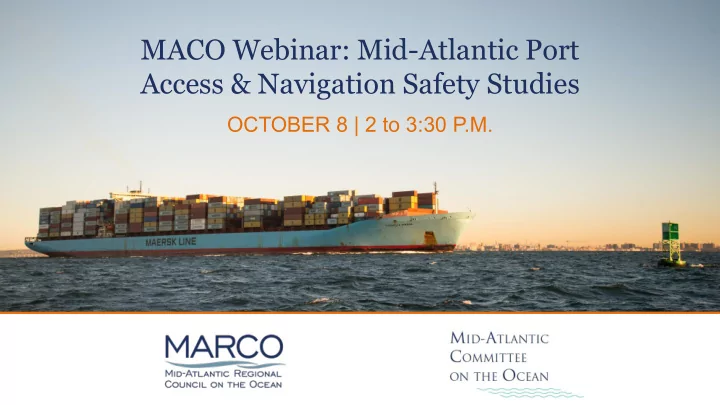
MACO Webinar: Mid-Atlantic Port Access & Navigation Safety Studies OCTOBER 8 | 2 to 3:30 P.M. Welcome to the Webinar Kevin Hassell , Chair, Mid-Atlantic Committee on the Ocean Audience audio/cameras are disabled by default.


slide-1
SLIDE 1

OCTOBER 8 | 2 to 3:30 P.M.

MACO Webinar: Mid-Atlantic Port Access & Navigation Safety Studies

slide-2
SLIDE 2

Welcome to the Webinar

  • Audience audio/cameras are

disabled by default.

  • Questions may be submitted at any

time in the Questions box. They will be read aloud and answered during Q&A session following the presentations and panel.

  • Speaker emails will be shared at

end of webinar.

  • Webinar recording and slides will be

posted at midatlanticocean.org

Kevin Hassell, Chair, Mid-Atlantic Committee on the Ocean

slide-3
SLIDE 3

United States Coast Guard

  • Mr. George Detweiler, Coast Guard Headquarters, Washington, DC
  • Ms. Michele DesAutels, First Coast Guard District, Boston, MA

CAPT Maureen Kallgren, Fifth Coast Guard District, Portsmouth, VA

slide-4
SLIDE 4

COAST GUARD ROLES, RESPONSIBILITIES & OBJECTIVES

  • Promote and maintain a safe, secure, efficient environmentally sound, and resilient Marine

Transportation System (MTS)

  • Ensure safe and efficient navigation routes to and from US major ports
  • Ensure a safe, secure and resilient flow of national defense and commercial vessels - vital to both
  • ur Nation’s national and economic security
  • Balance competing interests offshore, e.g., MTS, wind farms and other renewable energy areas,

fishing, recreation, tourism, aquaculture, etc.

  • Protection of
  • All mariners
  • Property (wind farm(s) or other structures/equipment)
  • Environment
slide-5
SLIDE 5

PORT ACCESS ROUTE STUDY (PARS)

  • Coast Guard is required (by law) to conduct a PARS before establishing new or adjusting existing

Traffic Separation Schemes (TSSs) or fairways.

  • Consult / coordinate with Federal, State, and foreign state agencies (as appropriate) and maritime

community representatives, environmental groups, and other interested stakeholders.

  • Primary purpose of this coordination is, to the extent practicable, to reconcile the need for safe

access routes with other reasonable waterway uses.

  • PARS (complete or modified) may be used to determine and justify if safety zones, security zones,

recommended routes, regulated navigation areas and other routing measures should be created

slide-6
SLIDE 6

PARS EXAMPLES

  • Atlantic Coast PARS (ACPARS)
  • Bering Strait PARS
  • Nantucket Sound PARS
  • Massachusetts – Rhode Island PARS (MARIPARS)
  • North Atlantic Right Whale PARS
  • Strait of Juan De Fuca PARS
slide-7
SLIDE 7

ATLANTIC COAST PORT ACCESS ROUTE STUDY

  • Study conducted study between 2011 – 2017
  • Identified navigation safety corridors along the Atlantic Coast
  • Corridors included deep draft routes and coastal tug and barge routes
  • Report recommended developing these navigation safety corridors into

shipping safety fairways (fairways)

slide-8
SLIDE 8

SHIPPING SAFETY FAIRWAYS

  • Must be created via the Federal Rulemaking Process
  • 1st Step was to publish an Advance Notice of Proposed Rulemaking (ANPRM) on June 19, 2020,
  • Docket # USCG – 2019 – 0279
  • ANPRM also reminded readers that USCG had announced potential studies of port

approaches and international entry and departure areas published in the Federal Register on March 15, 2019 (84 FR 9541)

  • Solicited comments about the establishment of fairways via a suite of questions in the notice
  • Provided a comment period ending August 18, 2020
  • ANPRM identified the fairways by name and geographical position
  • Review comments as preparation for developing a Notice of Proposed Rulemaking (NPRM)
  • Publish a Notice of Proposed Rulemaking (NPRM)
slide-9
SLIDE 9

FAIRWAYS AND SUPPLEMENTAL PARS AREAS OF STUDY

slide-10
SLIDE 10

SUPPLEMENTAL PARS RECOMMENDATIONS

  • Supplemental PARS could recommend:
  • Status Quo (no changes)
  • Fairways: A lane or corridor in which no artificial island or structure, whether temporary or

permanent, will be permitted so that vessels using U.S. ports will have unobstructed approaches.

  • Act like a routing measure – vessels operate as such
  • Fairways only created domestically – require regulations in 33 CFR 166
  • Created by USCG
  • Limited Access Areas (safety and security zones, restricted navigation areas (RNAs))
  • Created domestically – require regulations
  • Anchorages – require regulations
slide-11
SLIDE 11

SUPPLEMENTAL PARS RECOMMENDATIONS

  • Routing measures:
  • Created by the USCG
  • Approved internationally by the International Maritime Organization (IMO)
  • Approved domestically
  • Recommendatory, not mandatory
  • Some examples are:
  • Area to be avoided (ATBA)
  • No Anchoring Area
  • Precautionary area
  • Traffic Separation Scheme (TSS)
  • Traffic lane
  • Separation Zone or separation line
slide-12
SLIDE 12

FIRST DISTRICT – NORTHERN NEW YORK BIGHT PARS

The Notice of Study was published on June 29, 2020. It is available at Federal Register docket number USCG-2020- 0278, on the federal portal at https://www.regulations.gov/docket?D=USCG-2020-0278. The Coast Guard hosted two virtual public meetings:

  • Thursday, July 30th, 9 a.m. EST
  • Tuesday, August 11th, 6 p.m. EST

The comment period closed August 28, 2020.

  • 21 Comments received from Government, Fishing,

Offshore Wind, Maritime Transportation System users

  • Recommendations include consideration of additional

data, studies, and stakeholder outreach in addition to specific routing measures.

  • Next steps include in-depth comment analysis,

coordination with HQ/D5 and potential stakeholder

  • utreach.
  • Publication of PARS final results will be in the Federal

Register and may take 12 months or more to complete from Notice of Study (June 2020).

slide-13
SLIDE 13

FIFTH DISTRICT – APPROACHES TO THE CHESAPEAKE BAY

  • Published Notice on November 27, 2019,

Docket number USCG-2019-0862

  • Comment period closed January 27, 2020
  • 09 comments received from the public
  • Traffic Analysis completed and AIS data

reviewed/compiled

  • Possible routing measures under

consideration but not yet confirmed

  • Consultations underway with interested

parties

  • Draft report estimated November 2020
slide-14
SLIDE 14

FIFTH DISTRICT – NC SEACOAST AND CAPE FEAR RIVER APPROACHES

  • Published Notice on March 23, 2020, Docket

number USCG-2020-0093

  • Comment period closed May 23, 2020
  • 04 comments received from the public
  • Draft report estimated June 2021
slide-15
SLIDE 15

FIFTH DISTRICT – NJ SEACOAST AND DELAWARE BAY APPROACHES

  • Published Notice on May 5, 2020, Docket

number USCG-2020-0172

  • Initial comment period closed July 6, 2020
  • 18 comments received from the public
  • Public meetings scheduled Oct 29 and Nov 4

via virtual platform

  • Comment period re-opened until Nov 10,

2020

  • Draft report estimated March 2021
slide-16
SLIDE 16

QUESTIONS

Headquarters George Detweiler George.H.Detweiler@uscg.mil 202-372-1566 First District Michele DesAutels Michele.E.DesAutels@uscg.mil 617-223-8068 Fifth District CAPT Maureen Kallgren Maureen.R.Kallgren@uscg.mil 757-398-6250

slide-17
SLIDE 17

Coast Guard George Detweiler George.H.Detweiler@uscg.mil Michele DesAutels Michele.E.DesAutels@uscg.mil

  • Capt. Maureen Kallgren

Maureen.R.Kallgren@uscg.mil Mid-Atlantic Ocean Data Portal Nick Napoli/Karl Vilacoba portal@midatlanticocean.org Panelists Will Fediw will@vamaritime.com

  • Capt. Stuart Griffin

chairman@macdelriv.org Jeff Kaelin jKaelin@lundsfish.com Tom Vinson TVinson@awea.org Tony MacDonald amacdona@monmouth.edu MACO Kevin Hassell info@midatlanticocean.org

Thanks to Today’s Speakers