M ETRORAIL S TATION P ROJECT Potomac Yard Metrorail Implementation - - PowerPoint PPT Presentation

m etrorail s tation p roject
SMART_READER_LITE
LIVE PREVIEW

M ETRORAIL S TATION P ROJECT Potomac Yard Metrorail Implementation - - PowerPoint PPT Presentation

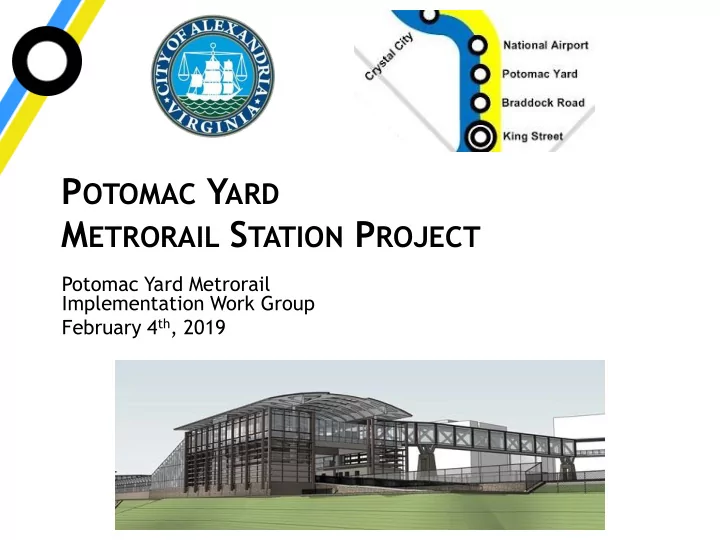
P OTOMAC Y ARD M ETRORAIL S TATION P ROJECT Potomac Yard Metrorail Implementation Work Group February 4 th , 2019 A GENDA Environmental Permitting Update Project History Supplemental Field Work Project Footprint Compensatory


slide-1
SLIDE 1

POTOMAC YARD METRORAIL STATION PROJECT

Potomac Yard Metrorail Implementation Work Group February 4th, 2019
slide-2
SLIDE 2

PYMIG| February 4, 2019

AGENDA

Environmental Permitting Update

  • Project History
  • Supplemental Field Work
  • Project Footprint
  • Compensatory Mitigation
  • Preparing the revised Joint Permit Application
  • Next Steps

2

slide-3
SLIDE 3

PYMIG| February 4, 2019

COMMUNITY COMMENTS

  • Station Location
  • Tidal Wetland Limits
  • Wetland Impacts
  • Restoration Plan
  • Regulatory Approval Process

– Agencies – Permits

3

slide-4
SLIDE 4

PYMIG| February 4, 2019

PROJECT TEAM

Stantec Loretta Cummings PhD

MS and PhD Environmental Science /Public Policy - GMU BS Biology/Chemistry - Shepherd College 30+ years experience with 404/401 permitting, NEPA, aquatic biology at USFWS, VDOT , Stantec

Chuck Roadley

BS Biology - Virginia Tech, MBA - VCU 30+ years experience: Virginia Institute of Marine Science (VIMS), Virginia Marine Resources Commission (VMRC), Williamsburg Environmental Group/Stantec, Member James City County Wetlands Board

Sean Wender - Ecologist – MS/BS Biology – 20+ years experience Jason Mann – Ecologist – BS Forestry – 16+ years experience Waterway Surveys & Engineering

39 years performing hydrographic surveys for streams, lakes, rivers and coastlines.

4

slide-5
SLIDE 5

PYMIG| February 4, 2019

PROJECT HISTORY

5

PYMS Design-Build Project Evolution  2011 – Environmental Impact Statement (NEPA) process began

Wetland delineation, values assessment, impact limits, alternatives analysis, purpose & need determined during NEPA  June 2, 2016 – Final Environmental Impact Statement Issued  Federal Transit Authority ROD October 31, 2016  National Park Service ROD November 11, 2016  October 3, 2017 – Joint Permit Application submitted

JPA developed exclusively on EIS data  September 10, 2018 – Potomac Yard Contractors selected

Contractor selection allows for JPA refinement  September 12, 2018 – VDEQ Draft Permit Issued

Responses gathered in public comments to be addressed in now-revised JPA

slide-6
SLIDE 6

PYMIG| February 4, 2019

AERIAL PHOTOGRAPHS

6

1988 – Google Imagery

slide-7
SLIDE 7

PYMIG| February 4, 2019

PROJECT AREA

7

slide-8
SLIDE 8

PYMIG| February 4, 2019

SUPPLEMENTAL FIELD WORK FALL 2018

8

  • Tidal wetland survey
  • Non-tidal wetland

data points

  • Habitat Evaluation
  • Wetland Functional

Assessment

slide-9
SLIDE 9

PYMIG| February 4, 2019

FIELD WORK - TIDAL LIMITS SURVEY

9

Waterway Surveys & Engineering Ltd Waterway Surveys & Engineering Ltd

slide-10
SLIDE 10

PYMIG| February 4, 2019

FIELD WORK - TIDAL LIMITS SURVEY

10

slide-11
SLIDE 11

PYMIG| February 4, 2019

TIDAL AREA – LIMITS OF DISTURBANCE

11

  • Original limits of disturbance did include tidal wetlands
  • Revised limits of disturbance avoid the tidal wetlands
  • A protective barrier will be erected to identify and protect

the wetlands during construction

slide-12
SLIDE 12

PYMIG| February 4, 2019

FIELD WORK - WETLAND DATA COLLECTION

12

  • Soils
  • Vegetation
  • Hydrology
slide-13
SLIDE 13

PYMIG| February 4, 2019

FIELD WORK - WETLAND FUNCTIONS AND VALUES

13

Functions

  • Groundwater recharge/Discharge
  • Flow Alteration
  • Fish and Shellfish Habitat
  • Sediment/Toxicant Retention
  • Nutrient Removal
  • Sediment Stabilization
  • Wildlife Habitat

Values

  • Recreation
  • Education
  • Uniqueness
  • Aesthetics
  • Threatened and

Endangered Species

slide-14
SLIDE 14

PYMIG| February 4, 2019

FIELD WORK - HABITAT ASSESSMENT

14

  • Both Palustrine Emergent (PEM) and

Palustrine Forested (PFO) wetland types are onsite

  • Emergent Tidal (E2EM), Tidal Open Water

(E1UB) and Tidal Stream Channel (R1SB) are present downstream of the project

  • Invasive species are dominant in the areas
  • f proposed impacts
  • Highly disturbed with spoil piles and

previous grading

slide-15
SLIDE 15

PYMIG| February 4, 2019

PROJECT FOOTPRINT

15

Potomac Greens

slide-16
SLIDE 16

PYMIG| February 4, 2019

PROJECT FOOTPRINT

16

slide-17
SLIDE 17

PYMIG| February 4, 2019

PROJECT FOOTPRINT - WETLAND IMPACT REDUCTION

October 2017 JPA

  • Permanent = 1.65

– PFO = 1.01 – PEM = 0.64

  • Temporary = 2.97

– PFO = 1.38 – PEM = 1.59

Current

  • Permanent = 1.56

– PFO = 0.92 – PEM = 0.64

  • Temporary = 2.01

– PFO = 1.01 – PEM = 0.91

17

REDUCTION 0.09 acre permanent 0.96 acre temporary

slide-18
SLIDE 18

PYMIG| February 4, 2019

COMPENSATORY MITIGATION

Wetland Type Amount Ratio Required PFO 0.92 2:1 1.84 PEM 0.64 1:1 0.64 2.48 CREDITS REQUIRED

18

The City must ensure “No Net Loss” of wetlands acreage and functions by providing compensatory mitigation. Credits will be purchased from the approved mitigation bank prior to construction in jurisdictional areas.

slide-19
SLIDE 19

PYMIG| February 4, 2019

RESTORATION PLAN

  • Approximately 2 acres of wetlands temporarily impacted

must be restored to the same of better condition

  • Forested area (1.01 acre) will be planted at a rate of 400

stems per acre

  • Emergent area (0.91 acre) will be seeded with a wetland

mix

  • Monitoring is required by DEQ during and after

construction

  • Monitoring wells will be installed to verify hydrology
  • An invasive control plan will be included.
  • Field studies and reporting will occur of 5-7 years or until

the site meets the success criteria required by the agencies

19

slide-20
SLIDE 20

PYMIG| February 4, 2019

PREPARING REVISED APPLICATION

20

  • Site visit with the agencies to walk the

property

  • Worked with PYC to minimize the proposed

permanent and temporary impacts

  • PYC is preparing a wetland restoration plan

for the temporary impact areas per DEQ guidance documents

  • Incorporate new ecology and tidal survey

information

  • Documenting Alternatives Analysis
slide-21
SLIDE 21

PYMIG| February 4, 2019

NEXT STEPS

21

  • Submit Revised Application in early February
  • US Army Corps of Engineers
  • Virginia Department of Environmental Quality
  • Virginia Marine Resources Commission
  • Will be posted on City website
  • Corps & DEQ will take public comments
  • City will request DEQ hold a public hearing
  • VMRC to review tidal wetland survey
slide-22
SLIDE 22

PYMIG| February 4, 2019

Discussion

22