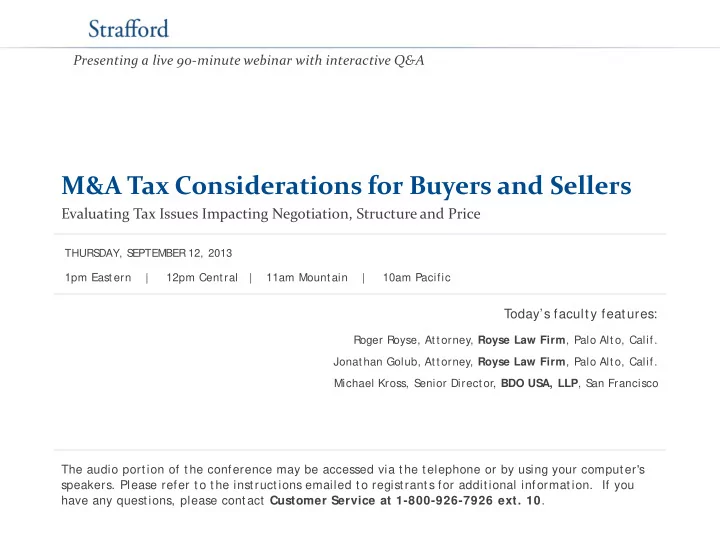
M&A Tax Considerations for Buyers and Sellers Evaluating Tax - - PowerPoint PPT Presentation

m a tax considerations for buyers and sellers evaluating
SMART_READER_LITE
LIVE PREVIEW

M&A Tax Considerations for Buyers and Sellers Evaluating Tax - - PowerPoint PPT Presentation

Presenting a live 90-minute webinar with interactive Q&A M&A Tax Considerations for Buyers and Sellers Evaluating Tax Issues Impacting Negotiation, Structure and Price THURS DAY, S EPTEMBER 12, 2013 1pm East ern | 12pm Cent ral


slide-1
SLIDE 1

M&A Tax Considerations for Buyers and Sellers

Evaluating Tax Issues Impacting Negotiation, Structure and Price

Today’s faculty features:

1pm East ern | 12pm Cent ral | 11am Mount ain | 10am Pacific

The audio portion of the conference may be accessed via the telephone or by using your computer's

  • speakers. Please refer to the instructions emailed to registrants for additional information. If you

have any questions, please contact Customer Service at 1-800-926-7926 ext. 10.

THURS DAY, S EPTEMBER 12, 2013

Presenting a live 90-minute webinar with interactive Q&A

Roger Royse, At t orney, Royse Law Firm, Palo Alt o, Calif. Jonat han Golub, At t orney, Royse Law Firm, Palo Alt o, Calif. Michael Kross, S enior Direct or, BDO USA, LLP, S an Francisco

slide-2
SLIDE 2

Tips for Optimal Quality

S

  • und Qualit y

If you are listening via your computer speakers, please note that the quality of your sound will vary depending on the speed and quality of your internet connection. If the sound quality is not satisfactory and you are listening via your computer speakers, you may listen via the phone: dial 1-888-450-9970 and enter your PIN when prompted. Otherwise, please send us a chat or e-mail sound@ straffordpub.com immediately so we can address the problem. If you dialed in and have any difficulties during the call, press *0 for assistance. Viewing Qualit y To maximize your screen, press the F11 key on your keyboard. To exit full screen, press the F11 key again.

FOR LIVE EVENT ONLY

slide-3
SLIDE 3

Continuing Education Credits

For CLE purposes, please let us know how many people are listening at your location by completing each of the following steps:

  • In the chat box, type (1) your company name and (2) the number of

attendees at your location

  • Click the S

END button beside the box If you have purchased S trafford CLE processing services, you must confirm your participation by completing and submitting an Official Record of Attendance (CLE Form). Y

  • u may obtain your CLE form by going to the program page and selecting the

appropriate form in the PROGRAM MATERIALS box at the top right corner. If you'd like to purchase CLE credit processing, it is available for a fee. For additional information about CLE credit processing, go to our website or call us at 1-800-926-7926 ext. 35.

FOR LIVE EVENT ONLY

slide-4
SLIDE 4

Program Materials

If you have not printed the conference materials for this program, please complete the following steps:

  • Click on the ^ sign next to “ Conference Materials” in the middle of the left-

hand column on your screen.

  • Click on the tab labeled “ Handouts” that appears, and there you will see a

PDF of the slides for today's program.

  • Double click on the PDF and a separate page will open.
  • Print the slides by clicking on the printer icon.

FOR LIVE EVENT ONLY

slide-5
SLIDE 5

M&A TAX CONSIDERATIONS FOR BUYERS AND SELLERS

Royse Law Firm, PC 1717 Embarcadero Road Palo Alto, CA 94303 www.rroyselaw.com

IRS Circular 230 Disclosure: To ensure compliance with the requirements imposed by the IRS, we inform you that any tax advice contained in this communication, including any attachment to this communication, is not intended or written to be used, and cannot be used, by any taxpayer for the purpose of (1) avoiding penalties under the Internal Revenue Code or (2) promoting, marketing or recommending to any other person any transaction or matter addressed herein.

Roger Royse rroyse@rroyselaw.com www.rogerroyse.com Skype: roger.royse Jonathan Golub jgolub@rroyselaw.com

September 12, 2013

slide-6
SLIDE 6

OVERVIEW OF TRANSACTIONS

  • Tax Free Reorganizations:

– Type A – Merger – Type B – Stock for Stock – Type C – Stock for Assets – Type D – Spin Off, Split Off, Split Up, and Type D Acquisitive Reorganizations

  • Compensation Issues
  • Taxable Transactions:

– Stock Sale – Asset Sale

  • S Corporation Strategies
  • Foreign Corporations

6

slide-7
SLIDE 7

TAXABLE VS. TAX FREE

  • Type of Acquisition Currency

– Stock – Securities/Debt – Deferred payments, earn outs – Compensatory

  • Nature of the Buyers and Seller

– Foreign Parties – Tax Attributes of Parties

  • Shareholder Level Considerations

– Tax Sensitivity of Shareholders – Appetite for Complexity & Risk

7

slide-8
SLIDE 8

CONTINUITY OF INTEREST

8

  • IRS – 50% Safe Harbor, Rev. Proc. 77-37
  • IRS – 40% in Temp. Reg. 1.368-1T(e)(2)(v), example (1)
  • John A. Nelson – 38% Stock
  • Miller v. CIR – 25% Stock
  • Kass v. CIR – 16% Stock is Insufficient
  • 2011 Regulations address changes in value between the date of

signing and close;

– if fixed consideration (Consideration is “fixed” if contract states exact number of shares and other cash or property to be exchanged)

  • Consideration is valued as of last business day before the first day the contract is binding and
  • If a portion of the fixed consideration is other property identified by value, then the specified

value is used for that portion (see Reg. 1.368-1(e)(2)).

– 2011 Proposed Regulations (Prop. Reg. 1.368-1(e)(2)(vi)) – consideration that varies as the value of issuing corporation stock changes prior to closing will not fall below (or above) contractual floor (or ceiling) markers for purposes of continuity of interest. If binding contract uses average value of issuing corporation stock that average value can be used for continuity of interest.

  • Post transaction sales and redemptions
slide-9
SLIDE 9

TAX FREE REORGANIZATIONS

  • Type A – Merger
  • Type B – Stock for Stock
  • Type C – Stock for Assets
  • Type D – Spin Off, Split Off, Split Up, and Type D

Acquisitive Reorganizations

  • Ruling Guidelines

– Rev. Rul. 77-37 – Rev. Proc. 86-42 – Rev. Rul. 73-54 (terms) – Rev. Proc. 89-50 – Rev. Proc. 96-30 (Type D Checklist)

9

slide-10
SLIDE 10

TYPE A REORGANIZATIONS – SECTION 368(a)(1)(A) STATUTORY MERGER

Requirements:

  • Necessary Continuity of Interest
  • Business Purpose
  • Continuity of Business Enterprise
  • Plan of Reorganization
  • Net Value

Tax Effect:

  • Shareholders – Gain recognized to the extent of boot
  • Target – No gain recognition
  • Acquiror takes Target’s basis in assets plus gain

recognized by Shareholders

  • Busted Merger – taxable asset sale followed by

liquidation

  • Statutory Merger – 2 or more

corporations combined and only

  • ne survives (Rev. Rul. 2000-5)
  • Requires strict compliance with

statute

  • Target can be foreign; Reg.

1.368-2(b)(1)(ii)

  • No “substantially all”

requirement

  • No “solely for voting stock”

requirement Target Acquiror Shareholders

10

slide-11
SLIDE 11

TYPE B REORGANIZATIONS – SECTION 368(a)(1)(B) STOCK FOR STOCK

11

  • Acquisition of stock of Target, by

Acquiror in exchange for Acquiror voting stock

  • Acquiror needs control of Target

immediately after the acquisition

  • Control = 80% by vote and 80% of

each class Target Acquiror Shareholders

  • Acquiror’s basis in Target stock is the

same as the Shareholder’s Solely for voting stock

  • No Boot in a B
  • Reorganization Expenses – distinguish

between Target expenses and Target Shareholder expenses (Rev. Rul. 73-54)

  • Creeping B – old and cold stock

purchased for cash should not be integrated with stock exchange

slide-12
SLIDE 12

TYPE C REORGANIZATIONS – SECTION 368(a)(1)(C) STOCK FOR ASSETS

12

  • Acquisition of substantially all of the assets
  • f Target, by Acquiror in exchange for

Acquiror voting stock

  • “Substantially All” – at least 90% of FMV of

Net Assets and at least 70% of FMV of Gross Assets

  • Target must liquidate in the reorganization
  • 20% Boot Exception – Acquiror can pay

boot (non-stock) for Target assets, up to 20% of total consideration; liabilities assumed are not considered boot unless

  • ther boot exists

Target Acquiror Shareholders

Target Assets Acquiror Stock Acquiror Stock

  • Reorganization Expenses – Aquiror may

assume expenses (Rev. Rul. 73-54)

  • Assumption of stock options not boot
  • Bridge loans by Acquiror are boot
  • Redemptions and Dividends – who pays

and source of funds

slide-13
SLIDE 13

TYPE D REORGANIZATIONS – SECTION 368(a)(1)(D) DIVISIVE SPIN OFF, SPLIT OFF, SPLIT UP

13

  • Divisive – transfer by a corporation of all or part of its assets

to another corporation if, immediately after the transfer, the transferor or its shareholders are in control of the transferee corporation.

  • Stock or securities of the transferee must be distributed under the plan in a

transaction that qualifies under Section 354, 355, or 356. Transferor Transferee Shareholders

Transferee Stock Transferee Stock Transferor Assets

slide-14
SLIDE 14

TYPE D REORGANIZATIONS – SECTION 368(a)(1)(D) NON-DIVISIVE

14

  • If shareholders of Transferor stock receive

Acquiror stock and own at least 50% of Acquiror stock, the transaction may be treated as a non-divisive D REORG even if it fails as an A REORG for lack of continuity

Transferor Acquiror Shareholders with 20%

Acquiror Stock Acquiror Stock Transferor Assets Merger

Merger Treated as Acquisitive D Failed Type C Treated as D

Shareholders

Transferor Acquiror

Assets Cash & Stock

Liquidation / Reincorporation

Shareholders

Transferor Acquiror

slide-15
SLIDE 15

NET VALUE RULES

15

  • 2005 Proposed Regulation 1.368-1(b)(1): Exchange of no net

value (liabilities exceed value) does not qualify as a reorganization

  • Example:

– Acquiror owns all of the stock of both Merger Sub and Target. Target has assets with FMV of $100 and liabilities of $160, all of which are owed to B. Target transfers all of its assets to S in exchange for the assumption of Target’s liabilities, and Target dissolves. The obligation to B is outstanding immediately after the transfer. Acquiror receives nothing in exchange for its Target stock.

  • Explanation:

– Under paragraph (f)(2)(i) of the Reg, Target does not surrender net value because the FMV of the property transferred by Target ($100) does not exceed the sum of the amount of liabilities of Target assumed by Merger Sub in connection with the exchange ($160). Therefore, under paragraph (f) of the Reg., there is no exchange of net value. See Prop. Reg. 1.368-1(f)(5) Example 3.

  • Alabama Asphalt
slide-16
SLIDE 16

NON-QUALIFIED PREFERRED STOCK

16

  • Preferred Stock – limited and preferred as to dividends; and does

not participate in corporate growth if:

– (1) shareholder has right to require issuer to redeem – (2) issuer is required to redeem – (3) issuer has right to redeem and is more likely than not to exercise that right; or – (4) dividend rate varies based on interest rate, or commodity price or

  • ther index
  • Redemption right exercisable within 20 years and not subject to

contingency that renders likelihood remote

  • Excludes stock compensation that may be repurchased on

separation from service

  • Conversion feature not enough to participate in growth
  • Generally treated as boot to shareholders
slide-17
SLIDE 17

TRI-ANGULAR OR SUBSIDIARY MERGERS

17

2. Reverse Subsidiary Merger

Target Acquiror

Merger Sub

Acquiror Target

Merger Sub

1. Forward Subsidiary Merger

slide-18
SLIDE 18

TRI-ANGULAR OR SUBSIDIARY MERGERS

18

Section 368(a)(2)(D) Forward Triangular Merger

  • A statutory merger of Target into Merger Sub (at least 80% owned by Merger

Sub)

  • Substantially all of Target’s assets acquired by Merger Sub
  • Would have been a good Type A merger if Target had merged into Merger

Sub

Target Acquiror

Target Shareholders

80%

Tax Consequences

  • Merger Sub takes Target’s

basis in assets increased by gain recognized by Target

  • Acquiror takes “drop

down” basis in stock of Merger Sub (same as asset basis)

Merger Sub

slide-19
SLIDE 19

TRI-ANGULAR OR SUBSIDIARY MERGERS

19

Section 368(a)(2)(E) Reverse Triangular Merger

  • Merger of Merger Sub into Target where

– (i) Target shareholders surrender control (80% of voting and nonvoting classes of stock) for Acquiror voting stock and – (ii) Target holds substantially all the assets of Target and Merger Sub

Target Acquiror

Target Shareholders

80%

Tax Consequences

  • Non-taxable to Target and carryover

basis

  • No gain to Acquiror and Merger Sub

under Sections 1032 and 361

  • No gain to Target shareholders except

to the extent of boot

  • Acquiror’s basis in Target stock

generally is the asset basis, but Acquiror can choose to take Target shareholders basis in stock (if it is also a B)

  • If transaction is also a 351, Acquiror can

use Target shareholders’ basis plus gain

Merger Sub

slide-20
SLIDE 20

DOUBLE MERGER

20

Acquiror

Target Shareholders

Step 2: A-type Forward Merger Step 1: Reverse Triangular Merger

Target Acquiror

Merger Sub

Target Shareholders

80%

Tax Benefit: A taxable reverse merger has just one tax on the shareholders, while a

taxable forward merger has two taxes (one on shareholders and one on corporation). Intended that entire transaction be a tax-free A-type merger (where 20% boot limitation does not exist). Pairing the two reduces the risk of incurring the corporate level tax in the event the entire transaction is not treated as an A-type merger.

  • REV. RUL. 2001-46

Merger Sub Target+Sub

Merger Sub Survives

slide-21
SLIDE 21

DOUBLE MERGER – WHOLLY OWNED LLC

21

Target+Sub

Acquiror LLC

Merger LLC Survives

Step 2: A-type Forward Merger Step 1: Reverse Triangular Merger

Target Acquiror

Merger Sub

Target Shareholders

80%

Tax Benefit: A taxable reverse merger has just one tax on the shareholders, while a

taxable forward merger has two taxes (one on shareholders and one on corporation). Intended that entire transaction be a tax-free A-type merger (where 20% boot limitation does not exist). Pairing the two reduces the risk of incurring the corporate level tax in the event the entire transaction is not treated as an A-type merger.

  • REV. RUL. 2001-46

Target Shareholders

slide-22
SLIDE 22

TARGET DEBT SECURITIES

22

  • Exchange of Target securities for Acquiror securities

is tax free under Sections 354 and 356, to the extent that the principal amount of Acquiror debt is less than the principal amount of Target debt

  • Portion attributable to cash basis accrued interest is

taxable

  • Possible COD income

– Example:

  • Target bonds with an issue price (stated principal amount) of

$1,000 exchanged for Acquiror stock or debt worth $900; Target has COD of $100

slide-23
SLIDE 23

DIVIDEND EQUIVALENCY

23

  • Section 356(a)(2) – Boot as dividend or capital gain; post-

reorganization redemption test of Rev. Rul. 93-61

  • Clark – hypothetical post-reorganization redemption reduced

shareholder’s interest from 1.32% to .92% - substantially disproportionate under Section 302(b)(2)

  • Section 302(b)(1) – redemption that results in meaningful

reduction in voting power is redemption and not essentially equivalent to a dividend

  • Section 302(b)(2) – greater than 20% reduction is substantially

disproportionate

  • E&P Limitation on Dividend – should be Target’s E&P but

unclear if Merger Sub’s E&P counted; PLR 9118025, PLR 9041086, and PLR 9039029

slide-24
SLIDE 24

CONTINGENT STOCK, ESCROWS, AND EARN-OUTS

24

  • Escrows:

– Target shareholders usually treated as owner of escrowed Acquiror shares unless

  • therwise agreed

– Especially true if Target shareholders have right to vote and receive dividends – Not clear who is owner if Target shareholders do not have right to vote or receive dividends

  • Earn-Out Stock:

– Target shareholders not considered owners until Acquiror shares are issued – Not treated as boot – Imputed Interest

  • Rev. Proc. 84-42 Ruling Guidelines – use of escrow or contingent stock

– (1) stock must be distributed within 5 years, subject to escrow or contingency – (2) valid business purpose – (3) maximum number of shares cannot exceed 50% – (4) trigger event not controlled by Target shareholders and not based on tax liability – (5) Formula is objective and readily ascertainable – (6) Restrictions on assignment and substitution – (7) In the case of escrows, Acquiror shares shown as issued to Target shareholders, current voting and dividend rights, and vested

slide-25
SLIDE 25

UNVESTED STOCK RECEIVED IN A TAXABLE OR NON-TAXABLE DEAL

25

  • Rev. Rul. 2007-49 - The revenue ruling addresses:

– (1) the exchange of fully vested stock for unvested stock of an acquiring corporation in a tax-free reorganization, and – (2) the exchange of fully vested stock for unvested stock of an acquiring corporation in a taxable exchange

  • Under either (1) or (2), the Rev. Rul. provides that the

exchange constitutes a transfer of property subject to Section 83.

– The service provider would need to file an 83(b) election to avoid the recognition of compensation income in the future as the shares vest. – The Rev. Rul. also provides that the spread will be zero, so there is no downside to the service provider’s 83(b) election.

slide-26
SLIDE 26

OPTIONS

26

  • Assumption or Substitution

– No tax on substitution of NSO – No tax on substitution of ISO, so long as the substitution is not a modification. There is no “modification” so long as:

  • (1) the aggregate spread in new option does not exceed the

spread in the old; and

  • (2) the new option does not have more favorable terms than the
  • ld; see Sections 424(a) and 424(h)(3)
slide-27
SLIDE 27

OPTIONS – CASH OUT

27

  • Cancel options for cash payment

– NSO

  • Ordinary income – compensation – withholding or 1099
  • Deduction to Target or Acquiror?

– TAM 9024002 – employer deducts based on method of accounting; not clear if cash

  • ut at close is pre-acquisition Target deduction or post-close Acquiror deduction in

absence of scripting the timing – Under the cash method, the deduction generally arises when the employer has “paid” the property to the employee. See Regs. §1.461-1(a)(1). Under the accrual method, the deduction arises when the employer's obligation to make the property transfer becomes fixed, the property's value is determinable and economic performance occurs. See Regs. §§1.461-1(a)(2) and -4(d)(2)(iii)(B)

– ISO

  • FICA
  • Exercise and disqualifying disposition treated differently
slide-28
SLIDE 28

409A

28

  • Deferred compensation

— A deferral of compensation occurs whenever the service provider (employee) has a legally binding right during a taxable year to compensation that will be paid to such person in a later year. Treasury Regulation Section 1.409A-1(b)

  • Consequences of violating 409A

— Amounts which were to be deferred are subject to immediate taxation — Additional 20% penalty on such amounts — Interest penalty — CA state tax penalty

  • Bonus or Carve Out Plans
  • Participation in Earn Outs (Reg. 1.409A-3(i)(5)(iv))

— Payments of compensation in this context may be treated as paid at a designated date

  • r pursuant to a schedule that complies with 409A if the transaction-based

compensation is paid on the same schedule and under the same terms and conditions as apply to payments to shareholders generally pursuant to the change in control event

slide-29
SLIDE 29

280G GOLDEN PARACHUTE RULES

29

  • 20% excise tax and loss of deduction on Excess Parachute Payment

– “Excess Parachute Payment” means the amount by which the Parachute Payment exceeds the Base Amount – “Parachute Payment” means a payment, the present value of which, exceeds three times the Base Amount – “Base Amount” means the average annual compensation for past 5 years – Must be paid to a disqualified individual (meaning employee, officer, shareholder,

  • r highly compensated individual)

– As compensation, AND – Contingent on a change in control (50% change ownership or effective control, or

  • wnership change in a substantial portion of the company’s assets)
  • Reduce Excess for reasonable compensation
  • Exclude reasonable compensation for future services
  • Exception for small business corporation and non publicly traded

corporation that has 75% uninterested shareholder approval

  • Withholding requirement
slide-30
SLIDE 30

280G – OTHER ISSUES

30

  • Non-Publicly Traded Stock

– Approval of 75% of shareholders after adequate disclosure – Vote determines the right of the shareholder to the payment – Ignore shares held by persons receiving the payment

  • Reduction for Excess (299% of payments)
  • Reduction for Reasonable Compensation
  • Reduction for Future Services
slide-31
SLIDE 31

TAXABLE STOCK PURCHASES

31

Cash Reverse Triangular Merger

  • Treated as Stock Sale
  • Shareholders have gain or loss
  • Acquiror takes cost basis in Target shares

Merger Sub Target Shareholders

Target Acquiror

slide-32
SLIDE 32

CASH FORWARD MERGER

32

Asset Sale Followed by Liquidation of Target

  • Target has gain on sale
  • Target shareholders have

gain on liquidation (unless 332 applies)

  • Acquiror takes cost basis

in Target assets

Target Shareholders

Merger Acquiror Survives

Target Shareholders Variation with Merger Sub:

Target Target Acquiror Acquiror

Merger Sub

slide-33
SLIDE 33

SECTION 382 – LIMITATION ON LOSSES AFTER CHANGE IN OWNERSHIP

33

  • Section 381 – Survival of Tax Attributes
  • Section 382

– When there has been an ownership change of a corporation with loss carry forwards, use of Net Operating Losses (NOLs) against future income is limited to the product of the value of the Target and the long term interest rate. – “Ownership Change” occurs if, within a 3 year testing period, the percentage of stock of Target held by 5 Percent Shareholders increases by more than 50% over lowest percentage held by such shareholders during the test period.

slide-34
SLIDE 34

BUSTED 351

34

Shareholders Target Shareholder Business Acquiror Target Stock Merger

Acquiror Stock

  • Rev. Ruling 70-140

Step 1: Incorporate Target Step 2: Merge Target into Acquiror

slide-35
SLIDE 35

USE OF WHOLLY OWNED LLC

35

Target Acquiror LLC

T Shareholders

Merger of Corporation into LLC

  • Reg. 1.368-2(b)(1) – by operation of law, all assets and liabilities of

Target become those of LLC, and Target ceases legal existence

  • A Type Reorganization
slide-36
SLIDE 36

SECTION 351 / 721 ROLLOVER

36

Target

Target Shareholders

PEG

  • 80% vote & value
  • Taxation of boot
  • Debt + non-qualified

voting stock

  • Assumption of liabilities

Cash out some and rollover

Target Target

Target Shareholders

PEG PEG NewCo NewCo

Target Shareholders

Target Shares Cash Cash Cash Cash Cash Assets Assets

slide-37
SLIDE 37

LLC TECHNIQUES

37

Acquiror

Step 1 Step 2

LLC

Former Target Shareholders

Target

$

Target

Target Corp.

LLC

T Shareholders

slide-38
SLIDE 38

INSTALLMENT METHOD

38

  • Gain on each payment = gross profit ratio times payment

– Gross profit ratio = ratio of total gain to purchase price – Pre-transaction planning opportunities to utilize basis

  • Section 453A – interest charge to the extent taxpayer holds

more than $5 million face amount of Section 453 obligations

  • Section 453 Limits

– Not available for publicly held stock or securities, or inventory – Not available for sales for demand notes or readily tradable notes – Not available for instruments secured by cash or cash equivalents – Obligor must be purchaser (cannot use parent debt)

  • Section 453 applies unless taxpayer affirmatively elects out
  • Section 453(h) – Target shareholders who receive Acquiror debt

in liquidation of Target allowed to use installment reporting

slide-39
SLIDE 39

CONTINGENT PAYMENTS AND EARN-OUTS

39

  • Distinguish Equity vs. Debt
  • 3 Issues

– (1) allocation between interest and sales proceeds; – (2) timing of realization of sales proceeds; and – (3) timing of basis recovery

  • Interest

– 1.1275-4(b)

  • Contingent payment debt for cash or publicly traded property – use

non-contingent bond method; projected non-contingent and contingent payments

– 1.1275-4(c)

  • Contingent debt instrument issued for non-publicly traded property –

bifurcate into non-contingent debt instrument and contingent debt instrument; contingent payment treated as principal based on present value, excess is interest

  • Buyer’s basis is non-contingent portion plus contingent payments

treated as principal

slide-40
SLIDE 40

CONTINGENT PAYMENTS AND GAIN RECOGNITION

40

  • Reg. 15A.453-1(c)
  • If capped by maximum amounts, assume maximum for

purposes of gross profit percentage (accelerates gain, backloads basis)

– If no cap, but term, basis recovered ratably over term – If neither time nor amount is capped, basis recovered ratably over 15 years

  • Election out of Section 453 – FMV of contingent
  • bligation is amount realized
  • Open transaction treatment – rare and extraordinary

situations only

slide-41
SLIDE 41

SECTION 338 ELECTION

41

  • Section 338(g) – Target in stock sale treated as selling all its

assets followed by liquidation post close (soaks up NOLs)

  • Section 338(h)(10) – Sale and liquidation deemed to occur

pre-close; joint election; S corporation or sale out of a consolidated group

  • Adjusted Grossed-Up Basis – New Asset basis is basis in

recently purchased stock (last 12 months) grossed up to reflect minority shareholder’s basis + liabilities of Target (including taxes in 338(g))

  • Adjusted Deemed Sale Price – grossed up amount realized
  • f recently purchased stock plus liabilities of old T (on day

after acquisition date)

slide-42
SLIDE 42

338(g) ELECTIONS

42

  • If there is a US Buyer of a foreign owned foreign

target, then 338(g) election steps up basis and eliminates E&P and foreign tax credits

  • Target may be able to offset 338(g) gains with NOLs
slide-43
SLIDE 43

PURCHASE PRICE ALLOCATION

43

  • Asset Sale or 338 Election

– Sections 1060 and 338 classes based on FMV – Class I – cash and equivalents – Class II – actively traded personal property under 1092 – Class III – debt instruments and marked to market – Class IV – inventory – Class V – assets other than those in I-IV or VI – Class VI – goodwill and going concern

  • Agreement Allocations – Danielson Rule

– Parties bound by agreement unless IRS determines that the allocation is NOT appropriate

  • SFAS 141R – Purchase Price Allocations

– Assets booked at FMV as of closing date (not signing date) – Bargain purchase results in accounting gain – Earn Outs – estimated and recorded – Deferred tax assets for excess tax deductible goodwill over book value – Transaction related costs recognized (expensed)

slide-44
SLIDE 44

S CORPORATIONS AND 338(h)(10)

44

T (S Corp) Acquiror

Merger Sub Target Shareholders

  • Character difference – ordinary

income assets

  • California 1.5% tax on S

corporations

  • All Target shareholders must

consent on Form 8023

  • Deemed 338 election for

subsidiaries

  • 1374 – BIG Tax
  • Minority shareholders in rollover
  • Hidden tax in liquidation or

deemed liquidation in installment sale.

slide-45
SLIDE 45

S CORP 338(h)(10) ELECTION AND 453B(h) BASIS ALLOCATION ISSUE

45

  • Gain to Shareholders in year of sale: $1 million x 80% = $800,000; A/B of

Shareholder = $1.8 million

  • No 331 liquidation: $1 million cash decreases A/B by $1 million to $800,000;

$800,000 A/B in Note = $3.2 million gain

  • 331 liquidation – apportion basis: $1.8 million basis apportioned $360,000 to cash

and $1,440,000 to Note; Gain in cash of $640,000 and gain in note of $2,560,000 for a total of $3.2 million gain (GP % on liquidation is 64%)

  • Defer cash portion and include in installment obligation: gain on liquidation equal

to zero; Shareholder A/B in note of $1 million; profit % is 80% Target Acquiror Shareholders

$1 million cash $4 million 453 Note Stock Sale $1 million basis Cash - $1 million / $1 million A/B Assets - $4 million / zero A/B

  • Reg. 1.338(h)(10) – 1(e) Example 10
slide-46
SLIDE 46

S CORP NO 338(h)(10) ELECTION – DISAPPEARING BASIS

46

Liquidate Target into Merger Sub or check the box Q-Sub T (S Corp) Acquiror

Merger Sub T Shareholders Carryover Basis

slide-47
SLIDE 47

Section 336(e)

47

Acquiror

Shareholder $

Target Stock

Basic Model (for stock sales): Target is treated as selling all of its assets to an unrelated person while owned by its former shareholders and then reacquiring same upon acquisition by Acquiror. $ $

Assets Assets = Actual Component = Deemed Component

Acquiror Shareholder

Target Target

3rd Party

slide-48
SLIDE 48

FOREIGN CORPORATIONS

48

  • Section 367(a) – outbound transactions

– Foreign corporation not treated as a corporation except as provided in regulations – Generally, gain recognized unless:

  • No more than 50% of stock of foreign Acquiror received by US transferors,
  • No more than 50% of stock of foreign Acquiror owned after the transfer by US persons that are
  • fficers or directors or 5% Target shareholders,
  • Gain Recognition Agreement ("GRA") is entered into by 5% US transferee shareholders
  • 36 month active trade or business test met,
  • No intent to substantially dispose of or discontinue such trade or business,
  • FMV of the assets of transferee must be at least equal to the FMV of the US target, and
  • Tax reporting
  • Section 367(b) – inbound and foreign to foreign transfers

– US Acquiror and foreign Target

  • Target can be treated as a corporation
  • May be income to Target’s US shareholders to extent of Target’s accumulated E&P
slide-49
SLIDE 49

FOREIGN CORPORATIONS

49

  • Anti-Inversion Rules – tax outbound reorganization and/or tax foreign

Acquiror as a U.S. taxpayer; Code Section 7874

– If ownership of former U.S. Target shareholders in foreign Acquiror is 80% or more; foreign Acquiror is treated as a U.S. company – If ownership continuity is between 60-80%; foreign Acquiror is NOT treated as a U.S. company, but U.S. tax attributes cannot be used to offset gains – 20% excise tax on stock-based compensation upon certain corporate inversion transactions – 7874 exception available for companies with “substantial business activities” in the foreign jurisdiction; facts and circumstances test compares activities of company in foreign jurisdiction with activities of company globally

  • Controlled Foreign Corporations (“CFCs”)

– A foreign entity is classified as a CFC if it has “United States Shareholders” who collectively own more than 50% of the voting power or value of the company. For the purposes of the CFC rules, a “United States Shareholder” is defined as US persons holding at least a 10% interest in the foreign corporation.

slide-50
SLIDE 50

1248 AMOUNT ON SALE OF CONTROLLED FOREIGN CORPORATION

50

Section 1248

  • Seller of Controlled Foreign Corporation (CFC) must

treat as dividend gain to extent of E&P

  • 1248 inclusion carries foreign tax credits
  • 1248 amount determined at year end and pro rated

based on day count, so post closing events can have an effect on the 1248 amount

slide-51
SLIDE 51

JOINT VENTURE STRUCTURES

51

  • Section 367 Issues
  • Disguised Sale

US Company Foreign Company LLC

US & Foreign Assets

slide-52
SLIDE 52

52

www.rroyselaw.com

PALO ALTO 1717 Embarcadero Road Palo Alto, CA 94303 LOS ANGELES 11150 Santa Monica Blvd. Suite 1200 Los Angeles, CA 90025 SAN FRANCISCO 135 Main Street 12th Floor San Francisco, CA 94105

slide-53
SLIDE 53

BDO US A, LLP, a Delaware limit ed liabilit y part nership, is t he U.S . member of BDO Int ernat ional Limit ed, a UK company limit ed by guarant ee, and forms part of t he int ernat ional BDO net work of independent member firms. BDO is t he brand name for t he BDO net work and for each of t he BDO Member Firms.

M & A Tax Considerations for Buyers & Sellers

S elected Tax Issues Webinar

Michael Kross, CPA JD

MKROS S @ bdo.com S eptember 12, 2013

slide-54
SLIDE 54

M&A Tax Considerations for Buyers and Sellers - Selected Tax Issues Page 54

Initial Considerations

  • Identify Non-Tax and Tax Goals of Each Party
  • Understand the Economics of the Deal
  • Buyer’ s Perspective vs. S

eller’ s Perspective

  • Types of Consideration
  • Continuing Equity Interests?
  • Installment Payments (Notes/ Debt/ Contingent)?
slide-55
SLIDE 55

M&A Tax Considerations for Buyers and Sellers - Selected Tax Issues Page 55

Basic Tax Structuring Alternatives

  • Taxable S

tock Acquisitions

  • Taxable Asset Acquisitions
  • Tax-Free S

tock Acquisitions

  • Tax-Free Asset Acquisitions
  • Tax-Free Contribution to Capital
  • This presentation will principally address selected tax issues with respect to

taxable stock and taxable asset acquisitions.

slide-56
SLIDE 56

M&A Tax Considerations for Buyers and Sellers - Selected Tax Issues Page 56

Tax Considerations in Structuring Acquisitions

  • Corporate S

tructure of Target and of Acquirer (or Acquiring Group)

  • Type of Entity of Target such as Corporation or Partnership or LLC
  • Tax Treatment of Target such as C Corporation, S

Corporation, Partnership or Disregarded Entity

  • Identity of S

hareholders (i.e., Corporate, Individual, Tax-exempt)

  • Overlap in Ownership among S

hareholders

  • Tax Aspects
  • Outside Tax Basis of S

tock vs. Inside Tax Basis of Assets

  • Built-in-Gain or Built in Loss Income or Deduction Items
  • Tax Attributes, such as Net Operating Losses (NOLs) and Tax Credits
slide-57
SLIDE 57

M&A Tax Considerations for Buyers and Sellers - Selected Tax Issues Page 57

Tax Considerations in Structuring Acquisition

  • Taxable Acquisitions vs. Tax-Free Reorganizations
  • Carry Over Basis to Buyer vs. Deferral of Gain to S

eller

  • Taxable S

tock Acquisitions vs. Taxable Asset Acquisitions with C Corporations

  • Double Taxation of C Corporations Liquidations (since 1986 repeal of General Utilities Doctrine)
  • Double Taxation generally imposed on Buyers in S

tock Acquisitions vs. S ellers in Asset Acquisitions

  • S

ection 338(h)(10) Elections

  • Qualified S

tock Purchase of S Corporation or Corporate S ubsidiary Treated as Asset Acquisition for Income Tax Purposes

  • S

ubstance vs. Form – S tep Transaction Doctrine

slide-58
SLIDE 58

M&A Tax Considerations for Buyers and Sellers - Selected Tax Issues Page 58

Consolidated Return Considerations

  • Consolidated Return Issues when Target is Member of Consolidated Group
  • Deferred Intercompany Transactions
  • Excess Loss Accounts
  • Tax S

haring Agreements

  • Loss Carrybacks
  • NOL Elections
  • Intercompany Loans
  • Uniform Loss Disallowance Rules
slide-59
SLIDE 59

M&A Tax Considerations for Buyers and Sellers - Selected Tax Issues Page 59

Taxable Acquisitions

  • Asset acquisitions, including S

ection 1060 Acquisitions

  • S

tock acquisitions, without S ection 338(h)(10) Election

  • S

tock acquisitions, with S ection 338(h)(10) Election

slide-60
SLIDE 60

M&A Tax Considerations for Buyers and Sellers - Selected Tax Issues Page 60

Financial Accounting (GAAP) Verses Tax Accounting

For Financial Accounting (GAAP) purposes, purchase accounting applies and the purchase price is generally allocated among the assets of Target to determine the beginning balance sheet of the Target.

slide-61
SLIDE 61

M&A Tax Considerations for Buyers and Sellers - Selected Tax Issues Page 61

Financial Accounting (GAAP) Verses Tax Accounting

For Tax Accounting purposes, the treatment depends on the form of the transaction:

  • In a S

tock Acquisition of the Target, the purchase price is generally allocated

  • nly to the stock of the Target and the Target (now owned by Acquirer) retains

its existing tax balance sheet and tax attributes (pre-acquisition tax basis in assets, net operating losses (“ NOL's” ), credits, tax liabilities, etc.).

  • In an Asset Acquisition of Target, the purchase price is generally allocated to

the purchased assets based on fair market values and Target (owned by S eller) retains tax attributes (NOL's, credits, tax liabilities, etc).

  • It is sometimes possible to elect “ deemed” Asset Acquisition treatment for tax

purposes in a S tock Acquisition (make an IRC “ S ection 338 or 338(h)(10) election” ).

slide-62
SLIDE 62

M&A Tax Considerations for Buyers and Sellers - Selected Tax Issues Page 62

Taxable Asset Acquisitions - General Tax Treatment

1. Purchaser obtains a tax basis in Target’ s assets based on purchase price. (This may produce a future tax benefit to Purchaser.) 2. Tax attributes of Target (such as NOL’ s and R&D credits) stay with S eller (through it s

  • wnership of S

eller) and do not carry over to Purchaser group. 3. Pre-acquisition liabilities of Target (including income tax liabilities) remain with Target (i.e. S eller). 4. Two levels of income tax imposed on S

  • eller. Corporation pays income tax based on its

tax basis in sold assets (but often may use NOL’ s and credits to offset gain). S eller pays income tax based on its tax basis in Target stock. 5. S ales taxes and/ or transfer taxes are generally not imposed on purchase but may be imposed in some j urisdictions. 6. Purchaser may be deemed to assume liability for pre-acquisition indirect taxes such as sales tax and VAT/ GS T. 7. Tax Accounting Methods do not generally carry over to Purchaser group.

slide-63
SLIDE 63

M&A Tax Considerations for Buyers and Sellers - Selected Tax Issues Page 63

Tax Considerations with Taxable Asset Acquisitions

  • Maj or Tax Considerations for S

eller of Assets

  • Amount realized on disposition of each asset
  • Overall gain or loss
  • Character of gain or loss
  • Timing of gain or loss recognition
  • Tax attributes available to offset gain recognized
  • Maj or Tax Considerations for Purchaser of Assets
  • Initial cost basis of each asset
  • Potential additional adj ustments to the tax basis of each asset due to contingent liabilities
  • Cost recovery for each asset or category
slide-64
SLIDE 64

M&A Tax Considerations for Buyers and Sellers - Selected Tax Issues Page 64

Section 1060 as It Applies to Taxable Asset Acquisitions

  • Defined as any transfer (directly or indirectly)
  • Of assets constituting a trade or business; and
  • With respect to which the transferee’ s basis in such assets is determined wholly by reference to the

amount of consideration paid for such assets

  • Consideration allocated to assets in each class subj ect to fair market value limitation
  • Allocated within each class based on relative fair market values of assets
  • No limitation applies to Class VII (residual class)
  • Form 8594 compliance
slide-65
SLIDE 65

M&A Tax Considerations for Buyers and Sellers - Selected Tax Issues Page 65

Identification of Asset Classes for Purchase Price Allocation to Assets under Section 1060

  • Class I - cash and cash equivalents
  • Class II - marketable securities
  • Class III - accounts receivable
  • Class IV - inventories and other property held for sale to customers
  • Class V - all other assets
  • Class VI - section 197 intangible assets other than Class VII assets
  • Class VII - goodwill and going concern value
slide-66
SLIDE 66

M&A Tax Considerations for Buyers and Sellers - Selected Tax Issues Page 66

Taxable Stock Acquisitions (without 338 Elections)

  • General Tax Treatment of Corporate Target

1. Purchaser obtains a tax basis in Target stock based on purchase price. (Target’ s tax basis in assets is not adj usted due to purchase.) 2. Tax attributes of Target (such as NOL's and research and development (“ R&D” ) credits) carry over to Purchaser group (through its ownership of Target) but their use may be limited. 3. Pre-acquisition liabilities of Target (including tax liabilities) attach with Target (i.e. Buyer). 4. One level of income tax imposed on S

  • eller. S

eller pays income tax based on S eller’ s tax basis in Target stock and tax rate. 5. S ales taxes and/ or transfer taxes are generally not imposed. 6. Liability for pre-acquisition taxes, such as income taxes, sales tax and VAT/ GS T, attach with Target. 7. Accounting methods of Target generally carry over to Purchaser group (through

  • wnership of Target) but may not if, for example, Target becomes member of

Consolidated Group

slide-67
SLIDE 67

M&A Tax Considerations for Buyers and Sellers - Selected Tax Issues Page 67

Taxable Stock Acquisitions (without Section 338 Elections)

  • Maj or Tax Considerations for S

eller of S tock

  • Generally only one level of taxable gain.
  • Maj or Tax Considerations for Purchaser of S

tock

  • Purchased Target Corporation Generally Continues with Existing Assets and Liabilities
  • Tax Attributes generally unaffected by stock transfer
  • Attributes belong to corporation, and are generally transferred together with other corporate

assets

  • A stock transfer does not affect basis of target corporation’ s assets or generally its accounting

methods

  • S

ections 382 and 383 may limit purchaser’ s ability to use acquired attributes following

  • wnership change
slide-68
SLIDE 68

M&A Tax Considerations for Buyers and Sellers - Selected Tax Issues Page 68

Taxable Stock Acquisitions (without Section 338 Elections)

  • Taxable Year and Accounting Methods generally continue but there are

exceptions.

  • Consolidated Return Rules apply when Target Joins a Consolidated Group:
  • Target’ s tax year ends (short period, closing of the books treatment of Target) when Target

becomes a member of the consolidated group.

  • Purchase of S

Corporations:

  • Target’ s tax year ends if Target ceases to qualify as an S

corporation

  • (1) For example, if purchaser is a non-qualifying shareholder or Target becomes a member of

a consolidated group.

  • Pro-rata method of allocating items to pre and post period generally applies, but closing of the

books allocation method applies if there an exchange of 50%

  • r more of the stock in the

corporation during such year or if all shareholders elect to apply closing of the books method to pre and post acquisition periods.

slide-69
SLIDE 69

M&A Tax Considerations for Buyers and Sellers - Selected Tax Issues Page 69

Taxable Stock Acquisitions (without 338 Elections)

  • General Operation of Section 382 Limitations
  • S

ection 382 limitations on use of losses generally apply following an “ ownership change” .

  • Use of “ pre-change” losses to offset “ post-change” income subj ect to annual

section 382 limitation.

  • Limitations may also apply to recognized built-in losses.
  • Limitation generally equals the value of the loss corporation’ s stock immediately

before the ownership change, multiplied by the long-term tax-exempt rate.

slide-70
SLIDE 70

M&A Tax Considerations for Buyers and Sellers - Selected Tax Issues Page 70

Stock Acquisitions (without 338 Elections) - General Policies of Section 382

  • Anti-trafficking rules - purpose of acquisition is irrelevant
  • An “ ownership change” occurs on a testing date when the stock of the loss

corporation owned by one or more five-percent shareholders increases by more than 50 percentage points during a testing period when compared with the lowest

  • wnership by each shareholder during that period
  • Rules for determining applicable testing period can require determining stock
  • wnership and stock transactions from formation of target.
  • Notice 2003-65, S

ection 338 Approach vs. S ection 1374 Approach

slide-71
SLIDE 71

M&A Tax Considerations for Buyers and Sellers - Selected Tax Issues Page 71

Stock Acquisitions (without 338 Elections) General Operation of Section 383

  • S

imilar limitations apply to other attributes, such as:

  • Capital losses
  • Business credits
  • Foreign tax credits
  • Alternative minimum tax credits
  • Annual S

ection 382 NOL limitation must be converted to “ credit equivalent”

slide-72
SLIDE 72

M&A Tax Considerations for Buyers and Sellers - Selected Tax Issues Page 72

Taxable Stock Acquisitions (with Section 338 Elections)

  • Deemed asset purchase and sale treatment requires
  • Qualified stock purchase; and
  • Election on Form 8023
  • Qualified stock purchase
  • Purchaser must be corporation
  • S

tock meeting section 1504(a)(2) requirements must be acquired by “ purchase”

  • Requires 12-month acquisition period
  • Fictions apply for most income tax purposes, but not for —
  • Payroll tax purposes;
  • Information reporting purposes; or
  • Most employee benefit plan purposes.
slide-73
SLIDE 73

M&A Tax Considerations for Buyers and Sellers - Selected Tax Issues Page 73

Taxable Stock Acquisitions (Section 338(g) vs. 338(h)(10) Elections)

  • S

ection 338(g) elections re-characterize old and new target transactions only

  • Purchaser of stock has stock purchase
  • S

ellers of stock have stock sale

  • The “ old target” and “ new target” have deemed asset purchases and sales
  • S

ection 338(h)(10) election re-characterize certain seller’ s transactions as well

  • S

ellers of S corporation stock have deemed taxable liquidation following deemed sale of assets

  • Eligible corporate sellers may have S

ection 332 treatment for deemed liquidation

slide-74
SLIDE 74

M&A Tax Considerations for Buyers and Sellers - Selected Tax Issues Page 74

Taxable Stock Acquisitions (with Section 338(h)(10) Election)

1. Form is a S tock Acquisition. 2. Target is a member of a consolidated group or an “ S ” corporation. 3. Purchaser and S eller elect to treat acquisition as an Asset Acquisition for income tax purposes under IRC S ection 338(h)(10). 4. Purchaser generally obtains benefits of Purchase Accounting for income tax purposes. 5. S eller is subj ect to income tax, as if Target had sold assets and liquidated. NOL's and tax credits remain with S eller and often may be used to offset gains and tax from deemed asset sale. 6. S ales taxes and/ or transfer taxes generally do not apply. 7. Pre-acquisition non-income tax liabilities remain with Target (now held by Purchaser).

slide-75
SLIDE 75

M&A Tax Considerations for Buyers and Sellers - Selected Tax Issues Page 75

Taxable Stock Acquisitions (Section 338(h)(10) Election Requirements)

  • Qualified stock purchase of one of the following types of corporations:
  • S

corporation

  • S

ubsidiary member of consolidated group

  • S

ubsidiary member of non-consolidated affiliated group

  • Election on Form 8023
  • Joint election by all S

corporation shareholders

  • S
  • me states require separate state “ S

ection 338” elections

slide-76
SLIDE 76

M&A Tax Considerations for Buyers and Sellers - Selected Tax Issues Page 76

Benefits of Section 338(h)(10) Election to Purchaser in a Taxable Stock Acquisition

  • Cost basis of assets deemed acquired
  • New accounting methods
  • New cost recovery methods
  • New elections
  • Elimination of earnings and profits
  • Eliminate reliance on old tax and accounting records
  • Tax consequences not dependent on form of transaction
slide-77
SLIDE 77

M&A Tax Considerations for Buyers and Sellers - Selected Tax Issues Page 77

Taxable Stock Acquisitions (with Section 338(h)(10) Election) Considerations with S Corporation Target

  • Consequences of an S

corporation section 338(h)(10) election

  • Deemed sale of assets by “ old target” corporation, followed by liquidation
  • Deemed purchase of assets by “ new target” corporation
  • S

ubj ect to built-in gains tax for S corporations, only one level of tax is imposed

  • n sale gains
  • Deemed sale gain is allocated to shareholders on S

chedule K-1 under normal S corporation rules

  • Basis increase reduces deemed liquidation gain
slide-78
SLIDE 78

M&A Tax Considerations for Buyers and Sellers - Selected Tax Issues Page 78

Tax Free Mergers and Acquisitions.

The tax treatment of tax free mergers and acquisitions is not discussed in detail in this presentation. In general, the purchaser in a tax free merger receives a carry over basis in the assets of the target and the seller defers gain with respect to shares of the target it exchanges for shares

  • f the acquirer. The seller generally recognized income, or a taxable gain, with respect to

boot it receives in the form or cash or property.

slide-79
SLIDE 79

M&A Tax Considerations for Buyers and Sellers - Selected Tax Issues Page 79

Liabilities of Target

In a S tock Acquisition (without a 338(h)(10) election), liabilities of the target generally continue as liabilities of the target and are not included in the purchase price paid for the stock of the target. In an Asset Acquisition, liabilities of the target assumed, or taken subj ect to, as part of the acquisition are generally included in the purchase price deemed paid for the assets of the target. In a S tock Acquisition (with a 338(h)(10) election), liabilities of the target are generally included in the purchase price deemed paid for the assets of the target. The purchase price paid for target is often subj ect to adj ustment as liabilities of the target are determined or become fixed. Most acquisitions provide for working capital adj ustments to the purchase price. Tax liabilities of target are typically among the liabilities taken into account in determining the amount of a working capital adj ustment.

slide-80
SLIDE 80

M&A Tax Considerations for Buyers and Sellers - Selected Tax Issues Page 80

Transaction Costs

Inherently facilitative costs incurred paid by the taxpayer in the process of investigating or

  • therwise pursuing a “ covered transaction” generally must be capitalized as a cost of the

transaction. Other than inherently facilitative costs, amounts paid by the taxpayer in the process of investigating or otherwise pursuing a “ covered transaction” facilitates the transaction and must generally be capitalized only if the amount relates to activities performed on or after the earlier of the following dates: (1) the date on which a letter of intent, exclusivity agreement, or similar written communication (other than a confidentiality agreement) is executed by representatives of the purchaser and the target; or (2) the date on which the material terms of the transaction, as tentatively agreed to by representatives of the purchaser and the target, are authorized or approved by the taxpayer's board of directors (or its committee) or, for a taxpayer that is not a corporation, are authorized or approved by the appropriate governing officials of the taxpayer. For a transaction that does not require authorization or approval of the taxpayer's board of directors or appropriate governing officials the date determined under the above rules is the date on which the purchaser and the target execute a binding writ ten contract reflecting the terms of the transaction.

slide-81
SLIDE 81

M&A Tax Considerations for Buyers and Sellers - Selected Tax Issues Page 81

Transaction Costs

A “ covered transaction” includes the following transactions: A taxable acquisition by the taxpayer of assets that constitute a trade or business; A taxable acquisition of an ownership interest in a business entity (whether the taxpayer is the purchaser or the target) if, immediately after the acquisition, the acquirer and the target are related within the meaning of IRC S ection 267(b) and IRC S ection 707(b); or Most a tax-free corporate reorganizations.

slide-82
SLIDE 82

M&A Tax Considerations for Buyers and Sellers - Selected Tax Issues Page 82

Transaction Costs

S uccess based fees, which are fees contingent on the completion of the transaction, must generally be capitalized, except to the extent the taxpayers satisfies certain documentation

  • requirements. Taxpayers meeting certain requirements may elect a safe harbor allocation.

Taxpayers who make the election can treat 70%

  • f the success-based fee as an amount that

doesn't facilitate the transaction and is therefore currently deductible. The remaining 30%

  • f

the fee must be capitalized. Borrowing costs generally must be capitalized as a cost of the borrowing as opposed to into the cost of the transaction. Certain de-minimis costs need not be capitalized as a cost of the transaction. Costs not capitalized under these rules under IRC S ection 263(a) may still be subj ect to capitalization under IRC S ections 195 or 248.

slide-83
SLIDE 83

M&A Tax Considerations for Buyers and Sellers - Selected Tax Issues Page 83

Transaction Costs

In a stock acquisition, transaction costs incurred by the target corporation to facilitate the transaction are generally considered incurred by the target on behalf of the selling shareholders and included in the consideration deemed received by the selling shareholders from the sale, increasing their gain from the sale of the target stock. However, these costs are also generally deemed expenditures of the selling shareholders with respect to their sale

  • f stock in the target, which may reduce their gain from the sale of stock in the target.

Transaction costs incurred by the purchaser to facilitate the transaction would generally be considered a cost of acquiring the stock and capitalized into the purchaser’ s stock basis in the purchased stock.

slide-84
SLIDE 84

M&A Tax Considerations for Buyers and Sellers - Selected Tax Issues Page 84

Transaction Costs

In an asset acquisition, transaction costs incurred by the target corporation to facilitate the transaction are generally considered incurred by the target reducing its gain from the sale of assets by the target. Transaction costs incurred by the purchaser to facilitate the transaction would generally be considered a cost of acquiring the assets and capitalized into the purchaser’ s basis in the purchased assets.

slide-85
SLIDE 85

M&A Tax Considerations for Buyers and Sellers - Selected Tax Issues Page 85

Contingent Liabilities

In an acquisition, the purchaser often assumes (directly or through its ownership of target) certain contingent liabilities of target. For income tax purposes, in an asset acquisition, or a stock acquisition with a 338(h)(10) election, such contingent liabilities are generally to be treated by the seller as an additional amount realized from the sale and by the purchaser as an adj ustment to the asset purchase price, as they accrue, or costs with respect to such liabilities are incurred. This means that the purchaser may not generally receive a current income tax deduction, as these liabilities accrue or costs with respect to such liabilities are incurred. While unclear this treatment is often thought to apply to the treatment of deferred revenue, which is a liability commonly found on the balance sheets of targets.

slide-86
SLIDE 86

M&A Tax Considerations for Buyers and Sellers - Selected Tax Issues Page 86

Deferred Revenue

There is often a difference between the amount of deferred revenue booked for GAAP purposes and the amount of the t arget’ s deferred revenue for income tax purposes. In an asset acquisition, tax deferred revenue assumed by the purchaser in the transaction is generally to be recognized by the seller as an additional amount realized from the sale. For the purchaser, as the purchaser incurs costs with respect to this deferred revenue, the treatment of these costs for income tax purposes is not entirely clear under existing

  • authority. It is often thought that the purchaser should capitalize these costs as they are

incurred, into the purchase price of the purchased assets. Under this treatment, often these capitalized costs would be allocated to increased goodwill, under S ection 1060, which increase could only be recovered over 15 years. However, the seller and the purchaser may be able to agree to treat the seller as having paid the purchaser a separate payment for agreeing to assume the obligation to perform the services required to generate the deferred revenue. This separate payment should generate a deduction to the seller and income to the purchaser, but the purchaser would then generally be entitled to deduct current ly its costs with respect to the deferred revenue. This treatment can be favorable or unfavorable to the purchaser depending on timing and the amounts of the costs to be incurred with respect to the deferred revenue.

slide-87
SLIDE 87

M&A Tax Considerations for Buyers and Sellers - Selected Tax Issues Page 87

Deferred Revenue

Further, for income tax purposes, under a line of authorities (mainly dealing wit h subscription fees and services), a seller might be deemed to have paid to the purchaser, through a deemed reduction in purchase price, a separate payment for agreeing to assume the obligation to perform the services required to generate the deferred revenue. This deemed payment should generates a deduction to the seller and income to the purchaser, but the purchaser would then generally be entitled to deduct currently its costs with respect to the deferred revenue. This treatment can be favorable or unfavorable to the purchaser depending on timing and the amounts of the costs to be incurred with respect to the deferred revenue. In most taxable asset acquisitions, or stock acquisitions with a S ection 338(h)(10) election, the parties should consider the tax treat ment to t he part ies resulting from the target’ s deferred revenue and their options with respect to the treatment of same. S ee, New York S tate Bar Association Tax S ection, Report on the Treatment of “ Deferred Revenue” by the Buyer in Taxable Asset Acquisitions, January 7, 2013.

slide-88
SLIDE 88

M&A Tax Considerations for Buyers and Sellers - Selected Tax Issues Page 88

Accounting Methods

Purchasers and S ellers must generally apply their own method of tax accounting in reporting a transaction.

slide-89
SLIDE 89

M&A Tax Considerations for Buyers and Sellers - Selected Tax Issues Page 89

Common Tax Due Diligence Issues

1. Accounting methods including revenue recognition. 2. Limitations on NOL and tax credit use due to prior ownership changes. 3. S tate income tax compliance and exposure. 4. S tate sales and use tax compliance and exposure. 5. Foreign income and transfer tax (VAT) Compliance and Reporting. 6. Review prior acquisitions by Target. 7. Compensation and benefits compliance and exposure.

  • Payroll tax compliance and exposure.
  • Possible IRC S

ection 409A deferred compensation penalty exposure.

  • IRC S

ection 280G golden parachute penalty exposure.

  • IRC S

ection 162(M) exposure.

  • S

tock option compliance related to IRC S ec 422. 8. Computational issues on all tax credits previously taken or carried forward.

  • Often it is possible to estimate the possible exposure for several of these items and

negotiate indemnities, holdbacks and purchase price reductions.

  • Possible exposure may result in a restructuring of the acquisition.
slide-90
SLIDE 90

M&A Tax Considerations for Buyers and Sellers - Selected Tax Issues Page 90

Disclosure

This outline is for information purposes only. Taxpayers are encouraged to consult their

  • wn tax advisors with respect to these issues.

To ensure compliance with Treasury Department regulations, we wish to inform you that any statements that may be contained in this communication are not intended or written to be used, and cannot be used, for the purpose of (i) avoiding tax-related penalties under the Internal Revenue Code or applicable state or local tax law provisions or (ii) promoting, marketing or recommending to another party any tax- related matters addressed herein.