LSD 41 to CVU Conversion LT Carl Bodin LT Katie Gerhard LTJG - - PowerPoint PPT Presentation

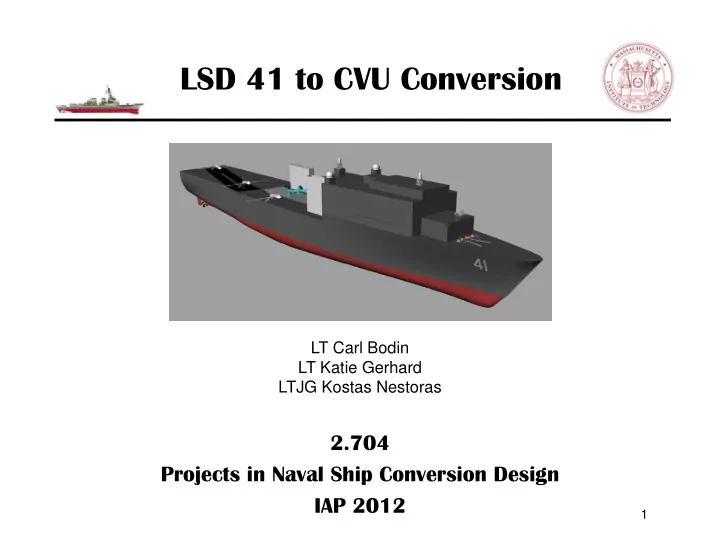
lsd 41 to cvu conversion
SMART_READER_LITE
LIVE PREVIEW

LSD 41 to CVU Conversion LT Carl Bodin LT Katie Gerhard LTJG - - PowerPoint PPT Presentation

LSD 41 to CVU Conversion LT Carl Bodin LT Katie Gerhard LTJG Kostas Nestoras 2.704 Projects in Naval Ship Conversion Design IAP 2012 1 Unmanned Vehicles: A new type of Soldier, Sailor, and Marine On Land In the Air At Sea 2 The


slide-1
SLIDE 1

2.704 Projects in Naval Ship Conversion Design IAP 2012

LSD 41 to CVU Conversion

LT Carl Bodin LT Katie Gerhard LTJG Kostas Nestoras

1
slide-2
SLIDE 2

Unmanned Vehicles: A new type of Soldier, Sailor, and Marine

2

On Land At Sea In the Air

slide-3
SLIDE 3

The vision…

3

slide-4
SLIDE 4

Sponsors

  • We would like to thank the following

people who sponsored this project and assisted the team:

– Mr. Jeffrey Smith, Director of Future Ship and Force Architecture Concepts, Division NAVSEA 05D – Mr. Steven Wynn, NAVSEA 05D

Problem Statement: “Convert an LSD to angled flight deck UAV and USV carrier”

4

slide-5
SLIDE 5

UAV Options

5

High: Example: Global Hawk Wingspan: 116 feet Payload: 4400 lbs. Medium: Example: MQ-9 Reaper Wingspan: 66 feet Payload: 3800 lbs Low: Example: Scan Eagle Wingspan: 10 feet Payload: 11 lbs

slide-6
SLIDE 6

USV Options

6

High: Example: Shadow Length: 39 feet Payload: 5000 lbs. Medium: Example: Spartan Scout Length: 36 feet Payload: 3000 lbs. Low: Example: Stingray Length: 12 feet Payload: 300 lbs.

slide-7
SLIDE 7

Launching System

  • Three variants:

– EMALS – Steam Catapult – None/mobile units

7

slide-8
SLIDE 8

Configuration of the Flight Deck

8

  • Straight runway
  • Angled runway
  • Two runways
  • Ski jump option
slide-9
SLIDE 9

Other Design Parameters

  • Ship’s (Max) Speed

– Low: 20 kts – Medium: 25 kts – High: 30 kts

  • Ship’s Motion

– Fin Stabilizers – No assistance

  • Number of UAV/USV

– High, Medium, Low

9

slide-10
SLIDE 10

Design Philosophy

Convert the LSD 41 into a CVU (Unmanned Aerial and Surface Vehicle Carrier)

  • Emphasizing UAV capabilities over USV
  • Maximizing performance for the lowest cost
  • Accepting higher risk to gain new capability

10

slide-11
SLIDE 11

Decision Framework

11

#12 #2 #16

Design Parameters Initial Number

  • f options

Final Number of

  • ptions

UAV Capability 3 2 Number of UAVs 3 2 Configuration of Flight Deck 6 2 Catapult System 3 1 Ship's Motion Control 2 1 Ship's Speed 3 2 USV Capability 3 2 Number of USVs 3 2

  • Weighted Sum and AHP

decreased variant combinations from 8748 to 64 and then to the final variant

  • Team member experience and

sponsor (weighted) inputs

Variant USV Capability USV Number # 2 Medium Medium # 12 Medium Low # 16 Low Low

  • Final Variant:

UAV Capability Medium USV Number Low UAV Number Medium Ship Speed Medium Flight Deck Angled Catapult System EMALS USV Capability Medium Ship's Motions Control Fin Stabilizers

slide-12
SLIDE 12

Topside View

12

RAM Ku-band SATCOM CIWS CIWS Ku-band SATCOM UAV Elevator UAV ramp Stack Stack Runway Arresting Wires UAV EMALS

RAM

slide-13
SLIDE 13

Internal Arrangement

13

slide-14
SLIDE 14

USV Bay/ Well Deck

14

slide-15
SLIDE 15

New SSDG Location

15

slide-16
SLIDE 16
slide-17
SLIDE 17
slide-18
SLIDE 18

Stability

18

Ship KG GMt Draft CVU 31.97 12.52 17.99 LSD 37.2 8.1 19.5

  • CVU has lower KG and higher GM,

making it more stable

  • Within the roll period of DDG 51 and

CVN LSD 41 Hull

slide-19
SLIDE 19

CVU Seakeeping

19 Overall Stability Profiles (Full Load) NO ski jump Sea State 4 Sea State 5 WITH ski jump

Sea State Wave Characteristic Height [m (ft)] 4 2.26 (7.41) 5 3.53 (11.58) 6 6.16 (20.21) Conditions selected were the worst identified in each sea state

  • Assessment based on STANAG 4154
  • Analysis made with MAXSURF suite
  • Ski Jump enhanced the operability of

CVU and increased her flight

  • perations envelope
  • Full flight operation can be conducted

up to SS5

  • At SS6 only launch operations can be

conducted

  • Effects of fin stabilizers not considered
slide-20
SLIDE 20

Strength

20

  • Stress meets all requirements in the

DDS-100-1 (<8.5 LT/in2 for a combatant)

  • Hangar bay deck considered in

strength calculations

slide-21
SLIDE 21

Cost Estimation

  • Modified 2N Cost Model

– Weight Based Cost estimation – Sponsors provided CERs

  • Base conversion cost calculated, GFE added in

separately

21

  • Cost Estimations

– Base conversion: $95M (FY11$) – GFE cost: $159M (FY11$) for 19 consoles – Total: $254 (FY11$)

slide-22
SLIDE 22

Summary

  • Team & Sponsor Goals met

– Enhanced UAV capability – Angled flight deck – Room for future growth – Met 2N Convergence criteria

22

CVU Characteristics Value Units Length Overall 610 ft Beam 84 ft Draft (Full Load) 17.6 ft Installed Power 6500 kW Light Ship Displacement 11,041 LT Full Load Displacement 14,255 LT Sustained Speed 23 kts Maximum Speed 25 kts Endurance 18 kts Number of UAV 20 Type of UAV MQ‐9 Reaper Number of USV 9 Type of USV Spartan Scout CP 0.604 CB 0.571 CX 0.946