
SLIDE 1
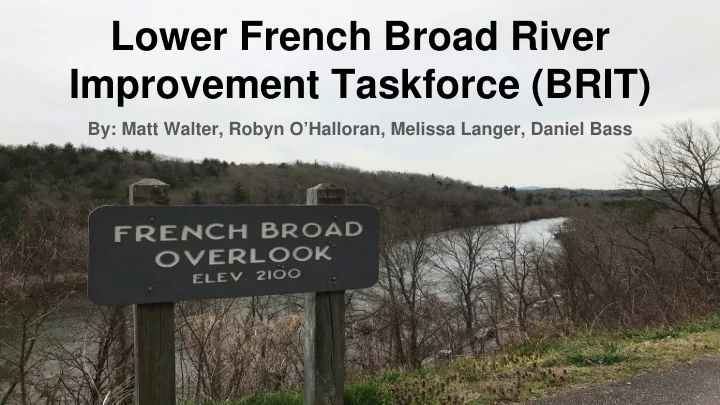
Lower French Broad River Improvement Taskforce (BRIT)
By: Matt Walter, Robyn O’Halloran, Melissa Langer, Daniel Bass
1
Lower French Broad River Improvement Taskforce (BRIT) By: Matt - - PowerPoint PPT Presentation
Lower French Broad River Improvement Taskforce (BRIT) By: Matt Walter, Robyn OHalloran, Melissa Langer, Daniel Bass 1 Contents 1. Lower French Broad River Background 2. BRIT Mission Statement 3. Problem 1: Insufficient Data for Water
By: Matt Walter, Robyn O’Halloran, Melissa Langer, Daniel Bass
1
1. Lower French Broad River Background 2. BRIT Mission Statement 3. Problem 1: Insufficient Data for Water Assessment 4. Problem 2: Nonpoint Source Pollution 5. Problem 3: Habitat Alteration 6. Project Goals
2
counties
3
4
species
and Catfish
5
To protect the 131 rare plant and animal species present in the Lower French Broad River Watershed by removing them from the endangered species list while promoting recreational activities such as rafting and fishing. We hope to achieve
6
What are the causes of the problem?
is residential, meaning many areas are hard to access and there is a lack of people to monitor water quality throughout the area. Why is this a problem?
Watershed have insufficient and outdated water data.
places do not assess streams that the Division of Water Pollution Control cannot access
7
How to improve this problem:
areas and other easily accessible areas of the watershed.
current unmonitored areas that aren’t easily accessible. End goal:
collect data for proper assessment of the watershed therefore the policies currently in place can represent the entire watershed
8
Why is this a problem?
caused many areas in the watershed to go over their Total Daily Maximum Loads through excessive nutrients and dissolved oxygen.
National Park.
the polluters. What are the causes of the problem?
removal of riparian buffers has lead to an increase in nonpoint source pollution as well as erosion.
9
How to improve this problem
farmers.
such as Best Management Practices. ○ Prevent new development on steep slopes to reduce erosion. ○ Prevent urbanization near the water.
○ Use the land for recreational activities, not urbanization. End goal:
Daily Maximum Loads back below the limit to improve the
10
What are the causes of the problem?
utilizing heavy equipment to clean river, impounding water in lakes and ponds, draining/filling wetlands and building dams.
individual landowners and developers. Why is this a problem?
River Watershed has lead to increased released sediment, increased dissolved oxygen, thermal alterations and loss in biodiversity.
11
How to improve this problem?
participating in a trash clean-up day, planting native vegetation along stream, and avoiding extensive use of culverts and heavy equipment.
to mandate a riparian buffer and regulate development into designated areas to protect the natural habitat. End goal:
the vast biodiversity present in the Lower French Broad River
12
G1: Consistently collect water assessment data.
easily accessed areas
Environment and Conservation, Division of Water Pollution Control to collect data in the currently unmonitored areas. G2: Encourage Best Management Practices.
through voluntary actions by landowner and volunteer groups and by new regulations that partake in corrective actions such as Best Management Practices. G3: Preserve habitat through updated zoning
13
To protect the 131 rare plant and animal species present in the Lower French Broad River Watershed by removing them from the endangered species list while promoting recreational activities such as rafting and fishing. We hope to achieve
14
Blue Ridge National Heritage Area. French Broad River. 2018.
Lower French Broad River Watershed (06010107) of the Tennessee River Basin watershed water quality management plan. 2008, United States, Congress, “Wild and Scenic Rivers: Authorized by the Wild and Scenic Rivers Act, Public Law 90-542, October 2, 1968, as Amended.” Wild and Scenic Rivers: Authorized by the Wild and Scenic Rivers Act, Public Law 90-542, October 2, 1968, as Amended, Dept. of the Interior, Bureau of Outdoor Recreation, 1975. “Waste Management Plan for the Lower East Fork Poplar Creek Remedial Action Project Oak Ridge, Tennessee.” 1996, doi:10.2172/432789. “The Watershed Management Plan.” The Watershed Project Management Guide, 2002, doi:10.1201/9781420031645.ch7 15