Low-power test results and analysis of the modular cavity
- D. Bowring1
with A. Haase2, T. Luo3, and J. van Pelt2
1Fermilab, 2SLAC, and 3LBNL
May 11-15, 2014
- D. Bowring (FNAL)
Modular Cavity Status May 11-15, 2014 1 / 18
Low-power test results and analysis of the modular cavity D. - - PowerPoint PPT Presentation
Low-power test results and analysis of the modular cavity D. Bowring 1 with A. Haase 2 , T. Luo 3 , and J. van Pelt 2 1 Fermilab, 2 SLAC, and 3 LBNL May 11-15, 2014 D. Bowring (FNAL) Modular Cavity Status May 11-15, 2014 1 / 18 1.
with A. Haase2, T. Luo3, and J. van Pelt2
1Fermilab, 2SLAC, and 3LBNL
May 11-15, 2014
Modular Cavity Status May 11-15, 2014 1 / 18
Modular Cavity Status May 11-15, 2014 2 / 18
What was done?
1
Repair N-to-975 adapter piece
2
With dead-soft OFHC Cu gaskets and no vacuum seal, measure RF properties as a function of clamping bolt torque.
3
Open cavity, replace gaskets, seal cavity again.
4
Repeat item # 2.
5
Profilometry on gaskets to assess “knife edge” indentation on
angular position. (This work is in progress.)
6
Discuss/plan for final proposal & discussion at MAP meeting.
By whom?
Andy Haase (SLAC) Tianhuan Luo (LBNL) John van Pelt (SLAC) Daniel Bowring (FNAL)
Modular Cavity Status May 11-15, 2014 3 / 18
We observed critical coupling using both sets of gaskets. Tightening clamp bolts improved RF properties monotonically and
inch-pounds of torque and 90 in-lbs in either case. Measurements were repeatable on loosening/re-tightening clamp
for repair options, to be discussed later in this talk.
Modular Cavity Status May 11-15, 2014 4 / 18
Modular Cavity Status May 11-15, 2014 5 / 18
1 Prior to her visit, the vacuum gaskets were removed from the cavity.
The dead-soft, OFHC Cu RF gaskets were left in.
2 During shipping, the N-to-975 adapter piece was damaged. This
damage was repaired. We observed some minor loss in the system during measurement (see below) that may be explained by this damage/repair process.
3 Bolts tightened with a torque wrench in 10 inch-pounnd increments.
Frequency, Q measured at each increment.
4 Asymptotic behavior observed at and above 80 inch-pounds.
Modular Cavity Status May 11-15, 2014 6 / 18
Ql 11903 beta 0.948 Q0 23188 Qe 24408 f0 f1 f2 f3 f4 804.615 6 804.633 6 804.598 9 804.648 9 804.581 3 Ql measured by s21 -3dB points is 11893.
Modular Cavity Status May 11-15, 2014 7 / 18
Modular Cavity Status May 11-15, 2014 8 / 18
Modular Cavity Status May 11-15, 2014 9 / 18
Modular Cavity Status May 11-15, 2014 10 / 18
Modular Cavity Status May 11-15, 2014 11 / 18
Modular Cavity Status May 11-15, 2014 12 / 18
Modular Cavity Status May 11-15, 2014 13 / 18
Modular Cavity Status May 11-15, 2014 14 / 18
Modular Cavity Status May 11-15, 2014 15 / 18
Modular Cavity Status May 11-15, 2014 16 / 18
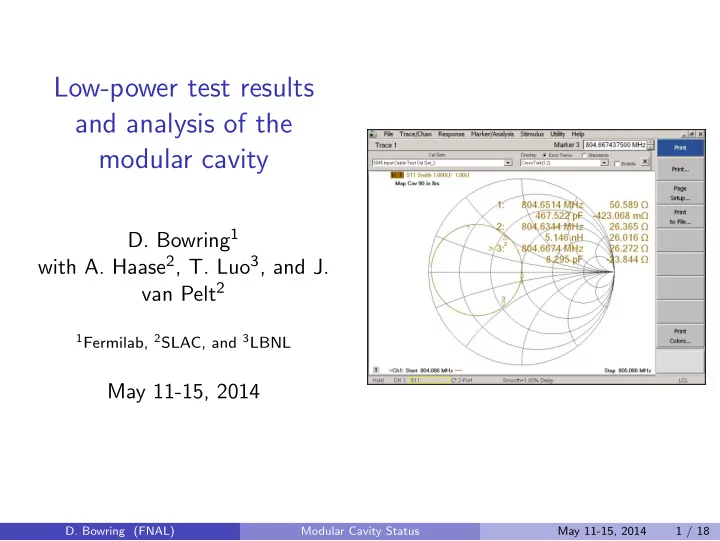
β ≈ 1, f = 804.65 MHz.
Modular Cavity Status May 11-15, 2014 17 / 18
After measurement at 100 inch-pounds, loosen upstream bolts to finger-tight. Tightening/loosening bolts moves repeatably between outer/inner circle. ∼ 10o tightening on two bolts is sufficient to make this transition!
Modular Cavity Status May 11-15, 2014 18 / 18
End plate, gasket deform during clamping to make RF seal. Good news: This is demonstrably easy in this case. Bad news: We don’t control the deformation! This gives further support to SLAC’s proposed clamp ring re-design. c.f. “push bolts”.
Modular Cavity Status May 11-15, 2014 19 / 18
1 SLAC will make their complete proposal at the MAP meeting. 2 On Tuesday they’ll circulate a written report so we can all be on the
same page, prepared for the MAP meeting.
3 They’re currently evaluating a design that uses Mo-alloyed “super
bolts”. These would eliminate the need to drill/tap new holes in the cavity.
4 I have a lot of photos to upload to the MTA site.
Modular Cavity Status May 11-15, 2014 20 / 18