
SLIDE 1
Low-Energy, Low-Cost Drip Irrigation and Desalination: Innovations from the MIT GEAR Lab
Amos G. Winter, V, PhD Ratan N. Tata Associate Professor of Mechanical Engineering Director, Global Engineering and Research (GEAR) Laboratory Massachusetts Institute of Technology http://gear.mit.edu/ The Global Engineering and Research (GEAR) Laboratory (http://gear.mit.edu/) characterizes the unique technical and socioeconomic constraints of emerging markets, then combines these insights with engineering science and product design to create high-performance, low-cost, globally-relevant technologies. This talk will focus on GEAR Lab’s innovations in water technologies: drip irrigation systems that require one-half the pumping power as conventional technology, lowering the capital cost of off-grid systems by up to 40%; and innovations in electrodialysis (ED) desalination that include photovoltaic (PV)-powered systems that are 40% less expensive than current technol-
- gy, and ED stack designs which cut capital cost or production time by more than 50%. In addition to advancing the
science and design knowledge in these areas, these projects have manifested in new engineering hardware and field tests with target stakeholders. Furthermore, by providing high-value, low-cost solutions, each project has become a “reverse innovation”, with variants of the technology now transferring to global markets.
Low-power drip irrigation
A B
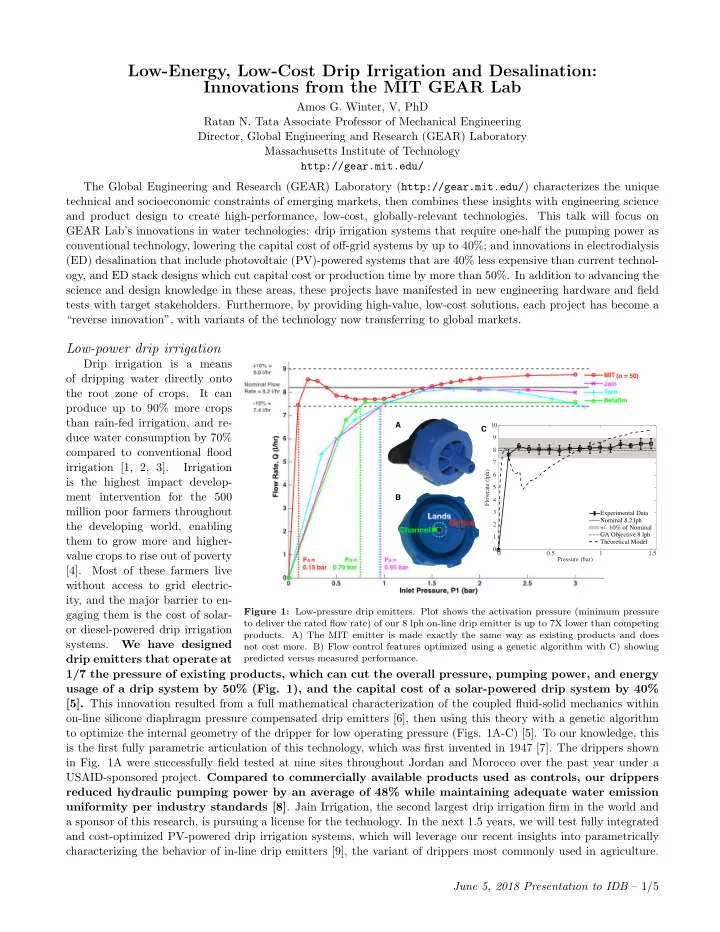
0.5 1 1.5 Pressure (bar) 1 2 3 4 5 6 7 8 9 10 Flowrate (lph) +/- 10% of Nominal Nominal 8.2 lph Experimental Data GA Objective 8 lph Theoretical Model
A
C
(n = 50)
Figure 1: Low-pressure drip emitters. Plot shows the activation pressure (minimum pressure to deliver the rated flow rate) of our 8 lph on-line drip emitter is up to 7X lower than competing
- products. A) The MIT emitter is made exactly the same way as existing products and does
not cost more. B) Flow control features optimized using a genetic algorithm with C) showing predicted versus measured performance.
Drip irrigation is a means
- f dripping water directly onto
the root zone of crops. It can produce up to 90% more crops than rain-fed irrigation, and re- duce water consumption by 70% compared to conventional flood irrigation [1, 2, 3]. Irrigation is the highest impact develop- ment intervention for the 500 million poor farmers throughout the developing world, enabling them to grow more and higher- value crops to rise out of poverty [4]. Most of these farmers live without access to grid electric- ity, and the major barrier to en- gaging them is the cost of solar-
- r diesel-powered drip irrigation
systems. We have designed drip emitters that operate at 1/7 the pressure of existing products, which can cut the overall pressure, pumping power, and energy usage of a drip system by 50% (Fig. 1), and the capital cost of a solar-powered drip system by 40% [5]. This innovation resulted from a full mathematical characterization of the coupled fluid-solid mechanics within
- n-line silicone diaphragm pressure compensated drip emitters [6], then using this theory with a genetic algorithm