Long-Term Research and Capacity Building at SIPI, NMSU Erin Riley , - - PowerPoint PPT Presentation

long term research and capacity building at sipi nmsu
SMART_READER_LITE
LIVE PREVIEW

Long-Term Research and Capacity Building at SIPI, NMSU Erin Riley , - - PowerPoint PPT Presentation

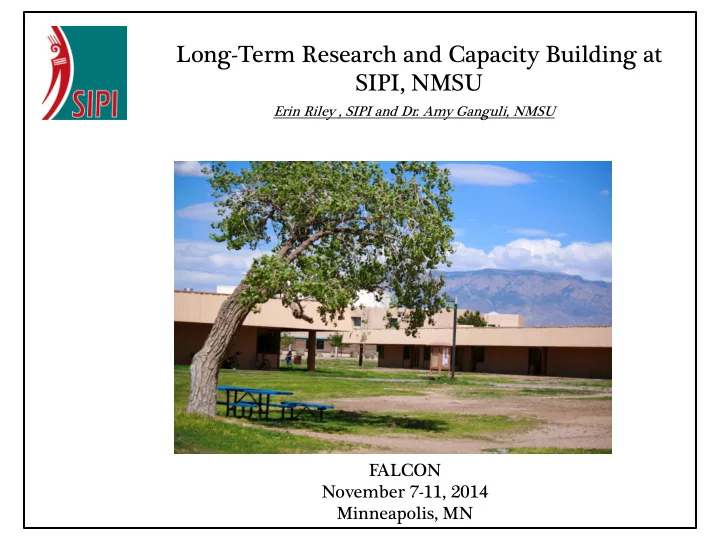
Long-Term Research and Capacity Building at SIPI, NMSU Erin Riley , SIPI and Dr. Amy Ganguli, NMSU FALCON November 7-11, 2014 Minneapolis, MN Natural Resources Management Program The Natural Resources Management Program will prepare students

slide-1
SLIDE 1

Long-Term Research and Capacity Building at SIPI, NMSU

Erin Riley , SIPI and Dr. Amy Ganguli, NMSU

FALCON November 7-11, 2014 Minneapolis, MN

slide-2
SLIDE 2

Natural Resources Management Program

SIPI Natural Resource Management students, Dustin Toledo, learn wildlife management practices at Valles Caldera National Preserve Students from NATR 221 collecting plants for the herbarium

The Natural Resources Management Program will prepare students to enter the natural resources field at the technical level with the knowledge and skills required to meet current employment standards. GOA OALS

  • Students will be able to work as technicians in the field of Natural

Resources

  • Students will be able to serve as leaders in the field of Natural Resources
slide-3
SLIDE 3

1994 Land Grant Research Leadership Development Initiative

Partne ners

  • 1. New Mexico State University
  • 2. United State Forest Service
  • 3. Agriculture Research Service
  • 4. First Americans Land-Grant Consortium (FALCON)
slide-4
SLIDE 4

1994 Land Grant Research Leadership Development Initiative

Goa Goals

  • 1. Increase the 1994’s Land Grant Institutional Research Capabilities
  • 2. Collaborate with mentors to assist in publishing peer reviewed

journals

  • 3. Build a culturally appropriate herbarium

Inside SIPI’s greenhouse SIPI’s Hogan

slide-5
SLIDE 5
  • 1. Increase the 1994’s Land-

Grant Institutional Research Capabilities

  • Short Term Research Capabilities
  • 3 Day Workshop in Las Cruces, NM
  • Webinars
  • Long-Term Research Capabilities
  • Long Term Plots on SIPI campus
  • Storage of Data and Metadata
slide-6
SLIDE 6
  • 1. Increase the 1994’s Land-

Grant Institutional Research Capabilities

  • Workshop in Las Cruces, NM
  • Day 1: The Jornada Long-Term Ecological Research Center
  • Day 2: NMSU Research Facilities and the Chijuajuan Desert

Rangeland Research Center, Dr. Danielle Lansing and

  • Dr. Leola Tsinnajinnie
  • Day 3: Dr. Richard Ford, Dr. Mary O’Connell, Dr. Lois Stanford
slide-7
SLIDE 7

Long-Term Research Workshop Attendees Comments

  • Please D

se Desc scrib ibe h e how your i inst stitution i is buildin ing i g its s resea earch c capabil ilit ities ies:

  • Identify culturally accepted research in tribal communities
  • MOU’s and programs with FS, and Land Grant institutions
  • Establishing consistent funding
  • Having a long term mission
  • Wha

What c can be improved up upon?

  • Not so much time in the classroom
  • Hear more about the local ecology, plants, animals
  • Incorporate more handouts to assist presenters
  • Keeping an indigenous perspective for TCU’s
  • What m

method

  • ds w

will y you incor

  • rpor
  • rate i

into y

  • your prog
  • gram?
  • Hands on lab work
  • Culturally relevant curriculum
  • Small scale long-term research
  • Smartphone apps
slide-8
SLIDE 8

Long-Term Research Workshop

slide-9
SLIDE 9

Long-Term Plots at the SIPI campus

slide-10
SLIDE 10

Long-Term Plots at the SIPI campus

slide-11
SLIDE 11
  • 2. Collaborate with mentors to

assist in publishing peer reviewed journals

  • Peer review journal and a platform for continued research

and scholarly activity

The American Naturalist, Vol. 20, No. 9 (Sept., 1886), pp 767-777

slide-12
SLIDE 12
  • 3. Build a culturally

appropriate herbarium

Zéé’iilwo’ii Hordeum jubatum Foxtail barley Ts’ah Artemesia tridentata Big Sagebrush Muhlenbergia arenicola Sand muhly

Navajo

slide-13
SLIDE 13

Exciting Things to Come

  • Workshop with the Forest Service (February,

2015)

  • Four webinars that will be disseminated towards

all TCU’s (Dr. Greg Cajete and Dr. Richard Ford)

  • Long-Term Research Workshop next year……
  • Publication from the experience
slide-14
SLIDE 14

Questions?

slide-15
SLIDE 15

Project Team

  • Project Directors

– Erin Riley (Lead PD, SIPI) – Amy Ganguli (Co-PD, NMSU)

  • Tribal Mentors

– Leola Tsinnajinnie (SIPI) – Justin McHorse (NMSU)

slide-16
SLIDE 16

Project Team (continued)

  • Federal Agency Participants

– Dr. Kris Havstead (ARS) – Dr. Debora Finch (USFS/RMRS)

  • NIFA Oversight

– Tim Grosser, Jill Lee, & Staff

slide-17
SLIDE 17

New Mexico State University (NMSU)

  • New Mexico’s Land Grant Institution
  • Mission: serve the educational needs of New

Mexico’s population through education, research, extension education, and service to the public

slide-18
SLIDE 18

New Mexico State University (NMSU)

  • Hispanic Serving Institution
  • NASA Space Grant College
  • 5 campuses with 28,262 active students in

2013 (16,765 in Las Cruces)

slide-19
SLIDE 19

New Mexico State University (NMSU, Las

Cruces)

  • Student Demographic

– full time 77.6%, part time 22.4% – ♂ 45.9%, ♀ 54.1%

  • Ethnicity

– American Indian & Alaskan Native 2.3% – Hispanic 48.5% – African American & Black 2.9%

slide-20
SLIDE 20

Research Facilities

(NMSU, Animal & Range Science Department)

  • 4 on-campus animal handling facilities,

numerous clean and “dirty” laboratories

  • Range Science Herbarium (~30,000 species)
  • Chihuahuan Desert Rangeland Research Center

(~64,000 acres)

  • Corona Ranch/Livestock Research Center
slide-21
SLIDE 21

Expectations of ARS, USFS, & NIFA

  • Training to help us achieve the goals associated

with this project (USFS & ARS)

  • Insight and direction on how we can build on this

project to contribute to USDA’s diversity initiatives (NIFA, USFS, & ARS)

slide-22
SLIDE 22

Advanced Technical Education Department

Progr gram Ar Areas: s:

  • Computer Aided Drafting and

Design

  • Culinary Arts
  • Geospatial Information

Technology

  • Natural Resources Management
  • Network Management
  • Pre-Engineering
  • Vision Care Technology
slide-23
SLIDE 23

SIPI Campus

slide-24
SLIDE 24

Natural Resources Management Program

SIPI Natural Resource Management students, Andy and Arlo, learn range management practices at Valles Caldera National Preserve Students from the Introduction to Fish and Wildlife Management Lab key birds at the Bosque del Apache National Wildlife Refuge

The Natural Resources Management Program will provide students with current knowledge and skills to be proficient in the technical aspects of resource management and graduate individuals with scientific base knowledge to perform successfully in tribal, private, non-government organizations (NGO’s), state, and federal organizations as well as transfer successfully into bachelor degree programs.

slide-25
SLIDE 25
  • 3. Build a culturally

appropriate herbarium

Narrowleaf Yucca Yucca angustissima Fremont Cottonwood Populus fremontii Annual Sunflower Helianthus annuus

Santa Domingo

slide-26
SLIDE 26

SIPI Archive

slide-27
SLIDE 27

SIPI Archive

slide-28
SLIDE 28
  • 1. Increase the 1994’s Land-

Grant Institutional Research Capabilities

  • Day1:
  • Long-term quadrat study
  • LTER Above Ground Net Primary Production Study
  • JORNEX
  • Phenology
  • NEON
  • Restore New Mexico
  • STATISTICS and EXPERIMENTAL DESIGN
slide-29
SLIDE 29
  • 1. Increase the 1994’s Land-

Grant Institutional Research Capabilities

  • Day2:
  • Use of Repeat Photography as part of a long-term

monitoring project.

  • Grasssnap
  • SoilWeb
  • Establishment and maintenance of long-term research and

Monitoring sites

  • Dr. Danielle Lansing and Leola Tsinnajinne, SIPI creating an

Indigenous Research Framework Across Disciplines in the TCU Movement

slide-30
SLIDE 30
  • 1. Increase the 1994’s Land-

Grant Institutional Research Capabilities

  • Day3:
  • Dr. Richard Ford, Arthur F. Thurnau Emeritus Professor of

Anthropology and Botany, University of Michigan Traditional Ecological Knowledge

  • Dr. Mary O’Connell, Professor of Plant and Environmental

Sciences, the abundance and composition of bioactive chemicals in medicinal plants

  • Dr. Lois Stanford, Associate Professor of Anthropology, NMSU

Anthropological Methods in Documenting Traditional Plants and Cultural Knowledge