Logistics Midterm we will be in two rooms The room you are assigned - - PowerPoint PPT Presentation

logistics
SMART_READER_LITE
LIVE PREVIEW

Logistics Midterm we will be in two rooms The room you are assigned - - PowerPoint PPT Presentation

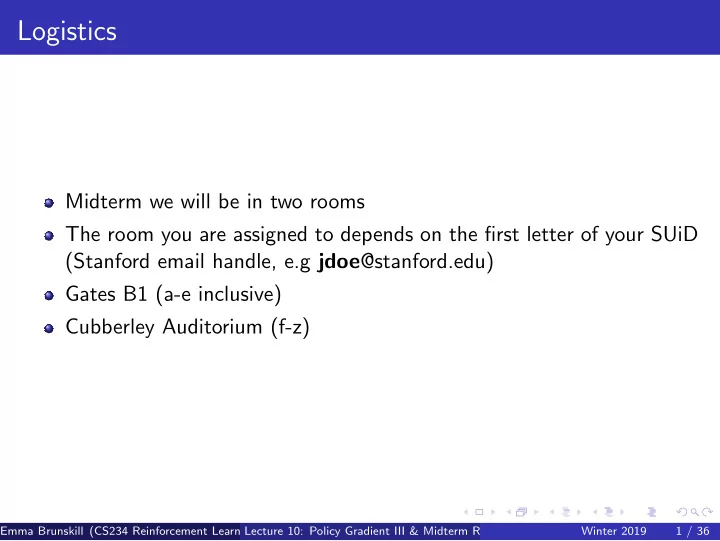
Logistics Midterm we will be in two rooms The room you are assigned to depends on the first letter of your SUiD (Stanford email handle, e.g jdoe @stanford.edu) Gates B1 (a-e inclusive) Cubberley Auditorium (f-z) Lecture 10: Policy Gradient III


slide-1
SLIDE 1

Logistics

Midterm we will be in two rooms The room you are assigned to depends on the first letter of your SUiD (Stanford email handle, e.g jdoe@stanford.edu) Gates B1 (a-e inclusive) Cubberley Auditorium (f-z)

Emma Brunskill (CS234 Reinforcement Learning. ) Lecture 10: Policy Gradient III & Midterm Review 1 Winter 2019 1 / 36

slide-2
SLIDE 2

Lecture 10: Policy Gradient III & Midterm Review 1

Emma Brunskill

CS234 Reinforcement Learning.

Winter 2019 Additional reading: Sutton and Barto 2018 Chp. 13

1With many policy gradient slides from or derived from David Silver and John Schulman and Pieter Abbeel

Emma Brunskill (CS234 Reinforcement Learning. ) Lecture 10: Policy Gradient III & Midterm Review 1 Winter 2019 2 / 36

slide-3
SLIDE 3

Class Structure

Last time: Policy Search This time: Policy Search & Midterm Review Next time: Midterm

Emma Brunskill (CS234 Reinforcement Learning. ) Lecture 10: Policy Gradient III & Midterm Review 1 Winter 2019 3 / 36

slide-4
SLIDE 4

Recall: Policy-Based RL

Policy search: directly parametrize the policy πθ(s, a) = P[a|s; θ] Goal is to find a policy π with the highest value function V π Focus on policy gradient methods

Emma Brunskill (CS234 Reinforcement Learning. ) Lecture 10: Policy Gradient III & Midterm Review 1 Winter 2019 4 / 36

slide-5
SLIDE 5

”Vanilla” Policy Gradient Algorithm

Initialize policy parameter θ, baseline b for iteration=1, 2, · · · do Collect a set of trajectories by executing the current policy At each timestep t in each trajectory τ i, compute Return G i

t = T−1 t′=t ri t′, and

Advantage estimate ˆ Ai

t = G i t − b(st).

Re-fit the baseline, by minimizing

i

  • t ||b(st) − G i

t||2,

Update the policy, using a policy gradient estimate ˆ g, Which is a sum of terms ∇θ log π(at|st, θ) ˆ At. (Plug ˆ g into SGD or ADAM) endfor

Emma Brunskill (CS234 Reinforcement Learning. ) Lecture 10: Policy Gradient III & Midterm Review 1 Winter 2019 5 / 36

slide-6
SLIDE 6

Choosing the Target

G i

t is an estimation of the value function at st from a single roll out

Unbiased but high variance Reduce variance by introducing bias using bootstrapping and function approximation

Just like in we saw for TD vs MC, and value function approximation

Estimate of V /Q is done by a critic Actor-critic methods maintain an explicit representation of policy and the value function, and update both A3C (Mnih et al. ICML 2016) is a very popular actor-critic method

Emma Brunskill (CS234 Reinforcement Learning. ) Lecture 10: Policy Gradient III & Midterm Review 1 Winter 2019 6 / 36

slide-7
SLIDE 7

”Vanilla” Policy Gradient Algorithm

Initialize policy parameter θ, baseline b for iteration=1, 2, · · · do Collect a set of trajectories by executing the current policy At each timestep t in each trajectory τ i, compute Target ˆ Ri

t

Advantage estimate ˆ Ai

t = G i t − b(st).

Re-fit the baseline, by minimizing

i

  • t ||b(st) − ˆ

Ri

t||2,

Update the policy, using a policy gradient estimate ˆ g, Which is a sum of terms ∇θ log π(at|st, θ) ˆ At. (Plug ˆ g into SGD or ADAM) endfor

Emma Brunskill (CS234 Reinforcement Learning. ) Lecture 10: Policy Gradient III & Midterm Review 1 Winter 2019 7 / 36

slide-8
SLIDE 8

Policy Gradient Methods with Auto-Step-Size Selection

Can we automatically ensure the updated policy π′ has value greater than or equal to the prior policy π: V π′ ≥ V π? Consider this for the policy gradient setting, and hope to address this by modifying step size

Emma Brunskill (CS234 Reinforcement Learning. ) Lecture 10: Policy Gradient III & Midterm Review 1 Winter 2019 8 / 36

slide-9
SLIDE 9

Objective Function

Goal: find policy parameters that maximize value function1 V (θ) = Eπθ ∞

  • t=0

γtR(st, at); πθ

  • where s0 ∼ µ(s0), at ∼ π(at|st), st+1 ∼ P(st+1|st, at)

Have access to samples from the current policy πθold (param. by θold) Want to predict the value of a different policy (off policy learning!)

1For today we will primarily consider discounted value functions

Emma Brunskill (CS234 Reinforcement Learning. ) Lecture 10: Policy Gradient III & Midterm Review 1 Winter 2019 9 / 36

slide-10
SLIDE 10

Objective Function

Goal: find policy parameters that maximize value function1 V (θ) = Eπθ ∞

  • t=0

γtR(st, at); πθ

  • where s0 ∼ µ(s0), at ∼ π(at|st), st+1 ∼ P(st+1|st, at)

Express expected return of another policy in terms of the advantage

  • ver the original policy

V (˜ θ) = V (θ) + Eπ ˜

θ

  • t=0

γtAπ(st, at)

  • = V (θ) +
  • s

µ˜

π(s)

  • a

˜ π(a|s)Aπ(s, a)

where µ˜

π(s) is defined as the discounted weighted frequency of state

s under policy ˜ π (similar to in Imitation Learning lecture) We know the advantage Aπ and ˜ π But we can’t compute the above because we don’t know µ˜

π, the

state distribution under the new proposed policy

1For today we will primarily consider discounted value functions

Emma Brunskill (CS234 Reinforcement Learning. ) Lecture 10: Policy Gradient III & Midterm Review 1 Winter 2019 10 / 36

slide-11
SLIDE 11

Table of Contents

1

Updating the Parameters Given the Gradient: Local Approximation

2

Updating the Parameters Given the Gradient: Trust Regions

3

Updating the Parameters Given the Gradient: TRPO Algorithm

Emma Brunskill (CS234 Reinforcement Learning. ) Lecture 10: Policy Gradient III & Midterm Review 1 Winter 2019 11 / 36

slide-12
SLIDE 12

Local approximation

Can we remove the dependency on the discounted visitation frequencies under the new policy? Substitute in the discounted visitation frequencies under the current policy to define a new objective function: Lπ(˜ π) = V (θ) +

  • s

µπ(s)

  • a

˜ π(a|s)Aπ(s, a) Note that Lπθ0(πθ0) = V (θ0) Gradient of L is identical to gradient of value function at policy parameterized evaluated at θ0: ∇θLπθ0(πθ)|θ=θ0 = ∇θV (θ)|θ=θ0

Emma Brunskill (CS234 Reinforcement Learning. ) Lecture 10: Policy Gradient III & Midterm Review 1 Winter 2019 12 / 36

slide-13
SLIDE 13

Conservative Policy Iteration

Is there a bound on the performance of a new policy obtained by

  • ptimizing the surrogate objective?

Consider mixture policies that blend between an old policy and a different policy πnew(a|s) = (1 − α)πold(a|s) + απ′(a|s) In this case can guarantee a lower bound on value of the new πnew: V πnew ≥ Lπold(πnew) − 2ǫγ (1 − γ)2 α2 where ǫ = maxs

  • Ea∼π′(a|s) [Aπ(s, a)]
  • Emma Brunskill (CS234 Reinforcement Learning. )

Lecture 10: Policy Gradient III & Midterm Review 1 Winter 2019 13 / 36

slide-14
SLIDE 14

Find the Lower-Bound in General Stochastic Policies

Would like to similarly obtain a lower bound on the potential performance for general stochastic policies (not just mixture policies) Recall Lπ(˜ π) = V (θ) +

s µπ(s) a ˜

π(a|s)Aπ(s, a)

Theorem

Let Dmax

TV (π1, π2) = maxs DTV (π1(·|s), π2(·|s)). Then

V πnew ≥ Lπold(πnew) − 4ǫγ (1 − γ)2 (Dmax

TV (πold, πnew))2

where ǫ = maxs,a |Aπ(s, a)|.

Emma Brunskill (CS234 Reinforcement Learning. ) Lecture 10: Policy Gradient III & Midterm Review 1 Winter 2019 14 / 36

slide-15
SLIDE 15

Find the Lower-Bound in General Stochastic Policies

Would like to similarly obtain a lower bound on the potential performance for general stochastic policies (not just mixture policies) Recall Lπ(˜ π) = V (θ) +

s µπ(s) a ˜

π(a|s)Aπ(s, a)

Theorem

Let Dmax

TV (π1, π2) = maxs DTV (π1(·|s), π2(·|s)). Then

V πnew ≥ Lπold(πnew) − 4ǫγ (1 − γ)2 (Dmax

TV (πold, πnew))2

where ǫ = maxs,a |Aπ(s, a)|. Note that DTV (p, q)2 ≤ DKL(p, q) for prob. distrib p and q. Then the above theorem immediately implies that V πnew ≥ Lπold(πnew) − 4ǫγ (1 − γ)2 Dmax

KL (πold, πnew)

where Dmax

KL (π1, π2) = maxs DKL(π1(·|s), π2(·|s))

Emma Brunskill (CS234 Reinforcement Learning. ) Lecture 10: Policy Gradient III & Midterm Review 1 Winter 2019 15 / 36

slide-16
SLIDE 16

Guaranteed Improvement1

Goal is to compute a policy that maximizes the objective function defining the lower bound:

1Lπ(˜

π) = V (θ) +

s µπ(s) a ˜

π(a|s)Aπ(s, a) Emma Brunskill (CS234 Reinforcement Learning. ) Lecture 10: Policy Gradient III & Midterm Review 1 Winter 2019 16 / 36

slide-17
SLIDE 17

Guaranteed Improvement1

Goal is to compute a policy that maximizes the objective function defining the lower bound: Mi(π) = Lπi(π) − 4ǫγ (1 − γ)2 Dmax

KL (πi, π)

V πi+1 ≥ Lπi(π) − 4ǫγ (1 − γ)2 Dmax

KL (πi, π) = Mi(πi+1)

V πi = Mi(πi) V πi+1 − V πi ≥ Mi(πi+1) − Mi(πi) So as long as the new policy πi+1 is equal or an improvement compared to the old policy πi with respect to the lower bound, we are guaranteed to to monotonically improve! The above is a type of Minorization-Maximization (MM) algorithm

1Lπ(˜

π) = V (θ) +

s µπ(s) a ˜

π(a|s)Aπ(s, a) Emma Brunskill (CS234 Reinforcement Learning. ) Lecture 10: Policy Gradient III & Midterm Review 1 Winter 2019 17 / 36

slide-18
SLIDE 18

Guaranteed Improvement1

V πnew ≥ Lπold(πnew) − 4ǫγ (1 − γ)2 Dmax

KL (πold, πnew)

Figure: Source: John Schulman, Deep Reinforcement Learning, 2014

1Lπ(˜

π) = V (θ) +

s µπ(s) a ˜

π(a|s)Aπ(s, a) Emma Brunskill (CS234 Reinforcement Learning. ) Lecture 10: Policy Gradient III & Midterm Review 1 Winter 2019 18 / 36

slide-19
SLIDE 19

Table of Contents

1

Updating the Parameters Given the Gradient: Local Approximation

2

Updating the Parameters Given the Gradient: Trust Regions

3

Updating the Parameters Given the Gradient: TRPO Algorithm

Emma Brunskill (CS234 Reinforcement Learning. ) Lecture 10: Policy Gradient III & Midterm Review 1 Winter 2019 19 / 36

slide-20
SLIDE 20

Optimization of Parameterized Policies1

Goal is to optimize

max

θ

Lθold(θnew) − 4ǫγ (1 − γ)2 Dmax

KL (θold, θnew) = Lθold(θnew) − CDmax KL (θold, θnew)

where C is the penalty coefficient In practice, if we used the penalty coefficient recommended by the theory above C =

4ǫγ (1−γ)2 , the step sizes would be very small

1Lπ(˜

π) = V (θ) +

s µπ(s) a ˜

π(a|s)Aπ(s, a) Emma Brunskill (CS234 Reinforcement Learning. ) Lecture 10: Policy Gradient III & Midterm Review 1 Winter 2019 20 / 36

slide-21
SLIDE 21

Optimization of Parameterized Policies1

Goal is to optimize

max

θ

Lθold(θnew) − 4ǫγ (1 − γ)2 Dmax

KL (θold, θnew) = Lθold(θnew) − CDmax KL (θold, θnew)

where C is the penalty coefficient In practice, if we used the penalty coefficient recommended by the theory above C =

4ǫγ (1−γ)2 , the step sizes would be very small

New idea: Use a trust region constraint on step sizes (Schulman, Levine, Abbeel, Jordan, & Moritz ICML 2015). Do this by imposing a constraint on the KL divergence between the new and old policy. max

θ

Lθold(θ) subject to D

s∼µθold KL

(θold, θ) ≤ δ This uses the average KL instead of the max (the max requires the KL is bounded at all states and yields an impractical number of constraints)

1Lπ(˜

π) = V (θ) +

s µπ(s) a ˜

π(a|s)Aπ(s, a) Emma Brunskill (CS234 Reinforcement Learning. ) Lecture 10: Policy Gradient III & Midterm Review 1 Winter 2019 21 / 36

slide-22
SLIDE 22

From Theory to Practice

Prior objective: max

θ

Lθold(θ) subject to D

s∼µθold KL

(θold, θ) ≤ δ where Lθold(θ) = V (θ) +

s µθold(s) a π(a|s, θ)Aθold(s, a)

Don’t know the discounted visitation weights nor true advantage function Instead do the following substitutions:

  • s

µθold(s) → 1 1 − γ Es∼µθold [. . .],

Emma Brunskill (CS234 Reinforcement Learning. ) Lecture 10: Policy Gradient III & Midterm Review 1 Winter 2019 22 / 36

slide-23
SLIDE 23

From Theory to Practice

Next substitution:

  • a

πθ(a|sn)Aθold(sn, a) → Ea∼q πθ(a|sn) q(a|sn) Aθold(sn, a)

  • where q is some sampling distribution over the actions and sn is a

particular sampled state. This second substitution is to use importance sampling to estimate the desired sum, enabling the use of an alternate sampling distribution q (other than the new policy πθ).

Emma Brunskill (CS234 Reinforcement Learning. ) Lecture 10: Policy Gradient III & Midterm Review 1 Winter 2019 23 / 36

slide-24
SLIDE 24

From Theory to Practice

Third substitution: Aθold → Qθold Note that these 3 substitutions do not change the solution to the above optimization problem

Emma Brunskill (CS234 Reinforcement Learning. ) Lecture 10: Policy Gradient III & Midterm Review 1 Winter 2019 24 / 36

slide-25
SLIDE 25

Selecting the Sampling Policy

Optimize max

θ

Es∼µθold ,a∼q πθ(a|s) q(a|s) Qθold(s, a)

  • subject to Es∼µθold DKL(πθold(·|s), πθ(·|s)) ≤ δ

Emma Brunskill (CS234 Reinforcement Learning. ) Lecture 10: Policy Gradient III & Midterm Review 1 Winter 2019 25 / 36

slide-26
SLIDE 26

Selecting the Sampling Policy

Optimize max

θ

Es∼µθold ,a∼q πθ(a|s) q(a|s) Qθold(s, a)

  • subject to Es∼µθold DKL(πθold(·|s), πθ(·|s)) ≤ δ

Standard approach: sampling distribution is q(a|s) is simply πold(a|s) For the vine procedure see the paper

Figure: Trust Region Policy Optimization, Schulman et al, 2015

Emma Brunskill (CS234 Reinforcement Learning. ) Lecture 10: Policy Gradient III & Midterm Review 1 Winter 2019 26 / 36

slide-27
SLIDE 27

Searching for the Next Parameter

Use a linear approximation to the objective function and a quadratic approximation to the constraint Constrained optimization problem Use conjugate gradient descent

schulman2015trust Emma Brunskill (CS234 Reinforcement Learning. ) Lecture 10: Policy Gradient III & Midterm Review 1 Winter 2019 27 / 36

slide-28
SLIDE 28

Table of Contents

1

Updating the Parameters Given the Gradient: Local Approximation

2

Updating the Parameters Given the Gradient: Trust Regions

3

Updating the Parameters Given the Gradient: TRPO Algorithm

Emma Brunskill (CS234 Reinforcement Learning. ) Lecture 10: Policy Gradient III & Midterm Review 1 Winter 2019 28 / 36

slide-29
SLIDE 29

Practical Algorithm: TRPO

1: for iteration=1, 2, . . . do 2:

Run policy for T timesteps or N trajectories

3:

Estimate advantage function at all timesteps

4:

Compute policy gradient g

5:

Use CG (with Hessian-vector products) to compute F −1g where F is the Fisher information matrix

6:

Do line search on surrogate loss and KL constraint

7: end for

schulman2015trust Emma Brunskill (CS234 Reinforcement Learning. ) Lecture 10: Policy Gradient III & Midterm Review 1 Winter 2019 29 / 36

slide-30
SLIDE 30

Practical Algorithm: TRPO

Applied to Locomotion controllers in 2D

Figure: Trust Region Policy Optimization, Schulman et al, 2015

Atari games with pixel input

schulman2015trust Emma Brunskill (CS234 Reinforcement Learning. ) Lecture 10: Policy Gradient III & Midterm Review 1 Winter 2019 30 / 36

slide-31
SLIDE 31

TRPO Results

Figure: Trust Region Policy Optimization, Schulman et al, 2015

Emma Brunskill (CS234 Reinforcement Learning. ) Lecture 10: Policy Gradient III & Midterm Review 1 Winter 2019 31 / 36

slide-32
SLIDE 32

TRPO Results

Figure: Trust Region Policy Optimization, Schulman et al, 2015

Emma Brunskill (CS234 Reinforcement Learning. ) Lecture 10: Policy Gradient III & Midterm Review 1 Winter 2019 32 / 36

slide-33
SLIDE 33

TRPO Summary

Policy gradient approach Uses surrogate optimization function Automatically constrains the weight update to a trusted region, to approximate where the first order approximation is valid Empirically consistently does well Very influential: +350 citations since introduced a few years ago

Emma Brunskill (CS234 Reinforcement Learning. ) Lecture 10: Policy Gradient III & Midterm Review 1 Winter 2019 33 / 36

slide-34
SLIDE 34

Common Template of Policy Gradient Algorithms

1: for iteration=1, 2, . . . do 2:

Run policy for T timesteps or N trajectories

3:

At each timestep in each trajectory, compute target Qπ(st, at), and baseline b(st)

4:

Compute estimated policy gradient ˆ g

5:

Update the policy using ˆ g, potentially constrained to a local region

6: end for

Emma Brunskill (CS234 Reinforcement Learning. ) Lecture 10: Policy Gradient III & Midterm Review 1 Winter 2019 34 / 36

slide-35
SLIDE 35

Policy Gradient Summary

Extremely popular and useful set of approaches Can input prior knowledge in the form of specifying policy parameterization You should be very familiar with REINFORCE and the policy gradient template on the prior slide Understand where different estimators can be slotted in (and implications for bias/variance) Don’t have to be able to derive or remember the specific formulas in TRPO for approximating the objectives and constraints Will have the opportunity to practice with these ideas in homework 3

Emma Brunskill (CS234 Reinforcement Learning. ) Lecture 10: Policy Gradient III & Midterm Review 1 Winter 2019 35 / 36

slide-36
SLIDE 36

Class Structure

Last time: Policy Search This time: Policy Search & Midterm review Next time: Midterm

Emma Brunskill (CS234 Reinforcement Learning. ) Lecture 10: Policy Gradient III & Midterm Review 1 Winter 2019 36 / 36