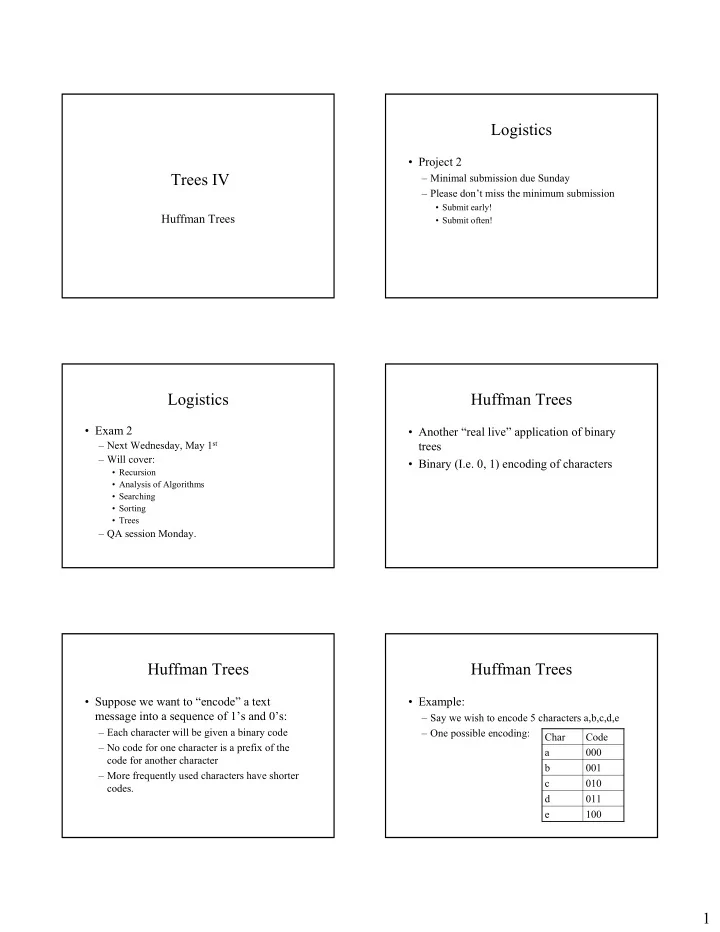
Logistics Project 2 Trees IV Minimal submission due Sunday - - PDF document

logistics
SMART_READER_LITE
LIVE PREVIEW

Logistics Project 2 Trees IV Minimal submission due Sunday - - PDF document

Logistics Project 2 Trees IV Minimal submission due Sunday Please dont miss the minimum submission Submit early! Huffman Trees Submit often! Logistics Huffman Trees Exam 2 Another real live application


slide-1
SLIDE 1

1

Trees IV

Huffman Trees

Logistics

  • Project 2

– Minimal submission due Sunday – Please don’t miss the minimum submission

  • Submit early!
  • Submit often!

Logistics

  • Exam 2

– Next Wednesday, May 1st – Will cover:

  • Recursion
  • Analysis of Algorithms
  • Searching
  • Sorting
  • Trees

– QA session Monday.

Huffman Trees

  • Another “real live” application of binary

trees

  • Binary (I.e. 0, 1) encoding of characters

Huffman Trees

  • Suppose we want to “encode” a text

message into a sequence of 1’s and 0’s:

– Each character will be given a binary code – No code for one character is a prefix of the code for another character – More frequently used characters have shorter codes.

Huffman Trees

  • Example:

– Say we wish to encode 5 characters a,b,c,d,e – One possible encoding: 100 e 011 d 010 c 001 b 000 a Code Char

slide-2
SLIDE 2

2

Huffman Trees

  • Using this encoding
  • abca = 000 001 010 000

100 e 011 d 010 c 001 b 000 a Code Char

Huffman Trees

  • Suppose we are given frequency of
  • ccurrences for each character

e d c b a Char 10 25 % 001 8 % 01 15 % 11 40 % 000 12 % Code Occurrence

Huffman Trees

  • Chars that occur more frequently have

shorter codes.

e d c b a Char 10 25 % 001 8 % 01 15 % 11 40 % 000 12 % Code Occurrence

Huffman Trees

  • No code is a prefix of any other code
  • Using this encoding

– abca = 000 11 01 000 – 10 bits

  • Using last encoding

– abca = 000 001 010 000 – 12 bits 10 e 011 d 01 c 11 b 000 a Code Char

Huffman Trees

  • This sequence of codes can be represented

by a binary tree:

– Leaves represent characters – Following left child represents appending a 0 to a code – Following right child represents appending a 1 to a code

Huffman Trees

  • To obtain a code for a given character

– Start at the root – Find a path to the character’s leaf node – Append a 0 to a code every time you follow a left child – Append a 1 to a code every time you follow a right child.

slide-3
SLIDE 3

3

Huffman Tree

10 e 011 d 01 c 11 b 000 a Code Char

a d c e b 1 1 1 1

Huffman Tree

10 e 011 d 01 c 11 b 000 a Code Char

a d c e b 1 1 1 1 Find the code for a 0 0 0

Huffman Tree

10 e 011 d 01 c 11 b 000 a Code Char

a d c e b 1 1 1 1 Find the code for e 1 0

Decoding using a Huffman Tree

  • Start with the root
  • For each “bit” follow an edge
  • When you get to leaf, write the char

associated with the leaf

  • Go back to the root.

Decoding using a Huffman Tree

a d c e b 1 1 1 1 Decode: 00100101100011101 d d c d e b c

Huffman Coding

  • How to build these Huffman trees

– Given:

  • Set of characters to be encoded
  • A “weight” assigned to each character (indicating its

frequency of occurrence).

slide-4
SLIDE 4

4

Huffman Coding

  • How to build these Huffman trees
  • 1. Begin with a forest of trees. All trees are one

node with the weight equal to the weight of the character.

  • 2. Repeat until there is only 1 tree
  • 1. Choose 2 trees: T1 and T2 with the smallest

weights and combine creating a new tree with left subtree = T1 and right subtree = T2

Huffman Coding

12 a 40 b 15 c 8 d Start: Each char is its own tree Combine trees with smallest weights: a & d 12 a 25 e 25 40 b 15 c 25 e 25 8 d 20

Huffman Coding

40 b 15 c 25 e 25 12 a 8 d 20 Combine trees with smallest weights: 12 a 8 d 20 15 c 35 40 b 25 e 25

Huffman Coding

12 a 8 d 20 15 c 35 40 b 25 e 25 Combine trees with smallest weights: 12 a 8 d 20 15 c 35 25 e 25 60 40 b

Huffman Coding

12 a 8 d 20 15 c 35 25 e 25 60 40 b Finally, combine the last 2 trees 100

Huffman Coding

a d c 25 e b 1 1 1 1

01 e 0001 d 001 c 1 b 0000 a Code Char

slide-5
SLIDE 5

5

Huffman Coding

  • This is an example of a greedy algorithm.

– Only considers information available during a given iteration. – Local decision → Global solution

  • You will be implementing the Huffman

coding algorithm in Lab 9.

Summary

  • Huffman Coding

– Used to encode characters into 0’s and 1’s – More frequent characters have smaller codes – Result represented by a binary tree – Built using a greedy algorithm – Questions?

Next time

  • Introduction to hashing