Logic Minimization M. Sachdev, Dept. of Electrical & Computer - - PDF document

logic minimization
SMART_READER_LITE
LIVE PREVIEW

Logic Minimization M. Sachdev, Dept. of Electrical & Computer - - PDF document

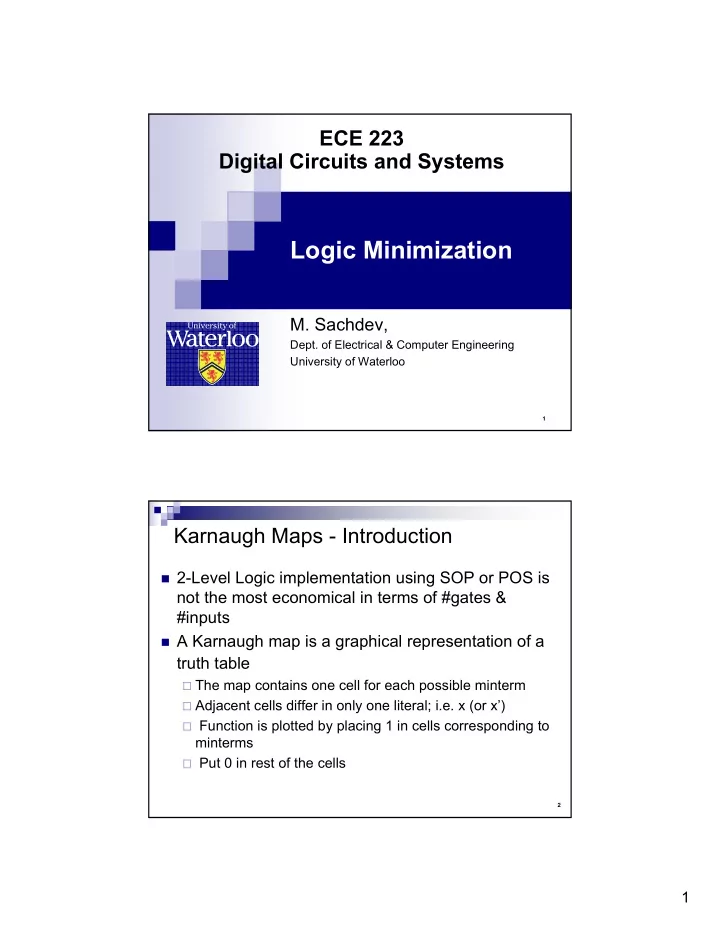
ECE 223 Digital Circuits and Systems Logic Minimization M. Sachdev, Dept. of Electrical & Computer Engineering University of Waterloo 1 Karnaugh Maps - Introduction 2-Level Logic implementation using SOP or POS is not the most


slide-1
SLIDE 1

1

1

Logic Minimization

  • M. Sachdev,
  • Dept. of Electrical & Computer Engineering

University of Waterloo

ECE 223 Digital Circuits and Systems

2

Karnaugh Maps - Introduction

2-Level Logic implementation using SOP or POS is

not the most economical in terms of #gates & #inputs

A Karnaugh map is a graphical representation of a

truth table

The map contains one cell for each possible minterm Adjacent cells differ in only one literal; i.e. x (or x’) Function is plotted by placing 1 in cells corresponding to

minterms

Put 0 in rest of the cells

slide-2
SLIDE 2

2

3

K Map with 2 Variables

m0 m1 1 m3 m2 1 y x m3 1 1 1 x m2 1 y m1 m0 F

F =f(x,y) Example, F1 = x’y

1 1 y x

4

K Map with 3 Variables

  • 3 Variable, F = f(x,y,z);
  • Given F2 = ∑(2,3,4,5)
  • Represent it on the K map
  • minimize the function

m0 m1 01 00 m5 m4 1 yz x m3 m7 m2 m6 11 10 x’y’z’ ’x’y’z 01 00 xy’z xy’z’ 1 yz x x’yz xyz x’yz’ xyz’ 11 10 01 00 1 yz x 11 10

slide-3
SLIDE 3

3

5

K Map with 3 Variables

  • 3 Variable, F = f(x,y,z);
  • Given F3 = ∑(3,4,6,7)
  • Minimize the function using K map

Function minimization

  • Find maximum size groups that cover all 1s in the map

(Comment – a group should not be a subset of other group) 4 cell group 2 literals can be removed 2 cell group 1 literal can be removed

  • Guidelines for logic synthesis (SOP)
  • Fewer groups fewer AND gates, and fewer inputs to the

OR gate

  • Fewer literals (larger group) fewer inputs to an AND gate
  • Synthesis Objective: Fewest # of gates and # of inputs

6

K Map with 4 Variables

  • 4 Variable, F = f(w,x,y,z)
  • Given, F4 = ∑(3,4,5,7,9,13,14,15)
  • represent it on the map
  • Minimize the logic
  • Clues
  • Make all possible groups
  • Do we need “the group of 4”?

F4 = w’xy’ +wxy +w’yz +wy’z

m0 m8 01 00 m12 m4 00 01 yz wx m9 m13 m1 m5 11 10 11 10 m3 m2 m7 m6 m15 m14 m11 m10 01 00 1 00 01 yz wx 1 1 1 11 10 11 10 1 1 1 1

slide-4
SLIDE 4

4

7

Implicants & Prime Implicants, …

  • Implicant: A group of one or more k map cell
  • Prime implicant: an implicant that is not a subset of

another implicant

  • Essential Prime Implicant: a prime implicant that covers

at least one cell not covered by another prime implicant

  • Example, F5 (w,x,y,z) = ∑(0,1,2,5,6,7,9,13,14)

1 01 00 00 01 yz wx 1 1 1 1 11 10 11 10 1 1 1 1 1 01 00 00 01 yz wx 1 1 1 1 11 10 11 10 1 1 1 1

8

Product of Sum Expression

  • Let F be the function F’ = ∑(all minterms not in F)
  • F = π(all minterms not in F)’ (de Morgan’s theorem)
  • Therefore, one cam obtain POS expression by

1.

Group all 0s on K map

2.

Use de Morgan’s theorem to obtain POS expression

F6 = x’z’ +x’y’ + w’y’z (SOP) = (w’ +x’)(y’ +z’)(x’ +z) (POS)

  • One is often simpler than the other Check both

1 1 01 00 00 01 yz wx 1 1 1 11 10 11 10 1 1 1 1 01 00 00 01 yz wx 1 1 1 11 10 11 10 1 1

slide-5
SLIDE 5

5

9

Plotting Product of Sum Expression

  • Given, F7 = (w +x)(x +y’ +z)(y +z)

F7’ = [(w +x)(x +y’ +z)(y +z)]’ = (w +x)’ +(x +y’ +z)’ +(y +z)’ = w’x’ +x’yz’ +y’z’

  • F7’ is plotted by putting 0s in

appropriate cells

  • Can F7’ be simplified further?

F7’ = w’x’ +x’z’ +y’z’ F7 = (w +x)(x +z)(y +z)

01 00 00 01 yz wx 1 1 1 11 10 11 10 1 1 1 1 1

10

Don’t care Conditions

  • Some time, not all values of a function are defined
  • Some inputs conditions will never occur
  • We don’t care what the output is for that input condition
  • In these cases, we can choose the output to be wither

0 or 1, whichever simplifies the circuit

  • Example – A circuit to produce output 1 if a BCD digit

is multiple of 3

  • BCD – Four inputs (wxyz) 0 (0000) 9 (1001)
  • Values of wxyz

10 (1010) 15 (1111) don’t care

  • The function F8 = ∑(3,6,9) +d(10,11,12,13,14,15)
slide-6
SLIDE 6

6

11

Don’t Care - Plotting

  • Don’t care are plotted as X in the K map
  • SOP expression Treat X as 1 if it allows a larger group
  • POS expression Treat x as 0 if it allows a larger group
  • F8_1

= wz +xyz’ +x’yz (SOP) F8’_2 = xz +w’y’ +x’z’ {F’ = ∑(all minterms not in F)} F8_2 = (x’ +z’)(w +y)(x +z) de Morgan’s theorem Is F8_1 = F8_2??

01 00 X 00 01 yz wx 1 X 11 10 11 10 1 1 X X X X 01 00 X 00 01 yz wx 1 X 11 10 11 10 1 1 X X X X

12

Simplest 2-Level Expression

  • Example, F(w,x,y,z) = ∑(0,1,2,5,6,7,9,14) +d(13)
  • Determine essential and prime implicants

1 01 00 00 01 yz wx 1 X 1 1 11 10 11 10 1 1 1 1 1 01 00 00 01 yz wx 1 X 1 1 11 10 11 10 1 1 1 1

Essential prime implicants Prime implicants

slide-7
SLIDE 7

7

13

Simplest 2-Level Expression

  • Example, F(w,x,y,z) = ∑(0,1,2,5,6,7,9,14) +d(13)
  • Determine essential and prime implicants

D √ √ w’xy (6,7) 14 9 7 6 5 2 1 ۞ √ √ √ y’z (1,5,9,13) √ √ √ √ w’yz’ (2,6) w’xz (5,7) w’x’z’ (0,2) w’x’y’ (0,1) xyz’ (6,14) √ √ √ √ √ E √ C B A ۞

  • All minterms must be covered
  • i.e., essential prime implicants must be included
  • Different choices for prime implicants

B +C; or B +D; or A +C +E; or A +D +E

14

Tabulation (Quine-McCluskey) Method

  • The map method of simplification is convenient if # of

variables ≤ 4

  • Tabulation method is preferred for function with large # of variables
  • For F(w,x,y,z) consider adjacent minterms

let a = m4 +m5 = w’xy’z’ + w’xy’z = w’xy’

  • r

= 0100 + 0101 = 010- Similarly, b =m12 +m13 = wxy’z’ + wxy’z = wxy’ = 110-

  • Let c = a +b = m4 +m5 +m12 +m13

w’xy’ +wxy’ = xy’ = -10-

  • Adjacent terms differ by a single bit in their representation
  • Tabulation method consists of grouping of minterms and

systematically checking for single bit differences

slide-8
SLIDE 8

8

15

Tabulation (Quine-McCluskey) Method

  • Example, F(w,x,y,z) = ∑(0,3,4,6,7,8,10,11,15) +d(5,9)
  • Place minterms in different Sections according to # of 1’s in their

binary representation

  • Each member of each Section is compared with each member of

Sections below; all reduction are recorded in next column

  • Mark terms that combine
  • All unmarked terms are prime implicants

16

Tabulation Method - Example

  • Example
slide-9
SLIDE 9

9

17

NAND & NOR Implementation

  • In digital logic families NAND & NOR implementations

are cheaper compared to AND & OR implementations

  • Hence, NAND & NOR are preferred
  • NAND and NOR are universal gates
  • Can mimic any logic gate
  • Example, NAND gate can implement:

NOT short inputs AND {(xy)’}’ OR (x’y’)’ = x +y

  • Similarly for NOR gate, one can show its universality

18

NAND – 2-level Implementation

  • Can implement any arbitrary logic

Example, F = AB + CD

slide-10
SLIDE 10

10

19

NAND – 2-level Implementation

  • Given, F9 (x,y,z) = ∑(1,2,3,4,5,7)

Minimize the function, and implement it with NAND gates

20

NAND – 2-level Implementation Procedure

1.

Simplify the function and express it in SOP form

2.

Draw a NAND gate for each product term

3.

Draw a single gate using AND-invert or invert-OR symbol for the sum term

4.

A term with single literal, complement if needed

  • Multi-level NAND Circuits

1.

Convert all AND gates to NAND gates

2.

Convert all OR gates to NAND gates with invert-OR symbols

3.

Balance all bubbles, insert an inverter if needed

slide-11
SLIDE 11

11

21

NOR – Implementation

  • NOR gate is a dual of NAND
  • Same rules and procedures

Example, F = (A +B)(C +D)E

22

Wired Logic

  • Two logic gate outputs are not shorted together
  • May create logical conflicts Logic is not defined
  • In some technologies, it is possible to short O/Ps
  • f some logic gates (wired logic)

F1 = (AB)’(CD)’ = (AB + CD)’ (wired AND) F2 = (A +B)’ + (C +D)’ = [A +B)(C +D)]’ (wired OR)

slide-12
SLIDE 12

12

23

Exclusive-OR Function

  • XOR gate is expensive to implement in silicon

XOR = xy’ +x’y XNOR = (xy’ +x’y)’ = xy +x’y’

  • But they are useful in
  • Parity checking
  • Arithmetic circuits (adders, subtractors)

1 1 XOR 1 1 1 1 x 1 y 1 XNOR

24

Exclusive-OR Function

  • XOR gate properties
  • Commutative
  • Associative
  • Odd and Even Functions
slide-13
SLIDE 13

13

25

Exclusive-OR Function

  • 4 Variable XOR

26

Parity Generation and Checking

  • Parity checking is useful for detecting and

correcting errors when transmitting binary data

  • We can always append a parity bit to the end of the

data bits (e.g. 32) so that the number of 1s in the packet is always even or odd

  • If we lose a bit in transmission, we can use the

parity bit to tell us there has been a problem

slide-14
SLIDE 14

14

27

Book Sections – Logic Minimization

Material is covered in Sections 3.1 – 3.8