
SLIDE 1
LOFT
LARGE OBSERVATORY FOR X-RAY TIMING
MARCO FEROCI INAF , ROME
ON BEHALF OF THE LOFT CONSORTIUM
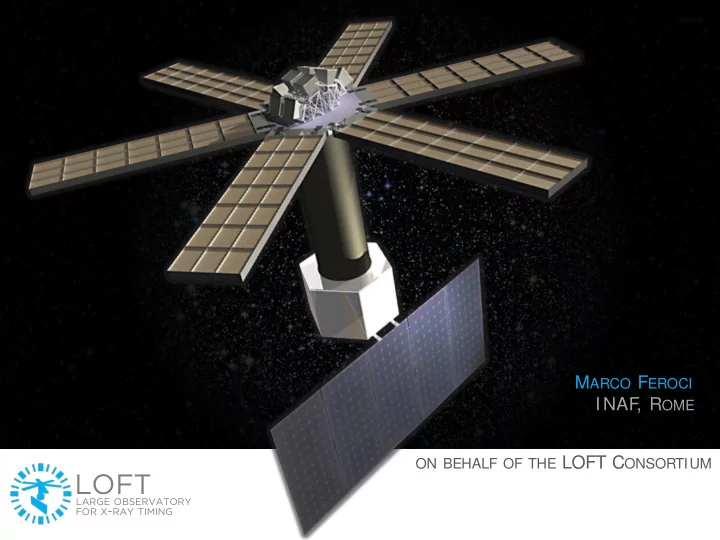
LOFT LARGE OBSERVATORY FOR X - RAY TIMING THE L ARGE O BSERVATORY F - - PowerPoint PPT Presentation
M ARCO F EROCI INAF , R OME ON BEHALF OF THE LOFT C ONSORTIUM LOFT LARGE OBSERVATORY FOR X - RAY TIMING THE L ARGE O BSERVATORY F OR X - RAY T IMING LOFT Consortium: national representatives: Marco Feroci INAF/IAPS-Rome, Italy Jan-Willem den
LARGE OBSERVATORY FOR X-RAY TIMING
MARCO FEROCI INAF , ROME
ON BEHALF OF THE LOFT CONSORTIUM
PROBING SPACETIME AND MATTER UNDER EXTREME CONDITIONS
THE LARGE OBSERVATORY FOR X- RAY TIMING
LOFT Consortium: national representatives:
Marco Feroci INAF/IAPS-Rome, Italy Jan-Willem den Herder SRON, the Netherlands Luigi Stella INAF/OAR-Rome, Italy Michiel van der Klis
Thierry Courvousier ISDC, Switzerland Silvia Zane MSSL, United Kingdom Margarita Hernanz IEEC-CSIC, Spain Søren Brandt DTU, Copenhagen, Denmark Andrea Santangelo
Didier Barret IRAP , T
Renè Hudec CTU, Czech Republic Andrzej Zdziarski
Juhani Huovelin
Paul Ray Naval Research Lab, USA Joao Braga INPE, Brazil Tad Takahashi ISAS, Japan Sudip Bhattacharyya TIFR, India LOFT Science Team composed of scientists from: Australia, Brazil, Canada, Czech Republic, Denmark, Finland, France, Germany, Greece, Ireland, Israel, Italy, Japan, the Netherlands, Poland, Spain, Sweden, Switzerland, Turkey, United Kingdom, USA
PROBING SPACETIME AND MATTER UNDER EXTREME CONDITIONS
LOFT SCIENCE
Probe gravity theory in the very strong field environment of Black Holes (“Strong Gravity”) Probe physics of hundreds of galactic and bright extragalactic cosmic sources (“Observatory Science”) Probe the state of matter at supra nuclear densities in Neutron Stars (“Dense Matter”)
PROBING SPACETIME AND MATTER UNDER EXTREME CONDITIONS
LOFT CORE SCIENCE OBECTIVES
PROBING SPACETIME AND MATTER UNDER EXTREME CONDITIONS
THE LOFT APPROACH
Exploit the Diagnostics of Spectral Variability
Good Energy Resolution (XMM-class) Exploit the Diagnostics of X-ray Variability
Large Collecting Area
PROBING SPACETIME AND MATTER UNDER EXTREME CONDITIONS
THE LOFT APPROACH
Good Energy Resolution (XMM-class) Large Collecting Area
LHC SDD Detectors Heritage Microchannel Plate Collimators
200 eV
PROBING SPACETIME AND MATTER UNDER EXTREME CONDITIONS
RXTE 1100 eV, 0.65 m 2 XMM 130 eV, 0.085 m 2
LOFT 200 eV, 10 m 2
LOFT’S CHANGING THE GAME
LOFT UNITES SPECTROSCOPY & TIMING, AT ENORMOUS AREA
No pile-up pile-up-limited
PROBING SPACETIME AND MATTER UNDER EXTREME CONDITIONS
LOFT - LARGE AREA DETECTOR
EFFECTIVE AREA 4 m 2 @ 2 keV 10 m 2 @ 8 keV 1 m 2 @ 30 keV ENERGY RANGE 2-30 keV (30-80 keV ext.) ENERGY RESOLUTION FWHM 200 eV @ 6 keV COLLIMATED FOV 1 deg FWHM ABSOLUTE TIME ACCURACY 1 µs
2 0 0 0 x
83 µm 16 µm
1 2 5 x
PROBING SPACETIME AND MATTER UNDER EXTREME CONDITIONS
LOFT - LARGE AREA DETECTOR PERFORMANCE LAD I NSTANTANEOUS SKY VISIBILITY
75% of the sky accessibile to LAD at any time. Combination of Sky Visibility and Mission Duration ensures required number of transients
180 eV 240 eV 300 eV 340 eV
PROBING SPACETIME AND MATTER UNDER EXTREME CONDITIONS
The Key to LOFT:
Frame Collimators Clamps SDDs + FEEs Radiator Frame
Readout electronics (∼2.5 kg/m2) Silicon Drift Detector (∼1.3 kg/m2) MCP Collimator (∼6 kg/m2) Mechanical support, harness, interfaces LAD density ≈ 10 kg/m2 (RXTE/PCA > 100 kg/m2)
LARGE AREA DETECTOR CONCEPT
PROBING SPACETIME AND MATTER UNDER EXTREME CONDITIONS
LOFT - WIDE FIELD MONITOR
5 Units
10 Cameras FIELD OF VIEW 5.5 steradian POSITION ACCURACY (10σ) 1 arcmin ENERGY RANGE 2-50 keV ENERGY RESOLUTION 300 eV @ 6 keV COLLECTING AREA 1820 cm 2 TIME RESOLUTION 10 µs (trigger) ∼minutes (images) SENSITIVITY (5σ, GALACTIC CENTER) 270 mCrab (3s) 2.1 mCrab (1day) GROUND TRANSMISSION OF GRB COORDINATES < 30s
PROBING SPACETIME AND MATTER UNDER EXTREME CONDITIONS
LOFT - WIDE FIELD MONITOR PERFORMANCE FIELD OF VIEW EXPOSURE MAP
cm 2
Ms
PROBING SPACETIME AND MATTER UNDER EXTREME CONDITIONS
MISSION CONFIGURATION FEASIBLE MISSION IN SEVERAL CONFIGURATIONS, WITH STANDARD EQUIPMENT
Item Value
Orbit Equatorial, 550 km Launcher Soyuz (6,000 kg launch capability) Mass 4,000 kg Power 4 kW Telemetry 6.7 Gbit/orbit Ground Stations Kourou, Malindi Pointing 3-axis stabilized Mission Duration 3+2 years
South atlantic anomaly
PROBING SPACETIME AND MATTER UNDER EXTREME CONDITIONS
MISSION FEASIBILITY
Item Value
Orbit Equatorial, 550 km Launcher Soyuz Mass 4,000 kg Power 4 kW Telemetry 10 Gbit/orbit Ground Stations Kourou, Malindi Pointing 3-axis stabilized Mission Duration 3+2 years
South atlantic anomaly
ESA Review : “m ission feasible and of low technical risk and medium schedule risk for a 2022 launch date; a launch in 2 0 2 3 is seen as realistic” “The overall instrument as well as the Science Ground Segment concept is considered to be mature and well documented. The level of detail with which the instrument design is described significantly exceeds general expectations at the end of a Phase A study.” FEASIBLE MISSION IN SEVERAL CONFIGURATIONS, WITH STANDARD EQUIPMENT
PROBING SPACETIME AND MATTER UNDER EXTREME CONDITIONS
THE ESA PREFERRED LOFT CONCEPT
PROBING SPACETIME AND MATTER UNDER EXTREME CONDITIONS
PROGRAMMATICS AND SCIENCE MANAGEMENT Payload and Science Data Center provided by Institutes in ESA Member States. LOFT Science Team even wider in Europe and worldwide LOFT IS AN OPEN OBSERVATORY All LAD data open to the Community through peer-reviewed proposals. All WFM data public after validation.
PROBING SPACETIME AND MATTER UNDER EXTREME CONDITIONS
LOFT IN THE MULTI-FREQUENCY CONTEXT LOFT in the Multi-wavelength and Multi-messenger Context of Time Domain Astronomy
PROBING SPACETIME AND MATTER UNDER EXTREME CONDITIONS
PROBING SPACETIME AND MATTER UNDER EXTREME CONDITIONS
I NSTRUMENT DEVELOPMENT IN PHASE A Instruments
Key T echnology
4 prototypes produced & tested Full-scale (6-inch) LAD prototype delivered by end 2013 Radiation (soft & hard protons) and debris accelerator tests
First prototype (8 channels, analogue section) produced & tested Second prototype (16 channels, mixed signal) delivered Jan ’14 T echnology back-up (Italian ASIC) produced and tested
First prototype (pore size and thickness, half-size) produced & tested Full scale prototype (ESA TDA) to be delivered Apr ’14
Additional H/W development
Half-size prototype produced & measured
Full-scale prototype produced & tested (acoustics) in a Module frame prototype
Electrical prototype produced & tested
PROBING SPACETIME AND MATTER UNDER EXTREME CONDITIONS
THE LARGE-AREA SILICON DRIFT DETECTOR (1991-> 2002)
20
1991
PROBING SPACETIME AND MATTER UNDER EXTREME CONDITIONS
An heritage of the Inner Tracking System of the ALICE experiment at the Large Hadron Collider (CERN):1.5 m2 of SDD detectors (approximately 300 units), operating since 2008. High TRL. Proven mass production.
LOFT TECHNOLOGY HERITAGE
21
LAD Configuration:
Thickness 450 µm Monolithic Active Area 76 cm2 Drift time <5 µs Anode Pitch 970 µm Single-channel area 0.3 cm2
PROBING SPACETIME AND MATTER UNDER EXTREME CONDITIONS
LAD – SILICON DRIFT DETECTORS SDDs Heritage of ALICE ITS (LHC) R&D IAPS, INFN-TS, FBK (Trento) for X-ray detection Advantages:
Development, production & testing in Italy (INFN & INAF)
PROBING SPACETIME AND MATTER UNDER EXTREME CONDITIONS
FBK-4 (end-2013)
LAD full-scale prototype (6-inch), production batch started on late 2013. TRL 5 (TRL 6 end 2015)
ALICE (2002) FBK-1 (2010-11) FBK-2 (2011-12) FBK-3 (end-2012) Increased eff. for soft X-rays Increased thickness (450 µm) Reduced power of voltage divider Reduced surface layer thickness Larger pitch (833 µm), Larger area Design optimization Soft protons, protons, CCE LAD pitch (970 µm) WFM pitch (145 µm) Soft protons, protons, debris X-ray characterization Proton irradiation (NIEL)
SDD DEVELOPMENT (2007-
PROBING SPACETIME AND MATTER UNDER EXTREME CONDITIONS
2013, 6-inch: Leakage Current <0.09 nA cm2 !
FBK – STATE- OF-THE-ART TECHNOLOGY
PROBING SPACETIME AND MATTER UNDER EXTREME CONDITIONS
FBK – BRUNO KESSLER FOUNDATION (TRENTO, I TALY)
PROBING SPACETIME AND MATTER UNDER EXTREME CONDITIONS
Largest monolithic SDD ever built
Monte et. al, in prep.) and debris impacts
Requirement of 200 eV FWHM energy resolution (EOL) verified in LAB
~30 µm pencil beam mapping
@ IAPS facility
SDD CHARACTERIZATION @ INAF
PROBING SPACETIME AND MATTER UNDER EXTREME CONDITIONS
Variation of the CCE (11 MeV p+): PSI - Zurich (E. Del Monte et al., in prep) NIEL from 11 MeV and 50 MeV protons: PSI – Zurich (E. Del Monte et al., in prep) NIEL from soft protons (800 keV p+): Tubingen Hypervelocity impacts from debris (0.5-3 µm diameter): MPIK - Heidelberg (G. Zampa et al., in prep.)
SDD QUALIFICATION
PROBING SPACETIME AND MATTER UNDER EXTREME CONDITIONS
LOFT ASIC
VEGA-1 R&D in Italy - PoliMi, Pavia Univ. (design) IAPS, IASFBo (characterization) ESA StarX32 heritage (<19 e- rms (no det), 500 μW/ch, 1024 ch)
LOFT baseline → Sirius ASIC: new development by Dolphin Integration
PROBING SPACETIME AND MATTER UNDER EXTREME CONDITIONS
SDD READ- OUT – THE VEGA ASIC VEGA (PoliMi, UniPv, INFN, INAF) Heritage: STARX-32
Ahangarianabhari et al. 2014
SIRIUS (IRAP, Dolphin, LAB)
PROBING SPACETIME AND MATTER UNDER EXTREME CONDITIONS
LAD - MCP COLLIMATOR MCP X-ray collimator Multi-pore, ∼mm thin sheet of lead-glass (Philips 3502, Pb 34.4%) able to absorb soft X-rays coming from outside the FoV. Holes aspect ratio 40 ÷ 200. Large-scale prototype manufactured & tested. Heritage of:
(MIXS) microchannel plate X-ray optics (GW Fraser et al., 2010)
PROBING SPACETIME AND MATTER UNDER EXTREME CONDITIONS
LAD COLLIMATOR 31
PROBING SPACETIME AND MATTER UNDER EXTREME CONDITIONS
ADDITIONAL H/ W DEVELOPMENT
PROBING SPACETIME AND MATTER UNDER EXTREME CONDITIONS