
SLIDE 1
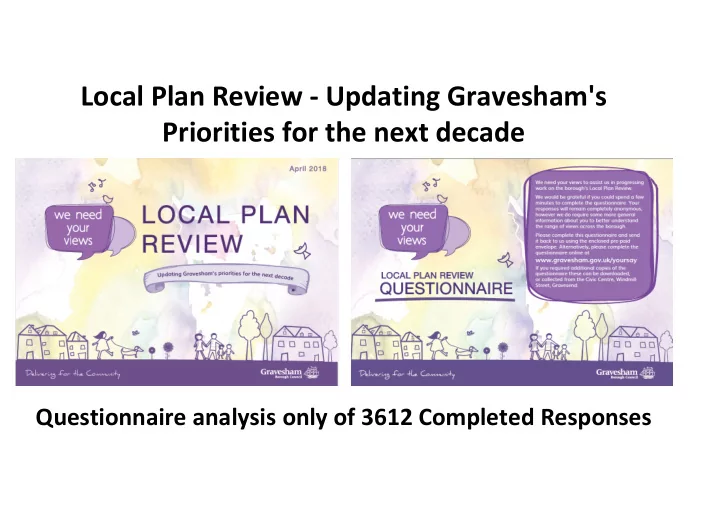
Local Plan Review - Updating Gravesham's Priorities for the next - - PowerPoint PPT Presentation
Local Plan Review - Updating Gravesham's Priorities for the next decade Questionnaire analysis only of 3612 Completed Responses Process and Timetable Infrastructure Evidence Base Requirements National, Regional Legislation, Appraisals e.g.
Evidence Gathering Regulation 18 Consultation Stage 1 Regulation 18 Consultation Stage 2 Regulation 19 Consultation Submission Examination Adoption April – June 2018 Autumn 2019 Summer 2020 Late 2020 Early 2021 Summer 2021 Site Allocations and Development Management Policies Document Infrastructure Requirements National, Regional Legislation, Policy and Guidance
Framework (NPPF)
Guidance (NPPG)
Duty to Co-operate KCC, EDC, South East LEP, neighbouring districts, etc Evidence Base Appraisals e.g.
Assessment
Assessment Community and Stakeholder Involvement e.g. Regulation 18 and 19 consultations
Ageing Population Falling working-age population
2017 Mid Year Population Estimates for Wards (Experimental) identify that approx. 21% of Gravesham’s residents live in the rural area and 79% in the urban area. (The rural area includes the urban component of Shorne, Cobham and Luddesdown Ward as the figures cannot be disaggregated)
Question 5: In England, the Green Belt is largely undeveloped land around or between large urban areas
are to prevent large urban areas from spreading out or merging together, and in some cases to preserve the character of historic towns and cities. However, it can be argued that it is necessary to build on parts of the Green Belt to meet housing and other needs. To what extent do you agree or disagree, in principle, that existing Green Belt land in the borough should be retained in its current form and not be built on?
Of those respondents who want green belt protected more agree that local authorities should be proactive about meeting housing needs Of those respondents who want green belt protected more agree that local housing needs should be met when compared to those who disagree
More respondents are for protecting the Green Belt and strongly against any new development, than those who disagree with any new development Even though respondents want the Green Belt protected there is some support for specialist housing, whilst for affordable and market housing there is very little support
Some support Some support Very limited support
Responses vary, but include:
doctors, hospitals, schools at full capacity
government.