A randomized trial of hyperbaric oxygen in U.S. Service Members with - - PowerPoint PPT Presentation

a randomized trial of hyperbaric oxygen in u s service
SMART_READER_LITE
LIVE PREVIEW

A randomized trial of hyperbaric oxygen in U.S. Service Members with - - PowerPoint PPT Presentation

A randomized trial of hyperbaric oxygen in U.S. Service Members with post-concussive symptoms Weaver LK 1,2 , Wilson SH 3 , Lindblad AS 3 , Churchill S 1 , Deru K 1 , Price R 4 , Williams C 5 , Orrison WW 5 , Walker J 5 , Meehan A 5 , Mirow S 2,5 ,


slide-1
SLIDE 1

A randomized trial of hyperbaric oxygen in U.S. Service Members with post-concussive symptoms

Weaver LK1,2, Wilson SH3, Lindblad AS3, Churchill S1, Deru K1, Price R4, Williams C5, Orrison WW5, Walker J5, Meehan A5, Mirow S2,5, and the BIMA study team

1 Division of Hyperbaric Medicine Intermountain Medical Center, Murray, Utah, and Intermountain LDS Hospital, Salt Lake City, Utah 2 University of Utah School of Medicine, Salt Lake City, Utah 3 The Emmes Corporation, Rockville, Maryland 4 Evans Army Community Hospital, Fort Carson, Colorado 5 Lovelace Biomedical Research, Albuquerque, New Mexico

Introduction Methods Conclusions Results Results

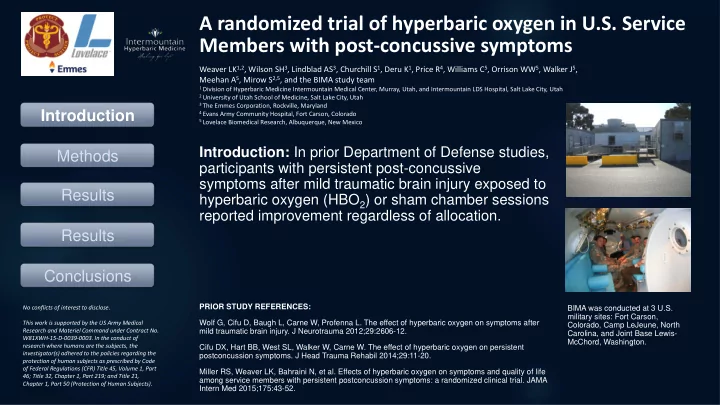
Introduction: In prior Department of Defense studies, participants with persistent post-concussive symptoms after mild traumatic brain injury exposed to hyperbaric oxygen (HBO2) or sham chamber sessions reported improvement regardless of allocation.

PRIOR STUDY REFERENCES: Wolf G, Cifu D, Baugh L, Carne W, Profenna L. The effect of hyperbaric oxygen on symptoms after mild traumatic brain injury. J Neurotrauma 2012;29:2606-12. Cifu DX, Hart BB, West SL, Walker W, Carne W. The effect of hyperbaric oxygen on persistent postconcussion symptoms. J Head Trauma Rehabil 2014;29:11-20. Miller RS, Weaver LK, Bahraini N, et al. Effects of hyperbaric oxygen on symptoms and quality of life among service members with persistent postconcussion symptoms: a randomized clinical trial. JAMA Intern Med 2015;175:43-52. BIMA was conducted at 3 U.S. military sites: Fort Carson, Colorado, Camp LeJeune, North Carolina, and Joint Base Lewis- McChord, Washington.

No conflicts of interest to disclose. This work is supported by the US Army Medical Research and Materiel Command under Contract No. W81XWH-15-D-0039-0003. In the conduct of research where humans are the subjects, the investigator(s) adhered to the policies regarding the protection of human subjects as prescribed by Code

  • f Federal Regulations (CFR) Title 45, Volume 1, Part

46; Title 32, Chapter 1, Part 219; and Title 21, Chapter 1, Part 50 (Protection of Human Subjects).

slide-2
SLIDE 2

A randomized trial of hyperbaric oxygen in U.S. Service Members with post-concussive symptoms

Introduction Methods Conclusions Results Results

Methods: In this exploratory, double-blind, sham-controlled trial of HBO2 for military personnel with persistent post-concussive symptoms, 71 randomized participants received forty 60-minute HBO2 (1.5 atmospheres absolute, n=36) or sham chamber sessions (air, 1.2 atmospheres absolute, n=35). At baseline, 35 participants (49%) met post-traumatic stress disorder (PTSD) criteria. Outcomes included post- concussive symptoms, quality

  • f life, neuropsychological,

neurological, EEG, sleep, audiology/vestibular, autonomic, visual, brain imaging, and laboratory testing, at baseline, 13 weeks (shortly post-intervention), and 6 months, plus 12-month symptom questionnaires.

No conflicts of interest to disclose. This work is supported by the US Army Medical Research and Materiel Command under Contract No. W81XWH-15-D-0039-0003. In the conduct of research where humans are the subjects, the investigator(s) adhered to the policies regarding the protection of human subjects as prescribed by Code

  • f Federal Regulations (CFR) Title 45, Volume 1, Part

46; Title 32, Chapter 1, Part 219; and Title 21, Chapter 1, Part 50 (Protection of Human Subjects).

slide-3
SLIDE 3

Introduction Methods Conclusions Results Results

Key findings:

  • By the Neurobehavioral Symptom Inventory, the HBO2 group had

improved 13-week scores compared to sham (HBO2 mean change -3.6 points, sham mean change +3.9 points, p=0.03).

  • In participants with PTSD, change with HBO2 was more pronounced (-8.6

points vs. +4.8 points with sham, p=0.02).

  • Rivermead Post-Concussion Symptom Questionnaire RPQ-3 improved

with HBO2 compared to sham (mean change difference -1.5, p=0.01). The PTSD Checklist-Civilian version scores also improved in the HBO2 group, and more so in the subgroup with PTSD.

  • Improvements regressed at 6 and 12 months.
  • HBO2 improved some cognitive processing speed and sleep measures.

A randomized trial of hyperbaric oxygen in U.S. Service Members with post-concussive symptoms

No conflicts of interest to disclose. This work is supported by the US Army Medical Research and Materiel Command under Contract No. W81XWH-15-D-0039-0003. In the conduct of research where humans are the subjects, the investigator(s) adhered to the policies regarding the protection of human subjects as prescribed by Code

  • f Federal Regulations (CFR) Title 45, Volume 1, Part

46; Title 32, Chapter 1, Part 219; and Title 21, Chapter 1, Part 50 (Protection of Human Subjects).

slide-4
SLIDE 4

Introduction Methods Conclusions Results Results

Key findings (continued):

  • Participants with PTSD receiving HBO2 had improved sensory
  • rganization test scores and reduced vestibular complaints at 13 weeks.
  • Participants without PTSD had improved anger control with HBO2.
  • Most measures independent of patient reports did not change over time
  • r did not change in a way that consistently favored one intervention over

another. Conclusions: By 13 weeks, HBO2 improved post-concussive and PTSD symptoms, cognitive processing speed, sleep quality, and vestibular symptoms, most dramatically in those with PTSD. However, most changes did not persist to 6-12 months. For military personnel, additional HBO2 studies are warranted.

A randomized trial of hyperbaric oxygen in U.S. Service Members with post-concussive symptoms

No conflicts of interest to disclose. This work is supported by the US Army Medical Research and Materiel Command under Contract No. W81XWH-15-D-0039-0003. In the conduct of research where humans are the subjects, the investigator(s) adhered to the policies regarding the protection of human subjects as prescribed by Code

  • f Federal Regulations (CFR) Title 45, Volume 1, Part

46; Title 32, Chapter 1, Part 219; and Title 21, Chapter 1, Part 50 (Protection of Human Subjects).