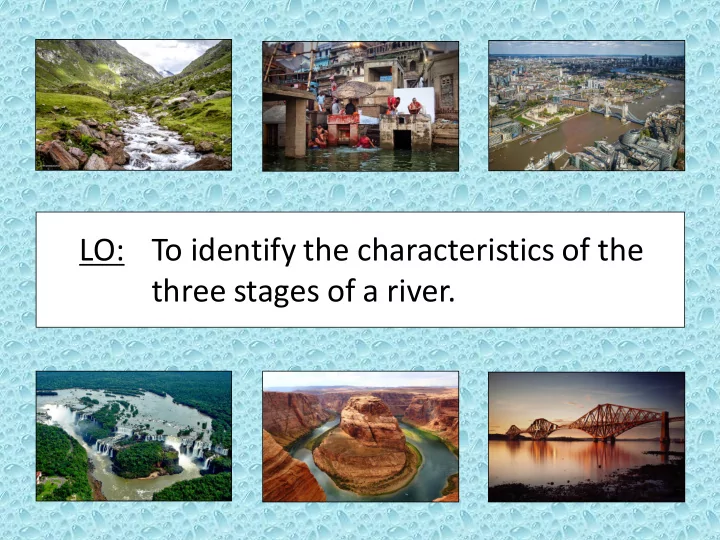
SLIDE 1
LO: To identify the characteristics of the three stages of a river.
SLIDE 2 Vocabulary – Try to match the word to the definition:
- 1. channel
- 1. sediment
- 2. altitude
- 1. floodplain
b) An area of low ground next to a
river which sometimes floods. a) Small particles of a solid material (e.g. sand). d) A groove in the land along which a river flows. c) The height of an object, normally measured from sea level.
SLIDE 3 Vocabulary – answers:
- 1. channel
- 1. sediment
- 2. altitude
- 1. floodplain
b) An area of low ground next to a
river which sometimes floods. a) Small particles of a solid material (e.g. sand). d) A groove in the land along which a river flows. c) The height of an object, normally measured from sea level.
SLIDE 4
e.g. High Force waterfall, County Durham, UK waterfalls e.g. Indus River, Himalayas, India valleys gorges e.g. the Grand Canyon in Arizona, USA This process is called erosion. Click here to learn more. Water is really powerful. Over millions of years, it shapes the Earth’s surface and creates landforms including…
Did you know? The Grand Canyon took 17 million years to form!
SLIDE 5 Rivers are split into three stages:
At each stage a river has different characteristics:
- altitude
- channel width
- water speed
- amount of erosion
Upper course Middle course Lower course
SLIDE 6 Describe the characteristics of the upper course. Think about:
- altitude
- channel width
- water speed
- amount of erosion
The upper course of a river starts at the source. This is a stream in the Alps mountain range in Austria.
SLIDE 7
r_____s
You often find these features in a river’s upper course. Can you identify them?
w_________l V-shaped v_____y c______n or g_____e rapids waterfall V-shaped valley canyon or gorge
SLIDE 8 This is part of the middle course of the Vitava River in the Czech Republic.
Describe the characteristics of the middle course. Think about:
- altitude
- channel width
- water speed
- amount of erosion
Why do rivers get wider as they flow from source to mouth?
Tributary streams contribute water, making the river wider and bigger.
SLIDE 9
m______s
You often find these features in a river’s middle course. Can you name them?
f_______n meanders floodplain
After heavy rain, the river water level rises. Sometimes a river ‘bursts its banks’ and overflows on to the floodplain.
River Waveney, Norfolk, UK
SLIDE 10 This is the lower course of the River Rhine flowing through Düsseldorf in Germany.
Describe the characteristics of the lower course. Think about:
- altitude
- channel width
- water speed
- amount of erosion
What do we call the place where a river meets the sea?
SLIDE 11
Upper course Middle course Lower course The river flows at its slowest. The river is slowing down. The river flows at its fastest.
The first ones have been done for you! Do not click on to the next page until you have had a go – you can place them and then check your answers before you glue them in Activity: Your challenge is to cut out the descriptions saved on the
website and put them in the correct columns.
Date _____________ LO: To identify the characteristics of the three stages of a river.
SLIDE 12 Did you put them in the right places?
Upper course Middle course Lower course The river flows at its slowest. The river mostly erodes sediment and rocks. The river channel is at its widest. The river both erodes and deposits in different places. The river is slowing down. The river reaches the sea at its mouth. The river channel is getting wider. The river is at sea level. The river deposits its remaining sediment. The river starts in hills
The river channel is at its narrowest. The river flows at its fastest. The river is at its highest altitude. The river travels through its floodplains. The river is getting closer to sea level.
SLIDE 13 Plenary – The Three Stages Game:
Close your books! Ask someone in your family to read out a description of one of the characteristics of a river from your book. If you think the description matches the:
- Upper course – put your hands in the air
- Middle course – put your hands on your head
- Lower course – put your hands on your lap
How many did you get correct?
SLIDE 14 The river flows at its slowest. The river channel is at its widest. The river mostly erodes sediment and rocks. The river both erodes and deposits in different places. The river is slowing down. The river reaches the sea at its mouth. The river channel is getting wider. The river is at sea level. The river deposits its remaining sediment. The river starts in hills
The river channel is at its narrowest. The river flows at its fastest. The river is at its highest altitude. The river travels through its floodplains. The river is getting closer to sea level.