Comp/Phys/Mtsc 715 Lecture 3: Visualization Stages, Sensory vs. - - PDF document

comp phys mtsc 715
SMART_READER_LITE
LIVE PREVIEW

Comp/Phys/Mtsc 715 Lecture 3: Visualization Stages, Sensory vs. - - PDF document

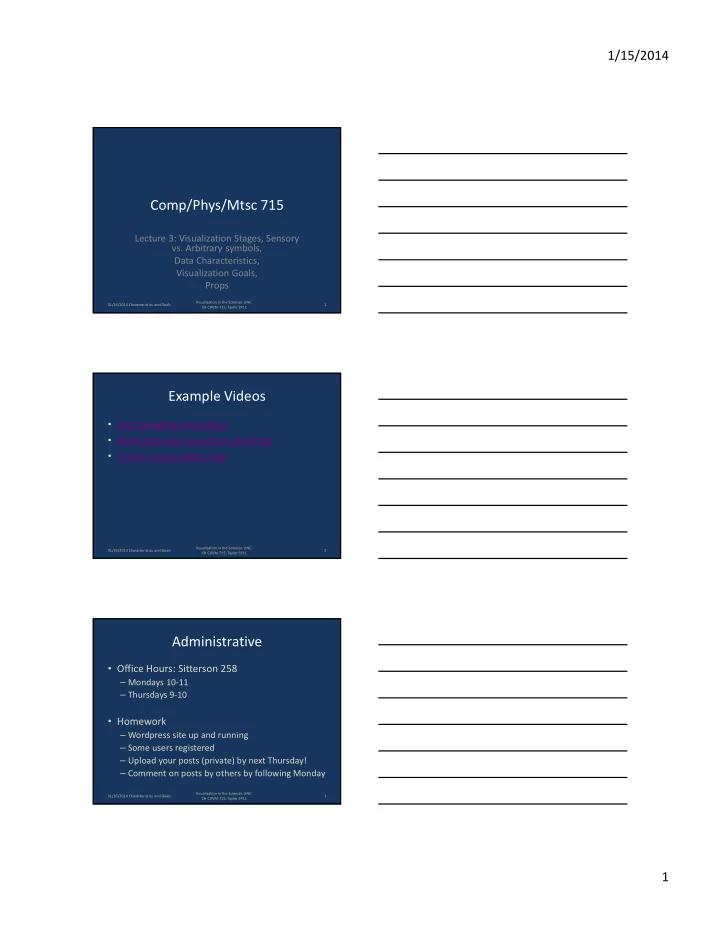
1/15/2014 Comp/Phys/Mtsc 715 Lecture 3: Visualization Stages, Sensory vs. Arbitrary symbols, Data Characteristics, Visualization Goals, Props Visualization in the Sciences UNC- 01/16/2014 Characteristics and Goals 1 CH C/P/M 715, Taylor


slide-1
SLIDE 1

1/15/2014 1

Comp/Phys/Mtsc 715

Lecture 3: Visualization Stages, Sensory

  • vs. Arbitrary symbols,

Data Characteristics, Visualization Goals, Props

01/16/2014 Characteristics and Goals 1 Visualization in the Sciences UNC- CH C/P/M 715, Taylor SP11

Example Videos

  • Dam breaking simulation
  • Multi-data-set isosurface similarity
  • Tumor access safety rays

01/16/2014 Characteristics and Goals Visualization in the Sciences UNC- CH C/P/M 715, Taylor SP11 2

Administrative

  • Office Hours: Sitterson 258

– Mondays 10-11 – Thursdays 9-10

  • Homework

– Wordpress site up and running – Some users registered – Upload your posts (private) by next Thursday! – Comment on posts by others by following Monday

01/16/2014 Characteristics and Goals 3 Visualization in the Sciences UNC- CH C/P/M 715, Taylor SP11

slide-2
SLIDE 2

1/15/2014 2 Foundation for a Science of Data Visualization

  • What are the advantages of visualization?

01/16/2014 Characteristics and Goals 4 Visualization in the Sciences UNC- CH C/P/M 715, Taylor SP11

Visualization Stages

  • Collect the data (lab work or simulation)
  • Transform the data

– into a format readable by the visualization software – into the form most likely to reveal information (Rspace)

  • Visualization algorithms run on graphics hardware or

software renderer

  • Human views and interacts with the visualization

(changing parameters, techniques, view direction)

  • Preferably: User studies to evaluate effectiveness

01/16/2014 Characteristics and Goals 5 Visualization in the Sciences UNC- CH C/P/M 715, Taylor SP11 01/16/2014 Characteristics and Goals 6 Visualization in the Sciences UNC- CH C/P/M 715, Taylor SP11

slide-3
SLIDE 3

1/15/2014 3

Sensory vs. Arbitrary Symbols

  • Sensory: You can see and understand without

training.

– Match the way our brains are wired – Object shape, color, texture

  • Arbitrary: Must be learned

– Having no perceptual basis – The word “dog”

  • “perro”, “hund”, “chien”, “cane”, “cão”, “犬”, “개”, “狗”

01/16/2014 Characteristics and Goals 7 Visualization in the Sciences UNC- CH C/P/M 715, Taylor SP11

Properties of Sensory Reps.

  • Can be understood without training
  • Resistant to instructional bias
  • Is processed very quickly, and in parallel
  • Is valid across cultures
  • Danger: Poor mappings can be misunderstood, even

in the presence of instruction, quickly and without effort.

01/16/2014 Characteristics and Goals 8 Visualization in the Sciences UNC- CH C/P/M 715, Taylor SP11

Properties of Arbitrary Reps.

  • Formally powerful
  • Capable of rapid change
  • May already be learned (summation notation)
  • Dangers:

– Can be hard to learn (alphabet) – Can be easy to forget – Can vary with culture and application (different disciplines use different symbols for the same concept and the same symbol for different concepts):

  • i = sqrt(-1), i = current

01/16/2014 Characteristics and Goals 9 Visualization in the Sciences UNC- CH C/P/M 715, Taylor SP11

slide-4
SLIDE 4

1/15/2014 4 Two-Stage Model of Perceptual Processing

Preattentive Attentive

01/16/2014 Characteristics and Goals 10 Visualization in the Sciences UNC- CH C/P/M 715, Taylor SP11 01/16/2014 Characteristics and Goals 11 Visualization in the Sciences UNC- CH C/P/M 715, Taylor SP11

What is a Good Visualization?

  • Understanding means making a model that captures the

essence of a system

  • A model is an abstraction with the important things in and

the unimportant out

  • Different visualizations provide different levels of detail,

show and hide different things; so support different abstractions

  • Good visualizations are those that are useful to aid

understanding, not just realistic representations (what color is a carbon atom?)

  • Good visualizations map the important parts of the task
  • nto techniques that show the relevant characteristics best

01/16/2014 Characteristics and Goals 12 Visualization in the Sciences UNC- CH C/P/M 715, Taylor SP11

slide-5
SLIDE 5

1/15/2014 5 Data Characteristics and Visualization Goals

  • Why classify data and visualization goals?

– No known “silver bullet” technique – Helps select which technique(s) to try – Helps predict other uses for good techniques – Some tools only work with some formats

(This section draws heavily on sources outside the Ware book) Print this lecture for reference (homeworks)!

01/16/2014 Characteristics and Goals 13 Visualization in the Sciences UNC- CH C/P/M 715, Taylor SP11

Data Characteristics

  • Dimensionality
  • Category of each value/field
  • Structure of the sampling
  • Other data characteristics

01/16/2014 Characteristics and Goals 14 Visualization in the Sciences UNC- CH C/P/M 715, Taylor SP11

Dimensionality

  • Of each data field (0=point, 1=line,

2=surface, 3=volume, …)

  • Of the space the fields are embedded in

(2D or 3D) + time (some call 4D)

  • Of the data type in each field

– (scalar, vector, tensor)

  • Of the space used to visualize the data

2D isosurfaces of 3D scalar field in 3D Two 2D scalar fields in 2D (drawn in 3D) 2D vec/tensor fields Embedded in 3D Drawn in 2D 3D vector field in 3D

01/16/2014 Characteristics and Goals 15 Visualization in the Sciences UNC- CH C/P/M 715, Taylor SP11

slide-6
SLIDE 6

1/15/2014 6

Category of each Scalar Field

  • Nominal: names without ordering

– Continents: Africa, America, Asia, Australia, Europe.

  • Ordinal: “Less than” relationship holds

– Rental cars: Economy, Compact, Mid-sized, Full-sized.

  • Interval: Relative measurements, no absolute zero

– Height of AFM scan or location

  • Ratio: Absolute zero (can say “twice as much as”)

– Account balance, Height above sea level, not “height”

01/16/2014 Characteristics and Goals 16 Visualization in the Sciences UNC- CH C/P/M 715, Taylor SP11

Structure of the Sampling Grid

  • Structured

– Square/Cube – Rectilinear – Curvilinear

  • Unstructured

– Tetrahedral – Cloud of points

  • Structured

– Square/Cube – Rectilinear – Curvilinear

  • Unstructured

– Tetrahedral – Cloud of points

01/16/2014 Characteristics and Goals 17 Visualization in the Sciences UNC- CH C/P/M 715, Taylor SP11

Other Data Characteristics

  • Continuous vs. Discrete

– Sampling of the field – Values within each sample

  • Rapid spatial/temporal changes in the data
  • Missing values?

– Interpolate? – Show explicitly?

  • Special values?

– Of particular interest to visualize – Zero for some ratio scales (height above sea level)

01/16/2014 Characteristics and Goals 18 Visualization in the Sciences UNC- CH C/P/M 715, Taylor SP11

slide-7
SLIDE 7

1/15/2014 7

Data Characteristics: Example

01/16/2014 Characteristics and Goals 19 Visualization in the Sciences UNC- CH C/P/M 715, Taylor SP11

Data Characteristics: Example

01/16/2014 Characteristics and Goals 20 Visualization in the Sciences UNC- CH C/P/M 715, Taylor SP11

Visualization Problems vs. Data Types

2D Vector Structured Unstructured Scalar n D 3D Medical Scientific Information 2D Scalar Square 3D Scalar Rectilinear

01/16/2014 Characteristics and Goals 21 Visualization in the Sciences UNC- CH C/P/M 715, Taylor SP11

slide-8
SLIDE 8

1/15/2014 8

01/16/2014 Characteristics and Goals 22 Visualization in the Sciences UNC- CH C/P/M 715, Taylor SP11

Goal-Based Visualization Design

  • High-level goals / middle-level tasks / atomic actions
  • Determine task(s) before determining

representations!!!

– tasks often determined informally or implicitly

  • Each representation may serve one high-level goal

01/16/2014 Characteristics and Goals 23 Visualization in the Sciences UNC- CH C/P/M 715, Taylor SP11

Visualization Goals

  • Debugging

– Quality control of simulations, measurements

  • Exploration

– Gaining new insights hypotheses – Increasing scientific productivity – Making invisible visible

  • Presentation

– Enhancing understanding of concepts and processes – Visual medium of communication

01/16/2014 Characteristics and Goals 24 Visualization in the Sciences UNC- CH C/P/M 715, Taylor SP11

slide-9
SLIDE 9

1/15/2014 9 Exploration Tasks

  • Identify and distinguish objects

– Categorize objects

  • Compare values

– Discover extrema (qualitative) – Look up metric information (quantitative)

  • Recognize pattern/structure

– Identify clusters – Correlations between data sets – “What’s going on here?”

Specialized General

01/16/2014 Characteristics and Goals 25 Visualization in the Sciences UNC- CH C/P/M 715, Taylor SP11

Presentation Tasks

  • Effective presentation of significant features
  • Attempt to convince
  • Attract interest

01/16/2014 Characteristics and Goals 26 Visualization in the Sciences UNC- CH C/P/M 715, Taylor SP11

Example: to Convince

  • Tufte, The Visual Display of Quantitative Information, p. 41.

01/16/2014 Characteristics and Goals 27 Visualization in the Sciences UNC- CH C/P/M 715, Taylor SP11

slide-10
SLIDE 10

1/15/2014 10

01/16/2014 Characteristics and Goals 28 Visualization in the Sciences UNC- CH C/P/M 715, Taylor SP11

Summary

  • Data Characteristics

– For each technique, consider what dimensions and types of data it can support – For each visualization, consider the best space to display it in – Consider rapid changes and missing values

  • Visualization Goals

– Consider what tasks need to be done to achieve the visualization goals – Consider what tasks are to be achieved, and which techniques are well suited for each

  • Final consideration: “Does this work?”

01/16/2014 Characteristics and Goals 29 Visualization in the Sciences UNC- CH C/P/M 715, Taylor SP11

“But How Do We Know Which Techniques Are Suitable?”

  • Learn a bit about how perception works…
  • Learn what techniques:

– Support different data types – Support different tasks

  • That’s what we’ll hear about in this course!

01/16/2014 Characteristics and Goals 30 Visualization in the Sciences UNC- CH C/P/M 715, Taylor SP11

slide-11
SLIDE 11

1/15/2014 11

01/16/2014 Characteristics and Goals 31 Visualization in the Sciences UNC- CH C/P/M 715, Taylor SP11

The Dream System, part 1

  • “Catalog of Visualizations:” Classification of simple and

complex visualization techniques [WEH90]

  • Categorize each visualization technique by:

– what kind of data can be displayed (“attributes”): [scalar field, nominal, direction field, shape, position, spatially extend region or

  • bject, structure]

– what operations act on these attributes (“operations/judgments”).

  • operations: [identify, locate, distinguish, categorize, cluster, distribution,

rank, compare within and between relations, associate, correlate]

  • Large 2-d matrix to identify meaningful visualization

techniques for a pair of (attribute/operation).

01/16/2014 Characteristics and Goals 32 Visualization in the Sciences UNC- CH C/P/M 715, Taylor SP11

The Dream System, part 2

  • Assisted Visualization

– Toolkit looks up the best visualization from the new version of the above table – Questions about the tasks drive selection from the table – AI gives you the best visualization

  • Chris Healey (NCSU) and others are working on this

– Working on a system that makes a reasonable first pass

  • Several others are working on this as well (see notes

from Domik lecture in ACM course)

01/16/2014 Characteristics and Goals 33 Visualization in the Sciences UNC- CH C/P/M 715, Taylor SP11

slide-12
SLIDE 12

1/15/2014 12

The Current System

  • “We’re not there yet” with the dream system
  • This course will present what is known
  • I try to organize like the ideal table

– Lots of entries untested as we reach the frontier

  • You are the “I” in place of “AI”

01/16/2014 Characteristics and Goals 34 Visualization in the Sciences UNC- CH C/P/M 715, Taylor SP11 01/16/2014 Characteristics and Goals 35 Visualization in the Sciences UNC- CH C/P/M 715, Taylor SP11

Props for Visualization Context

Comp/Phys/Mtsc 715

01/16/2014 Characteristics and Goals Visualization in the Sciences UNC-CH C/P/M 715, Taylor SP11

slide-13
SLIDE 13

1/15/2014 13

Hand-Held: CT Scan Slicer

  • Ken Hinckley, UVA

01/16/2014 Characteristics and Goals 37 Visualization in the Sciences UNC- CH C/P/M 715, Taylor SP11

Hand-Held: Molecular Models

  • Mike Pique and Art Olson, Scripps Research

01/16/2014 Characteristics and Goals 38 Visualization in the Sciences UNC- CH C/P/M 715, Taylor SP11

CG and Force Overlay

  • Mike Pique and Art Olson, Scripps Research

01/16/2014 Characteristics and Goals 39 Visualization in the Sciences UNC- CH C/P/M 715, Taylor SP11

slide-14
SLIDE 14

1/15/2014 14

Visual Inventory

  • Graham Johnson and Art Olson, Scripps
  • http://www.youtube.com/watch?v=Dl1ufW3cj4g&list=UUz7CvhTKmz6wkl

nQUWcIK8g&feature=plcp

01/16/2014 Characteristics and Goals Visualization in the Sciences UNC- CH C/P/M 715, Taylor SP11 40

Auto-Fill Blood Vessel

  • Graham Johnson and Art Olson, Scripps
  • http://www.youtube.com/watch?v=DKJPL79Uy_w&list=UUz7

CvhTKmz6wklnQUWcIK8g&index=31&feature=plcp

  • Molecules in blood
  • Correct ratios
  • Stir with Cinema 4D

01/16/2014 Characteristics and Goals Visualization in the Sciences UNC- CH C/P/M 715, Taylor SP11 41

Proximity-based Rendering

  • Visualizing Flow Trajectories Using Locality-

based Rendering and Warped Curve Plots

– Chad Jones, Kwan-Liu Ma; TVCG 2010

01/16/2014 Characteristics and Goals Visualization in the Sciences UNC- CH C/P/M 715, Taylor SP11 42

Left side: Proximity to selected flow lines increases opacity; color map shows minimum. Streamline color shows speed.

slide-15
SLIDE 15

1/15/2014 15

Geometric: Winged Aircraft

  • Han-Wei Shen, 1998

01/16/2014 Characteristics and Goals 43 Visualization in the Sciences UNC- CH C/P/M 715, Taylor SP11

Geometric: Theory plus Data

  • Julie Newdoll, UCSD (Keller&Keller p126)

01/16/2014 Characteristics and Goals 44 Visualization in the Sciences UNC- CH C/P/M 715, Taylor SP11

Video

  • What does a Protein Look Like?
  • (Online copy)
  • Subset of the visualizations shown here

01/16/2014 Characteristics and Goals 45 Visualization in the Sciences UNC- CH C/P/M 715, Taylor SP11

slide-16
SLIDE 16

1/15/2014 16

Protein Models

01/16/2014 Characteristics and Goals 46 Visualization in the Sciences UNC- CH C/P/M 715, Taylor SP11

Protein Models

01/16/2014 Characteristics and Goals 47 Visualization in the Sciences UNC- CH C/P/M 715, Taylor SP11

Protein Models

01/16/2014 Characteristics and Goals 48 Visualization in the Sciences UNC- CH C/P/M 715, Taylor SP11

slide-17
SLIDE 17

1/15/2014 17

Protein Models

01/16/2014 Characteristics and Goals 49 Visualization in the Sciences UNC- CH C/P/M 715, Taylor SP11 01/16/2014 Characteristics and Goals 50 Visualization in the Sciences UNC- CH C/P/M 715, Taylor SP11

References

  • Foundation, Stages, Sensory vs. Arbitrary, 2-

Stage Model: Ware.

  • Goals, Data, Categorizations, Analysis: Gitta

Domik.

  • Problems vs. data types, data structure: David

Ebert

  • Exploration tasks, Consider Task, Consider

Whole Visualization (and examples), Final Consideration: Penny Rheingans

01/16/2014 Characteristics and Goals 51 Visualization in the Sciences UNC- CH C/P/M 715, Taylor SP11