
SLIDE 1
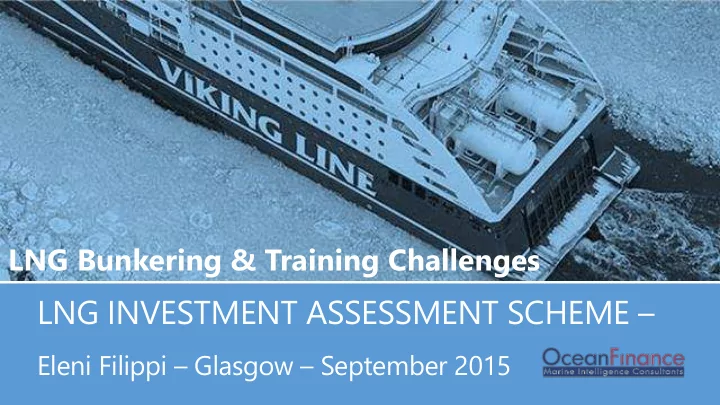
LNG INVESTMENT ASSESSMENT SCHEME Eleni Filippi Glasgow September - - PowerPoint PPT Presentation
LNG Bunkering & Training Challenges LNG INVESTMENT ASSESSMENT SCHEME Eleni Filippi Glasgow September 2015 CONTENTS 1. Overview of the OTMW-Network 2. Ocean Finance Ltd. as part of OTMW-Network 3. LNG Investment Overview 4.
1. Overview of the OTMW-Network 2. Ocean Finance Ltd. as part of OTMW-Network 3. LNG Investment Overview 4. LNG Investment Assessment Model 5. LNG Investment Critical Parameters
Ocean Finance Ltd. Glasgow – September 2015 | LNG Bunkering & Training Challenges 2
▪ Given the foreseen upcoming increase on the demand of Liquefied Natural Gas (LNG), as a cleaner marine fuel in the maritime industry, mainly due to the expected restriction on emissions and the prices opportunities, there is a clear training and building capacities need and interest from the sector's stakeholders. ▪ Specific indicative objectives of the projects are:
▪ Understanding the pros and cons of LNG’s use as a marine fuel. ▪ Developing a new culture in all the actors in understanding their role to the safe
▪ Bridging the different perspective that the crew on-board and at the port have, creating a common understanding. ▪ Bridging the gap in the existing training procedures and the different perspectives on the use of LNG for bunkering.
Ocean Finance Ltd. Glasgow – September 2015 | LNG Bunkering & Training Challenges 3
Involved Partners:
Activity 4: Communication & Capitalisation ▪ Sub-Activity 4.1: Stakeholders platforms
▪ Deliverable D4.1: Follow-up of the existing platform
Ocean Finance Ltd. Glasgow – September 2015 | LNG Bunkering & Training Challenges 4
▪ Our collection process included 18 European countries with waterborne activities. ▪ Following taxonomy used for each country:
▪ LNG Terminals ▪ Ports ▪ Shipping Companies ▪ Agents ▪ Bunkering Services ▪ Shipyards ▪ Logistics Companies
Some Examples,
Regasification Terminal (Italy), Barcelona LNG Regasification Terminal (Spain)
London (UK)
(Croatia), Maritec N.v. (Belgium)
Number of LNG Terminals per EU Country Belgium; 1 France; 4 Greece; 1 Italy; 2 Lithuania; 1 Netherlands; 1 Portugal; 1 Spain; 7 United Kingdom; 5
Ocean Finance Ltd. Glasgow – September 2015 | LNG Bunkering & Training Challenges 5
▪ Sub-Activity 4.2: Clustering with relevant projects and initiatives
▪ Deliverable D4.2.1: Southern Europe LNG project clustering
The Southern Clustering Event was postponed and it is planned to take place during the Poseidon Med Stakeholders Conference (possible date between 10-20 October).
▪ Deliverable D4.2.2: Northern Europe LNG project clustering
▪ The North Clustering Event took place during the TEN-T Days 2015 Exhibition in Riga (22-23 June 2015). ▪ Around 40 TEN-T projects participated in this Exhibition. ▪ You can download report from here:
http://www.onthemosway.eu/on-the-mos- way-network-northern-clustering-event/
Ocean Finance Ltd. Glasgow – September 2015 | LNG Bunkering & Training Challenges 6
▪ Sub-Activity 4.3: Final Conference ▪ Sub-Activity 4.4: Creation of a formal association of Stakeholders for the promotion of MoS and training
▪ A working group will be established by involving industries, universities and training institutions to promote cooperation and a European dimension in the maritime education. (Executed by University of Strathclyde)
▪ Module #1: LNG Fueled Vessels Design Training
▪ We took part in this module as a lecturer, with the lecture title “Decision Support Tools For Alternative Fuels Installations”.
▪ Module #5: Propulsion and Power Generation Training of LNG Driven Vessel
▪ Along with Environmental Protection Engineering – EPE, we will be responsible for organizing and delivering the final module of the Action.
Ocean Finance Ltd. Glasgow – September 2015 | LNG Bunkering & Training Challenges 7
▪ The LNG investment refers to either a retrofit of an existing ship or a new- building. ▪ Converting an existing ship run on LNG requires (a) a retrofit of the main engine, or (b) a new engine (re-engine), along with a fuel system. ▪ Apart from the main engines conversion, the indicative following are also needed: ▪ LNG/Inner gas system ▪ Auxiliary systems ▪ LNG storage tanks ▪ Fuel supply systems ▪ Existing piping/equipment removal ▪ Generally, a complete LNG system includes tanks, bunker station, gas line and gas preparation, ATEX compatible electrical system, double-wall pipes, etc.
Ocean Finance Ltd. Glasgow – September 2015 | LNG Bunkering & Training Challenges 8 Engine Tank
Indicative illustration of a retrofitted bulk carrier
▪ All these conversions have a significant initial investment cost for the shipping company.
▪ Their quotation included equipment installation, commissioning and start- up for approximately €7,4 million.
▪ The removal of the existing equipment, also requires the vessel remain idle for a period. This means an extra off hire cost depending
▪ The manufacturing company requires the vessels to be taken off hire for 110 days.
▪ The installation of the LNG tanks on-board implies a reduction of payload, based on vessel type. ▪ The crew costs are higher, but maintenance costs are lower due to an extension of periods between overhauls.
Ocean Finance Ltd. Glasgow – September 2015 | LNG Bunkering & Training Challenges 9
During our analysis we inquired a manufacturing company to provide us with a proposal for the conversion of 2 main engines of a passenger ship with around 67.000 kW combined engine power.
▪ A significant change also occurs to the Fuel Consumption Cost. ▪ The Fuel Consumption Cost highly depends on the following three:
▪ the Specific Fuel Consumption, ▪ the Engine Service Power Rate, and ▪ the Fuel Price. ▪ In our analysis we assume the following average fuel prices (bunkerindex.com, 2014):
Ocean Finance Ltd. Glasgow – September 2015 | LNG Bunkering & Training Challenges 10
Fuel €/Tonne $/Tonne HFO (Max 3.5% Sulfur) 508,04 568,65 MGO (Max 1.50% Sulfur) 866,42 969,78 LNG 454,38 512,93
10 $/MMBtu + 10%
Ocean Finance Ltd. Glasgow – September 2015 | LNG Bunkering & Training Challenges 11
Alternatives MGO LNG Retrofit Partial Retrofit Full Retrofit Re-Engine Dual Fuel/ Gas only Partial Re-Engine Full Re-Engine HFO & Scrubber
▪ The HFO & Scrubber alternative solution requires also a retrofit:
▪ New funnel layout ▪ Scrubber ▪ Installation of scrubber auxiliary machinery ▪ Installation of sludge tanks ▪ Steel work
▪ During our analysis a manufacturing company provided us with a proposal for the conversion of a passenger ship main engines (around 67.000 kW combined engine power). Their offer for retrofitting all engines is approximately €4,5 million. ▪ Similarly to the LNG investment, the vessel taken off hire time is 55 days. ▪ We assume a 5% fuel consumption increase, compared to typical HFO. ▪ Maintenance costs of the system are higher, and annually calculated.
Ocean Finance Ltd. Glasgow – September 2015 | LNG Bunkering & Training Challenges 12
Scrubber System
▪ To assess the LNG Investment we have developed a tool that calculates basic financial and economic indicators and promotes the most suitable solution, based on scenarios (pairs of solutions). 1. Considering the difference in OPEX,
Ocean Finance Ltd. Glasgow – September 2015 | LNG Bunkering & Training Challenges 13
20% ECA Operation
MGO LNG SCRUBBER HFO
YES YES (?) NO
The difference in OPEX is higher almost 6 times between HFO- MGO and almost 3 times between HFO-SCRUBBER, than the difference between HFO-LNG.
The MGO high price/tonne directly influences its OPEX making it a non- feasible solution
Ocean Finance Ltd. Glasgow – September 2015 | LNG Bunkering & Training Challenges 14
2. Considering the different scenarios (pairs of solutions), ▪ LNG and HFO & Scrubber are both preferred over MGO, despite their higher investment cost (Average NPV = 4.833.973 €). ▪ The Payback Period for LNG and HFO & Scrubber over MGO are both less than a year. ▪ The Payback Period for LNG over HFO & Scrubber is around 9 years.
Ocean Finance Ltd. Glasgow – September 2015 | LNG Bunkering & Training Challenges 15
Time spent within ECAs Vessel remaining lifetime Fuel price differences between LNG and HFO & Scrubber or MGO LNG Bunkering Logistics Cost in Refueling Terminal Investment cost for LNG technology Access to financial incentives
1 2 3 4 5 6 7 8 9 10 $-245 $-145 $-45 $55 $155 $255 $355
Payback Period Spread HFO & Scrubber vs LNG
SECA 0 SECA 25 SECA 50 SECA 75 SECA 100
Ocean Finance Ltd. Glasgow – September 2015 | LNG Bunkering & Training Challenges 16
Payback Period of LNG vs HFO Scrubber Spread SECA 0 SECA 25 SECA 50 SECA 75 SECA 100 $ -245 $ -145 $ -45 8,88 5,8 4,29 $ 55 7,18 3,48 2,29 1,7 $ 155 4,83 2,42 1,55 1,16 $ 255 3,63 1,78 1,18 0,88 $ 355 2,90 1,43 0,95 0,71
HFO is cheaper LNG is cheaper
Time spent within ECAs & Price differences
▪ Vessels lifetime pays a crucial role, as it is impossible for an old ship, with a little remaining operational life to payback the investment on LNG or even Scrubber.
▪ In our analysis we considered two sister vessels for a period of 25 years; the first one is 18 years
years old, so LNG DOES payback during its estimated operational life.
▪ Regarding the LNG Bunkering Logistics Cost in Refueling Terminal, we should consider that: LNG Final Price = Market Price + Surcharge for Bunkering Logistics. ▪ For small ports the bunkering logistics are around 2 $/MMBtu and 3,5 $/MMBtu. With the cost for facilities being around 1,5 $/MMBtu and for truck transportation around 2,2 $/MMBtu (depending on the loading point). For larger ports the costs are lower, but they require a higher initial investment on infrastructure.
Ocean Finance Ltd. Glasgow – September 2015 | LNG Bunkering & Training Challenges 17
▪ LNG Investment Cost: The proposal of the manufacturing company for the retrofit of the 2 main engines of a passenger ship was approximately €7,4 million. ▪ Scrubber Investment Cost: The proposal of another manufacturing company for the retrofit of all main engines of the same passenger ship was approximately €4,5 million. ▪ This significant difference in the investment costs of these two alternatives, turn LNG to a less attractive solution. ▪ However, it is expected that LNG will eventually become more attractive, through the potential economies of scale.
Ocean Finance Ltd. Glasgow – September 2015 | LNG Bunkering & Training Challenges 18
▪ For this reason it is important for the shipping companies to have access to financial incentives. ▪ The EU has identified the development of LNG as a marine fuel as key to its transport strategy for 2020. Funding mechanisms have been developed for studies and infrastructure investments. CEF 2014-2020 Co-funding Possibilities include:
▪ €26,25 billion from the EU’s 2014-2020 budget to co-fund TEN-T projects in the EU Member States ▪ 30% for Works in MoS ▪ 50% for Studies ▪ 50% for Pilot Cases, etc.
▪ Example: For studying the potential of building a bunkering station in the port, the Port of Dunkirk has been granted €1 million. It is estimated that the Dunkirk LNG terminal will have an annual regasification capacity of 13 billion m3 of gas, representing around 20% of France and Belgium's annual natural gas
end of 2015).
Ocean Finance Ltd. Glasgow – September 2015 | LNG Bunkering & Training Challenges 19
Eleni Filippi Business Development efilippi@oceanfinance.gr Ocean Finance Ltd. 23 Psarron Street, 185 46 Piraeus, Greece www.oceanfinance.gr
Ocean Finance Ltd. Glasgow – September 2015 | LNG Bunkering & Training Challenges 20