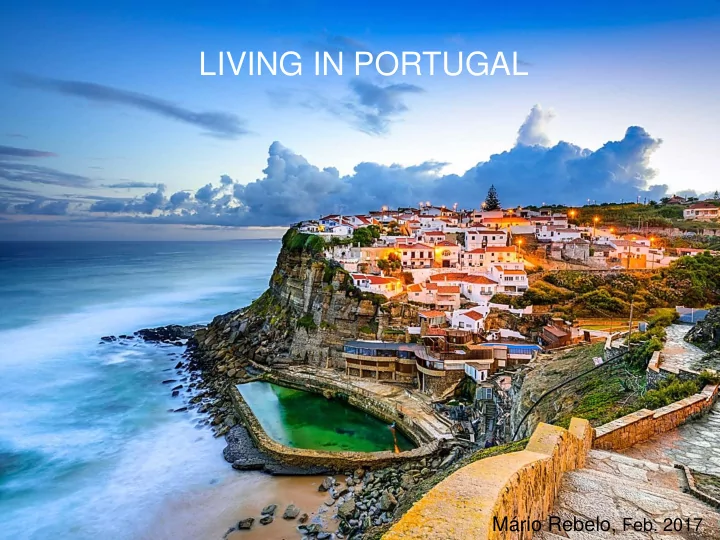
SLIDE 1
Mário Rebelo, Feb. 2017
LIVING IN PORTUGAL
SLIDE 2
The day by day; Habits, culture, singularities; Symbols; Expenses - Light, Water, Gas ...; Education; Leisure.
Agenda
SLIDE 3
The day by day - Habits, culture, singularities
Family, Friends, Work; Weather; Transports; Accommodation / Housing; Football and Fado; Social and Cultural Curiosity; Security;
SLIDE 4
Family, Friends, Work
SLIDE 5
Weather
Continental Portugal
The climate in Portugal varies significantly from region to region, and is influenced by the relief, latitude and proximity of the sea, which provides mild winters, especially in the Algarve. In the areas of Porto and Norte de Portugal and Beiras, especially in the areas closest to Spain, the winters are colder, although temperatures are moderate when compared to the rest of Europe. There is some snowfall, which is more frequent in Serra da Estrela, where the highest point of mainland Portugal (1991m) is situated and conditions for skiing can be found. The summers are warm and dry mainly in the interior regions (Northeast of the Transmontano and Alentejo), and on the coast the heat is moderated by the maritime influence. During the autumn there are often sunny days with mild temperatures which, when they occur in early November, are popularly known as the "Summer of Saint Martin", due to the proximity of the date of this Saint (11/11)
SLIDE 6
Weather
Continental Portugal
The climate in Portugal varies significantly from region to region, and is influenced by the relief, latitude and proximity of the sea, which provides mild winters, especially in the Algarve. In the areas of Porto and Norte de Portugal and Beiras, especially in the areas closest to Spain, the winters are colder, although temperatures are moderate when compared to the rest of Europe. There is some snowfall, which is more frequent in Serra da Estrela, where the highest point of mainland Portugal (1991m) is situated and conditions for skiing can be found. The summers are warm and dry mainly in the interior regions (Northeast of the Transmontano and Alentejo), and on the coast the heat is moderated by the maritime influence. During the autumn there are often sunny days with mild temperatures which, when they occur in early November, are popularly known as the "Summer of Saint Martin", due to the proximity of the date of this Saint (11/11)
SLIDE 7
Weather
Continental Portugal
SLIDE 8 Transports
Air transport
The privileged geographic situation of Portugal makes it a stopover point for many foreign airlines in the airports spread throughout the national territory and located in: Lisbon – General Humberto Deldado Airport - Tel: 218 413 500 Porto - Dr. Francisco Sá Carneiro Airport - Tel: 229 432 400 Faro - Faro Airport - Tel. 289 800 800 Madeira - Funchal - Funchal Airport - Tel: 291 520 700 Açores - Ponta Delgada - João Paulo II Airport - Tel: 296 205 400 ANA - Aeroportos de Portugal, SA regulates the operation of airports in Portugal, and provides information on departures and arrivals at www.ana.pt The various Portuguese airlines make regular domestic and international connections. TAP - Air Portugal (www.tap.pt) - the "flag" company regularly flies to more than 50 international destinations and provides domestic flights between Lisbon, Porto, Faro and the Autonomous Regions of Madeira and the Azores, as well as between Madeira Islands and Porto Santo. PORTUGALIA (www.pga.pt) - maintains regular domestic flights and connections with several international destinations. SATA (www.sata.pt) - regular flights between all the islands of the Azores, and the Azores to Madeira and mainland Portugal. SATA also operates regular flights to some international airports ATA - Aerocondor Transportes Aéreos (www.aerocondor.com) - operates regular domestic flights and international charter flights
SLIDE 9 Transports
Rail transport The CP - Portuguese Railways (www.cp.pt), offers a vast network of trains covering the entire Portuguese mainland, also ensuring international connections to Vigo, Madrid and Paris. There are several options to match the needs of each:
- the top-of-the-range "Alfa pendular" trains are the fastest and most comfortable connection between Lisbon
and the Algarve, and to the north of the country, with Porto, Braga or Guimarães stopping in Coimbra and Aveiro.
- The "Intercidades" service offers connections in the Lisbon-Porto-Braga, Lisbon-Guarda, Lisbon-Covilhã,
Lisbon-Alentejo and Lisbon-Algarve axes.
- the Sud-Express and the Lusitania train-hotel ensure the international connection from Lisbon and Porto.
- a vast network of regional, interregional and suburban trains that ensure a wide coverage of the entire
national territory. Tourist tickets - are the ideal option for those who travel a lot by train. These are personal and non- transferable nominative tickets valid for an unlimited number of trips within a period of 7, 14 or 21 consecutive days and at any time of the year for any category and class of train.
SLIDE 10 Transports
Road transport ROADS Portugal has a good road network composed of Motorways (AE), Main Itineraries (IP), Complementary Itineraries (IC), National Roads (EN) and Municipal Roads. All motorways are marked with their own symbol and equipped with toll booths, whose prices can be consulted at www.brisa.pt or at www.aeatlantico.pt In case of a breakdown or accident on the motorway you can ask for help through Tel: 808 508 508 The tolls have a Via Verde - an innovative toll system that allows payment by bank debit, and is intended only for holders of a greenway identifier, previously purchased at Brisa. BUSES Regular bus services connect all cities, towns and main localities of Portugal. For detailed information on routes, schedules and prices, please consult the National Express Network at www.rede-expressos.pt
SLIDE 11 Transports
SUBWAY An important complement to traditional public transport, Metro runs in the cities of Lisbon and Oporto between 06.00 and 01.00. Older, the Lisbon Metro (www.metrolisboa.pt) covers a vast area of the city, with a network that has been expanding in recent years. Both the first and most recent Stations have been decorated by tile panels of renowned Portuguese artists, making them true underground museums. In Porto, the Metro (www.metro-porto.pt) is recent and there are five lines - blue, red, green, yellow and violet
- in which a great part of the route is made to the surface.
TAXIS Taxis are usually beige-ivory, although some black vehicles continue to circulate with green roofs, the traditional colors of taxis in Portugal. The price is indicated on the meter, and the rates are posted inside the car or can be requested from the driver. The call of a taxi over the phone implies the payment of a fee of 0.75 Euros, and the transportation of luggage in the luggage carrier, implies an additional amount of 1.50 Euros, regardless of the number of volumes and
- weight. The transportation of cribs, pushchairs and wheelchairs, or means of transport is free.
Outside the localities the taxi transportation is paid in the kilometer, the amount previously agreed between the driver and the passenger. The toll and return tolls, if any, are paid by the customer. The tip is voluntary, with a usual value of around 5 to 10% or the rounding of the amount to be paid
SLIDE 12 Transports
Circulation
In Portugal traffic is on the right side. In squares, intersections and junctions, unless indicated otherwise, priority vehicles are shown on the right. At intersections with roundabouts, priority is given to vehicles that are already circulating in the interior. Traffic signs comply with international standards. Required documents:
- Personal identification document
- Driving title
- Certificate of insurance
- Title of registration of ownership of the vehicle or equivalent document
- Vehicle identification document (booklet) or equivalent documents
Fines, traffic ticket, must be paid on the spot. Maximum speed limits for motor cars without trailers and motorcycles: 50 km / hour - within the localities 90 km / hour - in the normal ways 100 km / hour - on roads reserved for cars 120 km / hour - on motorways. Alcohol content equal to or greater than 0.5 grams / liter, implies a driving ban. The use of the seat belt is always mandatory. The Road Code prohibits the use of mobile phones while driving vehicles unless loudspeakers or the headset are used. More detailed information is available on the website of the General Directorate of Transport at www.dgv.pt.
SLIDE 13 Accommodation / Housing
Hospitality The vast range of hotels available throughout the country provides accommodation, with or without meals and other ancillary services, and is classified as follows: HOTELS - the choice is diversified, among a large number of units, which, given the location and quality of the facilities, is rated from 1 to 5 stars; HOTELS APARTMENTS - classified from 2 to 5 stars, are the ideal option for those looking for more independence, while still enjoying all the services of a Hotel; ESTALAGENS - classified in 4 or 5 stars, are cozy units that reflect the characteristics of the area in which they are inserted; PENSIONS - are the cheapest option, and are classified in 3rd, 2nd and 1st category and the best as Inns; MOTÉIS - classified in 2 or 3 stars, are located near roads, and integrate independent housing units with direct entrance from the outside and private parking; BEDROOMS - Installed in monuments or places of great natural beauty, they are classified in 4 categories: Historical, Historical design, Nature and Charm; TOURISM ALDEAMENTOS - Classified from 3 to 5 stars, they are located in delimited spaces, in which all services and support equipment are concentrated; TOURIST APARTMENTS - Classified from 2 to 5 stars, are the ideal option for those who prefer to have complete autonomy;
SLIDE 14 Football and Fado
Fado, urban popular song
Inscribed in 2011 (6.COM) on the Representative List
the Intangible Cultural Heritage of Humanity
SLIDE 15
Social and Cultural Curiosity
The culture of Portugal has its roots in Celtic, Phoenician, African, Iberian, Germanic and Roman cultures. The cultural differentiation of the Portuguese is manifested through the types of housing, religious manifestations, gastronomy, folklore, typical Portuguese sidewalks, tiles, dances, music, theaters, cinemas and so on.
SLIDE 16
Symbols
Barcelos's Rooster Handkerchiefs and scarves Traditional filigree earrings, crosses and necklace
SLIDE 17
Symbols
1001 ways to eat cod Roasted Portuguese Sardine month of June the Lisbon Fes tivities Saint Anthony's - he is the patron of Lisbon popular Saints
SLIDE 18 Expenses - Light, Water, Gas ...
Rates Low Voltage Normal up to 20.7kVA
Transitional selling rate to final customers in BTN (≤20.7kVA)
*RRC art.119º, nº5
On the prices in the tables, VAT is charged at the rate in force. Note: While the appropriate counter is not installed, will be deemed void energy, 40% of the total active power. Tariff in force since January 2017, ERSE Directive 1/2017,
5.75 KVA is recommended for residences with 4 people
Encargos de potência kVA EUR/mês EUR/dia*
Simples 1,15 2,56 0,0842 2,3 4,49 0,1477 Simples, bi-horária e tri- horária 3,45 4,92 0,1616 4,6 6,39 0,2100 5,75 7,85 0,2582 6,9 9,32 0,3063 Simples, bi-horária e tri- horária 10,35 13,71 0,4508 13,8 18,11 0,5953 17,25 22,50 0,7397 20,7 26,90 0,8842
*RRC art.119º, nº5 EUR/kWh* Preço da energia ativa Período horário até 6,9 kVA acima de 6,9 kVA
Simples ≤ 2,3 kVA 0,1422
0,1652 0,1659 Bi-horária Horas fora de vazio 0,1942 0,1981 Horas de vazio 0,1014 0,1023 Tri-horária Horas de ponta 0,2207 0,2247 Horas de cheias0,1737 0,1768 Horas de vazio 0,1014 0,1023
SLIDE 19 EDP: Plan Gas + Electricity
- Gas - Category 2
- Electricity - Lisbon - 5.75 KVA
Gas Electricity
Expenses - Light, Water, Gas ...
Preço EDP Desconto Preço com desconto Termo tarifário fixo (€/dia) 0,1054 5% 0,1001 Energia (€/kWh) 0,0610 5% 0,0580 Preço EDP Desconto Preço com desconto Potência (€/dia) 0,2582 1% 0,2556 Energia (€/kWh) Normal 0,1652 1% 0,1635
SLIDE 20 The national legal documents referenced here are available
- n the Diário da República
website, the legal documents are available in the EUR-Lex Database, the ERSAR recommendations are available
ERSAR and
information in the Portuguese Environment Agency.
Expenses - Light, Water, Gas ...
SLIDE 21
Average final household consumption expenditure:
Total and by type of goods and services
Expenses
SLIDE 22 Average gross income of households by IRS Model
Total gross income earned by households in the calendar year / Number of households in the calendar year (Jan - Dec)
Expenses
SLIDE 23 Variation in the
price
fuels
(liberalized market)
Expenses
Evolution
Fuel Prices in the last 12 months
SLIDE 24
Those who earn up to just over 20,261 euros a year fail to pay, as early as January, the IRS surcharge. The measure impacting the first two IRS levels is expected to benefit about 1.2 million households. Those who are in the third tier, earning annually between 20.261 and 40.522 euros only get rid of the surcharge in the middle of the year. Whoever earns over 40,522 euros per year will continue to withhold the surcharge until November. The national minimum wage rises in January to 557 euros. The increase will impact nearly 650,000 workers. To accompany this movement is still a reduction for employers in the order of 1.25 percentage points.
Taxable income
SLIDE 25
Pensions will also increase in 2017. In January, following the inflation line, all pensions up to 838 euros will increase 0.5%. Those who receive up to € 631 in retirement will have a 10-euro pension increase in August. Those who receive less than the 263 euros of retirement will be increased by 6 euros. In the family allowance there will also be news. In some cases, the benefit increases to double and the income step 4 is restored. The Government guarantees that the replacement will benefit 30,000 children.
Taxable income
SLIDE 26 The family allowance is awarded to children and young people up to the age
- f 16 - or to 24 if the beneficiary is studying at certain levels of education. In
the case of the new fourth step, children up to 36 months are covered. However, this benefit depends on the family's income, which means that not all households are entitled. From the outset, families with 101 thousand euros of furniture assets are excluded. Then look at the household's annual income set - wages, pensions, capital or property income, etc. - and divide it by the number of children entitled to the allowance, plus one. In a family with two children, for example, the division is by three.
Family allowance
SLIDE 27 Thus, a family with a child with an annual income of only 5,000 euros (about 357 euros per month) falls within the first step
- this threshold has a ceiling of
0.5 IAS (2,934.5 euros) and as the calculation Of the allowance considers in this case two children, the income of the household is divided by two, being within the limit.
Family allowance
SLIDE 28
Education
Public versus Private School
Education levels
SLIDE 29
Education
Public School
Cost to families
SLIDE 30
Education
Public School
Cost to families Portuguese families spend 455 euros on return to classes, corresponding to clothing and footwear (78%), sports articles (55%) and education expenses (46%). Portuguese parents spend, on average, 20 euros a week for their children to spend in class time (for food, stationery and other expenses). The majority (25%) will give children up to 10 euros a week, very close to those who will give a weekly between 11 and 20 euros (24%).
SLIDE 31
Education
Private school
Although they follow the National Education Plan, they have their own rules and regulations. While private schools better prepare students for exams, training in public education enhances students' success in higher education. The conclusions are from a study of the University of Porto, which followed the academic course of 4280 students. It is in Portugal that the public school and the private school dependent on the State serve a greater heterogeneity of social classes, being that the private, independent, school is exclusively attended by students of high social classes.
SLIDE 32
Education
Private school
Results obtained
SLIDE 33 Education
Private school
There are a number of international schools in Lisbon. Below are the names and details of some of the most recognized.
- Carlucci American International School of Lisbon: A medium English school that caters to children between 3 and 18 years of age;
- International Preparatory School: an English school that follows the UK curriculum;
- St. Dominics International School: An average English school that follows an international curriculum and IB;
- St. Julians British International School: Offers UK, GSCE, IGCSE, IB curriculum. Aimed at students between 3-18 years of age;
- Lycée Français Charles Lepierre: The school of French that follows the French curriculum;
- Deutsche Schule Lissabon: Offers German education in accordance with the German curriculum;
- Luso-Swiss College, is composed of students of both sexes. The faculty consists of 3 Teachers, 3 Educators, 2 Language Teachers
(English and German) and 1 Physical Education Teacher. The non-teaching staff consists of 6 Watchmen, 1 Cook, 3 Kitchen Assistants, 3 Maids and 1 Maid, bilingual education;
- The Spanish Institute of Lisbon, the Institute has chosen as a project for the whole center, from Infant to Baccalaureate, to work
around the Tagus as a link between Lisbon, Portugal and Spain. Part of this project is a special collaboration with Camões Secondary School in Lisbon, an institution with which we share various activities.
SLIDE 34
Education
Private school Schools are opting for more competitive prices, which include teaching and extracurricular activities. The values are between € 300 and € 500 in Portuguese and bilingual education such as St. Julian's College in Carcavelos, which can reach 17 thousand euros - out of the price of jewelry, tuition and food - the English college Of São Julião is the most expensive in the country, but this does not prevent it from having a waiting list that reaches three years.
SLIDE 35
Leisure
Coastline and Beaches
SLIDE 36 Leisure
The Portuguese coast is extensive: it has 943 km in mainland Portugal, 667 km in the Azores, 250 km in Madeira where they also include the Desertas Islands, the Selvagens Islands and the Island of Porto Santo. The coast has beautiful beaches, with a variety of cliffs and sandy beaches. On the Island of Porto Santo a formation
- f dunes of organic origin (unlike the mineral origin of the Portuguese mainland
coast) with about 9 km is a tourist point very appreciated internationally. An important feature on the Portuguese coast is the Ria de Aveiro, estuary of the river Vouga, near the city of Aveiro, 45 km long and a maximum of 11 km wide, rich in fish and seabirds. There are four canals, and among these several islands and islets, and it is where four rivers meet the ocean. With the formation of coastal cords, a lagoon was defined as one of the most striking hydrographic elements of the Portuguese coast. Portugal has one of the largest exclusive economic zones (EEZs) in Europe, covering about 1 683 000 km².
SLIDE 37
Leisure
Coastline and Beaches
SLIDE 38 Leisure
Coastline and Beaches
Along more than 850 kilometers, the Portuguese coast has so many beaches of fine white sand that it is almost impossible to count them. All bathed in the Atlantic Ocean and all different, are places of a beauty difficult to describe, so nothing better than come discover them. The best known are the Algarve. With three thousand hours of sunshine a year and tepid waters, along 200kms there are beaches to suit all tastes and many dream resorts. Of the sand beaches to lose sight of the small ones nestled by cut rocks, the brand image of the region, there are multiple
- ptions that accompany a clear and quiet sea, ideal for the practice of
various water sports. Sagres, in the extreme southwest of the European continent, marks the
- transition. It is located on the Costa Vicentina that with the southwest
Alentejo constitute one of the best preserved stretches of the European
- coast. Here there are deserted beaches of wild beauty where we can enjoy a
unique contact with nature. And near Sines begins an areal that stretches
- ver over 60kms only ending in Troia, a challenge for hiking enthusiasts!
SLIDE 39 Leisure
Coastline and Beaches
Already the beaches of the Costa da Caparica are very dear of the lisboetas, that around the capital have varied options for sun bathing and sea. From the Estoril line, cosmopolitan with golden age marks in which it was a refuge
- f kings and nobility, to the demure beaches of the idyllic zone of Sintra, the
variety is great. And the sea has the perfect wave for surfing, which has the maximum exponent a little further north on the beaches of Ericeira, Peniche and Nazaré. In the center, there are very wide sandy beaches, to which the artisanal fishing adds a colorful picturesque. And further north, the cooler waters and the invigorating sea are tempered by the hospitable environment and by the good airs of the mountains and the forests. And we still have the islands. If in the archipelago of Madeira stands the long golden sand of the island of Porto Santo with therapeutic properties, in the Azores we find sands of black color with volcanic origin, framed by all the shades of green of a preserved nature.
SLIDE 40
Leisure
Coastline and Beaches
With all these differences there is a common feature - quality. Safe and with a wide range of support and fun services that guarantee all the needs of the users, a great number of Portuguese beaches receive every year the blue flag of Europe, an award that proves its excellent conditions. Another award that many of our beaches are proud to display is the affordable beach. This is how they are identified those who have access for people with difficulties of locomotion, many of them providing even equipment that allow everyone to enjoy the sea baths.
SLIDE 41 Leisure
Coastline and Beaches
Already the beaches of the Costa da Caparica are very dear of the lisboetas, that around the capital have varied options for sun bathing and sea. From the Estoril line, cosmopolitan with golden age marks in which it was a refuge
- f kings and nobility, to the demure beaches of the idyllic zone of Sintra, the
variety is great. And the sea has the perfect wave for surfing, which has the maximum exponent a little further north on the beaches of Ericeira, Peniche and Nazaré. In the center, there are very wide sandy beaches, to which the artisanal fishing adds a colorful picturesque. And further north, the cooler waters and the invigorating sea are tempered by the hospitable environment and by the good airs of the mountains and the forests. And we still have the islands. If in the archipelago of Madeira stands the long golden sand of the island of Porto Santo with therapeutic properties, in the Azores we find sands of black color with volcanic origin, framed by all the shades of green of a preserved nature.
SLIDE 42
Leisure
Mountain range
SLIDE 43
Leisure
Mountain range
Serra da Estrela Serra do Gerês Douro Valley Alentejo
SLIDE 44
Leisure
Golf
SLIDE 45 Leisure
Golf
From fresh mountain air in the north of the country to the beautiful beaches and fantastic climate of the Algarve, all visitors will be delighted by the fabulous golf courses set in truly inspiring natural settings, which are among the best in the world.
THERE ARE FOUR PORTUGUESE GOLF COURSES AMONG THE TOP 25 OF EUROPE Monte Rei (Tavira), Oitavos Dunes (Cascais), Troia
Golf (Troia) and Onyria Palmares (Lagos) are in the Top 25
- f Europe's Best Golf Courses, a ranking compiled by Golf
World magazine, -Brand. The fields occupy the 14th, 18th, 19th, 21st places, respectively. In the Top 100 there are also other Portuguese courses: San Lorenzo (28º), Praia d'el Rey (29º), Penha Longa (32º), Oceânico Old (44º), Royal Óbidos (57º), Quinta do Lago Sul The Oceanico Faldo (89º), Quinta do Lago Norte (92º) and Aroeira I (100º).
SLIDE 46
Sorry for the long presentations, but Portugal despite being a small country is very rich in diversity and attractions.
But I hope that you have aroused your curiosity and the desire to return.
Thank you and see you soon!
SLIDE 47
Mário Rebelo Mobile phone – 0035 91 75 75 705 mariorebelo.arquitecto@gmail.com