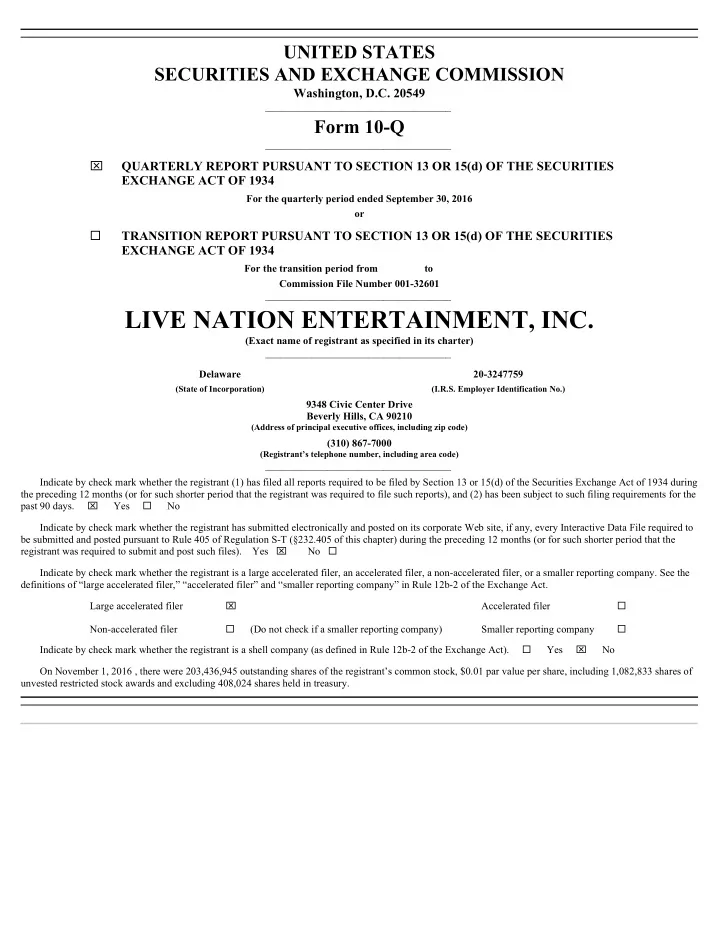
LIVE NATION ENTERTAINMENT, INC. (Exact name of registrant as - - PDF document

live nation entertainment inc
SMART_READER_LITE
LIVE PREVIEW

LIVE NATION ENTERTAINMENT, INC. (Exact name of registrant as - - PDF document

UNITED STATES SECURITIES AND EXCHANGE COMMISSION Washington, D.C. 20549 ____________________________________ Form 10-Q ____________________________________ x QUARTERLY REPORT PURSUANT TO SECTION 13 OR 15(d) OF THE SECURITIES EXCHANGE ACT OF


slide-1
SLIDE 1

UNITED STATES SECURITIES AND EXCHANGE COMMISSION

Washington, D.C. 20549

____________________________________

Form 10-Q

____________________________________

x QUARTERLY REPORT PURSUANT TO SECTION 13 OR 15(d) OF THE SECURITIES EXCHANGE ACT OF 1934

For the quarterly period ended September 30, 2016

  • r

¨ TRANSITION REPORT PURSUANT TO SECTION 13 OR 15(d) OF THE SECURITIES EXCHANGE ACT OF 1934

For the transition period from to Commission File Number 001-32601 ____________________________________

LIVE NATION ENTERTAINMENT, INC.

(Exact name of registrant as specified in its charter) ____________________________________ Delaware 20-3247759

(State of Incorporation) (I.R.S. Employer Identification No.)

9348 Civic Center Drive Beverly Hills, CA 90210

(Address of principal executive offices, including zip code)

(310) 867-7000

(Registrant’s telephone number, including area code)

____________________________________ Indicate by check mark whether the registrant (1) has filed all reports required to be filed by Section 13 or 15(d) of the Securities Exchange Act of 1934 during the preceding 12 months (or for such shorter period that the registrant was required to file such reports), and (2) has been subject to such filing requirements for the past 90 days. x Yes ¨ No Indicate by check mark whether the registrant has submitted electronically and posted on its corporate Web site, if any, every Interactive Data File required to be submitted and posted pursuant to Rule 405 of Regulation S-T (§232.405 of this chapter) during the preceding 12 months (or for such shorter period that the registrant was required to submit and post such files). Yes x No ¨ Indicate by check mark whether the registrant is a large accelerated filer, an accelerated filer, a non-accelerated filer, or a smaller reporting company. See the definitions of “large accelerated filer,” “accelerated filer” and “smaller reporting company” in Rule 12b-2 of the Exchange Act. Large accelerated filer x Accelerated filer

¨

Non-accelerated filer ¨ (Do not check if a smaller reporting company) Smaller reporting company

¨

Indicate by check mark whether the registrant is a shell company (as defined in Rule 12b-2 of the Exchange Act). ¨ Yes x No On November 1, 2016 , there were 203,436,945 outstanding shares of the registrant’s common stock, $0.01 par value per share, including 1,082,833 shares of unvested restricted stock awards and excluding 408,024 shares held in treasury.

slide-2
SLIDE 2

Table of Contents LIVE NATION ENTERTAINMENT, INC. INDEX TO FORM 10-Q

Page

PART I—FINANCIAL INFORMATION Item 1. Financial Statements 2 Consolidated Balance Sheets (Unaudited) as of September 30, 2016 and December 31, 2015 2 Consolidated Statements of Operations (Unaudited) for the three and nine months ended September 30, 2016 and 2015 3 Consolidated Statements of Comprehensive Income (Unaudited) for the three and nine months ended September 30, 2016 and 2015 4 Consolidated Statements of Cash Flows (Unaudited) for the nine months ended September 30, 2016 and 2015 5 Notes to Consolidated Financial Statements (Unaudited) 6 Item 2. Management’s Discussion and Analysis of Financial Condition and Results of Operations 16 Item 3. Quantitative and Qualitative Disclosures About Market Risk 34 Item 4. Controls and Procedures 35 PART II—OTHER INFORMATION Item 1. Legal Proceedings 36 Item 1A. Risk Factors 36 Item 2. Unregistered Sales of Equity Securities and Use of Proceeds 36 Item 3. Defaults Upon Senior Securities 36 Item 5. Other Information 36 Item 6. Exhibits 36

slide-3
SLIDE 3

Table of Contents LIVE NATION ENTERTAINMENT, INC. GLOSSARY OF KEY TERMS AOCI Accumulated other comprehensive income (loss) AOI Adjusted operating income (loss) Company Live Nation Entertainment, Inc. and subsidiaries FASB Financial Accounting Standards Board GAAP United States Generally Accepted Accounting Principles Live Nation Live Nation Entertainment, Inc. and subsidiaries SEC United States Securities and Exchange Commission Ticketmaster For periods prior to May 6, 2010, Ticketmaster means Ticketmaster Entertainment LLC and its predecessor companies (including without limitation Ticketmaster Entertainment, Inc.); for periods on and after May 6, 2010, Ticketmaster means the ticketing business of the Company. 1

slide-4
SLIDE 4

Table of Contents PART I—FINANCIAL INFORMATION Item 1. Financial Statements LIVE NATION ENTERTAINMENT, INC. CONSOLIDATED BALANCE SHEETS (UNAUDITED)

September 30, 2016 December 31, 2015 (in thousands)

ASSETS Current assets Cash and cash equivalents $ 1,039,706 $ 1,303,125 Accounts receivable, less allowance of $26,620 and $17,168, respectively 785,418 452,600 Prepaid expenses 533,283 496,226 Other current assets 48,798 36,364 Total current assets 2,407,205 2,288,315 Property, plant and equipment Land, buildings and improvements 827,960 840,032 Computer equipment and capitalized software 520,100 505,233 Furniture and other equipment 251,419 233,271 Construction in progress 95,398 47,684 1,694,877 1,626,220 Less accumulated depreciation 974,287 894,938 720,590 731,282 Intangible assets Definite-lived intangible assets, net 759,210 777,763 Indefinite-lived intangible assets 368,906 369,317 Goodwill 1,671,629 1,604,315 Other long-term assets 489,489 385,249 Total assets $ 6,417,029 $ 6,156,241 LIABILITIES AND EQUITY Current liabilities Accounts payable, client accounts $ 709,236 $ 662,941 Accounts payable 66,347 58,607 Accrued expenses 905,729 686,664 Deferred revenue 518,678 618,640 Current portion of long-term debt, net 46,693 42,352 Other current liabilities 34,314 32,002 Total current liabilities 2,280,997 2,101,206 Long-term debt, net 1,984,511 2,002,662 Deferred income taxes 198,660 199,472 Other long-term liabilities 125,040 142,267 Commitments and contingent liabilities Redeemable noncontrolling interests 308,773 263,715 Stockholders’ equity Common stock 2,027 2,020 Additional paid-in capital 2,401,969 2,428,566 Accumulated deficit (972,100) (1,075,111) Cost of shares held in treasury (6,865) (6,865) Accumulated other comprehensive loss (144,273) (111,657) Total Live Nation stockholders’ equity 1,280,758 1,236,953 Noncontrolling interests 238,290 209,966 Total equity 1,519,048 1,446,919 Total liabilities and equity $ 6,417,029 $ 6,156,241

slide-5
SLIDE 5

See Notes to Consolidated Financial Statements 2

slide-6
SLIDE 6

Table of Contents LIVE NATION ENTERTAINMENT, INC. CONSOLIDATED STATEMENTS OF OPERATIONS (UNAUDITED)

Three Months Ended September 30, Nine Months Ended September 30, 2016 2015 2016 2015 (in thousands except share and per share data)

Revenue $ 3,170,416 $ 2,622,917 $ 6,557,390 $ 5,509,006 Operating expenses: Direct operating expenses 2,428,003 1,974,322 4,817,894 3,974,710 Selling, general and administrative expenses 414,412 365,220 1,126,452 1,008,922 Depreciation and amortization 104,862 99,054 295,241 272,166 Loss (gain) on disposal of operating assets 253 625 (1) 588 Corporate expenses 31,600 30,186 85,649 80,800 Operating income 191,286 153,510 232,155 171,820 Interest expense 25,249 25,844 75,965 76,857 Interest income (625) (460) (1,831) (2,419) Equity in losses (earnings) of nonconsolidated affiliates 17,471 2,040 17,184 (573) Other expense, net 2,606 8,127 1,412 20,655 Income before income taxes 146,585 117,959 139,425 77,300 Income tax expense 13,824 13,577 26,157 19,232 Net income 132,761 104,382 113,268 58,068 Net income attributable to noncontrolling interests 21,682 15,333 8,966 12,242 Net income attributable to common stockholders of Live Nation $ 111,079 $ 89,049 $ 104,302 $ 45,826 Basic net income per common share available to common stockholders of Live Nation $ 0.51 $ 0.39 $ 0.35 $ 0.14 Diluted net income per common share available to common stockholders of Live Nation $ 0.49 $ 0.38 $ 0.34 $ 0.14 Weighted average common shares outstanding: Basic 202,118,412 201,392,591 201,904,305 200,776,477 Diluted 217,690,217 208,738,780 208,855,401 208,493,651 Reconciliation to net income available to common stockholders of Live Nation: Net income attributable to common stockholders of Live Nation $ 111,079 $ 89,049 $ 104,302 $ 45,826 Accretion of redeemable noncontrolling interests (8,576) (10,118) (33,204) (17,111) Net income available to common stockholders of Live Nation—basic 102,503 78,931 71,098 28,715 Convertible debt interest, net of tax 3,274 — — — Net income available to common stockholders of Live Nation—diluted $ 105,777 $ 78,931 $ 71,098 $ 28,715 See Notes to Consolidated Financial Statements 3

slide-7
SLIDE 7

Table of Contents LIVE NATION ENTERTAINMENT, INC. CONSOLIDATED STATEMENTS OF COMPREHENSIVE INCOME (UNAUDITED)

Three Months Ended September 30, Nine Months Ended September 30, 2016 2015 2016 2015 (in thousands)

Net income $ 132,761 $ 104,382 $ 113,268 $ 58,068 Other comprehensive income (loss), net of tax: Foreign currency translation adjustments (7,869) (6,196) (32,616) (24,255) Other — (107) — 31 Comprehensive income 124,892 98,079 80,652 33,844 Comprehensive income attributable to noncontrolling interests 21,682 15,333 8,966 12,242 Comprehensive income attributable to common stockholders of Live Nation $ 103,210 $ 82,746 $ 71,686 $ 21,602 See Notes to Consolidated Financial Statements 4

slide-8
SLIDE 8

Table of Contents LIVE NATION ENTERTAINMENT, INC. CONSOLIDATED STATEMENTS OF CASH FLOWS (UNAUDITED)

Nine Months Ended September 30, 2016 2015 (in thousands)

CASH FLOWS FROM OPERATING ACTIVITIES Net income $ 113,268 $ 58,068 Reconciling items: Depreciation 104,100 97,845 Amortization 191,141 174,321 Deferred income tax benefit (14,096) (7,181) Amortization of debt issuance costs, discounts and premium, net 7,823 7,974 Non-cash compensation expense 25,237 25,594 Equity in losses (earnings) of nonconsolidated affiliates, net of distributions 25,742 6,040 Provision for uncollectible receivables and advances 12,743 7,339 Other, net (6,094) (12,091) Changes in operating assets and liabilities, net of effects of acquisitions and dispositions: Increase in accounts receivable (345,343) (232,106) Increase in prepaid expenses and other assets (173,683) (215,009) Increase in accounts payable, accrued expenses and other liabilities 295,025 120,812 Decrease in deferred revenue (116,347) (46,530) Net cash provided by (used in) operating activities 119,516 (14,924) CASH FLOWS FROM INVESTING ACTIVITIES Advances and collections of notes receivable, net (7,971) (22,827) Investments made in nonconsolidated affiliates (18,628) (17,130) Purchases of property, plant and equipment (119,740) (97,506) Cash paid for acquisitions, net of cash acquired (113,065) (87,371) Other, net (770) (2,290) Net cash used in investing activities (260,174) (227,124) CASH FLOWS FROM FINANCING ACTIVITIES Payments on long-term debt (28,795) (22,910) Distributions to noncontrolling interests (25,279) (13,834) Purchases and sales of noncontrolling interests, net (32,266) (9,491) Proceeds from exercise of stock options 5,676 14,685 Payments for deferred and contingent consideration (21,809) (4,450) Other, net (7,227) 2,552 Net cash used in financing activities (109,700) (33,448) Effect of exchange rate changes on cash and cash equivalents (13,061) (45,150) Net decrease in cash and cash equivalents (263,419) (320,646) Cash and cash equivalents at beginning of period 1,303,125 1,382,029 Cash and cash equivalents at end of period $ 1,039,706 $ 1,061,383 See Notes to Consolidated Financial Statements 5

slide-9
SLIDE 9

Table of Contents LIVE NATION ENTERTAINMENT, INC. NOTES TO CONSOLIDATED FINANCIAL STATEMENTS (UNAUDITED) NOTE 1—BASIS OF PRESENTATION AND OTHER INFORMATION Preparation of Interim Financial Statements The accompanying unaudited consolidated financial statements have been prepared in accordance with GAAP for interim financial information and the instructions to Form 10-Q and Article 10 of Regulation S-X issued by the SEC. Accordingly, they do not include all of the information and footnotes required by GAAP for complete financial statements. In the opinion of management, they include all normal and recurring accruals and adjustments necessary to present fairly the results of the interim periods shown. The financial statements should be read in conjunction with the consolidated financial statements and notes thereto included in the Company’s 2015 Annual Report on Form 10-K filed with the SEC on February 25, 2016 , as amended by the Form 10-K/A filed with the SEC on June 29, 2016. Seasonality Due to the seasonal nature of shows at outdoor amphitheaters and festivals, which primarily occur from May through October, the Concerts and Sponsorship & Advertising segments experience higher revenue during the second and third quarters. The Artist Nation segment’s revenue is impacted, to a large degree, by the touring schedules of artists it represents and generally experiences higher revenue during the second and third quarters as the period from May through October tends to be a popular time for touring events. The Ticketing segment’s revenue is impacted by fluctuations in the availability of events for sale to the public, which vary depending upon scheduling by its clients. The Company’s seasonality also results in higher balances in cash and cash equivalents, accounts receivable, prepaid expenses, accrued expenses and deferred revenue at different times in the year. Therefore, the results to date are not necessarily indicative of the results expected for the full year. Cash and Cash Equivalents Included in the September 30, 2016 and December 31, 2015 cash and cash equivalents balance is $547.4 million and $549.0 million , respectively, of cash received that includes the face value of tickets sold on behalf of ticketing clients and their share of service charges, which amounts are to be remitted to the clients. Acquisitions During the first nine months of 2016 , the Company completed several acquisitions that were accounted for as business combinations under the acquisition method of accounting and were not significant either on an individual basis or in the aggregate. Income Taxes Each reporting period, the Company evaluates the realizability of all of its deferred tax assets in each tax jurisdiction. As of September 30, 2016 , the Company continued to maintain a full valuation allowance against its net deferred tax assets in certain jurisdictions due to sustained pre-tax losses. As a result of the valuation allowances, no tax benefits have been recognized for losses incurred in those tax jurisdictions for the first nine months of 2016 and 2015 . Reclassifications In connection with the modified retrospective application of new accounting guidance for employee share-based payment transactions as discussed below, the Company has reclassified $7.7 million of payments for employee taxes, where shares were withheld upon the vesting or exercise of equity awards in order to satisfy the withholding obligation, from operating activities to financing activities within the consolidated statements of cash flows for the nine months ended September 30, 2015 . Recent Accounting Pronouncements Recently Adopted Pronouncements In April 2015, the FASB amended its guidance on internal-use software providing clarification to customers about whether a cloud computing arrangement includes a software license. If a cloud computing arrangement includes a software license, then the customer should account for the software license element of the arrangement consistent with the acquisition of other software licenses. If a cloud computing arrangement does not include a software license, the customer should account for the arrangement as a service contract. The Company adopted this guidance prospectively on January 1, 2016 and it did not have a material effect on the Company’s financial position or results of operations. 6

slide-10
SLIDE 10

Table of Contents In March 2016, the FASB issued guidance that simplifies several aspects of the accounting for employee share-based payment transactions, including the accounting for forfeitures, employer tax withholding on share-based compensation and the financial statement presentation of excess tax benefits or deficiencies, as well as classification in the statement of cash flows. The Company adopted this guidance effective January 1, 2016 using a modified retrospective transition method with a cumulative-effect adjustment to retained earnings for the changes to the accounting for forfeitures and excess tax benefits or deficiencies. Upon adoption of this guidance, the Company no longer estimates forfeitures in advance and now recognizes forfeitures as they occur and has reflected a cumulative effect adjustment to accumulated deficit in the consolidated balance sheets of $ 1.3 million . Recently Issued Pronouncements In May 2014, the FASB issued a comprehensive new revenue recognition standard that will supersede nearly all existing revenue recognition guidance under

  • GAAP. The new standard provides a five-step analysis of transactions to determine when and how revenue is recognized. The core principle of the guidance is that

a company should recognize revenue to depict the transfer of promised goods or services to customers in an amount that reflects the consideration to which the entity expects to be entitled in exchange for those goods or services. The FASB continues to issue guidance clarifying certain guidelines of the standard including reframing the indicators in the principal versus agent guidance to focus on evidence that a company is acting as a principal rather than agent. The standard is effective for annual periods beginning after December 15, 2017 and interim periods within that year. Early adoption of the standard is only permitted for annual periods beginning after December 15, 2016 and interim periods within that year. The guidance should be applied retrospectively, either to each prior period presented in the financial statements, or only to the most current reporting period presented in the financial statements with a cumulative-effect adjustment as of the date of adoption. The Company will adopt this standard on January 1, 2018, and is currently assessing which implementation method it will apply and the impact that adoption will have on its financial position and results of operations. In January 2016, the FASB issued amendments for the recognition, measurement, presentation, and disclosure of financial instruments. Among other things, the guidance requires equity investments that do not result in consolidation and are not accounted for under the equity method to be measured at fair value with any change in fair value recognized in net income unless the investments do not have readily determinable fair values. The amendments are effective for annual periods beginning after December 15, 2017 and interim periods within that year. Early adoption is not permitted for most of the amendments. The amendments are to be applied through a cumulative-effect adjustment to the balance sheet as of the beginning of the fiscal year of adoption with the exception of equity investments without readily determinable fair values, which will be applied prospectively. The Company will adopt this standard on January 1, 2018, and currently expects that adoption of this guidance will not have a material impact on its financial position or results of operations. In February 2016, the FASB issued guidance that requires lessees to recognize most leases on their balance sheet as a lease liability and a right-of-use asset, and to disclose key information about leasing arrangements. The guidance is effective for annual periods beginning after December 15, 2018 and interim periods within that year, and early adoption is permitted. The guidance should be applied on a modified retrospective basis. The Company expects to adopt this standard on January 1, 2019, and is currently evaluating the impact that the standard will have on its financial position and results of operations. In March 2016, the FASB issued guidance clarifying that the assessment of whether an embedded contingent put or call option is clearly and closely related to the debt instrument only requires an analysis pursuant to the four-step decision sequence outlined in the guidance for embedded derivatives. The guidance is effective for fiscal years beginning after December 15, 2016 and interim periods within that year. The guidance should be applied to existing debt instruments using a modified retrospective method as of the beginning of the period of adoption. The Company will adopt this standard on January 1, 2017, and currently expects that adoption of this guidance will not impact its financial position or results of operations. NOTE 2—LONG-LIVED ASSETS Definite-lived Intangible Assets The Company has definite-lived intangible assets which are amortized over the shorter of either the lives of the respective agreements or the period of time the assets are expected to contribute to the Company’s future cash flows. The amortization is recognized on either a straight-line basis or in proportion to the asset’s expected cash flows. 7

slide-11
SLIDE 11

Table of Contents The following table presents the changes in the gross carrying amount and accumulated amortization of definite-lived intangible assets for the nine months ended September 30, 2016 :

Revenue- generating contracts Client / vendor relationships Trademarks and naming rights Non- compete agreements Venue management and leaseholds

Technology

Other Total (in thousands)

Balance as of December 31, 2015: Gross carrying amount $ 700,795 $ 379,282 $ 86,556 $ 176,354 $ 66,051 $ 30,265 $ 3,598 $ 1,442,901 Accumulated amortization (313,743) (169,620) (14,578) (121,319) (35,645) (8,602) (1,631) (665,138) Net 387,052 209,662 71,978 55,035 30,406 21,663 1,967 777,763 Gross carrying amount: Acquisitions— current year 48,912 51,211 — — 1,449 8,604 413 110,589 Acquisitions— prior year 11,404 782 3,618 1,500 1,174 — — 18,478 Dispositions — (2,299) — — (1,225) — — (3,524) Foreign exchange (12,950) (1) (522) (2,998) (2,345) (340) 2 (19,154) Other (1) (10,717) (3,089) (6) (117,152) (9,600) (627) 53 (141,138) Net change 36,649 46,604 3,090 (118,650) (10,547) 7,637 468 (34,749) Accumulated amortization: Amortization (54,787) (47,129) (7,018) (15,190) (4,260) (4,276) (332) (132,992) Dispositions — 599 — — 22 — — 621 Foreign exchange 4,991 (118) 220 772 1,110 277 (22) 7,230 Other (1) 10,772 3,089 — 117,227 9,600 627 22 141,337 Net change (39,024) (43,559) (6,798) 102,809 6,472 (3,372) (332) 16,196 Balance as of September 30, 2016: Gross carrying amount 737,444 425,886 89,646 57,704 55,504 37,902 4,066 1,408,152 Accumulated amortization (352,767) (213,179) (21,376) (18,510) (29,173) (11,974) (1,963) (648,942) Net $ 384,677 $ 212,707 $ 68,270 $ 39,194 $ 26,331 $ 25,928 $ 2,103 $ 759,210 ______________

(1) Other includes netdowns of fully amortized or impaired assets.

Included in the current year acquisitions amounts above are definite-lived intangible assets primarily associated with the acquisition of a controlling interest in an artist management business with locations in the United States and Canada, controlling interests in festival and concert promoters located in the United Kingdom and the United States, and a digital content company located in the United States. Included in the prior year acquisitions amounts above are definite-lived intangible assets primarily associated with the acquisition of a controlling interest in a festival promoter located in the United States. 8

slide-12
SLIDE 12

Table of Contents The 2016 additions to definite-lived intangible assets from acquisitions have weighted-average lives as follows:

Weighted- Average Life (years)

Revenue-generating contracts 7 Client/vendor relationships 5 Venue management and leaseholds 5 Technology 5 All categories 6 Amortization of definite-lived intangible assets for the three months ended September 30, 2016 and 2015 was $47.8 million and $42.3 million , respectively, and for the nine months ended September 30, 2016 and 2015 was $133.0 million and $118.4 million , respectively. Amortization related to nonrecoupable ticketing contract advances for the three months ended September 30, 2016 and 2015 was $20.5 million and $22.4 million , respectively, and for the nine months ended September 30, 2016 and 2015 was $57.0 million and $55.2 million , respectively. The following table presents the Company’s estimate of amortization expense for each of the five succeeding fiscal years for definite-lived intangible assets that exist at September 30, 2016 : (in thousands) October 1 - December 31, 2016 $ 46,174 2017 $ 163,937 2018 $ 142,989 2019 $ 119,495 2020 $ 99,868 As acquisitions and dispositions occur in the future and the valuations of intangible assets for recent acquisitions are completed, amortization may vary. Goodwill The following table presents the changes in the carrying amount of goodwill in each of the Company’s reportable segments for the nine months ended September 30, 2016 :

Concerts Sponsorship & Advertising Ticketing Artist Nation Total (in thousands)

Balance as of December 31, 2015: Goodwill $ 602,771 $ 332,081 $ 733,825 $ 340,501 $ 2,009,178 Accumulated impairment losses (386,915) — — (17,948) (404,863) Net 215,856 332,081 733,825 322,553 1,604,315 Acquisitions—current year 32,562 27,254 3,862 24,036 87,714 Acquisitions—prior year (18,906) 18,302 (108) 449 (263) Dispositions — — — (323) (323) Foreign exchange (25,067) 5,468 1,475 (1,690) (19,814) Balance as of September 30, 2016: Goodwill 591,360 383,105 739,054 362,973 2,076,492 Accumulated impairment losses (386,915) — — (17,948) (404,863) Net $ 204,445 $ 383,105 $ 739,054 $ 345,025 $ 1,671,629 Included in the current year acquisitions amounts above is goodwill primarily associated with the acquisition of controlling interests in festival and concert promoters located in the United Kingdom and the United States, an artist 9

slide-13
SLIDE 13

Table of Contents management business with locations in the United States and Canada and a digital content company located in the United States. Included in the prior year acquisitions amounts above are net reductions in goodwill resulting from changes in purchase price allocations of prior year acquisitions primarily related to the acquisition of a controlling interest in a festival promoter located in the United States and a venue management business in New Zealand. The Company is in various stages of finalizing its acquisition accounting for recent acquisitions, which include the use of external valuation consultants, and the completion of this accounting could result in a change to the associated purchase price allocations, including goodwill and its allocation between segments. Investments in Nonconsolidated Affiliates The Company reviews its investments in nonconsolidated affiliates for impairment whenever events or changes in circumstances indicate that the carrying amount of the asset may not be recoverable. For the nine months ended September 30, 2016 , the Company recorded impairment charges related to these investments of $15.1 million as equity in losses (earnings) of nonconsolidated affiliates, primarily related to investments in a digital content company and an online merchandise company that are located in the United States. See Note 3—Fair Value Measurements for further discussion of the inputs used to determine the fair

  • values. There were no significant impairments of investments in nonconsolidated affiliates for the comparable period of 2015.

NOTE 3 —FAIR VALUE MEASUREMENTS The Company’s outstanding debt held by third-party financial institutions is carried at cost, adjusted for any premium, discounts or debt issuance costs. The Company’s debt is not publicly traded and the carrying amounts typically approximate fair value for debt that accrues interest at a variable rate, which are considered to be Level 2 inputs as defined in the FASB guidance. The estimated fair values of the Company’s 7% senior notes, 5.375% senior notes and 2.5% convertible senior notes were $441.2 million , $259.0 million and $297.8 million , respectively, at September 30, 2016 . The estimated fair values of the 7% senior notes, 5.375% senior notes and 2.5% convertible senior notes were $443.1 million , $249.4 million and $280.2 million , respectively, at December 31, 2015 . See Note 7 —Subsequent Events for discussion of the October 2016 repayment of the 7% senior notes. The estimated fair value of the Company’s third-party fixed- rate debt is based on quoted market prices in active markets for the same or similar debt, which are considered to be Level 2 inputs. The Company had fixed-rate debt held by noncontrolling interest partners with a face value of $36.8 million and $32.9 million at September 30, 2016 and December 31, 2015 , respectively. The Company is unable to determine the fair value of this debt. The following table shows the fair value of the Company’s financial assets that have been adjusted to fair value on a non-recurring basis which had a significant impact on the Company’s results of operations for the nine months ended September 30, 2016:

Fair Value Fair Value Measurements Using Loss Description Measurements Level 1 Level 2 Level 3 (Gain) (in thousands)

2016 Investments in nonconsolidated affiliates $ — $ — $ — $ — $ 15,088 As discussed in Note 2—Long-Lived Assets, the Company believed certain of its investment balances were impaired based on financial information received regarding the bankruptcy or dissolution of two nonconsolidated affiliates, which are considered Level 3 inputs. NOTE 4—COMMITMENTS AND CONTINGENT LIABILITIES Ticketing Fees Consumer Class Action Litigation On March 18, 2016, all appeals relating to a settlement agreement reached by the plaintiffs and Ticketmaster in respect of a ticketing fees consumer class action litigation matter originally filed in October 2003 against Ticketmaster were dismissed, thus resolving this matter and allowing the implementation of the terms of the settlement. The Company has funded a portion of the settlement primarily related to the plaintiffs’ attorney fees. Ticketmaster and its parent, Live Nation, have not acknowledged any violations of law or liability in connection with the matter. As of September 30, 2016 , the Company had accrued $14.8 million , its best estimate of the probable remaining costs associated with the settlement referred to above, which was recorded in prior years. The calculation of this liability is based in part upon an estimated redemption rate. Any difference between the Company’s estimated redemption rate and the actual 10

slide-14
SLIDE 14

Table of Contents redemption rate it experiences will impact the final settlement amount; however, the Company does not expect this difference to be material. NOTE 5—EQUITY The following table shows the reconciliation of the carrying amount of stockholders’ equity attributable to Live Nation, equity attributable to noncontrolling interests, total equity and also redeemable noncontrolling interests for the nine months ended September 30, 2016 :

Live Nation Stockholders’ Equity Noncontrolling Interests Total Equity Redeemable Noncontrolling Interests (in thousands) (in thousands)

Balance at December 31, 2015 $ 1,236,953 $ 209,966 $ 1,446,919 $ 263,715 Non-cash compensation expense 25,237 — 25,237 — Common stock issued under stock plans, net of shares withheld for employee taxes (4,110) — (4,110) — Exercise of stock options 5,676 — 5,676 — Acquisitions — 40,705 40,705 26,183 Divestitures — (1,856) (1,856) — Purchases of noncontrolling interests (21,480) (9,663) (31,143) 623 Redeemable noncontrolling interests fair value adjustments (33,204) — (33,204) 33,204 Cash distributions — (15,982) (15,982) (9,297) Other — 759 759 (260) Comprehensive income (loss): Net income (loss) 104,302 14,361 118,663 (5,395) Foreign currency translation adjustments (32,616) — (32,616) — Balance at September 30, 2016 $ 1,280,758 $ 238,290 $ 1,519,048 $ 308,773 Accumulated Other Comprehensive Loss The following table presents changes in the components of AOCI, net of taxes, for the nine months ended September 30, 2016 :

Defined Benefit Pension Items Foreign Currency Items Total (in thousands)

Balance at December 31, 2015 $ (358) $ (111,299) $ (111,657) Other comprehensive loss before reclassifications — (32,616) (32,616) Balance at September 30, 2016 $ (358) $ (143,915) $ (144,273) Earnings Per Share The following table sets forth the computation of weighted average common shares outstanding:

Three Months Ended September 30, Nine Months Ended September 30, 2016 2015 2016 2015

Weighted average common shares—basic 202,118,412 201,392,591 201,904,305 200,776,477 Effect of dilutive securities: Stock options and restricted stock 7,641,823 7,346,189 6,951,096 7,717,174 Convertible senior notes 7,929,982 — — — Weighted average common shares—diluted 217,690,217 208,738,780 208,855,401 208,493,651 Basic net income (loss) per common share is computed by dividing the net income (loss) available to common 11

slide-15
SLIDE 15

Table of Contents stockholders by the weighted average number of common shares outstanding during the period. The calculation of diluted net income (loss) per common share includes the effects of the assumed exercise of any outstanding stock options, the assumed vesting of shares of restricted stock awards and the assumed conversion

  • f the convertible senior notes where dilutive.

The following table shows securities excluded from the calculation of diluted net income (loss) per common share because such securities are anti-dilutive:

Three Months Ended September 30, Nine Months Ended September 30, 2016 2015 2016 2015

Options to purchase shares of common stock 1,726,732 3,177,293 5,309,138 3,153,930 Restricted stock awards—unvested 316,810 164,536 319,310 164,536 Conversion shares related to the convertible senior notes — 7,929,982 7,929,982 7,929,982 Number of anti-dilutive potentially issuable shares excluded from diluted common shares outstanding 2,043,542 11,271,811 13,558,430 11,248,448 NOTE 6—SEGMENT DATA The Company’s reportable segments are Concerts, Sponsorship & Advertising, Ticketing and Artist Nation. The Concerts segment involves the promotion of live music events globally in the Company’s owned or operated venues and in rented third-party venues, the production of music festivals, the operation and management of music venues and the creation of associated content. The Sponsorship & Advertising segment manages the development of strategic sponsorship programs in addition to the sale of international, national and local sponsorships and placement of advertising such as signage, promotional programs, rich media

  • fferings, including advertising associated with live streaming and music-related original content, and ads across the Company’s distribution network of venues,

events and websites. The Ticketing segment involves the management of the Company’s global ticketing operations, including providing ticketing software and services to clients, ticket resale services and online access for customers relating to ticket and event information, and is responsible for the Company’s primary websites, www.livenation.com and www.ticketmaster.com . The Artist Nation segment provides management services to artists and other services including event production services and merchandise sales. Revenue and expenses earned and charged between segments are eliminated in consolidation. The Company’s capital expenditures below include accruals and expenditures funded by outside parties such as landlords or replacements funded by insurance proceeds. The Company manages its working capital on a consolidated basis. Accordingly, segment assets are not reported to, or used by, the Company’s management to allocate resources to or assess performance of the segments, and therefore, total segment assets have not been presented. The following table presents the results of operations for the Company’s reportable segments for the three and nine months ended September 30, 2016 and 2015 :

Concerts Sponsorship & Advertising Ticketing Artist Nation Other Corporate Eliminations Consolidated (in thousands)

Three Months Ended September 30, 2016 Revenue $ 2,497,136 $ 136,087 $ 456,443 $ 150,823 $ 2,138 $ — $ (72,211) $ 3,170,416 Direct operating expenses 2,160,233 15,510 231,979 91,550 149 — (71,418) 2,428,003 Selling, general and administrative expenses 216,255 20,667 124,007 49,383 4,100 — — 414,412 Depreciation and amortization 34,002 4,448 47,113 18,187 1,153 752 (793) 104,862 Loss (gain) on disposal of

  • perating

assets 176 — 13 65 — (1) — 253 12

slide-16
SLIDE 16

Table of Contents

Concerts Sponsorship & Advertising Ticketing Artist Nation Other Corporate Eliminations Consolidated (in thousands)

Corporate expenses — — — — — 31,600 — 31,600 Operating income (loss) $ 86,470 $ 95,462 $ 53,331 $ (8,362) $ (3,264) $ (32,351) $ — $ 191,286 Intersegment revenue $ 66,139 $ — $ 4,415 $ 1,657 $ — $ — $ (72,211) $ — Three Months Ended September 30, 2015 Revenue $1,991,909 $ 126,576 $ 426,177 $ 136,675 $ 793 $ — $ (59,213) $ 2,622,917 Direct operating expenses 1,722,880 16,978 210,022 83,171 — — (58,729) 1,974,322 Selling, general and administrative expenses 188,063 14,190 120,429 42,138 400 — — 365,220 Depreciation and amortization 36,075 2,525 46,533 13,152 12 1,241 (484) 99,054 Loss (gain) on disposal of

  • perating

assets 250 — 188 187 — — — 625 Corporate expenses — — — — — 30,186 — 30,186 Operating income (loss) $ 44,641 $ 92,883 $ 49,005 $ (1,973) $ 381 $ (31,427) $ — $ 153,510 Intersegment revenue $ 50,635 $ — $ 7,921 $ 657 $ — $ — $ (59,213) $ — Nine Months Ended September 30, 2016 Revenue $4,775,970 $ 288,923 $ 1,305,577 $ 312,608 $ 4,485 $ — $ (130,173) $ 6,557,390 Direct operating expenses 4,047,664 44,711 673,990 179,636 149 — (128,256) 4,817,894 Selling, general and administrative expenses 571,252 50,540 363,336 129,841 11,483 — — 1,126,452 Depreciation and amortization 101,122 13,777 132,789 44,891 2,053 2,526 (1,917) 295,241 Loss (gain) on disposal of

  • perating

assets (182) — 44 20 — 117 — (1) Corporate expenses — — — — — 85,649 — 85,649 Operating income (loss) $ 56,114 $ 179,895 $ 135,418 $ (41,780) $ (9,200) $ (88,292) $ — $ 232,155 Intersegment revenue $ 119,027 $ — $ 8,552 $ 2,594 $ — $ — $ (130,173) $ — Capital expenditures $ 50,294 $ 1,318 $ 64,513 $ 1,059 $ 777 $ 5,454 $ — $ 123,415 13

slide-17
SLIDE 17

Table of Contents

Concerts Sponsorship & Advertising Ticketing Artist Nation Other Corporate Eliminations Consolidated (in thousands)

Nine Months Ended September 30, 2015 Revenue $ 3,883,525 $ 259,744 $ 1,162,004 $ 302,455 $ 2,377 $ — $ (101,099) $ 5,509,006 Direct operating expenses 3,284,359 38,323 566,759 183,807 1,068 — (99,606) 3,974,710 Selling, general and administrative expenses 497,176 41,140 350,016 118,940 1,650 — — 1,008,922 Depreciation and amortization 105,289 6,738 125,390 33,943 36 2,263 (1,493) 272,166 Loss (gain) on disposal of

  • perating

assets 421 — 9 187 — (29) — 588 Corporate expenses — — — — — 80,800 — 80,800 Operating income (loss) $ (3,720) $ 173,543 $ 119,830 $ (34,422) $ (377) $ (83,034) $ — $ 171,820 Intersegment revenue $ 90,410 $ — $ 9,499 $ 1,190 $ — $ — $ (101,099) $ — Capital expenditures $ 27,042 $ 4,138 $ 60,413 $ 1,538 $ — $ 1,715 $ — $ 94,846 14

slide-18
SLIDE 18

Table of Contents NOTE 7 —SUBSEQUENT EVENTS In October 2016, the Company issued $575 million of 4.875% senior notes due 2024 and amended its senior secured credit facility to provide for (i) a new $190 million term loan A facility, (ii) a new $975 million term loan B facility and (iii) a new $365 million revolving credit facility. The proceeds will be used to repay the $1.005 billion principal balance outstanding on the term loan A and term loan B under the existing senior secured credit facility, to repay the entire $425 million principal amount of the Company’s 7% senior notes due 2020 and to pay the related redemption premium of $14.9 million on the senior notes and estimated accrued interest and fees of $38.1 million , leaving approximately $257.0 million for general corporate purposes. The Company expects the loss on extinguishment of debt related to this refinancing to be between $14 million and $17 million . The Company estimates that its cash interest expense will be reduced initially by approximately $2.0 million annually due to the lower interest rate on the 4.875% senior notes due 2024 and the reduction of the interest rate on the term loan B facility from LIBOR plus 2.75% per annum subject to a LIBOR floor of 0.75% to LIBOR plus 2.5% with no LIBOR floor. Amended Senior Secured Credit Facility The amended senior secured credit facility provides for (i) a $190 million term loan A facility with a maturity of five years, (ii) a $975 million term loan B facility with a maturity of seven years and (iii) a $365 million revolving credit facility with a maturity of five years. In addition, subject to certain conditions, the Company has the right to increase such facilities by an amount equal to the sum of $625 million and the aggregate principal amount of voluntary prepayments of the term B loans and permanent reductions of the revolving credit facility commitments, in each case, other than from proceeds of long-term indebtedness, and additional amounts so long as the senior secured leverage ratio calculated on a pro-forma basis (as defined in the agreement) is no greater than 3.25 x. The revolving credit facility provides for borrowing up to $365 million with sublimits of up to (i) $150 million for the issuance of letters of credit, (ii) $50 million for swingline loans, (iii) $200 million for borrowings in Euros and British Pounds and (iv) $50 million for borrowings in one or more other approved currencies. The amended senior secured credit facility is secured by a first priority lien on substantially all of the tangible and intangible personal property of the Company and the domestic subsidiaries that are guarantors, and by a pledge of substantially all of the shares of stock, partnership interests and limited liability company interests of the Company’s direct and indirect domestic subsidiaries and 65% of each class of capital stock of any first-tier foreign subsidiaries, subject to certain exceptions. The interest rates per annum applicable to revolving credit facility loans and the term loan A under the amended senior secured credit facility are, at the Company’s option, equal to either LIBOR plus 2.25% or a base rate plus 1.25% , subject to stepdowns based on the Company’s net leverage ratio. The interest rates per annum applicable to the term loan B are, at the Company’s option, equal to either LIBOR plus 2.50% or a base rate plus 1.50% . The Company is required to pay a commitment fee of 0.5% per year on the undrawn portion available under the revolving credit facility, subject to a stepdown based on the Company’s net leverage ratio, and variable fees on outstanding letters of credit. For the term loan A, the Company is required to make quarterly payments ranging from $2.4 million to $28.5 million with the balance due at maturity in October 2021. For the term loan B, the Company is required to make quarterly payments of $2.4 million with the balance due at maturity in October 2023. The Company is also required to make mandatory prepayments of the loans under the credit agreement, subject to specified exceptions, from excess cash flow and with the proceeds of asset sales, debt issuances and specified other events. 4.875% Senior Notes The $575 million senior notes due 2024 bear interest at 4.875% , which is payable semi-annually in cash in arrears on May 1 and November 1 of each year beginning on May 1, 2017, and will mature on November 1, 2024. The Company may redeem some or all of the notes, at any time prior to November 1, 2019, at a price equal to 100% of the aggregate principal amount, plus any accrued and unpaid interest to the date of redemption, plus a ‘make-whole’ premium. The Company may redeem up to 35% of the aggregate principal amount of the notes from the proceeds of certain equity offerings prior to November 1, 2019, at a price equal to 104.875% of the aggregate principal amount, plus accrued and unpaid interest thereon, if any, to the date of redemption. In addition, on or after November 1, 2019, the Company may redeem some or all of the notes at any time at the redemption prices specified in the indenture governing the notes, plus any accrued and unpaid interest to the date of redemption. The Company must make an offer to redeem the notes at 101% of their aggregate principal amount, plus accrued and unpaid interest to the repurchase date, if it experiences certain defined changes of control. 15

slide-19
SLIDE 19

Table of Contents Item 2. Management’s Discussion and Analysis of Financial Condition and Results of Operations “Live Nation” (which may be referred to as the “Company,” “we,” “us” or “our”) means Live Nation Entertainment, Inc. and its subsidiaries, or one of

  • ur segments or subsidiaries, as the context requires. You should read the following discussion of our financial condition and results of operations together with

the unaudited consolidated financial statements and notes to the financial statements included elsewhere in this quarterly report. Special Note About Forward-Looking Statements Certain statements contained in this quarterly report (or otherwise made by us or on our behalf from time to time in other reports, filings with the SEC, news releases, conferences, internet postings or otherwise) that are not statements of historical fact constitute “forward-looking statements” within the meaning of Section 27A of the Securities Act of 1933, as amended, and Section 21E of the Exchange Act of 1934, as amended, notwithstanding that such statements are not specifically identified. Forward-looking statements include, but are not limited to, statements about our financial position, business strategy, competitive position, potential growth opportunities, potential operating performance improvements, the effects of competition, the effects of future legislation or regulations and plans and objectives of our management for future operations. We have based our forward-looking statements on our beliefs and assumptions considering the information available to us at the time the statements are made. Use of the words “may,” “should,” “continue,” “plan,” “potential,” “anticipate,” “believe,” “estimate,” “expect,” “intend,” “outlook,” “could,” “target,” “project,” “seek,” “predict,” or variations of such words and similar expressions are intended to identify forward-looking statements but are not the exclusive means of identifying such statements. Forward-looking statements are not guarantees of future performance and are subject to risks and uncertainties that could cause actual results to differ materially from those in such statements. Factors that could cause actual results to differ from those discussed in the forward-looking statements include, but are not limited to, those set forth below under Part II Item 1A.—Risk Factors, in Part I Item IA.—Risk Factors of our 2015 Annual Report on Form 10-K, as well as

  • ther factors described herein or in our annual, quarterly and other reports we file with the SEC (collectively, “cautionary statements”). Based upon changing

conditions, should any one or more of these risks or uncertainties materialize, or should any underlying assumptions prove incorrect, actual results may vary materially from those described in any forward-looking statements. All subsequent written and oral forward-looking statements attributable to us or persons acting

  • n our behalf are expressly qualified in their entirety by the applicable cautionary statements. We do not intend to update these forward-looking statements, except

as required by applicable law. Executive Overview In the third quarter of 2016, our total revenue increased by $547 million , or 21% , on a reported basis as compared to last year, or $593 million , a 23% increase, without the impact of changes in foreign exchange rates. The revenue increase was largely driven by growth in our Concerts segment due to the increase in the number of events and fans. All of our segments reported revenue growth in the quarter as a result of our highest third quarter concerts attendance ever, higher primary and secondary ticket sales in our Ticketing business and continued growth of our Sponsorship & Advertising business. For the first nine months of 2016,

  • ur total revenue grew $1,048 million , or 19% , on a reported basis as compared to last year, or $1,139 million , a 21% increase, without the impact of changes in

foreign exchange rates. Our three largest segments also delivered revenue increases in the first nine months of the year, underscoring the continued success of our strategic initiatives and the underlying health of the live event and ticketing businesses. Further indicative of our success in executing our growth plan, operating income has improved by 35% year-over-year. As the leading global live event and ticketing company, we believe that we are well-positioned to provide the best service to artists, teams, fans and venues and therefore drive growth across all our businesses and that by leveraging our leadership position in the entertainment industry to reach fans through the live concert experience, we will sell more tickets and grow our Sponsorship & Advertising segment revenue. Our Concerts segment revenue for the quarter increased by $505 million , or 25% , on a reported basis as compared to last year, or $542 million , a 27% increase, without the impact of changes in foreign exchange rates. Overall, attendance at our shows increased by 16% in the third quarter of 2016 as compared to last year. This increase was partly due to significant stadium activity in both North America and Europe with shows by artists including Beyoncé, Coldplay, and Guns N’ Roses. Our amphitheater business in North America had a very strong quarter, growing year-over-year attendance by 13% to almost 11.5 million fans in the quarter. There was an 8% increase in our North America amphitheater ancillary revenue per fan in the quarter as we continued to see the various food and beverage initiatives we began rolling out at our venues this year gain popularity and traction. These include “Grab and Go” options, focused wine programs, and specialty branded restaurants. Attendance at our festivals was up 18% in the quarter, partly due to the shift of some of our biggest events, such as the Rock Werchter festival in Belgium, from the second quarter in 2015 to the third quarter in 2016. However, we also had significant increases in attendance and operating results at festivals in North America as well as our Leeds and V festivals in the United Kingdom. Our Concerts segment operating results for the quarter exceeded last year and this was again largely driven by the high volume of stadium, amphitheater, and festival activity as well as our new onsite initiatives. 16

slide-20
SLIDE 20

Table of Contents For the first nine months, our Concerts segment was the largest contributor to our overall revenue growth, with an increase of $892 million , or 23% , on a reported basis as compared to last year, or $960 million , a 25% increase, without the impact of changes in foreign exchange rates. This higher revenue was partly due to our stadium activity doubling on a global basis year-over-year, both in terms of the number of events and fans. Our amphitheater business also had strong revenue growth in 2016, driven by higher attendance and ancillary products. We are particularly encouraged by the response to our concessions initiatives and plan to continue rolling out new technology to enhance speed of service and customer convenience as well as elevated food and beverage offerings. For the first nine months of the year, our ancillary revenue per fan increased by 9% over last year in our North America amphitheaters. Year-to-date, there has also been a 16% increase in the overall number of fans attending our shows as compared to 2015. Operating income for the first nine months of the year was up due to the higher number of shows and fans in stadiums, improved results for our North America festivals, and strong growth in our amphitheaters. Internationally, our new Germany promotion business has delivered strong results during the first three quarters, increasing Concerts revenue and also creating opportunities elsewhere in

  • ur business. We will continue to look for expansion opportunities, both domestically and internationally, as well as ways to market our events more effectively, in
  • rder to continue to expand our fan base and geographic reach and to sell more tickets and advertising.

Our Sponsorship & Advertising segment revenue for the third quarter was up $10 million , or 8% , on a reported basis as compared to last year, or $12 million , a 10% increase, without the impact of changes in foreign exchange rates. Higher revenue resulted from new clients, growth in our online business and increased festival sponsorship, which also improved our operating income. For the first nine months, Sponsorship & Advertising revenue was up $29 million , or 11% , on a reported basis as compared to last year, or $34 million , a 13% increase, without the impact of changes in foreign exchange rates, which also drove improved

  • perating income. Our focus on expanding our amphitheater and festival products with new VIP, mobile app, and social media offerings in North America as well

as adding new sales categories has contributed to this growth. We believe that our extensive on-site and online reach, global venue distribution network, artist relationships and ticketing operations are the key to securing long-term sponsorship agreements with major brands, and we plan to expand these assets while extending further into new markets internationally. Our Ticketing segment revenue for the third quarter increased by $30 million , or 7% , on a reported basis as compared to last year, or $34 million , an 8% increase, without the impact of changes in foreign exchange rates. This increase was due to a 3% growth in primary ticket sales as well as a 12% increase in gross transaction value, or GTV, from our resale ticketing business globally, driven by both concerts and arts tickets. We delivered historically high revenue and ticket sales for our Ticketing segment in the third quarter, driven by high demand for concert tickets and continued positive fan response to our integrated ticketing platform of primary and resale tickets which drove higher operating results for the quarter. For the first nine months, Ticketing revenue was up $144 million , or 12% , on a reported basis as compared to last year, or $158 million , a 14% increase, without the impact of changes in foreign exchange rates, driven by both higher primary ticket sales and our expanding resale business which also led to increased

  • perating results and a 13% increase in our global GTV. In our primary business, we have sold 123 million tickets worldwide for the first nine months, a 6%

increase over last year. Resale GTV grew by 32% in the same period, with increases in both our North America and Europe sales as the number of events activated

  • n our TM+ product increased by 13%. In addition, we launched our secondary business in Sweden, Finland and South Africa as we continue to expand our resale
  • business. In the first nine months of the year, we made several improvements to our apps which drove a 44% increase in app installs. We also continued to see

growth in our mobile ticket sales with an increase of 38% in the first nine months of the year and they now represent 27% of our total ticket sales. Internationally, we have seen strong growth in ticket sales in Germany as a result of the launch of our concert promotion business in that country. As we roll out new tools via our TM One platform, we are seeing encouraging rates of adoption and positive feedback, helping to keep our client net retention over 100%. We will continue to implement new features to drive further expansion of mobile ticket transactions and invest in initiatives aimed at improving the ticket search, purchase and transfer process which we expect will attract more ticket buyers and enhance the overall fan and venue client experience. Our Artist Nation segment revenue for the third quarter increased $14 million , or 10% , on a reported basis as compared to last year, or $16 million , a 12% increase, without the impact of changes in foreign exchange rates, due largely to the acquisition of artist management businesses as well as event production

  • services. For the first nine months of the year, Artist Nation revenue increased $10 million , or 3% , on a reported basis as compared to last year, or $14 million , a

5% increase, without the impact of changes in foreign exchange rates, with changes in timing of management clients’ activity and events. For the first nine months, Artist Nation’s operating results were down primarily due to increased amortization expense in the period from acquisitions. Our Artist Nation segment is focused

  • n providing best-in-class service to its existing clients as well as developing new relationships with top artists and extending the various services it provides to its

clients. We continue to be optimistic about the long-term potential of our company and are focused on the key elements of our business model - expand our concert platform, drive conversion of ticket sales, including through social and mobile channels, sell more tickets for our Ticketmaster clients, deliver to our fans an integrated offering of primary and secondary tickets, grow 17

slide-21
SLIDE 21

Table of Contents

  • ur sponsorship and online revenue, drive cost efficiencies and continue to align our artist management group with our other core businesses.

Our History We were incorporated in Delaware on August 2, 2005 in preparation for the contribution and transfer by Clear Channel Communications, Inc. of substantially all of its entertainment assets and liabilities to us. We completed the separation on December 21, 2005, and became a publicly traded company on the New York Stock Exchange trading under the symbol “LYV.” On January 25, 2010, we merged with Ticketmaster Entertainment LLC and it became a wholly-owned subsidiary of Live Nation. Effective with the merger, Live Nation, Inc. changed its name to Live Nation Entertainment, Inc. Segment Overview Our reportable segments are Concerts, Sponsorship & Advertising, Ticketing, and Artist Nation. Concerts Our Concerts segment principally involves the global promotion of live music events in our owned or operated venues and in rented third-party venues, the

  • peration and management of music venues, the production of music festivals across the world and the creation of associated content. While our Concerts segment
  • perates year-round, we experience higher revenue during the second and third quarters due to the seasonal nature of shows at our outdoor amphitheaters and

festivals, which primarily occur from May through October. Revenue and related costs for events are generally deferred and recognized when the event occurs. All advertising costs incurred during the year for shows in future years are expensed at the end of the year. Concerts direct operating expenses include artist fees, event production costs, show-related marketing and advertising expenses, along with other costs. To judge the health of our Concerts segment, we primarily monitor the number of confirmed events in our network of owned or operated and third-party venues, talent fees, average paid attendance and advance ticket sales. In addition, at our owned or operated venues and festivals, we monitor ancillary revenue per fan and premium ticket sales. For business that is conducted in foreign markets, we also compare the operating results from our foreign operations to prior periods without the impact of changes in foreign exchange rates. Sponsorship & Advertising Our Sponsorship & Advertising segment employs a sales force that creates and maintains relationships with sponsors through a combination of strategic, international, national and local opportunities that allow businesses to reach customers through our concerts, venue, artist relationship and ticketing assets, including advertising on our websites. We drive increased advertising scale to further monetize our concerts platform through rich media offerings including advertising associated with live streaming and music-related original content. We work with our corporate clients to help create marketing programs that drive their business goals and connect their brands directly with fans and artists. We also develop, book and produce custom events or programs for our clients’ specific brands which are typically experienced exclusively by the clients’ consumers. These custom events can involve live music events with talent and media, using both

  • nline and traditional outlets. We typically experience higher revenue in the second and third quarters, as a large portion of sponsorships are associated with shows

at our outdoor amphitheaters and festivals, which primarily occur from May through October. Direct operating expenses include fulfillment costs related to our sponsorship programs, along with other costs. To judge the health of our Sponsorship & Advertising segment, we primarily review the revenue generated through sponsorship arrangements, the percentage of expected revenue under contract and online advertising revenue through our websites. For business that is conducted in foreign markets, we also compare the operating results from our foreign operations to prior periods without the impact of changes in foreign exchange rates. 18

slide-22
SLIDE 22

Table of Contents Ticketing Our Ticketing segment is primarily an agency business that sells tickets for events on behalf of our clients and retains a service charge for these services. Gross Transaction Value, or GTV, represents the total amount of the transaction related to a ticket sale and includes the face value of the ticket as well as the service charge. Service charges are generally based on a percentage of the face value or a fixed fee. We sell tickets through websites, mobile apps, ticket outlets and telephone call centers. Our ticketing sales are impacted by fluctuations in the availability of events for sale to the public, which may vary depending upon scheduling by our clients. We also offer ticket resale services, sometimes referred to as secondary ticketing, primarily through our integrated inventory platform, league/team platforms and other platforms internationally. Our Ticketing segment also manages our online activities including enhancements to our websites and product offerings. Through our websites, we sell tickets to our own events as well as tickets for our clients and provide event information. Revenue related to ticketing service charges is recognized when the ticket is sold except for our own events where our concert promoters control ticketing and then the revenue is deferred and recognized as the event occurs. Ticketing direct operating expenses include ticketing client royalties and credit card fees, along with other costs. To judge the health of our Ticketing segment, we primarily review the gross transaction value and the number of tickets sold through our primary and secondary ticketing operations, the number of clients renewed or added and the average royalty rate paid to clients who use our ticketing services. In addition, we review the number of visits to our websites, the overall number of customers in our database, the number of tickets sold via mobile and the number of app installs. For business that is conducted in foreign markets, we also compare the operating results from our foreign operations to prior periods without the impact of changes in foreign exchange rates. Artist Nation Our Artist Nation segment primarily provides management services to music artists and other clients in exchange for a commission on the earnings of these

  • artists. Our Artist Nation segment also provides event production services and creates and sells merchandise for music artists at live performances, to retailers and

directly to consumers via the internet. Revenue earned from our Artist Nation segment is impacted to a large degree by the touring schedules of the artists we represent and generally we experience higher revenue during the second and third quarters as the period from May through October tends to be a popular time for touring events. Artist Nation direct operating expenses include merchandise royalties and event production costs, along with other costs. To judge the health of our Artist Nation segment, we primarily review the number of major clients represented. For business that is conducted in foreign markets, we also compare the operating results from our foreign operations to prior periods without the impact of changes in foreign exchange rates. 19

slide-23
SLIDE 23

Table of Contents Key Operating Metrics

Three Months Ended September 30, Nine Months Ended September 30, 2016 2015 2016 2015 (in thousands except estimated events)

Concerts (1) Estimated events: North America 4,955 4,438 12,848 12,257 International 1,207 1,467 5,800 5,135 Total estimated events 6,162 5,905 18,648 17,392 Estimated fans: North America 22,161 18,674 39,296 34,896 International 5,808 5,533 16,724 13,425 Total estimated fans 27,969 24,207 56,020 48,321 Ticketing (2) Number of tickets sold 42,579 41,473 123,489 116,206 _________

(1)

Events generally represent a single performance by an artist. Fans generally represent the number of people who attend an event. Festivals are counted as one event in the quarter in which the festival begins, but the number of fans is based on the days the fans were present at the festival and thus can be reported across multiple quarters. Events and fan attendance metrics are estimated each quarter.

(2)

The number of tickets sold includes primary tickets only. This metric includes tickets sold during the period regardless of event timing except for our own events where our concert promoters control ticketing which are reported as the events occur. The total number of tickets sold reported above for the three months ended September 30, 2016 and 2015 excludes approximately 68 million and 69 million , respectively, and for the nine months ended September 30, 2016 and 2015 excludes approximately 205 million and 202 million , respectively, of tickets sold using our Ticketmaster systems, through season seat packages and our venue clients’ box offices, for which we do not receive a fee. Non-GAAP Measures Reconciliation of Segment Adjusted Operating Income (Loss) AOI is a non-GAAP financial measure that we define as operating income (loss) before acquisition expenses (including transaction costs, changes in the fair value of acquisition-related contingent consideration obligations, acquisition-related severance and compensation), depreciation and amortization (including goodwill impairment), loss (gain) on disposal of operating assets and certain stock-based compensation expense . We use AOI to evaluate the performance of our

  • perating segments. We believe that information about AOI assists investors by allowing them to evaluate changes in the operating results of our portfolio of

businesses separate from non-operational factors that affect net income, thus providing insights into both operations and the other factors that affect reported

  • results. AOI is not calculated or presented in accordance with GAAP. A limitation of the use of AOI as a performance measure is that it does not reflect the

periodic costs of certain amortizing assets used in generating revenue in our business. Accordingly, AOI should be considered in addition to, and not as a substitute for, operating income (loss), net income (loss), and other measures of financial performance reported in accordance with GAAP. Furthermore, this measure may vary among other companies; thus, AOI as presented herein may not be comparable to similarly titled measures of other companies. AOI Margin AOI margin is a non-GAAP financial measure that we calculate by dividing AOI by revenue. We use AOI margin to evaluate the performance of our

  • perating segments. We believe that information about the AOI margin assists investors by allowing them to evaluate changes in the operating results of our

portfolio of businesses separate from non-operational factors that affect net income, thus providing insights into both operations and the other factors that affect reported results. AOI margin is not calculated or presented in accordance with GAAP. A limitation of the use of AOI margin as a performance measure is that it does not reflect the periodic costs of certain amortizing assets used in generating revenue in our business. Accordingly, the AOI margin should be considered in addition to, and not as a substitute for, operating income (loss) margin, net income (loss) margin, and other measures of financial performance reported in accordance with GAAP. Furthermore, this measure may vary 20

slide-24
SLIDE 24

Table of Contents among other companies; thus, AOI margin as presented herein may not be comparable to similarly titled measures of other companies. The following table sets forth the reconciliation of adjusted operating income (loss) to operating income (loss):

Adjusted

  • perating

income (loss) Stock- based compensation expense Loss (gain)

  • n disposal of
  • perating

assets Depreciation and amortization Acquisition expenses Operating income (loss) (in thousands)

Three Months Ended September 30, 2016 Concerts $ 119,483 $ 1,781 $ 176 $ 34,002 $ (2,946) $ 86,470 Sponsorship & Advertising 100,215 305 — 4,448 — 95,462 Ticketing 101,701 744 13 47,113 500 53,331 Artist Nation 11,435 880 65 18,187 665 (8,362) Other and Eliminations (2,862) 17 — 360 25 (3,264) Corporate (27,216) 4,366 (1) 752 18 (32,351) Total $ 302,756 $ 8,093 $ 253 $ 104,862 $ (1,738) $ 191,286 Three Months Ended September 30, 2015 Concerts $ 85,842 $ 1,633 $ 250 $ 36,075 $ 3,243 $ 44,641 Sponsorship & Advertising 95,783 375 — 2,525 — 92,883 Ticketing 97,063 681 188 46,533 656 49,005 Artist Nation 12,885 1,195 187 13,152 324 (1,973) Other and Eliminations (91) — — (472) — 381 Corporate (25,840) 4,148 — 1,241 198 (31,427) Total $ 265,642 $ 8,032 $ 625 $ 99,054 $ 4,421 $ 153,510 Nine Months Ended September 30, 2016 Concerts $ 166,404 $ 5,522 $ (182) $ 101,122 $ 3,828 $ 56,114 Sponsorship & Advertising 194,667 995 — 13,777 — 179,895 Ticketing 271,298 2,327 44 132,789 720 135,418 Artist Nation 5,958 3,082 20 44,891 (255) (41,780) Other and Eliminations (8,828) 29 — 136 207 (9,200) Corporate (72,303) 13,282 117 2,526 64 (88,292) Total $ 557,196 $ 25,237 $ (1) $ 295,241 $ 4,564 $ 232,155 Nine Months Ended September 30, 2015 Concerts $ 111,479 $ 5,471 $ 421 $ 105,289 $ 4,018 $ (3,720) Sponsorship & Advertising 181,525 1,244 — 6,738 — 173,543 Ticketing 248,666 2,186 9 125,390 1,251 119,830 Artist Nation 4,895 3,753 187 33,943 1,434 (34,422) Other and Eliminations (1,834) — — (1,457) — (377) Corporate (67,750) 12,940 (29) 2,263 110 (83,034) Total $ 476,981 $ 25,594 $ 588 $ 272,166 $ 6,813 $ 171,820 Constant Currency Constant currency is a non-GAAP financial measure. We calculate currency impacts as the difference between current period activity translated using the current period’s currency exchange rates and the comparable prior period’s currency exchange rates. We present constant currency information to provide a framework for assessing how our underlying businesses performed excluding the effect of foreign currency rate fluctuations. 21

slide-25
SLIDE 25

Table of Contents Segment Operating Results Concerts Our Concerts segment operating results were, and discussions of significant variances are, as follows:

Three Months Ended September 30, % Change Nine Months Ended September 30, % Change 2016 2015 2016 2015 (in thousands) (in thousands)

Revenue $ 2,497,136 $ 1,991,909 25% $ 4,775,970 $ 3,883,525 23% Direct operating expenses 2,160,233 1,722,880 25% 4,047,664 3,284,359 23% Selling, general and administrative expenses 216,255 188,063 15% 571,252 497,176 15% Depreciation and amortization 34,002 36,075 (6)% 101,122 105,289 (4)% Loss (gain) on disposal of operating assets 176 250 * (182) 421 * Operating income (loss) $ 86,470 $ 44,641 94% $ 56,114 $ (3,720) * Operating margin 3.5% 2.2% 1.2% (0.1)% AOI** $ 119,483 $ 85,842 39% $ 166,404 $ 111,479 49% AOI margin** 4.8% 4.3% 3.5% 2.9 % _______ * Percentages are not meaningful. ** See “—Non-GAAP Measures” above for definition and reconciliation of AOI and AOI margin. Three Months Revenue Concerts revenue increased $505.2 million during the three months ended September 30, 2016 as compared to the same period of the prior year. Excluding the decrease of $37.2 million related to currency impacts, revenue increased $542.4 million , or 27% , on a constant currency basis, primarily due to more shows along with higher average attendance and average ticket prices in our stadiums worldwide and in our North America arenas, more North America amphitheater events and increased festival activity due to the timing of certain festivals in Europe and new festivals in North America. Concerts had incremental revenue of $56.6 million from the acquisitions of various festival and concert promotion businesses. Operating results The increase in Concerts operating income for the three months ended September 30, 2016 was primarily driven by strong worldwide stadium and North America festival, amphitheater and arena operating results partially offset by higher compensation costs associated with annual salary increases and timing of incentive compensation associated with the improved operating results. Nine Months Revenue Concerts revenue increased $892.4 million during the nine months ended September 30, 2016 as compared to the same period of the prior year. Excluding the decrease of $67.9 million related to currency impacts, revenue increased $960.3 million , or 25% , on a constant currency basis, primarily due to more shows and higher average ticket prices in our worldwide stadiums, arenas, theaters and clubs and our North America amphitheaters. Concerts had incremental revenue of $154.5 million from the acquisitions of various festival and concert promotion businesses. Operating results The increased operating income for Concerts for the nine months ended September 30, 2016 was primarily driven by strong worldwide stadium and North America amphitheater and festival operating results partially offset by higher compensation costs associated with annual salary increases and timing of incentive compensation in association with the increased operating results, and loss of certain rent credits received in 2015. 22

slide-26
SLIDE 26

Table of Contents Sponsorship & Advertising Our Sponsorship & Advertising segment operating results were, and discussions of significant variances are, as follows:

Three Months Ended September 30, % Change Nine Months Ended September 30, % Change 2016 2015 2016 2015 (in thousands) (in thousands)

Revenue $ 136,087 $ 126,576 8% $ 288,923 $ 259,744 11% Direct operating expenses 15,510 16,978 (9)% 44,711 38,323 17% Selling, general and administrative expenses 20,667 14,190 46% 50,540 41,140 23% Depreciation and amortization 4,448 2,525 76% 13,777 6,738 * Operating income $ 95,462 $ 92,883 3% $ 179,895 $ 173,543 4% Operating margin 70.1% 73.4% 62.3% 66.8% AOI** $ 100,215 $ 95,783 5% $ 194,667 $ 181,525 7% AOI margin** 73.6% 75.7% 67.4% 69.9% _______ * Percentages are not meaningful. ** See “—Non-GAAP Measures” above for definition and reconciliation of AOI and AOI margin. Three Months Revenue Sponsorship & Advertising revenue increased $9.5 million during the three months ended September 30, 2016 as compared to the same period of the prior

  • year. Excluding the decrease of $2.7 million related to currency impacts, revenue increased $12.2 million , or 10% , on a constant currency basis, primarily due to

new sponsorship programs and increased online advertising in North America. Operating results The increase in Sponsorship & Advertising operating income for the three months ended September 30, 2016 was primarily driven by higher North America sponsorship revenue partially offset by higher reserves for bad debt. Nine Months Revenue Sponsorship & Advertising revenue increased $29.2 million during the nine months ended September 30, 2016 as compared to the same period of the prior

  • year. Excluding the decrease of $5.2 million related to currency impacts, revenue increased $34.4 million , or 13% , on a constant currency basis, primarily due to

new sponsorship programs and online advertising in North America, and incremental revenue of $6.9 million from the acquisitions of various festival and concert promotion businesses. Operating results The increase in Sponsorship & Advertising operating income for the nine months ended September 30, 2016 was primarily driven by the higher North America sponsorship revenue partially offset by incremental amortization of $7.9 million from the acquisitions noted above and higher reserves for bad debt. 23

slide-27
SLIDE 27

Table of Contents Ticketing Our Ticketing segment operating results were, and discussions of significant variances are, as follows:

Three Months Ended September 30, % Change Nine Months Ended September 30, % Change 2016 2015 2016 2015 (in thousands) (in thousands)

Revenue $ 456,443 $ 426,177 7% $ 1,305,577 $ 1,162,004 12% Direct operating expenses 231,979 210,022 10% 673,990 566,759 19% Selling, general and administrative expenses 124,007 120,429 3% 363,336 350,016 4% Depreciation and amortization 47,113 46,533 1% 132,789 125,390 6% Loss on disposal of operating assets 13 188 * 44 9 * Operating income $ 53,331 $ 49,005 9% $ 135,418 $ 119,830 13% Operating margin 11.7% 11.5% 10.4% 10.3% AOI** $ 101,701 $ 97,063 5% $ 271,298 $ 248,666 9% AOI margin** 22.3% 22.8% 20.8% 21.4% _______ * Percentages are not meaningful. ** See “—Non-GAAP Measures” above for definition and reconciliation of AOI and AOI margin. Three Months Revenue Ticketing revenue increased $30.3 million during the three months ended September 30, 2016 as compared to the same period of the prior year. Excluding the decrease of $3.9 million related to currency impacts, revenue increased $34.2 million , or 8% , on a constant currency basis, primarily due to increased North America primary ticket sales and fees along with higher North America resale ticket volume for professional sports and theatrical events. Operating results The increase in Ticketing operating income for the three months ended September 30, 2016 was primarily due to increased operating results from North America primary ticket sales, net of the impact of royalty fees and other costs. Nine Months Revenue Ticketing revenue increased $143.6 million during the nine months ended September 30, 2016 as compared to the same period of the prior year. Excluding the decrease of $14.2 million related to currency impacts, revenue increased $157.8 million , or 14% , on a constant currency basis, primarily due to increased worldwide primary ticket volume and fees along with higher resale ticket volume driven by professional sports, theatrical and concerts events. Operating results The increase in Ticketing operating income for the nine months ended September 30, 2016 was primarily due to increased operating results from the higher primary and resale tickets, net of the impact of royalty fees and other costs, partially offset by higher compensation costs associated with annual salary increases and higher headcount. 24

slide-28
SLIDE 28

Table of Contents Artist Nation Our Artist Nation segment operating results were, and discussions of significant variances are, as follows:

Three Months Ended September 30, % Change Nine Months Ended September 30, % Change 2016 2015 2016 2015 (in thousands) (in thousands)

Revenue $ 150,823 $ 136,675 10% $ 312,608 $ 302,455 3% Direct operating expenses 91,550 83,171 10% 179,636 183,807 (2)% Selling, general and administrative expenses 49,383 42,138 17% 129,841 118,940 9% Depreciation and amortization 18,187 13,152 38% 44,891 33,943 32% Loss on disposal of operating assets 65 187 * 20 187 * Operating loss $ (8,362) $ (1,973) * $ (41,780) $ (34,422) (21)% Operating margin (5.5)% (1.4)% (13.4)% (11.4)% AOI** $ 11,435 $ 12,885 (11)% $ 5,958 $ 4,895 22% AOI margin** 7.6 % 9.4 % 1.9 % 1.6 % _______ * Percentages are not meaningful. ** See “—Non-GAAP Measures” above for definition and reconciliation of AOI and AOI margin. Three Months Revenue Artist Nation revenue increased $14.1 million during the three months ended September 30, 2016 as compared to the same period of the prior year. Excluding the decrease of $1.6 million related to currency impacts, revenue increased $15.7 million , or 12% , on a constant currency basis, primarily due to higher commissions in the management business and incremental revenue of $6.9 million from the acquisitions of various artist management businesses. Operating results The increased operating loss for Artist Nation for the three months ended September 30, 2016 was primarily driven by increased compensation costs and timing of amortization of an event-related intangible asset partially offset by higher revenue in the management business. Nine Months Revenue Artist Nation revenue increased $10.2 million during the nine months ended September 30, 2016 as compared to the same period of the prior year. Excluding the decrease of $3.5 million related to currency impacts, revenue increased $13.7 million , or 5% , primarily due to incremental revenue of $10.6 million from the acquisitions of various artist management businesses. Operating results The increased operating loss for Artist Nation for the nine months ended September 30, 2016 was primarily driven by increased compensation costs, timing

  • f amortization of an event-related intangible asset and incremental amortization of $4.6 million from the acquisitions noted above.

25

slide-29
SLIDE 29

Table of Contents Consolidated Results of Operations Three Months

Three Months Ended September 30, % Change 2016 2015 As Reported Currency Impacts Constant Currency** As Reported As Reported Constant Currency** (in thousands)

Revenue $ 3,170,416 $ 45,347 $ 3,215,763 $ 2,622,917 21% 23% Operating expenses: Direct operating expenses 2,428,003 36,688 2,464,691 1,974,322 23% 25% Selling, general and administrative expenses 414,412 7,265 421,677 365,220 13% 15% Depreciation and amortization 104,862 1,865 106,727 99,054 6% 8% Loss (gain) on disposal of operating assets 253 (42) 211 625 * * Corporate expenses 31,600 (1) 31,599 30,186 5% 5% Operating income 191,286 $ (428) $ 190,858 153,510 25% 24% Operating margin 6.0% 5.9% 5.9% Interest expense 25,249 25,844 Interest income (625) (460) Equity in losses of nonconsolidated affiliates 17,471 2,040 Other expense, net 2,606 8,127 Income before income taxes 146,585 117,959 Income tax expense 13,824 13,577 Net income 132,761 104,382 Net income attributable to noncontrolling interests 21,682 15,333 Net income attributable to common stockholders of Live Nation $ 111,079 $ 89,049 ________ * Percentages are not meaningful. ** See “—Non-GAAP Measures” above for definition of constant currency. Equity in losses of nonconsolidated affiliates Equity in losses of nonconsolidated affiliates for the three months ended September 30, 2016 includes impairment charges of $15.1 million primarily related to investments in a digital content company and an online merchandise company that are located in the United States. Other expense, net Other expense, net includes the impact of net foreign exchange rate losses of $1.9 million and $10.6 million for the three months ended September 30, 2016 and 2015 , respectively, primarily from revaluation of certain foreign currency denominated net assets held internationally. 26

slide-30
SLIDE 30

Table of Contents Nine Months

Nine Months Ended September 30, % Change 2016 2015 As Reported Currency Impacts Constant Currency** As Reported As Reported Constant Currency** (in thousands)

Revenue $ 6,557,390 $ 90,727 $ 6,648,117 $ 5,509,006 19% 21% Operating expenses: Direct operating expenses 4,817,894 70,443 4,888,337 3,974,710 21% 23% Selling, general and administrative expenses 1,126,452 15,829 1,142,281 1,008,922 12% 13% Depreciation and amortization 295,241 4,453 299,694 272,166 8% 10% Loss (gain) on disposal of operating assets (1) (34) (35) 588 * * Corporate expenses 85,649 14 85,663 80,800 6% 6% Operating income 232,155 $ 22 $ 232,177 171,820 35% 35% Operating margin 3.5% 3.5% 3.1% Interest expense 75,965 76,857 Interest income (1,831) (2,419) Equity in losses (earnings) of nonconsolidated affiliates 17,184 (573) Other expense, net 1,412 20,655 Income before income taxes 139,425 77,300 Income tax expense 26,157 19,232 Net income 113,268 58,068 Net income attributable to noncontrolling interests 8,966 12,242 Net income attributable to common stockholders of Live Nation $ 104,302 $ 45,826 The following table summarizes the components of depreciation and amortization in each respective period:

Three Months Ended September 30, % Change Nine Months Ended September 30, % Change 2016 2015 2016 2015 (in thousands) (in thousands)

Depreciation $ 36,618 $ 34,140 7% $ 104,100 $ 97,845 6% Amortization of intangibles 47,827 42,270 13% 132,992 118,400 12% Amortization of nonrecoupable ticketing contract advances *** 20,502 22,394 (8)% 56,983 55,171 3% Amortization of other assets (84) 250 * 1,166 750 * $ 104,863 $ 99,054 $ 295,241 $ 272,166 ___________ * Percentages are not meaningful. ** See “—Non-GAAP Measures” above for definition of constant currency. *** In accounting for the merger between Live Nation and Ticketmaster in January 2010, the nonrecoupable ticketing contract advances that existed at the date

  • f the merger were written off in acquisition accounting in accordance with GAAP. Had we continued amortizing the net book value of these

nonrecoupable ticketing contract advances, the amortization above would have been $0.3 million and $0.4 million higher for the three months ended September 30, 2016 and 2015, respectively, and $1.0 million and $1.3 million higher for the nine months ended September 30, 2016 and 2015, respectively. 27

slide-31
SLIDE 31

Table of Contents Equity in losses (earnings) of nonconsolidated affiliates Equity in losses (earnings) of nonconsolidated affiliates for the nine months ended September 30, 2016 includes the charges discussed above in “— Consolidated Results of Operations” for the three-month period. Other expense, net Other expense, net includes the impact of net foreign exchange rate losses of $0.8 million and $31.2 million for the nine months ended September 30, 2016 and 2015 , respectively, primarily from revaluation of certain foreign currency denominated net assets held internationally. The 2015 period includes gains of $11.3 million recorded in connection with the consolidation of a festival promotion business, a ticketing company and an artist management business that were previously accounted for as equity investments. Liquidity and Capital Resources Our working capital requirements and capital for our general corporate purposes, including acquisitions and capital expenditures, are funded from operations

  • r from borrowings under our senior secured credit facility described below. Our cash is centrally managed on a worldwide basis. Our primary short-term liquidity

needs are to fund general working capital requirements, capital expenditures and debt service requirements while our long-term liquidity needs are primarily related to acquisitions and debt repayment. Our primary sources of funds for our short-term liquidity needs will be cash flows from operations and borrowings under our senior secured credit facility, while our long-term sources of funds will be from cash flows from operations, long-term bank borrowings and other debt

  • r equity financings. We may from time to time engage in open market purchases of our outstanding debt securities or redeem or otherwise repay such debt.

Our balance sheet reflects cash and cash equivalents of $1.0 billion at September 30, 2016 and $1.3 billion at December 31, 2015 . Included in the September 30, 2016 and December 31, 2015 cash and cash equivalents balances are $547.4 million and $549.0 million , respectively, of cash received that includes the face value of tickets sold on behalf of our ticketing clients and their share of service charges that we refer to as client cash. We generally do not utilize client cash for our own financing or investing activities as the amounts are payable to clients on a regular basis. Our foreign subsidiaries held approximately $415.4 million in cash and cash equivalents, excluding client cash, at September 30, 2016 . We generally do not intend to repatriate these funds, but if we did, we would need to accrue and pay United States federal and state income taxes on any future repatriations, net of applicable foreign tax credits. We may from time to time enter into borrowings under our revolving credit facility. If the original maturity of these borrowings is 90 days or less, we present the borrowings and subsequent repayments on a net basis in the statement of cash flows to better represent our financing activities. Our balance sheet reflects total net debt of $2.0 billion at each

  • f September 30, 2016 and December 31, 2015 . Our weighted-average cost of debt, excluding unamortized debt discounts and debt issuance costs and including

the debt premium on our term loans and notes, was 4.3% at September 30, 2016 . Our cash and cash equivalents are held in accounts managed by third-party financial institutions and consist of cash in our operating accounts and invested

  • cash. Cash held in non-interest-bearing and interest-bearing operating accounts in many cases exceeds the Federal Deposit Insurance Corporation insurance limits.

The invested cash is in interest-bearing funds consisting primarily of bank deposits and money market funds. While we monitor cash and cash equivalent balances in our operating accounts on a regular basis and adjust the balances as appropriate, these balances could be impacted if the underlying financial institutions fail. To date, we have experienced no loss or lack of access to our cash and cash equivalents; however, we can provide no assurances that access to our cash and cash equivalents will not be impacted by adverse conditions in the financial markets. For our Concerts segment, we generally receive cash related to ticket revenue at our owned or operated venues in advance of the event, which is recorded in deferred revenue until the event occurs. With the exception of some upfront costs and artist deposits, which are recorded in prepaid expenses until the event occurs, we pay the majority of event-related expenses at or after the event. We view our available cash as cash and cash equivalents, less ticketing-related client cash, less event-related deferred revenue, less accrued expenses due to artists and cash collected on behalf of others, plus event-related prepaid expenses. This is essentially our cash available to, among other things, repay debt balances, make acquisitions and finance capital expenditures. Our intra-year cash fluctuations are impacted by the seasonality of our various businesses. Examples of seasonal effects include our Concerts and Artist Nation segments, which report the majority of their revenue in the second and third quarters. Cash inflows and outflows depend on the timing of event-related payments but the majority of the inflows generally occur prior to the event. See “—Seasonality” below. We believe that we have sufficient financial flexibility to fund these fluctuations and to access the global capital markets on satisfactory terms and in adequate amounts, although there can be no assurance that this will be the case, and capital could be less accessible and/or more costly given current economic conditions. We expect cash 28

slide-32
SLIDE 32

Table of Contents flows from operations and borrowings under our senior secured credit facility, along with other financing alternatives, to satisfy working capital requirements, capital expenditures and debt service requirements for at least the succeeding year. We may need to incur additional debt or issue equity to make other strategic acquisitions or investments. There can be no assurance that such financing will be available to us on acceptable terms or at all. We may make significant acquisitions in the near term, subject to limitations imposed by our financing agreements and market conditions. The lenders under our revolving loans and counterparties to our interest rate hedge agreements consist of banks and other third-party financial institutions. While we currently have no indications or expectations that such lenders and counterparties will be unable to fund their commitments as required, we can provide no assurances that future funding availability will not be impacted by adverse conditions in the financial markets. Should an individual lender default on its

  • bligations, the remaining lenders would not be required to fund the shortfall, resulting in a reduction in the total amount available to us for future borrowings, but

would remain obligated to fund their own commitments. Should any counterparty to our interest rate hedge agreements default on its obligations, we could experience higher interest rate volatility during the period of any such default. Sources of Cash In October 2016, we issued $575 million of 4.875% senior notes due 2024 and amended our senior secured credit facility to provide for (i) a new $190 million term loan A facility, (ii) a new $975 million term loan B facility and (iii) a new $365 million revolving credit facility. The proceeds will be used to repay the $1.005 billion principal balance outstanding on the term loan A and term loan B under the existing senior secured credit facility, to repay the entire $425 million principal amount of our 7% senior notes due 2020 and to pay the related redemption premium of $14.9 million on the senior notes and estimated accrued interest and fees of $38.1 million , leaving approximately $257.0 million for general corporate purposes. We estimate that our cash interest expense will be reduced initially by approximately $2.0 million annually due to the lower interest rate on the 4.875% senior notes due 2024 and the reduction of the interest rate on the term loan B facility from LIBOR plus 2.75% per annum subject to a LIBOR floor of 0.75% to LIBOR plus 2.5% with no LIBOR floor. Amended Senior Secured Credit Facility The amended senior secured credit facility provides for (i) a $190 million term loan A facility with a maturity of five years, (ii) a $975 million term loan B facility with a maturity of seven years and (iii) a $365 million revolving credit facility with a maturity of five years. In addition, subject to certain conditions, we have the right to increase such facilities by an amount equal to the sum of $625 million and the aggregate principal amount of voluntary prepayments of the term B loans and permanent reductions of the revolving credit facility commitments, in each case, other than from proceeds of long-term indebtedness, and additional amounts so long as the senior secured leverage ratio calculated on a pro-forma basis (as defined in the agreement) is no greater than 3.25x. The revolving credit facility provides for borrowing up to $365 million with sublimits of up to (i) $150 million for the issuance of letters of credit, (ii) $50 million for swingline loans, (iii) $200 million for borrowings in Euros and British Pounds and (iv) $50 million for borrowings in one or more other approved currencies. The amended senior secured credit facility is secured by a first priority lien on substantially all of our tangible and intangible personal property and our domestic subsidiaries that are guarantors, and by a pledge of substantially all of the shares of stock, partnership interests and limited liability company interests of our direct and indirect domestic subsidiaries and 65% of each class of capital stock of any first-tier foreign subsidiaries, subject to certain exceptions. The interest rates per annum applicable to revolving credit facility loans and the term loan A under the amended senior secured credit facility are, at our

  • ption, equal to either LIBOR plus 2.25% or a base rate plus 1.25%, subject to stepdowns based on our net leverage ratio. The interest rates per annum applicable

to the term loan B are, at our option, equal to either LIBOR plus 2.50% or a base rate plus 1.50%. We are required to pay a commitment fee of 0.5% per year on the undrawn portion available under the revolving credit facility, subject to a stepdown based on our net leverage ratio, and variable fees on outstanding letters of credit. For the term loan A, we are required to make quarterly payments ranging from $2.4 million to $28.5 million with the balance due at maturity in October

  • 2021. For the term loan B, we are required to make quarterly payments of $2.4 million with the balance due at maturity in October 2023. We are also required to

make mandatory prepayments of the loans under the credit agreement, subject to specified exceptions, from excess cash flow and with the proceeds of asset sales, debt issuances and specified other events. 4.875% Senior Notes The $575 million senior notes due 2024 bear interest at 4.875%, which is payable semi-annually in cash in arrears on May 1 and November 1 of each year beginning on May 1, 2017, and will mature on November 1, 2024. We may redeem some or all of the notes, at any time prior to November 1, 2019, at a price equal to 100% of the aggregate principal amount, plus any accrued and unpaid interest to the date of redemption, plus a ‘make-whole’ premium. We may redeem up to 35% of the aggregate principal amount of the notes from the proceeds of certain equity offerings prior to November 1, 2019, at a price equal to 104.875% of the aggregate principal amount, plus accrued and unpaid interest thereon, if any, to the date of 29

slide-33
SLIDE 33

Table of Contents

  • redemption. In addition, on or after November 1, 2019, we may redeem some or all of the notes at any time at the redemption prices specified in the indenture

governing the notes, plus any accrued and unpaid interest to the date of redemption. We must make an offer to redeem the notes at 101% of their aggregate principal amount, plus accrued and unpaid interest to the repurchase date, if we experience certain defined changes of control. Debt Covenants Our amended senior secured credit facility contains a number of covenants and restrictions that, among other things, requires us to satisfy certain financial covenants and restricts our and our subsidiaries’ ability to incur additional debt, make certain investments and acquisitions, repurchase our stock and prepay certain indebtedness, create liens, enter into agreements with affiliates, modify the nature of our business, enter into sale-leaseback transactions, transfer and sell material assets, merge or consolidate, and pay dividends and make distributions (with the exception of subsidiary dividends or distributions to the parent company or other subsidiaries on at least a pro-rata basis with any noncontrolling interest partners). Non-compliance with one or more of the covenants and restrictions could result in the full or partial principal balance of the credit facility becoming immediately due and payable. The senior secured credit facility agreement has one covenant, measured quarterly, that relates to total leverage. The consolidated total leverage covenant requires us to maintain a ratio of consolidated total funded debt to consolidated EBITDA (both as defined in the credit agreement) of 5.50x over the trailing four consecutive quarters through September 30, 2017. The consolidated total leverage ratio will reduce to 5.25x on December 31, 2017, 5.0x on December 31, 2018, 4.75x on December 31, 2019 and 4.50x on December 31, 2020. The indentures governing our 5.375% senior notes and 4.875% senior notes contain covenants that limit, among other things, our ability and the ability of

  • ur restricted subsidiaries to incur certain additional indebtedness and issue preferred stock, make certain distributions, investments and other restricted payments,

sell certain assets, agree to any restrictions on the ability of restricted subsidiaries to make payments to us, merge, consolidate or sell all of our assets, create certain liens, and engage in transactions with affiliates on terms that are not on an arms-length basis. Certain covenants, including those pertaining to incurrence of indebtedness, restricted payments, asset sales, mergers, and transactions with affiliates will be suspended during any period in which the notes are rated investment grade by both rating agencies and no default or event of default under the indenture has occurred and is continuing. The 5.375% senior notes and the 4.875% senior notes contain two incurrence-based financial covenants, as defined, requiring a minimum fixed charge coverage ratio of 2.0x and a maximum secured indebtedness leverage ratio of 3.50x. Some of our other subsidiary indebtedness includes restrictions on entering into various transactions, such as acquisitions and disposals, and prohibits payment of ordinary dividends. They also have financial covenants including minimum consolidated EBITDA to consolidated net interest payable, minimum consolidated cash flow to consolidated debt service and maximum consolidated debt to consolidated EBITDA, all as defined in the applicable debt agreements. As of September 30, 2016 , we believe we were in compliance with all of our debt covenants. We expect to remain in compliance with all of our debt covenants throughout 2016 . Uses of Cash Acquisitions When we make acquisitions, the acquired entity may have cash at the time of acquisition. All amounts related to the use of cash for acquisitions discussed in this section are presented net of any cash acquired. During the nine months ended September 30, 2016 , we used $113.1 million of cash primarily for the acquisitions of a concert promoter located in Germany, controlling interests in festival and concert promoters located in the United Kingdom and the United States and an artist management business with locations in the United States and Canada. As of the date of acquisition, the acquired businesses had a total of $21.1 million of cash on their balance sheets, primarily related to deferred revenue for future events. During the nine months ended September 30, 2015 , we used $87.4 million of cash primarily for the acquisitions of controlling interests in festival promoters located in the United States and Sweden and a ticketing business located in the United States. As of the date of acquisition, these businesses had a total of $114.6 million of cash on their balance sheets, primarily related to deferred revenue for future events. Capital Expenditures Venue and ticketing operations are capital intensive businesses, requiring continual investment in our existing venues and ticketing systems in order to address fan, client and artist expectations, technological industry advances and various federal, state and/or local regulations. We categorize capital outlays between maintenance capital expenditures and revenue generating capital expenditures. Maintenance capital expenditures are associated with the renewal and improvement of existing venues and technology systems, web development and administrative offices. Revenue generating capital expenditures generally relate to the construction of new venues, major renovations to existing buildings or buildings that are being added to our venue network, the development 30

slide-34
SLIDE 34

Table of Contents

  • f new online or ticketing tools and other technology enhancements. Revenue generating capital expenditures can also include smaller projects whose purpose is to

increase revenue and/or improve operating income. Capital expenditures typically increase during periods when venues are not in operation since that is the time that such improvements can be completed. Our capital expenditures, including accruals but excluding expenditures funded by outside parties such as landlords or replacements funded by insurance proceeds, consisted of the following:

Nine Months Ended September 30, 2016 2015 (1) (in thousands)

Maintenance capital expenditures $ 58,407 $ 44,347 Revenue generating capital expenditures 62,229 50,085 Total capital expenditures $ 120,636 $ 94,432 ___________

(1) Approximately $4.6 million has been reclassified from maintenance to revenue generating capital expenditures from amounts previously reported in 2015. The

total capital expenditures are unchanged. Maintenance capital expenditures during the first nine months of 2016 increased from the same period of the prior year primarily associated with technology systems and enhancements. Revenue generating capital expenditures during the first nine months of 2016 increased from the same period of the prior year primarily associated with the timing and amount of venue-related projects. We currently expect capital expenditures to be between approximately $180 million and $185 million for the full year 2016 . Cash Flows

Nine Months Ended September 30, 2016 2015 (in thousands)

Cash provided by (used in): Operating activities $ 119,516 $ (14,924) Investing activities $ (260,174) $ (227,124) Financing activities $ (109,700) $ (33,448) Operating Activities Cash provided by operating activities increased $134.4 million for the nine months ended September 30, 2016 as compared to the same period of the prior

  • year. During the first nine months of 2016, we increased our accounts payable and accrued liabilities based on the timing of payments along with higher cash-

related net income partially offset by a larger increase in accounts receivable and lower cash received for future events, decreasing deferred revenue, as compared to the same period of the prior year. Investing Activities Cash used in investing activities increased $33.1 million for the nine months ended September 30, 2016 as compared to the same period of the prior year primarily due to higher acquisition activity and higher payments for purchases of property, plant, and equipment partially offset by lower advances of notes

  • receivable. See “—Uses of Cash” above for further discussion.

Financing Activities Cash used in financing activities increased $76.3 million for the nine months ended September 30, 2016 as compared to the same period of the prior year primarily as a result of higher purchases of noncontrolling interests and distributions to noncontrolling interest partners along with higher payments for deferred and contingent consideration due to past acquisitions. 31

slide-35
SLIDE 35

Table of Contents Seasonality Our Concerts, Sponsorship & Advertising and Artist Nation segments typically experience higher operating income in the second and third quarters as our

  • utdoor venues and festivals are primarily used in or occur from May through October, and our artist touring activity is higher. In addition, the timing of when

tickets are sold and the tours of top-grossing acts can impact comparability of quarterly results year over year, although annual results may not be impacted. Our Ticketing segment revenue is impacted by fluctuations in the availability of events for sale to the public, which vary depending upon scheduling by our clients. Cash flows from our Concerts segment typically have a slightly different seasonality as payments are often made for artist performance fees and production costs for tours in advance of the date the related event tickets go on sale. These artist fees and production costs are expensed when the event occurs. Once tickets for an event go on sale, we generally begin to receive payments from ticket sales at our owned or operated venues and festivals in advance of when the event

  • ccurs. We record these ticket sales as revenue when the event occurs.

Market Risk We are exposed to market risks arising from changes in market rates and prices, including movements in foreign currency exchange rates and interest rates. Foreign Currency Risk We have operations in countries throughout the world. The financial results of our foreign operations are measured in their local currencies. Our foreign subsidiaries also carry certain net assets or liabilities that are denominated in a currency other than that subsidiary’s functional currency. As a result, our financial results could be affected by factors such as changes in foreign currency exchange rates or weak economic conditions in the foreign markets in which we have

  • perations. Currently, we do not operate in any hyper-inflationary countries. Our foreign operations reported operating income of $78.4 million for the nine months

ended September 30, 2016 . We estimate that a 10% change in the value of the United States dollar relative to foreign currencies would change our operating income for the nine months ended September 30, 2016 by $7.8 million . As of September 30, 2016 , our primary foreign exchange exposure included the Euro, British Pound, Australian Dollar and Canadian Dollar. This analysis does not consider the implication such currency fluctuations could have on the overall economic conditions of the United States or other foreign countries in which we operate or on the results of operations of our foreign entities. In addition, the reported carrying value of our assets and liabilities, including the total cash and cash equivalents held by our foreign operations, will also be affected by changes in foreign currency exchange rates. We primarily use forward currency contracts, in addition to options, to reduce our exposure to foreign currency risk associated with short-term artist fee

  • commitments. We also may enter into forward currency contracts to minimize the risks and/or costs associated with changes in foreign currency rates on forecasted
  • perating income. At September 30, 2016 , we had forward currency contracts and options outstanding with a notional amount of $45.8 million.

Interest Rate Risk Our market risk is also affected by changes in interest rates. We had $2.1 billion of total debt, excluding debt discounts, issuance costs and premium,

  • utstanding as of September 30, 2016 , of which $1.0 billion was fixed-rate debt and $1.1 billion was floating-rate debt.

Based on the amount of our floating-rate debt as of September 30, 2016 , each 25-basis point increase or decrease in interest rates would increase or decrease

  • ur annual interest expense and cash outlay by approximately $2.6 million when the floor rate is not applicable. This potential increase or decrease is based on the

simplified assumption that the level of floating-rate debt remains constant with an immediate across-the-board increase or decrease as of September 30, 2016 with no subsequent change in rates for the remainder of the period. We have one interest rate cap agreement with an aggregate notional amount of $7.2 million at September 30, 2016 . The interest rate cap agreement ensures that a portion of our floating-rate debt does not exceed 4.25% and expires in June 2018. This agreement has not been designated as a hedging instrument. Therefore, any change in fair value is recorded in earnings during the period of change. Ratio of Earnings to Fixed Charges The ratio of earnings to fixed charges is as follows:

Nine months ended September 30, Year Ended December 31, 2016 2015 2015 2014 2013 2012

2.25 1.66 1.03 * * * 32

slide-36
SLIDE 36

Table of Contents * For the years ended December 31, 2014 , 2013 and 2012 , fixed charges exceeded earnings before income taxes and fixed charges by $104.0 million, $6.0 million and $142.1 million. The ratio of earnings to fixed charges was computed on a total company basis. Earnings represent income before income taxes less equity in undistributed net income (loss) of nonconsolidated affiliates plus fixed charges. Fixed charges represent interest, amortization of debt discount, debt issuance costs and premium and the estimated interest portion of rental charges. Rental charges exclude variable rent expense for events in third-party venues. Recent Accounting Pronouncements Recently Adopted Pronouncements In April 2015, the FASB amended its guidance on internal-use software providing clarification to customers about whether a cloud computing arrangement includes a software license. If a cloud computing arrangement includes a software license, then the customer should account for the software license element of the arrangement consistent with the acquisition of other software licenses. If a cloud computing arrangement does not include a software license, the customer should account for the arrangement as a service contract. We adopted this guidance prospectively on January 1, 2016 and it did not have a material effect on our financial position or results of operations. In March 2016, the FASB issued guidance that simplifies several aspects of the accounting for employee share-based payment transactions, including the accounting for forfeitures, employer tax withholding on share-based compensation and the financial statement presentation of excess tax benefits or deficiencies, as well as classification in the statement of cash flows. We adopted this guidance effective January 1, 2016 using a modified retrospective transition method with a cumulative-effect adjustment to retained earnings for the changes to the accounting for forfeitures and excess tax benefits or deficiencies. Upon adoption of this guidance, we no longer estimate forfeitures in advance and now recognize forfeitures as they occur and have reflected a cumulative effect adjustment to accumulated deficit in the consolidated balance sheets of $ 1.3 million . Recently Issued Pronouncements In May 2014, the FASB issued a comprehensive new revenue recognition standard that will supersede nearly all existing revenue recognition guidance under

  • GAAP. The new standard provides a five-step analysis of transactions to determine when and how revenue is recognized. The core principle of the guidance is that

a company should recognize revenue to depict the transfer of promised goods or services to customers in an amount that reflects the consideration to which the entity expects to be entitled in exchange for those goods or services. The FASB continues to issue guidance clarifying certain guidelines of the standard including reframing the indicators in the principal versus agent guidance to focus on evidence that a company is acting as a principal rather than agent. The standard is effective for annual periods beginning after December 15, 2017 and interim periods within that year. Early adoption of the standard is only permitted for annual periods beginning after December 15, 2016 and interim periods within that year. The guidance should be applied retrospectively, either to each prior period presented in the financial statements, or only to the most current reporting period presented in the financial statements with a cumulative-effect adjustment as of the date of adoption. We will adopt this standard on January 1, 2018, and are currently assessing which implementation method we will apply and the impact that adoption will have on our financial position and results of operations. In January 2016, the FASB issued amendments for the recognition, measurement, presentation, and disclosure of financial instruments. Among other things, the guidance requires equity investments that do not result in consolidation and are not accounted for under the equity method to be measured at fair value with any change in fair value recognized in net income unless the investments do not have readily determinable fair values. The amendments are effective for annual periods beginning after December 15, 2017 and interim periods within that year. Early adoption is not permitted for most of the amendments. The amendments are to be applied through a cumulative-effect adjustment to the balance sheet as of the beginning of the fiscal year of adoption with the exception of equity investments without readily determinable fair values, which will be applied prospectively. We will adopt this standard on January 1, 2018, and currently expect that adoption of this guidance will not have a material impact on our financial position or results of operations. In February 2016, the FASB issued guidance that requires lessees to recognize most leases on their balance sheet as a lease liability and a right-of-use asset, and to disclose key information about leasing arrangements. The guidance is effective for annual periods beginning after December 15, 2018 and interim periods within that year, and early adoption is permitted. The guidance should be applied on a modified retrospective basis. We expect to adopt this standard on January 1, 2019, and are currently evaluating the impact that the standard will have on our financial position and results of operations. In March 2016, the FASB issued guidance clarifying that the assessment of whether an embedded contingent put or call option is clearly and closely related to the debt instrument only requires an analysis pursuant to the four-step decision sequence outlined in the guidance for embedded derivatives. The guidance is effective for fiscal years beginning after December 15, 2016 and interim periods within that year. The guidance should be applied to existing debt instruments using a modified retrospective method as of the beginning of the period of adoption. We will adopt this standard on January 1, 2017, and currently expect that adoption of this guidance will not impact our financial position or results of operations. 33

slide-37
SLIDE 37

Table of Contents Critical Accounting Policies and Estimates The preparation of our financial statements in conformity with GAAP requires management to make estimates, judgments and assumptions that affect the reported amounts of assets and liabilities, disclosure of contingent assets and liabilities at the date of the financial statements and the reported amount of revenue and expenses during the reporting period. On an ongoing basis, we evaluate our estimates that are based on historical experience and on various other assumptions that are believed to be reasonable under the circumstances. The result of these evaluations forms the basis for making judgments about the carrying values of assets and liabilities and the reported amount of revenue and expenses that are not readily apparent from other sources. Because future events and their effects cannot be determined with certainty, actual results could differ from our assumptions and estimates, and such difference could be material. Management believes that the accounting estimates involved in business combinations, impairment of long-lived assets and goodwill, revenue recognition, litigation accruals and income taxes are the most critical to aid in fully understanding and evaluating our reported financial results, and they require management’s most difficult, subjective or complex judgments, resulting from the need to make estimates about the effect of matters that are inherently uncertain. These critical accounting estimates, the judgments and assumptions and the effect if actual results differ from these assumptions are described in Part II Financial Information — Item 7. Management’s Discussion and Analysis of Financial Condition and Results of Operations of our Annual Report on Form 10-K filed with the SEC on February 25, 2016 . There have been no changes to our critical accounting policies during the nine months ended September 30, 2016 . Item 3. Quantitative and Qualitative Disclosures About Market Risk Required information is within Item 2. Management’s Discussion and Analysis of Financial Condition and Results of Operations—Market Risk. 34

slide-38
SLIDE 38

Table of Contents Item 4. Controls and Procedures Evaluation of Disclosure Controls and Procedures We have established disclosure controls and procedures to ensure that material information relating to our company, including our consolidated subsidiaries, is made known to the officers who certify our financial reports and to other members of senior management and our board of directors. Based on their evaluation as of September 30, 2016 , our Chief Executive Officer and Chief Financial Officer have concluded that our disclosure controls and procedures (as defined in Rules 13a-15(e) and 15d-15(e) under the Securities Exchange Act of 1934, as amended) are effective to ensure that (1) the information required to be disclosed by us in the reports that we file or submit under the Securities Exchange Act of 1934, as amended, is recorded, processed, summarized and reported within the time periods specified in SEC rules and forms, and (2) the information we are required to disclose in such reports is accumulated and communicated to management, including our Chief Executive Officer and Chief Financial Officer, as appropriate to allow timely decisions regarding required disclosure. Our management, including our Chief Executive Officer and Chief Financial Officer, does not expect that our disclosure controls and procedures or internal controls will prevent all possible errors and fraud. Our disclosure controls and procedures are, however, designed to provide reasonable assurance of achieving their objectives, and our Chief Executive Officer and Chief Financial Officer have concluded that our disclosure controls and procedures are effective at that reasonable assurance level. Changes in Internal Control Over Financial Reporting There has been no change in our internal control over financial reporting during the period covered by this report that has materially affected, or is reasonably likely to materially affect, our internal control over financial reporting. 35

slide-39
SLIDE 39

Table of Contents PART II—OTHER INFORMATION Item 1. Legal Proceedings None. Item 1A. Risk Factors While we attempt to identify, manage and mitigate risks and uncertainties associated with our business to the extent practical under the circumstances, some level of risk and uncertainty will always be present. Part I Financial Information — Item 1A. Risk Factors of our 2015 Annual Report on Form 10-K filed with the SEC on February 25, 2016 , describes some of the risks and uncertainties associated with our business which have the potential to materially affect our business, financial condition or results of operations. We do not believe that there have been any material changes to the risk factors previously disclosed in our 2015 Annual Report on Form 10-K. Item 2. Unregistered Sales of Equity Securities and Use of Proceeds None. Item 3. Defaults Upon Senior Securities None. Item 5. Other Information None. Item 6. Exhibits The information in the Exhibit Index of this Quarterly Report on Form 10-Q is incorporated into this Item 6 by reference. 36

slide-40
SLIDE 40

Table of Contents SIGNATURES Pursuant to the requirements of the Securities Exchange Act of 1934, the registrant has duly caused this report to be signed on its behalf by the undersigned, thereunto duly authorized, on November 7, 2016 . LIVE NATION ENTERTAINMENT, INC. By: /s/ Brian Capo

Brian Capo Chief Accounting Officer (Duly Authorized Officer)

37

slide-41
SLIDE 41

Table of Contents EXHIBIT INDEX

Exhibit Description Incorporated by Reference Filed Here with Exhibit No. Form File No.

Exhibit No. Filing Date 3.1 Certificate of Amendment to the Amended and Restated Certificate of Incorporation of Live Nation Entertainment, Inc. 8-K 001-32601 3.1 6/7/2013 3.2 Fifth Amended and Restated Bylaws of Live Nation Entertainment, Inc. 8-K 001-32601 3.2 6/7/2013 31.1 Certification of Chief Executive Officer X 31.2 Certification of Chief Financial Officer X 32.1 Section 1350 Certification of Chief Executive Officer X 32.2 Section 1350 Certification of Chief Financial Officer X 101.INS XBRL Instance Document X 101.SCH XBRL Taxonomy Schema Document X 101.CAL XBRL Taxonomy Calculation Linkbase Document X 101.DEF XBRL Taxonomy Definition Linkbase Document X 101.LAB XBRL Taxonomy Label Linkbase Document X 101.PRE XBRL Taxonomy Presentation Linkbase Document X 38

slide-42
SLIDE 42

Exhibit 31.1 CERTIFICATION OF CHIEF EXECUTIVE OFFICER CERTIFICATION I, Michael Rapino, certify that:

  • 1. I have reviewed this Quarterly Report on Form 10-Q of Live Nation Entertainment, Inc.;
  • 2. Based on my knowledge, this report does not contain any untrue statement of a material fact or omit to state a material fact necessary to make the statements

made, in light of the circumstances under which such statements were made, not misleading with respect to the period covered by this report;

  • 3. Based on my knowledge, the financial statements, and other financial information included in this report, fairly present in all material respects the financial

condition, results of operations and cash flows of the registrant as of, and for, the periods presented in this report;

  • 4. The registrant’s other certifying officer(s) and I are responsible for establishing and maintaining disclosure controls and procedures (as defined in Exchange Act

Rules 13a-15(e) and 15d-15(e)) and internal control over financial reporting (as defined in Exchange Act Rules 13a-15(f) and 15d-15(f)) for the registrant and have: a) designed such disclosure controls and procedures, or caused such disclosure controls and procedures to be designed under our supervision, to ensure that material information relating to the registrant, including its consolidated subsidiaries, is made known to us by others within those entities, particularly during the period in which this report is being prepared; b) designed such internal control over financial reporting, or caused such internal control over financial reporting to be designed under our supervision, to provide reasonable assurance regarding the reliability of financial reporting and the preparation of financial statements for external purposes in accordance with generally accepted accounting principles; c) evaluated the effectiveness of the registrant’s disclosure controls and procedures and presented in this report our conclusions about the effectiveness of the disclosure controls and procedures, as of the end of the period covered by this report based on such evaluation; and d) disclosed in this report any change in the registrant’s internal control over financial reporting that occurred during the registrant’s most recent fiscal quarter (the registrant’s fourth fiscal quarter in the case of an annual report) that has materially affected, or is reasonably likely to materially affect, the registrant’s internal control over financial reporting; and

  • 5. The registrant’s other certifying officer(s) and I have disclosed, based on our most recent evaluation of internal control over financial reporting, to the

registrant’s auditors and the audit committee of the registrant’s board of directors (or persons performing the equivalent functions): a) all significant deficiencies and material weaknesses in the design or operation of internal control over financial reporting which are reasonably likely to adversely affect the registrant’s ability to record, process, summarize and report financial information; and b) any fraud, whether or not material, that involves management or other employees who have a significant role in the registrant’s internal control over financial reporting. Date: November 7, 2016 By: /s/ Michael Rapino Michael Rapino President and Chief Executive Officer

slide-43
SLIDE 43

Exhibit 31.2 CERTIFICATION OF CHIEF FINANCIAL OFFICER CERTIFICATION I, Kathy Willard, certify that:

  • 1. I have reviewed this Quarterly Report on Form 10-Q of Live Nation Entertainment, Inc.;
  • 2. Based on my knowledge, this report does not contain any untrue statement of a material fact or omit to state a material fact necessary to make the statements

made, in light of the circumstances under which such statements were made, not misleading with respect to the period covered by this report;

  • 3. Based on my knowledge, the financial statements, and other financial information included in this report, fairly present in all material respects the financial

condition, results of operations and cash flows of the registrant as of, and for, the periods presented in this report;

  • 4. The registrant’s other certifying officer(s) and I are responsible for establishing and maintaining disclosure controls and procedures (as defined in Exchange Act

Rules 13a-15(e) and 15d-15(e)) and internal control over financial reporting (as defined in Exchange Act Rules 13a-15(f) and 15d-15(f)) for the registrant and have: a) designed such disclosure controls and procedures, or caused such disclosure controls and procedures to be designed under our supervision, to ensure that material information relating to the registrant, including its consolidated subsidiaries, is made known to us by others within those entities, particularly during the period in which this report is being prepared; b) designed such internal control over financial reporting, or caused such internal control over financial reporting to be designed under our supervision, to provide reasonable assurance regarding the reliability of financial reporting and the preparation of financial statements for external purposes in accordance with generally accepted accounting principles; c) evaluated the effectiveness of the registrant’s disclosure controls and procedures and presented in this report our conclusions about the effectiveness of the disclosure controls and procedures, as of the end of the period covered by this report based on such evaluation; and d) disclosed in this report any change in the registrant’s internal control over financial reporting that occurred during the registrant’s most recent fiscal quarter (the registrant’s fourth fiscal quarter in the case of an annual report) that has materially affected, or is reasonably likely to materially affect, the registrant’s internal control over financial reporting; and

  • 5. The registrant’s other certifying officer(s) and I have disclosed, based on our most recent evaluation of internal control over financial reporting, to the

registrant’s auditors and the audit committee of the registrant’s board of directors (or persons performing the equivalent functions): a) all significant deficiencies and material weaknesses in the design or operation of internal control over financial reporting which are reasonably likely to adversely affect the registrant’s ability to record, process, summarize and report financial information; and b) any fraud, whether or not material, that involves management or other employees who have a significant role in the registrant’s internal control over financial reporting. Date: November 7, 2016 By: /s/ Kathy Willard Kathy Willard Chief Financial Officer

slide-44
SLIDE 44

Exhibit 32.1 SECTION 1350 CERTIFICATION OF CHIEF EXECUTIVE OFFICER In connection with this Quarterly Report of Live Nation Entertainment, Inc. (the “Company”) on Form 10-Q for the quarter ended September 30, 2016 as filed with the Securities and Exchange Commission on the date hereof (the “Report”), I, Michael Rapino, President and Chief Executive Officer of the Company, certify, pursuant to 18 U.S.C. Section 1350, as adopted pursuant to Section 906 of the Sarbanes-Oxley Act of 2002, that:

  • 1. The Report fully complies with the requirements of Section 13(a) or 15(d) of the Securities Exchange Act of 1934; and
  • 2. The information contained in the Report fairly presents, in all material respects, the financial condition and results of operations of the Company.

Date: November 7, 2016 By: /s/ Michael Rapino Michael Rapino President and Chief Executive Officer A signed original of this written statement required by Section 906 has been provided to the Company and will be retained by the Company and furnished to the Securities and Exchange Commission or its staff upon request.

slide-45
SLIDE 45

Exhibit 32.2 SECTION 1350 CERTIFICATION OF CHIEF FINANCIAL OFFICER In connection with this Quarterly Report of Live Nation Entertainment, Inc. (the “Company”) on Form 10-Q for the quarter ended September 30, 2016 as filed with the Securities and Exchange Commission on the date hereof (the “Report”), I, Kathy Willard, Chief Financial Officer of the Company, certify, pursuant to 18 U.S.C. Section 1350, as adopted pursuant to Section 906 of the Sarbanes-Oxley Act of 2002, that:

  • 1. The Report fully complies with the requirements of Section 13(a) or 15(d) of the Securities Exchange Act of 1934; and
  • 2. The information contained in the Report fairly presents, in all material respects, the financial condition and results of operations of the Company.

Date: November 7, 2016 By: /s/ Kathy Willard Kathy Willard Chief Financial Officer A signed original of this written statement required by Section 906 has been provided to the Company and will be retained by the Company and furnished to the Securities and Exchange Commission or its staff upon request.