Literacy Brought to Life Beth Lawrence, MA, CCC-SLP & Deena - - PowerPoint PPT Presentation

literacy brought to life
SMART_READER_LITE
LIVE PREVIEW

Literacy Brought to Life Beth Lawrence, MA, CCC-SLP & Deena - - PowerPoint PPT Presentation

Literacy Brought to Life Beth Lawrence, MA, CCC-SLP & Deena Seifert, MS, CCC-SLP Co-Founders Why Focus on Vocabulary? When students struggle with vocabulary it impacts all learning. Vocabulary is the key building block for reading


slide-1
SLIDE 1

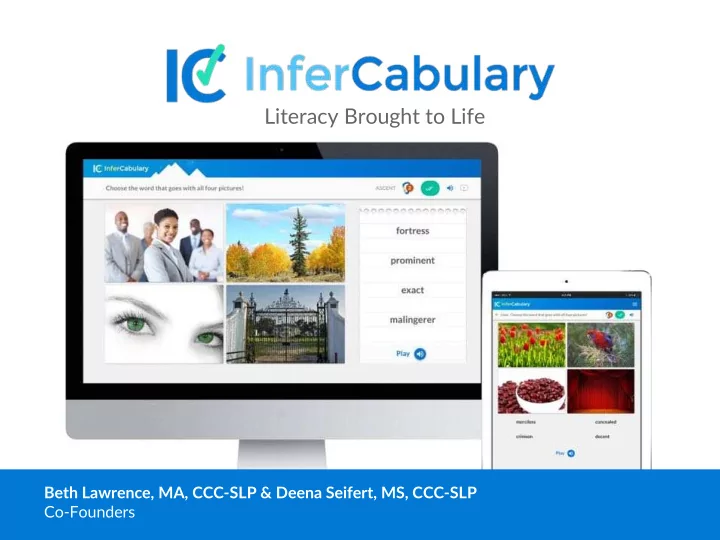
Literacy Brought to Life

Beth Lawrence, MA, CCC-SLP & Deena Seifert, MS, CCC-SLP Co-Founders
slide-2
SLIDE 2

Why Focus on Vocabulary?

Vocabulary is the key building block for reading comprehension.

Students must understand 95% - 98% of the words in a given text to independently comprehend that text. Hu & Nation, 2000

Students who enter school with low vocabulary rarely catch up.

Low socioeconomic status and learning disabilities can limit a student’s vocabulary; and that gap widens through the school

  • years. Loftus et al., 2010

When students struggle with vocabulary it impacts all learning.

slide-3
SLIDE 3

Current Teaching Methods

Rely heavily on language.

Current methods use language to teach language to students who struggle with language. Even for more proficient students, definitions often include advanced words that challenge, rather than teach.

Prioritize rote memorization over critical thinking.

Exercises, such as memorizing definitions or using the word in a sentence, fail to promote authentic learning.

slide-4
SLIDE 4

prudent [prood-nt]

adjective Wise or judicious in practical affairs; sagacious; discreet or circumspect; sober

4

Process: Rote memorization of 11th grade words in definition to “learn” a 6th grade word Result: Students forget definition after test

Typical Dictionary Definition

slide-5
SLIDE 5

35 million students struggle with language and vocabulary, negatively impacting all learning.

Ineffective for Students:

  • Using language to teach language doesn’t work.
  • Rote memorization ≠ actual learning.

Expensive for Schools:

  • Vocabulary instruction dollars are disproportionately spent
  • n expensive in-person instruction for special

education/English Language instruction.

  • Quality instruction for regular education is time-intensive.

Current Approaches Fail

slide-6
SLIDE 6

Two Ways of Measuring Vocabulary

semantic representations for each known word

(predicts comprehension)

(Walley, Metsala, & Garlock, 2003)

number of lexical entries

(predicts decoding)

(Ouellette & Beers, 2010)

6

slide-7
SLIDE 7

Two Phases of Vocabulary Development

Extended Mapping (Depth) Fast Mapping (Breadth)

A child’s ability to learn a new word or concept with minimal exposure to it

7

slide-8
SLIDE 8

8

InferCabulary

slide-9
SLIDE 9

Teacher Differentiation

9

Instructors assign words by:

  • Grade level
  • Category label
  • Title of novel being taught

Teachers monitor progress with Reports

InferCabulary.com

slide-10
SLIDE 10

Independent Research

80 85 90 95 100 105 110 Week 1 Week 2 Week 3 Week 4 Week 5 Week 6 Traditional InferCabulary

  • University of Virginia’s Dr. Michael Kennedy conducted a 6-week study with 75 regular education fifth-

grade students. Results “statistically significant.” Research is in review for publication in peer-reviewed

  • journal. 6.5 to 19% higher quiz scores.
  • Additional studies planned with Vanderbilt, and Universities of Maryland, Virginia & Rhode Island

Raw score

InferCabulary Traditional Methods

10

slide-11
SLIDE 11

Teacher Questions in 20 Minute Blocks

0" 10" 20" 30" 40" 50" 60" 70" 80" 90" 100" Week"1" Week"2" Week"3" Week"4" Week"5" Week"6" Tradi4onal" InferCabulary"

11

slide-12
SLIDE 12

Evidence & Anecdotes From A Maryland School

10/11th Grade English

  • Prior to InferCabulary, 29% regularly failed

quizzes.

  • The first week of InferCabulary, students reported

enjoying learning the words

  • 100% received ≥ 80% on quiz items that required

them to apply understanding to novel contexts

  • 86% received a score of 90% or above.

Computer Lab

  • students regularly ask to play InferCabulary when

given a choice

12

slide-13
SLIDE 13

ERB Assessment Vocabulary Scores 4th then 5th Grade

1 2 3 4 5 6 7 8 9 Student 1 Student 2 Student 3 Student 4 Student 5 Student 6 Student 7 Student 8 2016 Stanine 2017 Stanine Independent School English class for students identified with language-learning needs Student 7 transferred, no data available on Student 8

13

slide-14
SLIDE 14

InferCabulary Activity

14

slide-15
SLIDE 15

15

Deena Seifert, M.S., CCC-SLP deena@infercabulary.com Beth Lawrence, M.A., CCC-SLP beth@infercabulary.com

Copies of this presentation, handouts, and research

https://InferCabulary.com

Literacy Brought to Life

slide-16
SLIDE 16

16