SLIDE 2
Chapter 1
SLIDE 3 Literacy Strategies
- A “Literacy Strategy” is a way to help yourself
and your students to understand what you are reading.
- “Interact With A Visual Image” is a literacy
strategy that we used with the RMI Weather and Climate booklet.
- Another literacy strategy is to look at the
pages of a reading before starting to read it.
- We will use this literacy strategy with Chapter
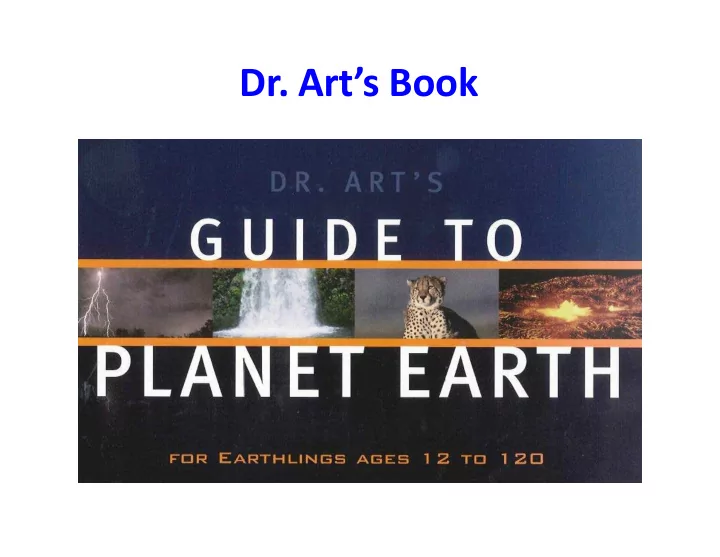
1 of Dr. Art’s Guide to Planet Earth
SLIDE 4 Looking at Chapter 1
- Just look at and briefly read some Section
Titles, Big Ideas, and Drawings With A Text Box.
- Talk with a partner about what you think you
might learn in this chapter.
- Write some words or ideas that you think you
will be learning about in the chapter.
- Be ready to share these words or ideas with
the whole class.
SLIDE 5
Science Ideas Come in Different Sizes
SLIDE 6 AWESOME IDEAS TO FACTOIDS
Often Some; Vocabulary Rarely TESTING Often Some; Vocabulary Rarely TEACHING One One or More Across All DISCIPLINE CONCEPT AWESOME IDEA FACTOID
We want to move teaching, learning and testing away from mostly memorizing vocabulary toward more understanding of big ideas.
SLIDE 7 Systems in Current Science Education
- Body systems: circulatory system, nervous
system, immune system, skeletal system, etc
- Ecosystems
- Earth systems: atmosphere, hydrosphere,
geosphere, biosphere
- Whole Earth system: Earth system science
SLIDE 8
Systems within Systems within Systems
SLIDE 9
Water has properties that are QUALITATIVELY different than those of its parts.
SLIDE 10 Important Features of Systems
- Systems are made of parts that connect with
each other.
- Each part of a system can itself be described
as a system. (“Systems within systems within systems.”)
- A system can have properties that are very
different than those of its parts. (“System Properties”)
SLIDE 11
SYSTEMS
Systems are made of parts that are themselves systems made of parts. Systems have qualitatively different properties.
SLIDE 12
Systems Can Make a Planet
SLIDE 13 Three Parts of the Earth System
- Earth’s Matter
- Earth’s Energy
- Earth’s Life
SLIDE 14
Earth is Essentially a Closed System for Matter
SLIDE 15
Earth is an Open System with Respect to Energy
SLIDE 16
Earth is a Networked System with Respect to Life
SLIDE 17 Earth’s Global Temperature
Earth’s global temperature is a property of the whole Earth system. Earth’s global temperature arises from the interactions of all of Earth’s parts with each
incoming sunlight.
SLIDE 18 Begin to Draw A System: Part 1
- Start with a partner to draw a system. The
system can be a school, taro patch or village.
- Keep the drawing simple. This Part 1 is to help
you begin to get your ideas on paper.
- Include and label the parts of your system.
- Include in the drawing what goes into your
system (inputs)
- Include in the drawing what goes out of your
system (outputs)
SLIDE 19 Water In Carbon Dioxide Out Oxygen In Sunlight Energy In Electric Energy In Sunlight Energy In Heat Energy Out Food In Water Out Oxygen Out Carbon Dioxide In Heat Energy Out Garbage Out Waste Out
A Home and Garden System
Some System Properties: A Happy Family; Energy Efficiency
- r Carbon Footprint of Home
SLIDE 20 Draw a System: Part 2
- Join with another pair of people who have
worked on the same system as you
- Look at the home/garden system model
– On chart paper, make a new large drawing of your system that you will share with the whole class – Indicate at least one place where a part of the system interacts with another part of the system – Write at least one property of the whole system that is different than the properties of its parts