
SLIDE 1
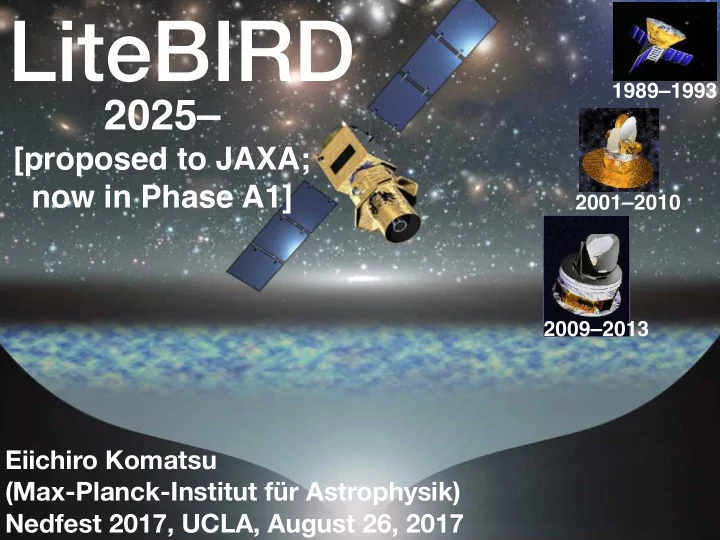
LiteBIRD
Eiichiro Komatsu (Max-Planck-Institut für Astrophysik) Nedfest 2017, UCLA, August 26, 2017
2025–
[proposed to JAXA; now in Phase A1]
1989–1993 2001–2010 2009–2013
LiteBIRD 19891993 2025 [proposed to JAXA; now in Phase A1] - - PowerPoint PPT Presentation
LiteBIRD 19891993 2025 [proposed to JAXA; now in Phase A1] 20012010 20092013 Eiichiro Komatsu (Max-Planck-Institut fr Astrophysik) Nedfest 2017, UCLA, August 26, 2017 Part I: What do we know about inflation, and how do we
Eiichiro Komatsu (Max-Planck-Institut für Astrophysik) Nedfest 2017, UCLA, August 26, 2017
2025–
[proposed to JAXA; now in Phase A1]
1989–1993 2001–2010 2009–2013
Part I: What do we know about inflation, and how do we know it?
microwave background and their interpretation taught us that galaxies, stars, planets, and
fluctuations in the early Universe
scales become macroscopic fluctuations over large distances?
scales?
Mukhanov & Chibisov (1981); Hawking (1982); Starobinsky (1982); Guth & Pi (1982); Bardeen, Turner & Steinhardt (1983)
Sato (1981); Guth (1981); Linde (1982); Albrecht & Steinhardt (1982) Quantum fluctuations on microscopic scales
distribution originate from quantum fluctuations during inflation
scalar mode
tensor mode
gravitational waves generated during inflation
Starobinsky (1979)
We measure distortions in space
d`2 = a2(t)[1 + 2⇣(x, t)][ij + hij(x, t)]dxidxj
X
i
hii = 0
We measure distortions in space
d`2 = a2(t)[1 + 2⇣(x, t)][ij + hij(x, t)]dxidxj
X
i
hii = 0
scale factor
Defining the Hubble expansion rate as H(t)=dln(a)/dt, we must find
¨ a a = ˙ H + H2 > 0 ✏ ≡ − ˙ H H2 < 1
the number of e-folds of expansion counted from the end
N ≡ ln aend a = Z tend
t
dt0 H(t0) ≈ 50
does not change very much with time
✏ ≡ − ˙ H H2
Fluctuations are proportional to H
proportional to H
its wavelength is stretched, and thus the bigger the angles they subtend in the sky. We can map H(t) by measuring CMB fluctuations over a wide range of angles
Fluctuations are proportional to H
wide range of angles
does not depend very much on angles
decreasing function of time. It would be fantastic to show that the amplitude of CMB fluctuations actually DOES depend on angles such that the small scale has slightly smaller power
Long Wavelength Short Wavelength
180 degrees/(angle in the sky) Amplitude of Waves [μK2]
WMAP Collaboration
180 degrees/(angle in the sky) Amplitude of Waves [μK2]
Long Wavelength Short Wavelength
Removing Ripples: Power Spectrum of Primordial Fluctuations
180 degrees/(angle in the sky) Amplitude of Waves [μK2]
Long Wavelength Short Wavelength
Removing Ripples: Power Spectrum of Primordial Fluctuations
180 degrees/(angle in the sky) Amplitude of Waves [μK2]
Long Wavelength Short Wavelength
Removing Ripples: Power Spectrum of Primordial Fluctuations
180 degrees/(angle in the sky) Amplitude of Waves [μK2]
Long Wavelength Short Wavelength
Let’s parameterise like
180 degrees/(angle in the sky) Amplitude of Waves [μK2]
Long Wavelength Short Wavelength
COBE 2-Year Limit! ns=1.25+0.4–0.45 (68%CL)
1989–1993
l=3–30
Wright, Smoot, Bennett & Lubin (1994)
In 1994:
180 degrees/(angle in the sky) Amplitude of Waves [μK2]
Long Wavelength Short Wavelength
WMAP 9-Year Only: ns=0.972±0.013 (68%CL)
2001–2010
WMAP Collaboration
20 years later…
1000 100
South Pole Telescope [10-m in South Pole] Atacama Cosmology Telescope [6-m in Chile]
Amplitude of Waves [μK2]
ns=0.965±0.010
2001–2010
WMAP Collaboration
1000 100
South Pole Telescope [10-m in South Pole] Atacama Cosmology Telescope [6-m in Chile]
Amplitude of Waves [μK2]
2001–2010
ns=0.961±0.008
~5σ discovery of ns<1 from the CMB data combined with the distribution of galaxies
WMAP Collaboration
Residual
Planck 2013 Result!
180 degrees/(angle in the sky)
Amplitude of Waves [μK2]
2009–2013
ns=0.960±0.007
First >5σ discovery of ns<1 from the CMB data alone [Planck+WMAP]
[Values of Temperatures in the Sky Minus 2.725 K] / [Root Mean Square]
Fraction of the Number of Pixels Having Those Temperatures Quantum Fluctuations give a Gaussian distribution of temperatures. Do we see this in the WMAP data?
[Values of Temperatures in the Sky Minus 2.725 K] / [Root Mean Square]
Fraction of the Number of Pixels Having Those Temperatures
Histogram: WMAP Data Red Line: Gaussian
WMAP Collaboration
is symmetric, it must yield a vanishing 3-point function
[Values of Temperatures in the Sky Minus 2.725 K]/ [Root Mean Square] Fraction of the Number of Pixels Having Those Temperatures
Histogram: WMAP Data Red Line: Gaussian
hδT 3i ⌘ Z ∞
−∞
dδT P(δT)δT 3
this by averaging the product
different locations in the sky
hδT(ˆ n1)δT(ˆ n2)δT(ˆ n3)i
fluctuations of CMB is very precisely Gaussian
ζ(x) = ζgaus(x) + 3 5fNLζ2
gaus(x) with fNL = 37 ± 20 (68% CL)
magnitude: deviation is <0.03% (95%CL)
fNL = 0.8 ± 5.0 (68% CL)
WMAP 9-year Result Planck 2015 Result
evidence”
Theoretical energy density
Watanabe & EK (2006)
GW entered the horizon during the radiation era GW entered the horizon during the matter era
Watanabe & EK (2006) CMB PTA Interferometers
Wavelength of GW ~ Billions of light years!!!
Theoretical energy density
Finding Signatures of Gravitational Waves in the CMB
waves
that the signal comes from vacuum fluctuation
New Research Area!
d`2 = dx2 = X
ij
ijdxidxj d`2 = X
ij
(ij + hij)dxidxj
Mirror Mirror detector
No signal
Mirror Mirror
Signal!
detector
Mirror Mirror
Signal!
detector
LIGO detected GW from a binary blackholes, with the wavelength
But, the primordial GW affecting the CMB has a wavelength of billions of light-years!! How do we find it?
Isotropic electro-magnetic fields
GW propagating in isotropic electro-magnetic fields
hot hot cold cold c
d c
d h
h
Space is stretched => Wavelength of light is also stretched
hot hot cold cold c
d c
d h
h
Detecting GW by CMB Polarisation
electron electron Space is stretched => Wavelength of light is also stretched
hot hot cold cold c
d c
d h
h
Detecting GW by CMB Polarisation
Space is stretched => Wavelength of light is also stretched
41
r<0.07 (95%CL)
BICEP2/Keck Array Collaboration (2016)
WMAP 3-Year Data
Limits on r mostly from the temperature data
WMAP 5-Year Data
Limits on r mostly from the temperature data
WMAP 7-Year Data
Limits on r mostly from the temperature data
WMAP 9-Year Data
Limits on r mostly from the temperature data
WMAP 9-Year Data + ACT + SPT
Limits on r mostly from the temperature data
WMAP 9-Year Data + ACT + SPT + BAO
Limits on r mostly from the temperature data
WMAP(temp+pol)+ACT+SPT+BAO+H0 WMAP(pol) + Planck + BAO
ruled
WMAP Collaboration
WMAP(temp+pol)+ACT+SPT+BAO+H0 WMAP(pol) + Planck + BAO
ruled
ruled out! ruled out! ruled out! ruled out!
Polarsiation limit added: r<0.07 (95%CL)
Planck Collaboration (2015); BICEP2/Keck Array Collaboration (2016)
Are GWs from vacuum fluctuation in spacetime, or from sources?
at linear order
Maleknejad & Sheikh-Jabbari (2013); Dimastrogiovanni & Peloso (2013); Adshead, Martinec & Wyman (2013)
GW from Axion-SU(2) Dynamics
negligible energy density compared to the inflaton)
Dimastrogiovanni, Fasielo & Fujita (2017)
components
coupling to the axion field
(well-known result)
strongly non-Gaussian!
Agrawal, Fujita & EK (2017)
Large bispectrum in GW from SU(2) fields
detected GW comes from the vacuum fluctuation or from sources
BRRR
h
(k, k, k) P 2
h(k)
≈ 25 ΩA
Agrawal, Fujita & EK (2017) Aniket Agrawal (MPA) Tomo Fujita (Stanford->Kyoto)
GW yet
experiments are taking data now
The search continues!!
1989–1993 2001–2010 2009–2013 202X–
2025– [proposed]
+ possible participations
from USA, Canada, Europe
LiteBIRD
2025– [proposed]
Target: δr<0.001
2025– [proposed]
Polarisation satellite dedicated to measure CMB polarisation from primordial GW, with a few thousand super-conducting detectors in space
+ possible participations
from USA, Canada, Europe
LiteBIRD
2025– [proposed]
2025– [proposed]
Down-selected by JAXA as
competing for a launch in mid 2020’s
+ possible participations
from USA, Canada, Europe
LiteBIRD
2025– [proposed]
LiteBIRD working group
152 members, international and interdisciplinary (as of July 2017)
JAXA
Osaka U.
Osaka Pref. U.
Okayama U.
NIFS
Kavli IPMU
KEK
Konan U.
NAOJ
Saitama U.
NICT
SOKENDAI
TIT
Tohoku U.
Nagoya U.
Yokohama
RIKEN
APC Paris
CU Boulder
McGill U.
MPA
NIST
Stanford U.
C.-L. Kuo
UC Berkeley / LBNL
UC San Diego
CMB Infrared Satellite X-ray
Kansei Gakuin U.
Paris ILP
Cardiff U.
2
Kitazato U.
AIST
LiteBIRD working group
152 members, international and interdisciplinary (as of July 2017)
JAXA
Osaka U.
Osaka Pref. U.
Okayama U.
NIFS
Kavli IPMU
KEK
Konan U.
NAOJ
Saitama U.
NICT
SOKENDAI
TIT
Tohoku U.
Nagoya U.
Yokohama
RIKEN
APC Paris
CU Boulder
McGill U.
MPA
NIST
Stanford U.
C.-L. Kuo
UC Berkeley / LBNL
UC San Diego
CMB Infrared Satellite X-ray
Kansei Gakuin U.
Paris ILP
Cardiff U.
2
Kitazato U.
AIST
PI: Masashi Hazumi
(KEK / Kavli IPMU / SOKENDAI / JAXA)
Observation Strategy
6
JAXA H3 Launch Vehicle (JAXA) Anti-sun vector Spin angle b = 30°、0.1rpm Sun Precession angle a = 65°、~90 min. L2: 1.5M km from the earth Earth
Slide courtesy Toki Suzuki (Berkeley)
Foreground Removal
7
Polarized galactic emission (Planck X) LiteBIRD: 15 frequency bands
Slide courtesy Toki Suzuki (Berkeley)
Instrument Overview
8
LFT HFT
LFT primary mirror LFT Secondary mirror HFT HFT FPU Sub-K Cooler HFT Focal Plane LFT Focal Plane Readout
Sub-Kelvin Instrument Cold Mission System Stirling & Joule Thomson Coolers Half-wave plate Mission BUS System Solar Panel
200 mm ~ 400 mmSlide courtesy Toki Suzuki (Berkeley)
2 B B
July 12, 2017 20 Rencontres du Vietnam @ Quy Nhon, Vietnam
High frequency focal plane
frequency multiplexing system.
Three colors per pixel with a lenslet coupling.
Each color per feed, and three colors within
Low frequency focal plane
Slide courtesy Tomo Matsumura (Kavli IPMU)
Cooling system
Cryogenics
Sub-Kelvin cooler
heritage is also under development.
July 12, 2017 22 Rencontres du Vietnam @ Quy Nhon, Vietnam
Mechanical cooler
Akari (Astro-F), JEM-SMILES and Astro-H.
SHI/JAXA ADR from CEA
Slide courtesy Tomo Matsumura (Kavli IPMU)
?F 2B?
July 12, 2017 21 Rencontres du Vietnam @ Quy Nhon, Vietnam
the continuously rotating achromatic half-wave plate (HWP).
differential systematics.
HWP@aperture Cooled at 4 K.
Note: we also employ the polarization modulator for HFT. The continuous rotation is achieved by employing the superconducting magnetic bearing. This system has a heritage from EBEX. The prototype system has built and test the kinetic and thermal feasibility. The proton irradiation test is conducted to key components, including sapphire, YBCO, and
go results. And the further test is in progress.
reflection structure.
achromatic HWP.
Broadband coverage Rotational mechanism
The 1/9 scale prototype model
Incident radiation
Slide courtesy Tomo Matsumura (Kavli IPMU)
You are a moron…
We need it for a critical reason: mitigation of 1/f noise
reduce the 1/f noise to a sufficient level
rotating HWP to modulate the input sky signal to a higher frequency
BB Power Spectrum
better than the current bound
physics
72
Figure by Yuji Chinone
B-mode power spectrum measurements
Polarization Modulator
broadband AR coating and polarization modulation efficiency
73 from LTD17 poster (T. Matsumura et al.)