Application of normal mode functions for the (g) 10 days improved - - PowerPoint PPT Presentation

application of normal mode functions for the
SMART_READER_LITE
LIVE PREVIEW

Application of normal mode functions for the (g) 10 days improved - - PowerPoint PPT Presentation

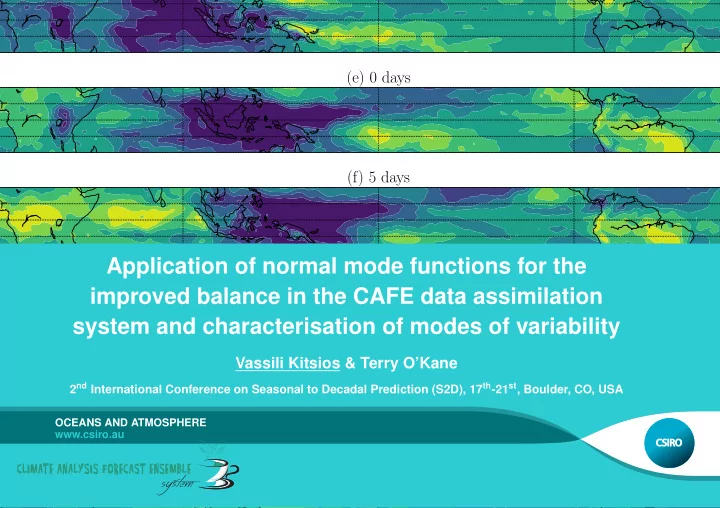
(e) 0 days (f) 5 days Application of normal mode functions for the (g) 10 days improved balance in the CAFE data assimilation system and characterisation of modes of variability Vassili Kitsios & Terry OKane (h) 15 days 2 nd


slide-1
SLIDE 1

(e) 0 days (f) 5 days (g) 10 days (h) 15 days (i) 20 days

CSIRO

Application of normal mode functions for the improved balance in the CAFE data assimilation system and characterisation of modes of variability

Vassili Kitsios & Terry O’Kane

2nd International Conference on Seasonal to Decadal Prediction (S2D), 17th-21st, Boulder, CO, USA

OCEANS AND ATMOSPHERE www.csiro.au

slide-2
SLIDE 2

Application of normal mode functions for the improved balance in the CAFE data assimilation system and characterisation of modes of variability

Approach

  • Will focus on the characterisation of the Madden Julian Oscillation (MJO)

via a Normal Mode Functions (NMF) decomposition of JRA55, and dis- cuss implications for Normal Mode Inialisation (NMI).

  • MJO is a mode of variability resulting from coupled tropical deep convec-

tion and atmospheric dynamics.

  • Use key MJO properties to identify representatives NMFs:

– Eastward propagating – Dominant variance over intra-seasonal timescales: 30-90 days. – Tropics centric dynamics. – Horizontal velocity field has a dominant longitudinal wave of k = 1. – Dominant component of the zonal velocity is symmetric about the equator.

  • Using one such mode we produce phase and conditional averages of:

– velocity potential to illustrate atmospheric dynamics – outgoing longwave radiation to illustrate convection

  • Acknowledge ˇ

Zagar for sharing the NCAR NMF code, MODES.

slide-3
SLIDE 3

Application of normal mode functions for the improved balance in the CAFE data assimilation system and characterisation of modes of variability

What are Normal Mode Functions ?

  • Decompose 3D (λ, φ, σ) velocity (u, v) and geopotential height (h) fields

into horizonal and vertical scales, and mode type, using the eigensolu- tion of the linearised primitive equations on a sphere.

  • Each scale decomposed into: Balanced Component (BAL) ; Eastward

Inertial Gravity Wave (EIG) ; Westward Inertial Gravity Wave (WIG).

  • Vertical Structure Functions (VSF), Gm in σ coordinates.
  • Longitudinal (λ) waves eikλ
  • Meridional (φ) Horizonal Structure Functions (HSF) of wind and height

(U, V, H) for EIG, WIG and BAL modes. u(σ, λ, φ, t) v(σ, λ, φ, t) h(σ, λ, φ, t)

  • =

M

  • m=1

Gm(σ) √gDm √gDm gDm

  • K
  • k=−K

eikλ

N

  • n=0

EIG,WIG,BAL

  • p
  • U(φ)

−iV (φ) H(φ) p

knm

χp

knm(t)

  • Complex coefficients, χp

knm(t), represent contributions of each compo-

nent.

slide-4
SLIDE 4

Application of normal mode functions for the improved balance in the CAFE data assimilation system and characterisation of modes of variability

Vertical Structure Functions

  • VSF given by solution of the VSF eigenvalue problem (EVP).
  • VSF EVP requires only a time and horizontally averaged static stability

profile in σ coordinates.

  • Equivalent heights Dm (eigenvalues) are indicative of vertical scale.
  • VSF Gm(σ) (eigenvectors) have m−1 zero crossings. G1 is the barotropic,

G2 the first baroclinic, G3 the second baroclinic, ...

  • For large m, the VSF represent boundary layer processes.

101 102 103 104 105 Γ0 [K] 100 101 102 103 σ × p0 [hPa]

(a) static stability ≡ Γ0

10 20 30 40 vertical mode number 10−1 100 101 102 103 104 Dm [metres]

(b) equivalent height ≡ Dm

−0.5 0.0 0.5 amplitude [unitless] 100 101 102 103 σ × p0 [hPa]

(c) vertical structure functions

m=1 m=2 m=8 m=15 m=28

slide-5
SLIDE 5

Application of normal mode functions for the improved balance in the CAFE data assimilation system and characterisation of modes of variability

Horizontal Structure Functions

  • HSF given by solution of a HSF EVP for each equivalent height (Dm).
  • Eigenvectors give meridional dependence, with mode types (EIG, WIG,

BAL) defined by symmetry properties.

  • Frequency ν (eigenvalue) is indicative of temporal scale.

−30 −20 −10 10 20 30 longitudinal wavenumber (k) 100 101 102 103 104 1/νq

knm [days]

(a) timescales for m = 28

BAL EIG WIG MRG KW

10 20 30 40 vertical mode number (m) 100 101 102 103 1/νq

knm [days]

90days 60days 30days

(b) timescales

BAL(1,1,m) WIG(1,0,m) EIG(1,0,m)

−1 1 amplitude −75 −50 −25 25 50 75 latitude (φ)

(c) U q

knm(φ)

EIG(1,0,28) EIG(1,0,8) BAL(1,1,15) BAL(1,1,8)

  • Recall for MJO: k = 1; tropics centric; U is symmetric
  • Only the EIG n = 0, WIG n = 0, and BAL n = 1 are tropics centric with

the appropriate symmetries.

  • EIG m = 23 − 32 ; BAL m = 11 − 22 have intra-seasonal timescales.
slide-6
SLIDE 6

Application of normal mode functions for the improved balance in the CAFE data assimilation system and characterisation of modes of variability

Energy Contribution χp

knm(t)χp∗ knm(t) of NMFs in JRA55

  • BAL dominates for low k, IG dominate for high k
  • BAL dominates for all vertical modes m
  • For (k, n) = (1, 1) BAL HSF eigenvectors have MJO-like properties:

– BAL (k, n, m) = (1, 1, 2) and (1, 1, 2) local peaks in energy, but too fast – BAL (k, n, m) = (1, 1, 15) has HSF eigenvalue of 46 days.

  • For (k, n) = (1, 0) EIG HSF eigenvectors also have MJO-like properties:

– EIG (k, n, m) = (1, 0, 8) has most energy, but timescale too fast – EIG (k, n, m) = (1, 0, 28) has HSF eigenvalue of 56 days.

100 101 102 zonal wavenumber (k) 10−4 10−3 10−2 10−1 100 101 102 103 104 nonzonal energy [J/kg]

(a)

BAL EIG WIG total 10 20 30 vertical mode (m)

(b)

10 20 30 vertical mode (m)

(c) (k, n) = (1, 1)

10 20 30 vertical mode (m)

(d) (k, n) = (1, 0)

slide-7
SLIDE 7

Application of normal mode functions for the improved balance in the CAFE data assimilation system and characterisation of modes of variability

Cross-spectral Analysis of Candidate NMFs

  • All candidate modes are tropics centric and have the appropriate symme-

tries.

  • Only EIG (k, n, m) = (1, 0, 28) has an intra-seasonal timescale, and

propagates eastward, but has low energy.

  • Cross-spectral analysis identifies only slow intra-seasonal timescales are

coherent between EIG (k, n, m) = (1, 0, 28) and the more energetic modes.

  • Fast Kelvin wave removed from energetic EIG (k, n, m) = (1, 0, 8).

2 4 6 8 10 k 0.0 0.1 0.2 0.3 0.4 0.5 f [1/days]

30days (a) PSD of EIG(k,0,8) [J/kg]

10−4 10−3 10−2 10−1 100 101 2 4 6 8 10 k

(b) PSD of EIG(k,0,28) [J/kg]

10−4 10−3 10−2 10−1 2 4 6 8 10 k

(c) coherence

0.0 0.2 0.4 0.6 0.8 1.0 2 4 6 8 10 k

(d) coherence output [J/kg]

10−4 10−3 10−2 10−1 100 101

slide-8
SLIDE 8

Application of normal mode functions for the improved balance in the CAFE data assimilation system and characterisation of modes of variability

Cross-spectral Analysis of Candidate NMFs

  • All candidate modes are tropics centric and have the appropriate symme-

tries.

  • Only EIG (k, n, m) = (1, 0, 28) has an intra-seasonal timescale, and

propagates eastward, but has low energy.

  • Cross-spectral analysis identifies only slow intra-seasonal timescales are

coherent between EIG (k, n, m) = (1, 0, 28) and the more energetic modes.

  • Repeated for all vertical scales (m) with k = 1 for BAL and EIG.

k k k k 5 10 15 20 25 30 35 m 0.0 0.1 0.2 0.3 0.4 0.5 f [1/days]

(e) coherence output of EIG(1,0,m) [J/kg]

10−4 10−3 10−2 10−1 100 101 102 5 10 15 20 25 30 35 m

(f) coherence output of BAL(1,1,m) [J/kg]

10−4 10−3 10−2 10−1 100 101 102

  • Other candidate modes highlighted in coherence output clusters.
slide-9
SLIDE 9

Application of normal mode functions for the improved balance in the CAFE data assimilation system and characterisation of modes of variability

Phase Average on Basis of EIG (k, n, m) = (1, 0, 28)

  • Phase angle calculated from complex χp
  • nmk. Dates associated with each

phase angle octant averaged. All modes contribute to phase averages.

  • Velocity potential is a propagating longitudinal wave, with a vertical sign

change representing upper level divergence and lower level convergence.

slide-10
SLIDE 10

Application of normal mode functions for the improved balance in the CAFE data assimilation system and characterisation of modes of variability

Phase Average on Basis of EIG (k, n, m) = (1, 0, 28)

  • Phase angle calculated from complex χp
  • nmk. Dates associated with each

phase angle octant averaged. All modes contribute to phase averages.

  • OLR has a dipole pattern over the maritime continent, tracking with veloc-

ity potential of like sign.

slide-11
SLIDE 11

Application of normal mode functions for the improved balance in the CAFE data assimilation system and characterisation of modes of variability

Large and Persistent MJO Events

  • Start and end of each event defined as discontinuities in phase angle of

EIG (k, n, m) = (1, 0, 28).

  • Persistent events have a continuous phase for longer than 270◦.
  • Large events have a magnitude in the upper quartile.
  • Composite average magnitude is greater than background for 20 days be-

fore and after day 0.

  • Composite average phase angle indicates eastward propagation.
  • Dates associated with each phase shift identified and averaged to produce

composite fields of velocity potential and outgoing longwave radiation.

slide-12
SLIDE 12

Application of normal mode functions for the improved balance in the CAFE data assimilation system and characterisation of modes of variability

Velocity Potential at 200hPa - Wave Like

15◦S 7.5◦S 0◦ 7.5◦N 15◦N

(a) -20 days

15◦S 7.5◦S 0◦ 7.5◦N 15◦N

(b) -15 days

15◦S 7.5◦S 0◦ 7.5◦N 15◦N

(c) -10 days

15◦S 7.5◦S 0◦ 7.5◦N 15◦N

(d) -5 days

15◦S 7.5◦S 0◦ 7.5◦N 15◦N

(e) 0 days

15◦S 7.5◦S 0◦ 7.5◦N 15◦N

(f) 5 days

15◦S 7.5◦S 0◦ 7.5◦N 15◦N

(g) 10 days

15◦S 7.5◦S 0◦ 7.5◦N 15◦N

(h) 15 days

15◦S 7.5◦S 0◦ 7.5◦N 15◦N 0◦ 90◦E 180◦ 90◦W 0◦

(i) 20 days

slide-13
SLIDE 13

Application of normal mode functions for the improved balance in the CAFE data assimilation system and characterisation of modes of variability

Outgoing Longwave Radiation at 200hPa - Dipole Like

15◦S 7.5◦S 0◦ 7.5◦N 15◦N

(a) -20 days

15◦S 7.5◦S 0◦ 7.5◦N 15◦N

(b) -15 days

15◦S 7.5◦S 0◦ 7.5◦N 15◦N

(c) -10 days

15◦S 7.5◦S 0◦ 7.5◦N 15◦N

(d) -5 days

15◦S 7.5◦S 0◦ 7.5◦N 15◦N

(e) 0 days

15◦S 7.5◦S 0◦ 7.5◦N 15◦N

(f) 5 days

15◦S 7.5◦S 0◦ 7.5◦N 15◦N

(g) 10 days

15◦S 7.5◦S 0◦ 7.5◦N 15◦N

(h) 15 days

15◦S 7.5◦S 0◦ 7.5◦N 15◦N 0◦ 90◦E 180◦ 90◦W 0◦

(i) 20 days

slide-14
SLIDE 14

Application of normal mode functions for the improved balance in the CAFE data assimilation system and characterisation of modes of variability

Instantaneous Comparison of NMFs and WH

  • Wheeler & Hendon index based on first two PCs of meridionally averaged

u at 200hPa, 850hPa and OLR within 15◦S and 15◦N.

  • Compare to tropics centric NMFs, with MJO-like symmetries:

– BAL(k, n, m) = (1, 1, 8) : energetic, but westward, timescale too fast. – EIG(k, n, m) = (1, 0, 8) : energetic, but timescale too fast. – BAL(k, n, m) = (1, 1, 15) : intra-seasonal timescale, but westward. – EIG(k, n, m) = (1, 0, 28) : intra-seasonal timescale, eastward, not energetic.

  • Correlation of BAL (k, n, m) = (1, 1, 8) with WH when filtered to retain

temporal scales coherent with EIG (k, n, m) = (1, 0, 28) is 0.78.

2001 2003 2005 2007 2009 2011 2013 2015 0.00 0.25 0.50 0.75 1.00 1.25 1.50 1.75 2.00

  • WHMA

0.0 0.5 1.0 1.5 2.0 2.5 3.0

  • Eq

knmMA

(a) 91 day moving average

BAL(1,1,8) unfiltered BAL(1,1,8) EIG(1,0,8) BAL(1,1,15) EIG(1,0,28) unfiltered WH

slide-15
SLIDE 15

Application of normal mode functions for the improved balance in the CAFE data assimilation system and characterisation of modes of variability

Instantaneous Comparison of NMFs and WH

  • Wheeler & Hendon index based on first two PCs of meridionally averaged

u at 200hPa, 850hPa and OLR within 15◦S and 15◦N.

  • In comparision to WH, coherence filtered BAL(k, n, m) = (1, 1, 8) mode

exhibits: – high correlation in magnitude over the entire time series (1958-2016) – consistent phase propagation for a specific event (Jan 2012) – consistent spiralling in for a specific event in phase space

2 1 2

  • 2
  • 5

2 1 2

  • 2
  • 1

9 2 1 2

  • 3
  • 4

2 1 2

  • 3
  • 1

8 2 1 2

  • 4
  • 1

2 1 2

  • 4
  • 1

5 −150 −100 −50 50 100 150 phase angle

(b) phase angle

−2 −1 1 2 RMM1 −2 −1 1 2 RMM2

(c) phase space WH

−2 −1 1 2 3 real(χq

knm)

  • Dmg/2

−2 −1 1 2 imaginary(χq

knm)

  • Dmg/2

(d) phase space BAL(1,1,8)

slide-16
SLIDE 16

Application of normal mode functions for the improved balance in the CAFE data assimilation system and characterisation of modes of variability

Proposed MJO Skeleton

  • Nonlinear interactions of these modes generates an energetic MJO of

eastward propagation and correct phase period.

  • All modes have MJO-like longitudinal and meridional structure.
  • Interaction strength inferred from cross-spectral analysis.
  • In the future will calculate the nonlinear transfer terms explicitly.
slide-17
SLIDE 17

Application of normal mode functions for the improved balance in the CAFE data assimilation system and characterisation of modes of variability

Concluding Remarks

  • NMFs decompose a 3-D atmospheric geopotential height and horizon-

tal velocity field into scale (zonal, meridional, vertical) and mode class (BAL, EIG, WIG).

  • MJO-like NMF modes and their interactions were isolated in the JRA-55.
  • A skeleton physical model of the MJO was proposed.
  • Implications for Normal Modes Initialisation:

– Since the IG waves have shorter timescales, they are potentially less predictable over a multi-year period. – Naively one would think that filtering the IG waves would improve pre- dictability. – However, the EIG waves (even of small vertical scale and low energy) are shown here to be dynamically important for the MJO.

slide-18
SLIDE 18

Application of normal mode functions for the improved balance in the CAFE data assimilation system and characterisation of modes of variability

Questions

Vertical Structure Functions Horizontal Structure Functions

−0.5 0.0 0.5 amplitude [unitless] 100 101 102 103 σ × p0 [hPa]

(c) vertical structure functions

m=1 m=2 m=8 m=15 m=28 −1 1 amplitude −75 −50 −25 25 50 75

(c) U q

knm(φ)

EIG(1,0,28) EIG(1,0,8) BAL(1,1,15) BAL(1,1,8)

Cross-Spectral Analysis Phase Averages

k k

4 3 2 1

5 10 15 20 25 30 35 m

(f) coherence output of BAL(1,1,m) [J/kg]

10−4 10−3 10−2 10−1 100 101 102

Composite Averages Skeleton Physical Model

(e) 0 days (f) 5 days

slide-19
SLIDE 19

CSIRO OCEANS AND ATMOSPHERE www.csiro.au

CSIRO Oceans and Atmosphere Vassili Kitsios t 0362325312 e Vassili.Kitsios@csiro.au w research.csiro.au/dfp/ CSIRO Oceans and Atmosphere Terry O’Kane t e Terrence.O’Kane@csiro.au w research.csiro.au/dfp/