LISTENING as exploration image: grcimagenet.grc.nasa.gov 1 - - PowerPoint PPT Presentation

listening
SMART_READER_LITE
LIVE PREVIEW

LISTENING as exploration image: grcimagenet.grc.nasa.gov 1 - - PowerPoint PPT Presentation

LISTENING as exploration image: grcimagenet.grc.nasa.gov 1 Exploration is traveling in or through an unfamiliar country, where you dont know what youll find, and you wont be sure how to interpret things. Its where youll learn


slide-1
SLIDE 1

LISTENING

as exploration

image: grcimagenet.grc.nasa.gov

1

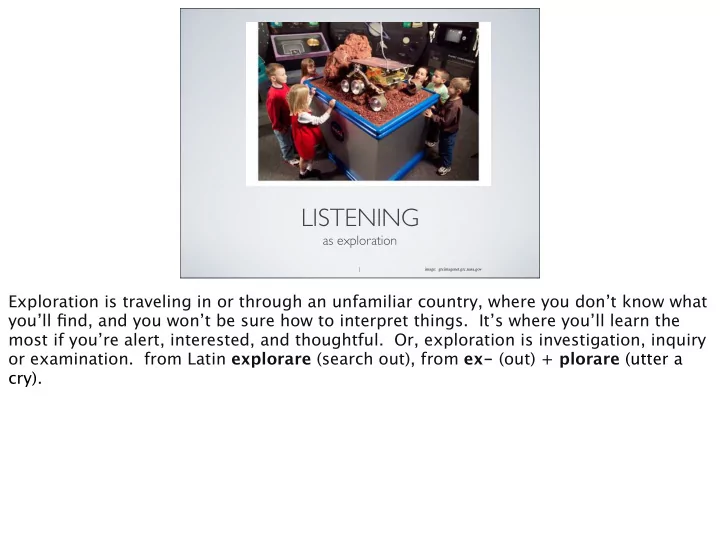
Exploration is traveling in or through an unfamiliar country, where you don’t know what you’ll find, and you won’t be sure how to interpret things. It’s where you’ll learn the most if you’re alert, interested, and thoughtful. Or, exploration is investigation, inquiry

  • r examination. from Latin explorare (search out), from ex- (out) + plorare (utter a

cry).

slide-2
SLIDE 2

WHAT’S OUR PURPOSE?

Image: NASA/JPL

2

You are no doubt already a good communicator. You get along very well in the world. But, like everyone, you also no doubt miss things from time to time, or perhaps misinterpret things. Or encounter situations that test your confidence. The Institute surveyed its graduates some years ago, and asked them what they actually do in their professional lives. The answer is a part of why we’re doing this exploration together.

slide-3
SLIDE 3

18 35 53 70

Engineering Writing Talking

Engineers were asked how they really spend their time.

% work time

MIT Alumni office 3

Professional scientists and engineers spend most of their time talking and writing. (The talk/write balance is probably more equal now, with email.) From time to time, they get to do science of engineering. You will leave here with the ability to do excellent science and engineering. We want you to leave with an ability to communicate that is a match for the quality of your work.

slide-4
SLIDE 4

18 35 53 70

Engineering Writing Talking

Engineers were asked how they really spend their time.

META

% work time

MIT Alumni office 4

This program, Listening as Exploration, will not be a set of directions for what to do or how to do it. It will ask you to examine your communication directly, as

  • communication. You will observe yourself and others, and begin to notice the strange

and wonderful world of human communication and collaboration. At the same time, you will expand your efgectiveness in a wider range of situations.

slide-5
SLIDE 5

LEARNING TEAMWORK:

5

You can get the “how to do it” information from any of hundreds of books. (The photos above, selected at random, are probably perfectly useful as sources of ideas.)

slide-6
SLIDE 6

LEARNING TEAMWORK:

understanding is the booby prize

6

But, in much the same way that a book on baseball isn’t the surest way to learn to play, it’s hard to learn collaboration from a book, even if the information is solid and useful. Collaboration, like baseball, requires physical and emotional activity, practice, experience, and, most of all, other people. Even if you understand a lot about it, you’ll won’t really learn to collaborate without experience and practice.

slide-7
SLIDE 7

Most of what you need to know is on the 2.009 website.

7

Besides, most of the information you really need is already communicated, clearly and succinctly, on the 2.009 website. Be sure to read it there!

slide-8
SLIDE 8

Ground Rules for our Teamwork:

8

For this project, we will ask you to strive towards compliance with three essential ground rules. Note that none of them can be “followed.” They all need to be stewed in,

  • r wrestled with. Explored.
slide-9
SLIDE 9

Ground Rules for our Teamwork:

Be curious.

9

You might wonder why being curious is a ground rule. You already are. You do it. You know what it is. But what if there’s something about curiosity that you don’t already know? Something you’re blind to? Consider that, and see what you discover!

slide-10
SLIDE 10

Ground Rules for our Teamwork:

Be respectful. Be curious.

10

You are certainly a respectful person! Well, except for that one person, over there, who really *is* a jerk! You can’t be expected to be respectful of them!!

slide-11
SLIDE 11

Ground Rules for our Teamwork:

Be respectful. Be curious. Be responsible.

11

Same with responsible. You are entirely responsible. The homework? Well, gee, the dog ate it. Couldn’t be helped. Not my fault.... We say that the pointy finger of blame, when turned around towards you, becomes the pointy finger of responsibility. What do you see if you consider, with curiosity, your role in the dog eating your homework?

slide-12
SLIDE 12

Ground Rules for our Teamwork:

Be respectful. Be curious. Be responsible.

Being, not doing.

12

So notice that our three ground rules are about ways of being. They’re not things to do.

slide-13
SLIDE 13

What’s going on with your teams so far?

Source: Ridpath, John Clarke. History of the World. Cincinnati: The Jones Brothers Publishing Company, 1919.

13

So up until this point, you’ve been exploring with your teams, brainstorming, getting to know each other, engaging in a process that’s new and exciting, with people who may be new to you. Everything is possible! No idea is a bad idea! What have you noticed so far? What’s going on with your teams?

slide-14
SLIDE 14

COMMON TEAM ISSUES:

  • Time management.
  • Resolving disagreements.
  • Equitable workload.
  • Everyone being heard.

14

Oh, right. Some people are too busy to get their work done. Not committed. Don’t care. Don’t deliver. Do all the work. Try to boss everyone. Want to run the show. Complain. Won’t listen. Won’t talk. Sulk. Laugh too much.... Darn it!

slide-15
SLIDE 15

COMMON TEAM ISSUES:

  • Time management.
  • Resolving disagreements.
  • Equitable workload.
  • Everyone being heard. }

communication

15

So we’re going to say that these four issues are common among teams. And each of them comes into existence through communication, and each can be addressed, and sometimes even solved, with communication. We’ll come back to this idea, and this list, in a bit.

slide-16
SLIDE 16

WHAT’S THE PLAN?

16

OK, back to exploring, and learning about communication and collaboration. What’s the plan? What are we going to do?

slide-17
SLIDE 17
  • trust
  • emotion
  • planning
  • perception
  • common ground

The plan is to develop awareness of and strategies for strengthening key components of teamwork:

17

Here’s the plan. We’re going to explore these five things in depth. Not sequentially, not even especially logically, in fact quite circuitously. But in depth. Over the next

  • month. Your deepening experience of each of these aspects of collaboration will give

you many new ways to relate to collaborative work. It is our hope that you will use this learning, and pass it on to your teammates.

slide-18
SLIDE 18
  • planning
  • 18

We’ll start with planning: the thinking part, and the doing part.

slide-19
SLIDE 19

COMMON TEAM ISSUES:

  • Time management.
  • Resolving disagreements.
  • Equitable workload.
  • Everyone being heard. }

communication How can planning help?

19

How can planning be used to mitigate, prevent, or solve these common team issues?

slide-20
SLIDE 20

COMMON TEAM ISSUES:

  • Time management.
  • Resolving disagreements.
  • Equitable workload.
  • Everyone being heard. }

planning

20

slide-21
SLIDE 21

COMMON TEAM ISSUES:

  • Time management.
  • Resolving disagreements.
  • Equitable workload.
  • Everyone being heard. }

planning

21

You brainstormed, and came up with some planning tools, such as Google calendar. That’s fine. But unless you actually talk with each other about your schedules, your crunch times, your need for predictability, your ability to be flexible on any given day or week, you haven’t yet planned optimally.

slide-22
SLIDE 22

COMMON TEAM ISSUES:

  • Time management.
  • Resolving disagreements.
  • Equitable workload.
  • Everyone being heard. }

planning

22

Many disagreements can be *prevented* by planning. Establish ground rules, and get your team members’ buy-in for common disruptive behaviors. Discuss decision- making tools, and agree on how your team will decide under the various circumstances you’re likely to face. Think ahead to what you’re likely to disagree about, and ask your instructors and mentors for insight as well. Then make plans to maximize learning and minimize disruptions from these common disagreements.

slide-23
SLIDE 23

COMMON TEAM ISSUES:

  • Time management.
  • Resolving disagreements.
  • Equitable workload.
  • Everyone being heard. }

planning

23

One of the most common complaints in collaborative work at MIT is that some team members “care” and “do the work,” while others team members “don’t care,” or “have

  • ther priorities,” or “disappear and leave the work to the rest of us.” Maybe you’ve even

done some of that at one time or another. Usually, it’s not lack of caring that’s the problem--it’s lack of planning. Look at each person’s schedule in advance. Identify the weeks for each of you when you won’t be able to be in 2.009 lab much. Identify the weeks when you will be able to put in extra work. Incorporate that information into your planning.

slide-24
SLIDE 24

COMMON TEAM ISSUES:

  • Time management.
  • Resolving disagreements.
  • Equitable workload.
  • Everyone being heard. }

planning

24

A major source of lost opportunities--of good ideas going down the tubes without a fair hearing--is the quiet people on the team not being fully heard. So make a plan for how your team will ensure that everyone’s voice is fully heard. Find the balance of (a) making sure each individual accepts responsibility for being heard; and (b) making sure each team member looks out for the others. Under pressure, some people get louder and some people get softer. Plan for it, so you don’t lose good ideas in the fray.

slide-25
SLIDE 25

COMMON TEAM ISSUES:

}

planning Good teams don’t just happen.

25

slide-26
SLIDE 26

to be persuasive, we must be believable; to be believable, we must be credible; to be credible, we must be truthful.

Edward R. Murrow, 1908-1965, television news pioneer producer of news reports leading to the censure of Joseph McCarthy 26

slide-27
SLIDE 27

persuasive

27

The groundwork of a good team is trust in each other, willingness to make mistakes, willingness to speak out, willingness to be wrong, willingness to critique, willingness to be honest, willingness to work until diffjculties and disagreements are solved. What does this take? Where does it come from?

slide-28
SLIDE 28

AN INFLUENTIAL PERSON

  • listens more than they advocate their own views;
  • knows about the people they work with, their likes and dislikes;
  • is seen as understanding, or empathetic, rather than as

persuasive or articulate;

  • is seen as flexible, open to new ideas, able to be influenced;
  • talks openly and directly, rather than keeping their views “close

to the vest”;

  • builds a network and uses it.

Source: David Burnham, BurnhamRosen Group, personal communication

28

Trust and genuine influence are closely related, as this research shows.

slide-29
SLIDE 29

JoHari Window

unknown to others known to others unknown to self known to self

Luft, J.; Ingham, H. (1955). "The Johari window, a graphic model of interpersonal awareness". Proceedings of the western training laboratory in group development (Los Angeles: UCLA).

29

This grid, known as the JoHari window, is a conceptual tool for understanding what happens as information flows among people. It represents all knowledge about, say, you.

slide-30
SLIDE 30

JoHari Window

unknown to others known to others unknown to self known to self PUBLIC

Luft, J.; Ingham, H. (1955). "The Johari window, a graphic model of interpersonal awareness". Proceedings of the western training laboratory in group development (Los Angeles: UCLA).

30

There’s public information that anyone could know about you: you have brown eyes.

slide-31
SLIDE 31

JoHari Window

unknown to others known to others unknown to self known to self PUBLIC HIDDEN

Luft, J.; Ingham, H. (1955). "The Johari window, a graphic model of interpersonal awareness". Proceedings of the western training laboratory in group development (Los Angeles: UCLA).

31

There’s hidden information, that others can only know if you tell them. What are your hobbies? What are your aspirations? What’s your shoe size?

slide-32
SLIDE 32

JoHari Window

unknown to others known to others unknown to self known to self PUBLIC HIDDEN BLIND

Luft, J.; Ingham, H. (1955). "The Johari window, a graphic model of interpersonal awareness". Proceedings of the western training laboratory in group development (Los Angeles: UCLA).

32

Then there’s this bothersome category of things that people can see about you that you can’t see about yourself. You learn about this category when you ask about it. Sometimes this is called getting feedback. Sometimes it’s just called talking to people you trust.

slide-33
SLIDE 33

JoHari Window

unknown to others known to others unknown to self known to self PUBLIC UNKNOWN HIDDEN BLIND

Luft, J.; Ingham, H. (1955). "The Johari window, a graphic model of interpersonal awareness". Proceedings of the western training laboratory in group development (Los Angeles: UCLA).

33

Finally, there’s all the information about you that is unknown, both to you and to

  • thers. This information can be revealed in many ways over time.
slide-34
SLIDE 34

JoHari Window

unknown to others known to others unknown to self known to self PUBLIC UNKNOWN HIDDEN BLIND

Luft, J.; Ingham, H. (1955). "The Johari window, a graphic model of interpersonal awareness". Proceedings of the western training laboratory in group development (Los Angeles: UCLA).

34

Information moves from “hidden” to “public” squares when you talk to people, or when people ask you questions and you answer them.

slide-35
SLIDE 35

JoHari Window

unknown to others known to others unknown to self known to self PUBLIC UNKNOWN HIDDEN BLIND

Luft, J.; Ingham, H. (1955). "The Johari window, a graphic model of interpersonal awareness". Proceedings of the western training laboratory in group development (Los Angeles: UCLA).

35

Information moves from blind to public when people tell you what they see, or when you ask them for feedback or input.

slide-36
SLIDE 36

JoHari Window

unknown to others known to others unknown to self known to self PUBLIC UNKNOWN HIDDEN BLIND

Luft, J.; Ingham, H. (1955). "The Johari window, a graphic model of interpersonal awareness". Proceedings of the western training laboratory in group development (Los Angeles: UCLA).

36

Information moves out of what’s unknown into any of the other three categories at any time, under many kinds of circumstances. So these quadrants change shape, size, and importance over time.

slide-37
SLIDE 37

THINK OF ONE OF THOSE THINGS YOU SCREWED UP.

37

Now, for a change of pace, here is an exercise for your imagination. Think of something you screwed up, in a minor way. An annoyance, not a catastrophe. (Later, you’ll see the value of this exercise for all manner of things, but start with a moderate mistake.)

slide-38
SLIDE 38

IMAGINE THAT IT’S

38

With that thing you screwed up in your mind, imagine it in each of the following 8 ways.

slide-39
SLIDE 39

IMAGINE THAT IT’S

  • right
  • wrong
  • good
  • bad
  • stupid
  • smart
  • better
  • worse

39

Imagine that it was a right (either the thing you screwed up, or the fact that you screwed it up). Then imagine that it’s wrong. Imagine it’s good, and then imagine it’s

  • bad. Notice that you don’t have to *believe* it’s good or bad--just imagine it. Imagine

that someone else may perceive it as good or bad, even if you don’t. Change your mind about it. Change the context in which you hold it. Make your mind flex about it. Do this 8 times.

slide-40
SLIDE 40

PRACTICE CHANGING YOUR POINT OF VIEW.

40

This is a very valuable mental exercise when you sense that our own point of view may be limiting how clearly you can see something. Run that thing through this grid of value judgments, and see if you can loosen up your thinking about it. Or run that person through this grid of value judgments, and see if you can come up with a way to understand them better.

slide-41
SLIDE 41
  • trust
  • emotion
  • planning
  • perception
  • common ground

The plan is to develop an array of practical communication tools for strengthening key components of teamwork:

41

Now back to the five aspects of teamwork we looked at earlier. We said these would be the five areas in which we would develop your collaborative strengths over the course of these workshops: trust, emotion, planning, perception, common ground.

slide-42
SLIDE 42
  • trust
  • 42

Next, we’ll look at trust. What is trust? What is it for? Why is it important? How can it be created? Developed? Broken? Repaired?

slide-43
SLIDE 43

TRUST

HOW IS IT BUILT?

  • 1. Recognize a vulnerability.

photo courtesy of lowbagger.org/wolfprscam.html

  • 2. Then, don’t exploit it.

43

Trust exists outside of language. If I tell you that you can trust me, I’ve done nothing to engender trust. (In fact, telling you might actually make you suspicious!) Trust takes two: one to expose a vulnerability, the other to fail to exploit it. It also takes time. The vulnerability must be shown. The attack must be withheld.

slide-44
SLIDE 44

TRUST

“I could, but I won’t.”

photo courtesy of lowbagger.org/wolfprscam.html

“They could have, but they didn’t.” What does this tell you about trust?

44

Trust consists of two communications: “I could.” “But I won’t.” This transaction can happen by accident or by design. I can tell you something about me that makes me (a bit) vulnerable. You can either exploit that, or not. I need to be responsible for not

  • pening up too much; if I expose a weakness, I want to feel certain that, even if you

exploit it, I’ll survive. Then, the next time, I can expose something a little more risky, and see whether you exploit it. And so on.

slide-45
SLIDE 45
  • emotion
  • perception
  • common ground

45

Trust requires awareness of emotion, perception, and potential common

  • ground. We will examine these components of collaboration a bit at a

time. To start, imagine what emotions you want to have about the work that you do?

slide-46
SLIDE 46
  • emotion
  • perception
  • common ground

COMPLAINING

46

Complaining, emotion, perception, and common ground: how might they be related?

slide-47
SLIDE 47

How much would it be worth to you to get people to STOP COMPLAINING?

47

slide-48
SLIDE 48

COMPLAINING

48

Complaining can take up a lot of time and energy: resources that can be used to solve

  • problems. But what if your team declared, “No complaining” as a ground rule? What if

your team focused on converting complaints into solutions?

slide-49
SLIDE 49

COMPLAINING = UNSTATED REQUEST

49

Explore the point of view that underneath every complaint, there’s a request waiting to be made.* Sometimes the complainer is aware of it, but often not. *adapted from Building Trust: In Business, Politics, Relationships, and Life by Robert C. Solomon and Fernando Flores

slide-50
SLIDE 50

COMPLAINING = UNSTATED REQUEST What does this tell you about complaints?

50

slide-51
SLIDE 51

COMPLAINING STOP COMPLAINING To help people ,

51

slide-52
SLIDE 52

COMPLAINING REQUEST STOP COMPLAINING To help people , help them make their .

52

slide-53
SLIDE 53

COMPLAINING REQUEST STOP COMPLAINING To help people , help them make their . Ask questions that will help them:

  • understand what the real concern is, and
  • figure out what they really want to do.

53

slide-54
SLIDE 54

ASK:

How is that a problem for you?

What would you rather have?

Anything else?

And what is it about that that’s a problem?

54

Here is one of the most useful communication tools: questions! And in this case, a certain protocol of questions that explores what may be previously unknown about a problem, concern, or complaint. First, try this out on a person you trust, on a problem that’s real but not huge. Ask them exactly as they’re written here, even though they may feel uncomfortable. Stay curious.

slide-55
SLIDE 55

ASK:

And what would having that do for you?

How is that a problem for you?

What would having that do for you?

What would you rather have?

Anything else?

And what is it about that that’s a problem?

So what you really want is....

55

slide-56
SLIDE 56

I know this might seem stupid, but....

IF YOU FEEL THE NEED, ASK:

This is “framing”: making your intention explicit. It’s an invaluable tool.

“This might seem really

  • bvious, but...”

“...I really want to understand it from your point of view.”

56

Sometimes in the course of asking these questions, you feel you’re about to sound stupid, insincere, invasive, boring. In fact, you may feel any of these things in a number

  • f difgerent communication contexts. Framing is another tool to help you say what you

need to, despite feeling uncomfortable about it. Simply put, you state your intention explicitly.

slide-57
SLIDE 57

I know this might seem stupid, but....

IF YOU FEEL THE NEED, ASK:

This is “framing”: making your intention explicit. It’s an invaluable tool.

“This might seem really

  • bvious, but...”

“...I really want to understand it from your point of view.”

57

This is an invaluable tool. You should use it a lot. It can clarify, smooth over, prevent, reassure, explain, persuade.... It is a metacommunication that can get you and your audience onto the same page when trust is not yet suffjciently developed to carry a complex communication.

slide-58
SLIDE 58

ASK:

And what would having that do for you?

How is that a problem for you?

What would having that do for you?

What would you rather have?

Anything else?

What is it about that that’s a problem? So what you really want is....

58

Note: don’t ask “WHY” questions. “Why?” collapses the personal and the problem. It very often has a pointy finger embedded in it, whether intended or not, as in, “Why did you do that? (you idiot!)” Rephrase: “What had you do that?” “What was it about that book that you liked?” “How did you choose that restaurant?” Eliminate “why” from your interpersonal vocabulary entirely, and prevent a lot of misunderstandings.

slide-59
SLIDE 59

the problem? What did you learn about them? you? questions?

59

Try the question protocol whenever you think there might be more to learn in a

  • situation. See what you learn from it. It may confirm what you already thought, or it

may produce information that surprises you. It is a tool to help you and your audience listen more acutely.

slide-60
SLIDE 60

NOW, THINK OF A PERSONALITY TRAIT THAT ANNOYS YOU.

60

Try the imagination exercise again, this time with a trait that other people have that you find annoying.

slide-61
SLIDE 61

NOW, THINK OF A PERSONALITY TRAIT THAT ANNOYS YOU.

61

You might want to try a trait that’s a little more challenging or provocative than you used last time, something you have slightly stronger feelings about.

slide-62
SLIDE 62

IMAGINE THAT IT’S

  • right
  • wrong
  • good
  • bad
  • stupid
  • smart
  • better
  • worse

62

This is gymnastics for the collaborative mind.... Being nimble about changing your own point of view can help you be more efgective with others‘ varying points of view. Notice whether there are some qualities, people, problems that you just can’t imagine in

  • ne of these states. Why might that be?
slide-63
SLIDE 63

HOMEWORK:

Observe your teams. Consider trust, emotion, planning, perception, common ground, and whatever else you notice. Read “Running a Meeting” on the 2.009 site. Do what it says :) In addition, find 2 challenges you expect your team to

  • encounter. Apply planning.

Extra credit: When it occurs to you, make something right, wrong, stupid, smart, good, bad, better, worse.

1. 2.

Find three situations where you can question someone to learn more about their complaint or concern. Use the questioning protocol, and see what you learn from it.

3.

due via email to 2009cr by 10/13 midnight

*

63

Now, start exploring how to put this all to work for you and your team. Remember, be curious, respectful, and responsible. Recommendation: enjoy!

slide-64
SLIDE 64

WHAT QUESTIONS DO YOU HAVE?

64

If you have questions or thoughts, let us know: 2009cr@mit.edu. We’d love to hear from you.

slide-65
SLIDE 65

LISTENING

as exploration (part 1) is over.

65