Linus Pauling Background Born in Portland, Oregon, on February 28, - - PowerPoint PPT Presentation

linus pauling background
SMART_READER_LITE
LIVE PREVIEW

Linus Pauling Background Born in Portland, Oregon, on February 28, - - PowerPoint PPT Presentation

Linus Pauling Background Born in Portland, Oregon, on February 28, 1901 - Son of a pharmacist Attended Oregon State College in 1917, receiving the degree of B.Sc. in chemical engineering in 1922. In 1925 he was awarded the Ph.D. in


slide-1
SLIDE 1

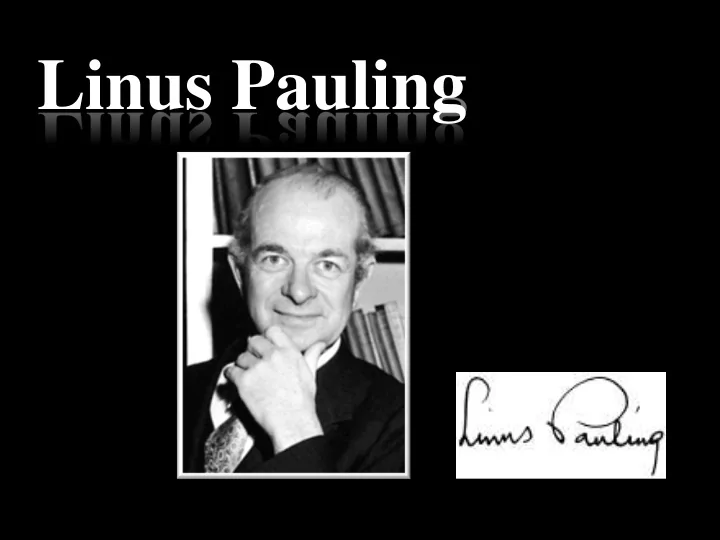
Linus Pauling

slide-2
SLIDE 2

Background

  • Born in Portland, Oregon, on February 28, 1901
  • Son of a pharmacist
  • Attended Oregon State College in 1917, receiving the degree of B.Sc.

in chemical engineering in 1922.

  • In 1925 he was awarded the Ph.D. in chemistry by California Institute
  • f Technology (CalTech)
  • Married wife Ava Helen Miller on June 17, 1923
  • Had three sons and a daughter
  • Sons went on to become scientists and researchers
  • Research focused on how the physical and chemical

properties of substances are related to the structure of the atoms of which they are composed

slide-3
SLIDE 3

Career

  • Interest in how chemical structure and properties related to atom’s

and their electrons began in graduate school

  • This interest became the new field of “Quantum Chemistry”
  • In 1926 he went to Europe to study under pioneers in the emerging

field of Quantum Chemistry

  • Arnold Sommerfeld
  • Niels Bohr
  • Erwin Schrodinger
slide-4
SLIDE 4

Career

  • While in Europe, began to focus his interests in understanding the

electronic structure of the chemical bond

  • The basis of his studies and calculations was focused on the
  • rbitals involved in bonds and their energies
  • In 1932 Pauling publishes what is considered to be his most important

paper which focuses on two key topics:

  • The concept of the hybridization of atomic orbitals
  • Analysis of the tetravalency of the carbon atom
slide-5
SLIDE 5

Career

  • In 1954 is awarded the Nobel Prize in Chemistry:

"for his research into the nature of the chemical bond and its implication to the elucidation of the structure of complex substances".

  • In 1939 Pauling publishes his textbook The Nature of the Chemical Bond
  • One of the most influential chemistry books ever published
  • In the 30 years after its first edition was published, the book

was cited more than 16,000 times

slide-6
SLIDE 6

Career

  • Pauling’s study of the chemical bond focuses on three major areas:

1.) The concept of hybridized atomic orbitals

  • atomic orbitals can combine in different schemes
  • hybridization of orbitals explains how bonding occurs in both

simple and complex molecules 2.) The differentiation between ionic and covalent bonds

  • in ionic bonds, electrons are transferred
  • in covalent bonds, electrons are shared

3.) Bonding in the structures of aromatic hydrocarbons

  • the concept of resonance: that the “true” structure of a

molecule can sometimes be thought of as a blend of multiple structures

slide-7
SLIDE 7
  • In 1962, he was awarded the Nobel Peace Prize.
  • The only person to be awarded two unshared Nobel Prizes
  • One of only four individuals to have won more than one Nobel

Prize

  • One of only two people to be awarded Nobel Prizes in

different fields, the other being Marie Curie

Interesting Facts

  • Later in life was criticized as being “arguably the world's greatest

quack” for his beliefs that dietary supplements could cure diseases

  • Namely, that Vitamin C could prevent colds
  • Linus Pauling died on August 19, 1994 at 93
slide-8
SLIDE 8

Works Cited

"Linus Pauling - Biographical". Nobelprize.org. Nobel Media AB 2013. Web. 17 Sep 2013. <http://www.nobelprize.org/nobel_prizes/chemistry/laureates/1954/pauling-bio.html> “Linus Pauling Online”. Oregon State University. Oregon State University. Web. 17 Sep 2013. <http://pauling.library.oregonstate.edu/> "Linus Pauling." 2013. The Biography Channel website. Sep 16 2013. <http://www.biography.com/people/linus-pauling-9435195>