
SLIDE 1
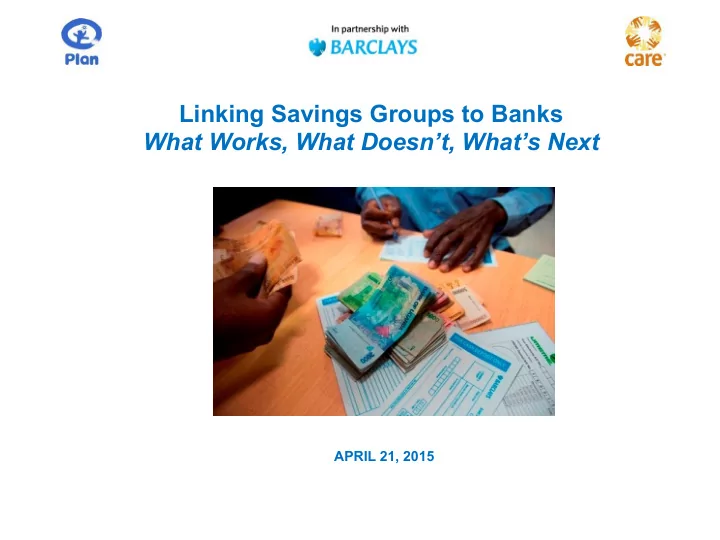
Linking Savings Groups to Banks What Works, What Doesn’t, What’s Next
APRIL 21, 2015
Linking Savings Groups to Banks What Works, What Doesnt, Whats Next - - PowerPoint PPT Presentation
Linking Savings Groups to Banks What Works, What Doesnt, Whats Next APRIL 21, 2015 Agenda: Linking savings groups to Barclays Insights from Banking on Change Sybil Chidiac, Senior Technical Advisor, CARE Internationa l Amalia Johnsson,
APRIL 21, 2015
2
Agenda: Linking savings groups to Barclays – Insights from Banking on Change
Sybil Chidiac, Senior Technical Advisor, CARE International Amalia Johnsson, Corporate Programmes Manager, Plan UK Matt Wilson, Global Community Investment, Barclays
The experience of Fidelity Bank Ghana
Digital linkage – Technology solutions explored by Grameen Foundation
Veronica Sentongo, Program Lead, Mobile Financial Services, Grameen Foundation
3 Banking on Change (BoC) has found that with the right help and support no-one is too poor to save, even those who are generally the most marginalised, particularly young people and women. If the 2.5 billion people who are ‘unbanked’ participate in savings-led microfinance, they represent a group of customers with the potential to save $145bn a year*, contributing to local and national economies. Extending formal banking services to the world’s poorest communities delivers additional social, business, and wider economic benefits. For this reason, between 2012 and 2015, Banking on Change aims to link 5,000 informal Savings Groups (SG) to formal financial institutions (FFIs) in Ghana, Kenya, Tanzania, Uganda and Zambia.
Banking on Change and linkage:
*Based on our experience that shows that with support, individual informal savers save around US$58 per year
4
Overview and methodology of the Linkage Study
When?
Carried out between late October through early December 2014
Where?
Across 5 countries: Ghana Kenya Tanzania Uganda Zambia
How?
Discussions (BoC SGs linked and not yet linked)
key informant interviews with staff from CARE, Plan, implementing partners, Barclays and other FFIs
Who?
Eight SGs/IMAs in each country were selected to participate Selection of the SGs/IMAs based on a number of key factors:
loan
Study Rationale: To better understand six key linkage challenges:
Objectives of the Linkage Study:
5 The study revealed that the successful delivery of linkage required Barclays, CARE and Plan to address three interrelated sets of factors, which we summarise as: group factors, training & support factors, and bank product & process factors.
Key Findings:
Training & Support Product & Processes Group Product and Process factors relate to the
account opening and Know Your Customer (KYC) processes, and the availability of competitive and adapted products.
Group factors relate to the location,
account usage, and demands of the SGs
Training and Support factors
relate to the skills training and sensitisation process Structuring the findings and recommendations in this way helps to reinforce the following points:
6
Key Learnings about Groups:
Groups want to link: There is clearly a high demand for linkage among savings
groups, particularly among youth savings groups.
Accessibility remains a significant barrier: Data shows that the majority of
BoC groups are more than 50km from the nearest Barclays branch. Underlying this issue is the fact that travelling long distances to the bank (usually with large sums of cash and on public transport) is risky, inconvenient, time consuming and expensive.
Account usage is not straightforward: Group deposits tend to be more
frequent and substantial (higher value) during months 5-7 in the saving cycle; the frequency of deposits (weekly, bi-weekly, monthly) varies across groups depending on distance and the amount of money saved.
There is a high demand for credit: Although security of funds remains a key
reason for linking, savings groups - especially those that have been saving for two
is especially true during the first three months of the SG savings cycle when savings in the group are particularly low and the demand for loans is high.
Case Study from the Linkage Report:
In many farming communities in Chibombo, Zambia, pickup trucks leave early in the morning with merchandise to sell at the local market, only to return at the end of the day. When the trucks are available the group members use them to get to town, getting to the bank in about 3
in anywhere from 5 to 30 minutes, but thereafter have to wait until the end of the day for the same trucks to take them home. This essentially means spending the whole day to make a single deposit or withdrawal.
7
Key Learnings about Training and Support:
Financial literacy and money management skills training contributes to effective linkage: Skills training helps to develop the groups
after formation and builds their capacity to save. Adhering to an established sequence of training makes this process even more effective, and reduces the chance that groups will link prematurely.
Groups also benefit from financial product training: The financial
education and linkage training materials should be designed to cover the attributes of financial products; without this groups will not be sufficiently prepared to compare products offered by FFIs to ensure they are competitive and offered responsibly. This will also ensure groups have realistic expectations about what the bank will and will not offer (e.g. the availability of credit products).
The benefit of linkage assessment tools: Linkage assessment tools help
to flag potential issues related to savings capacity, group quality and potential group conflicts. When used properly, they ensure that groups only link when they are ready, reducing frustration experienced by the group and the linking FFI.
Case Study from the Linkage Report:
During the linkage process groups sometimes arrive confused about the documentation required to open an account. This can be a time-consuming challenge for many groups, who have to return to their communities to gather additional documents or seek
the requirements. The additional time and effort taken to collect the appropriate documentation and return to the bank causes frustration and further delays to the account
8
Key Learnings about Products and Processes:
KYC requirements can be a major hurdle for groups: Groups,
particularly those with low levels of literacy, have found it challenging to comply with the Know Your Customer (KYC) requirements such as proof of income or the need for a signature. Requirements can also vary across banks and change from time to time, causing delays or preventing account opening.
Traditional products offered to groups do not always suit their needs: Linking to savings groups may require bespoke savings products that
have reduced or no fees; many groups also expect interest to offset the cost of travelling to the bank and to ensure their savings are growing.
Groups require additional time and resources from bank staff: Due
to a lack of experience with banking and low levels of literacy, groups often need additional assistance from bank staff to complete the account opening process; busy staff may lack the required time and incentive to help.
Linkage needs to be owned by the business: To deliver effective and
sustainable linkage, business teams must understand the market, perform regular account analysis, and support the development of tailored products and services that meet group needs (e.g. credit, mobile).
Case Study from the Linkage Report:
The Barclays Uganda branch in Iganga has two personal bankers who are responsible for attending to clients, and waiting times are often long. Because the SG accounts take much longer to open and are not part of the branch’s targets, the bankers struggle to find time to open and process the accounts. To respond to this challenge, Barclays Uganda has provided additional staff members whose sole responsibility is to link groups, with targets for number
For more information about Banking on Change and additional resources visit our websites at: http://www.careinternational.org.uk/fighting-poverty/working-way-out-poverty/banking-change http://www.barclays.com/citizenship/citizenship-in-action/banking-on-change.html http://www.plan-uk.org/what-we-do/partnerships/private-sector/our-partners/barclays/
9
Director, Inclusive Banking & CSR Linking for Change Savings Charter Webinar April 2015
individual ¡and ¡institutional ¡investors ¡and ¡its ¡ executives ¡
deposits ¡out ¡of ¡30 ¡universal ¡banks ¡
2014 ¡
Retail ¡Banking ¡and ¡Wholesale ¡Banking ¡Groups ¡
¡
11
Providing savings, credit and financial education to 1200 Village Savings and Loans Associations (VSLAs) of CARE in the Brong Ahafo, Northern, Upper East and Upper West regions.
$200,000
30,000
1200
4
US $1,000,000
Q3 2013 Q1 2014 Q2 2014 Q3 2014 Q4 2014
Care/Fidelity discussions commence in September Proposal submitted in October/ November MOF approves project in March Fidelity invited & attends 1st MLE workshop in Kigali in February Fidelity/Care/ UNCDF sign PBA in March Group account developed Group account specifications firmed up April Partner activity inception workshop held In Tamale in May Linkage commences 2000 active accounts By YE
¡ NOW ¡
Savings ¡account ¡– ¡need ¡only ¡ ¡valid ¡national ¡ID, ¡ can ¡thumbprint ¡
facilitate ¡tracking ¡and ¡data ¡collection ¡
both ¡group ¡and ¡individual ¡accounts ¡under ¡the ¡ same ¡code ¡
not ¡meet ¡business ¡registration ¡requirements ¡
¡ FUTURE ¡
individual ¡accounts ¡
¡
13
NOW ¡
Implementing ¡Partner ¡organizations ¡(IPOs) ¡ and ¡Fidelity ¡Bank ¡
in ¡clusters ¡
locations ¡to ¡open ¡accounts ¡and ¡set ¡up ¡agents ¡ ¡
to ¡open ¡roughly ¡500 ¡accounts ¡with ¡5 ¡Smart ¡ Friends ¡and ¡approximately ¡5 ¡Agents ¡ ¡ FUTURE ¡
and ¡equipped ¡with ¡phones ¡to ¡open ¡accounts ¡ (effective ¡March ¡2015 ¡– ¡10 ¡IPO ¡CVs ¡already ¡ trained ¡and ¡equipped) ¡ ¡
¡
14
¡ CHALLENGES ¡
¡ MITIGATING ¡MEASURES ¡
SUCCESSES ¡
quarter ¡
¡ ¡
15
Banking on Change
Commenced 2009 Financial Inclusion and skills building Commenced 2012 Addressing barriers to linkage/ scale through innovation
Innovation Project
Our mandate: To design and develop innovative, digitally-enabled products complementary to the existing suite to serve the VSLA segment.
Each project is unique. We recognize this and adjust our process phases
Our field research comprises more than 500 interactions with potential customers and
identified the following potential opportunities to pursue.
Cycle continuity Trusted transition Impactful information Grow together Let me borrow Group power Say it simply
Make VSLAs a continuous component of members’ lives.
1 2 3 4 5 6 7
Provide opportunities that help groups and individuals grow their savings together. Create trust in the process of transitioning funds from the physical to the virtual. Capitalize on the power of a group to provide better services to both the group and individuals. Provide efficient, transparent methods of collecting and sharing information. Create new solutions to deliver lower-cost credit to VSLA groups. Communicate offers clearly and consistently, and make good on promises.
Fear of Losing Records Lack of Visibility by Bank
Security in Community Security In and Cost of Transit
Barclays
(storage)
DATA
Reducing Fraud Simplifying Meetings Increasing Savings
Cost Visibility Security
“I would trust a phone SMS message from the bank more than a paper receipt.” “Even when we deposit we send at least 2 people. Ideally we’d send 3 each time to have a witness.”
Airtel Group e-Wallet Airtel Group e-Wallet
3 x PIN Barclays SMS notification
Step 1: Withdrawal (Pull) from Barclays Group Account –> Airtel Group Wallet Step 2: Withdrawal (Cash out) from Airtel Group Wallet –> Cash at Agent
3 x PIN Agent SMS notification
Thank you for your participation!
The Linking for Change Savings Charter
Sets out international principles for effectively and responsively linking informal savings groups to formal banking products and services. 1. It’s a win-win investment that brings social and economic rewards 2. Banking the poorest is possible 3. It starts with savings 4. People come first 5. Financial education matters 6. No one can do it alone For more information about the principles and other resources please visit the Charter website: www.careinternational.org.uk/linking-for-change/
26