Lindenmayer Systems, Coalgebraically Baltasar Trancn y Widemann 1 - - PowerPoint PPT Presentation

lindenmayer systems coalgebraically
SMART_READER_LITE
LIVE PREVIEW

Lindenmayer Systems, Coalgebraically Baltasar Trancn y Widemann 1 - - PowerPoint PPT Presentation

Introduction Principles Extensions Outlook Lindenmayer Systems, Coalgebraically Baltasar Trancn y Widemann 1 Joost Winter 2 1 University of Bayreuth, DE 2 CWI, Amsterdam, NL 11th CMCS, Tallinn, Estonia 2012-03-31 / -04-01 Trancn y


slide-1
SLIDE 1

Introduction Principles Extensions Outlook

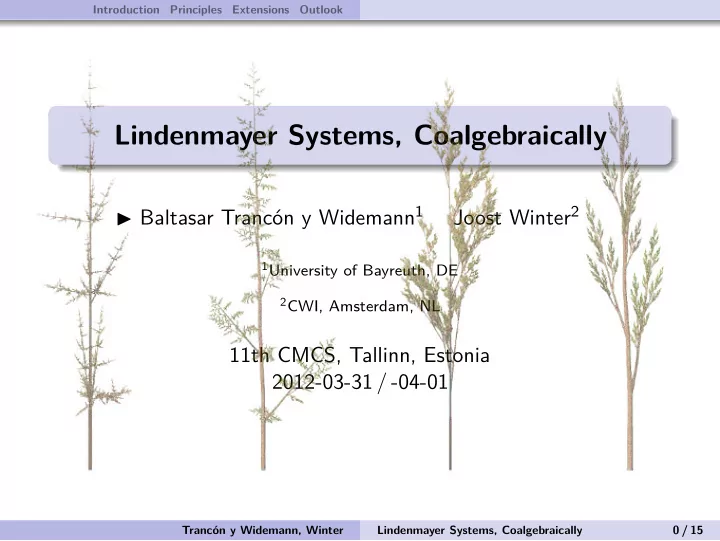
Lindenmayer Systems, Coalgebraically

◮ Baltasar Trancón y Widemann1 Joost Winter2

1University of Bayreuth, DE 2CWI, Amsterdam, NL

11th CMCS, Tallinn, Estonia 2012-03-31 / -04-01

Trancón y Widemann, Winter Lindenmayer Systems, Coalgebraically 0 / 15

slide-2
SLIDE 2

Introduction Principles Extensions Outlook

1

Introduction

2

Principles of Lindenmayer Systems

3

Extensions of Lindenmayer Systems

4

Outlook

Trancón y Widemann, Winter Lindenmayer Systems, Coalgebraically 0 / 15

slide-3
SLIDE 3

Introduction Principles Extensions Outlook

Context of Our Research

Work not quite in progress. . . Lindenmayer Systems

– as example of behavioral environmental modelling in a lecture (2010, Bayreuth) – as running example for an invited tutorial on categories, algebra and coalgebra (2011 Workshop Young Modellers in Ecology, Wallenfels, DE)

Context-free Grammars, Coalgebraically (2011 CALCO, Winchester, UK) How are the two related? (2011 CALCO Coffee Break)

Trancón y Widemann, Winter Lindenmayer Systems, Coalgebraically 1 / 15

slide-4
SLIDE 4

Introduction Principles Extensions Outlook

Context of Our Research

Work not quite in progress. . . Lindenmayer Systems

– as example of behavioral environmental modelling in a lecture (2010, Bayreuth) – as running example for an invited tutorial on categories, algebra and coalgebra (2011 Workshop Young Modellers in Ecology, Wallenfels, DE)

Context-free Grammars, Coalgebraically (2011 CALCO, Winchester, UK) How are the two related? (2011 CALCO Coffee Break)

Trancón y Widemann, Winter Lindenmayer Systems, Coalgebraically 1 / 15

slide-5
SLIDE 5

Introduction Principles Extensions Outlook

Context of Our Research

Work not quite in progress. . . Lindenmayer Systems

– as example of behavioral environmental modelling in a lecture (2010, Bayreuth) – as running example for an invited tutorial on categories, algebra and coalgebra (2011 Workshop Young Modellers in Ecology, Wallenfels, DE)

Context-free Grammars, Coalgebraically (2011 CALCO, Winchester, UK) How are the two related? (2011 CALCO Coffee Break)

Trancón y Widemann, Winter Lindenmayer Systems, Coalgebraically 1 / 15

slide-6
SLIDE 6

Introduction Principles Extensions Outlook

History of Lindenmayer Systems

Mathematical model for the growth of simple multicellular

  • rganisms: yeasts, algae, fungi (Lindenmayer 1968)

– following the example of formal grammars (Chomsky 1957)

Later generalized to complex organisms: vascular plants Graphical interpretation

– from simple turtle graphics for theoreticians and children – to state-of-the-art photorealistic image synthesis

Trancón y Widemann, Winter Lindenmayer Systems, Coalgebraically 2 / 15

slide-7
SLIDE 7

Introduction Principles Extensions Outlook

History of Lindenmayer Systems

Mathematical model for the growth of simple multicellular

  • rganisms: yeasts, algae, fungi (Lindenmayer 1968)

– following the example of formal grammars (Chomsky 1957)

Later generalized to complex organisms: vascular plants Graphical interpretation

– from simple turtle graphics for theoreticians and children – to state-of-the-art photorealistic image synthesis

Trancón y Widemann, Winter Lindenmayer Systems, Coalgebraically 2 / 15

slide-8
SLIDE 8

Introduction Principles Extensions Outlook

History of Lindenmayer Systems

Mathematical model for the growth of simple multicellular

  • rganisms: yeasts, algae, fungi (Lindenmayer 1968)

– following the example of formal grammars (Chomsky 1957)

Later generalized to complex organisms: vascular plants Graphical interpretation

– from simple turtle graphics for theoreticians and children – to state-of-the-art photorealistic image synthesis

Trancón y Widemann, Winter Lindenmayer Systems, Coalgebraically 2 / 15

slide-9
SLIDE 9

Introduction Principles Extensions Outlook

History of Lindenmayer Systems

Mathematical model for the growth of simple multicellular

  • rganisms: yeasts, algae, fungi (Lindenmayer 1968)

– following the example of formal grammars (Chomsky 1957)

Later generalized to complex organisms: vascular plants Graphical interpretation

– from simple turtle graphics for theoreticians and children – to state-of-the-art photorealistic image synthesis

Trancón y Widemann, Winter Lindenmayer Systems, Coalgebraically 2 / 15

slide-10
SLIDE 10

Introduction Principles Extensions Outlook

Philosophy of Lindenmayer Systems

Growth is. . . Replacement of building blocks by more building blocks Decentral with local rules of replacement Discrete with steps of simultaneous growth, proceeding from one global stage to the next Creation of form by establishing neighbourship between blocks, in the simplest case linear

Trancón y Widemann, Winter Lindenmayer Systems, Coalgebraically 3 / 15

slide-11
SLIDE 11

Introduction Principles Extensions Outlook

Lindenmayer Systems in Literature

The standard reference is The Algorithmic Beauty of Plants (Prusinkiewicz and Lindenmayer 1990, free high-quality PDF edition avaliable). See also

http://algorithmicbotany.org/.

Trancón y Widemann, Winter Lindenmayer Systems, Coalgebraically 4 / 15

slide-12
SLIDE 12

Introduction Principles Extensions Outlook

1

Introduction

2

Principles of Lindenmayer Systems

3

Extensions of Lindenmayer Systems

4

Outlook

Trancón y Widemann, Winter Lindenmayer Systems, Coalgebraically 4 / 15

slide-13
SLIDE 13

Introduction Principles Extensions Outlook

Deterministic Context-free Lindenmayer Systems I

Classical Definition (Syntactic) A deterministic context-free L-System is a triple (V , ω, P) with

– V a finite set – ω ∈ V + an axiom – P ⊆ V × V ∗ a functional rewrite relation

A derivation step of (V , ω, P) replaces each symbol vi in a word v1 · · · vn ∈ V ∗ simultaneously by the subword wi such that (vi, wi) ∈ P. The derivation sequence of (V , ω, P) is the infinite sequence

  • f steps starting from ω.

Comparison to Grammars Parallel instead of serial rewriting No final state: the journey is the reward

Trancón y Widemann, Winter Lindenmayer Systems, Coalgebraically 5 / 15

slide-14
SLIDE 14

Introduction Principles Extensions Outlook

Deterministic Context-free Lindenmayer Systems I

Classical Definition (Syntactic) A deterministic context-free L-System is a triple (V , ω, P) with

– V a finite set – ω ∈ V + an axiom – P ⊆ V × V ∗ a functional rewrite relation

A derivation step of (V , ω, P) replaces each symbol vi in a word v1 · · · vn ∈ V ∗ simultaneously by the subword wi such that (vi, wi) ∈ P. The derivation sequence of (V , ω, P) is the infinite sequence

  • f steps starting from ω.

Comparison to Grammars Parallel instead of serial rewriting No final state: the journey is the reward

Trancón y Widemann, Winter Lindenmayer Systems, Coalgebraically 5 / 15

slide-15
SLIDE 15

Introduction Principles Extensions Outlook

Deterministic Context-free Lindenmayer Systems II

Coalgebraic Definition (Semantic) P is the graph of a function p : V → V ∗ = LV

– trivial pairs (v, v) are omitted in writing

Unpointed L-Systems are coalgebras (V , p) of the list functor L Derivation steps apply p elementwise, and forget boundaries between subwords V ∗∗ V ∗

✑ ✑ ✸

map p

Bottom Line L-Systems are essentially list coalgebras. L-System derivation is Kleisli extension in the list monad.

Trancón y Widemann, Winter Lindenmayer Systems, Coalgebraically 6 / 15

slide-16
SLIDE 16

Introduction Principles Extensions Outlook

Deterministic Context-free Lindenmayer Systems II

Coalgebraic Definition (Semantic) P is the graph of a function p : V → V ∗ = LV

– trivial pairs (v, v) are omitted in writing

Unpointed L-Systems are coalgebras (V , p) of the list functor L Derivation steps apply p elementwise, and forget boundaries between subwords V ∗∗ V ∗

✑ ✑ ✸

map p

Bottom Line L-Systems are essentially list coalgebras. L-System derivation is Kleisli extension in the list monad.

Trancón y Widemann, Winter Lindenmayer Systems, Coalgebraically 6 / 15

slide-17
SLIDE 17

Introduction Principles Extensions Outlook

Deterministic Context-free Lindenmayer Systems II

Coalgebraic Definition (Semantic) P is the graph of a function p : V → V ∗ = LV

– trivial pairs (v, v) are omitted in writing

Unpointed L-Systems are coalgebras (V , p) of the list functor L Derivation steps apply p elementwise, and forget boundaries between subwords V ∗∗ V ∗

✑ ✑ ✸

map p

Bottom Line L-Systems are essentially list coalgebras. L-System derivation is Kleisli extension in the list monad.

Trancón y Widemann, Winter Lindenmayer Systems, Coalgebraically 6 / 15

slide-18
SLIDE 18

Introduction Principles Extensions Outlook

Deterministic Context-free Lindenmayer Systems II

Coalgebraic Definition (Semantic) P is the graph of a function p : V → V ∗ = LV

– trivial pairs (v, v) are omitted in writing

Unpointed L-Systems are coalgebras (V , p) of the list functor L Derivation steps apply p elementwise, and forget boundaries between subwords V ∗∗ V ∗ V ∗

◗ ◗ s

flatten

✑ ✑ ✸

map p

Bottom Line L-Systems are essentially list coalgebras. L-System derivation is Kleisli extension in the list monad.

Trancón y Widemann, Winter Lindenmayer Systems, Coalgebraically 6 / 15

slide-19
SLIDE 19

Introduction Principles Extensions Outlook

Deterministic Context-free Lindenmayer Systems II

Coalgebraic Definition (Semantic) P is the graph of a function p : V → V ∗ = LV

– trivial pairs (v, v) are omitted in writing

Unpointed L-Systems are coalgebras (V , p) of the list functor L Derivation steps apply p elementwise, and forget boundaries between subwords L2V LV LV

◗ ◗ s

µL

✑ ✑ ✸

Lp

pL

Bottom Line L-Systems are essentially list coalgebras. L-System derivation is Kleisli extension in the list monad.

Trancón y Widemann, Winter Lindenmayer Systems, Coalgebraically 6 / 15

slide-20
SLIDE 20

Introduction Principles Extensions Outlook

Deterministic Context-free Lindenmayer Systems II

Coalgebraic Definition (Semantic) P is the graph of a function p : V → V ∗ = LV

– trivial pairs (v, v) are omitted in writing

Unpointed L-Systems are coalgebras (V , p) of the list functor L Derivation steps apply p elementwise, and forget boundaries between subwords L2V LV LV

◗ ◗ s

µL

✑ ✑ ✸

Lp

pL

Bottom Line L-Systems are essentially list coalgebras. L-System derivation is Kleisli extension in the list monad.

Trancón y Widemann, Winter Lindenmayer Systems, Coalgebraically 6 / 15

slide-21
SLIDE 21

Introduction Principles Extensions Outlook

1

Introduction

2

Principles of Lindenmayer Systems

3

Extensions of Lindenmayer Systems

4

Outlook

Trancón y Widemann, Winter Lindenmayer Systems, Coalgebraically 6 / 15

slide-22
SLIDE 22

Introduction Principles Extensions Outlook

Recipe: Composite Monads

General Idea Define L-System extension components as monadic functors, to be composed (left or right) with L. Composite Monads Bad News Two monadic functors S, T do not generally give rise to a monad for ST. Good News A distributive law of T over S does the job. λ : TS ⇒ ST · · · = ⇒ ηST = ηSηT µST = µSµT ◦ SλT Excellent News The obvious distributive laws for L-System component monads are exactly the missing semantical links.

Trancón y Widemann, Winter Lindenmayer Systems, Coalgebraically 7 / 15

slide-23
SLIDE 23

Introduction Principles Extensions Outlook

Recipe: Composite Monads

General Idea Define L-System extension components as monadic functors, to be composed (left or right) with L. Composite Monads Bad News Two monadic functors S, T do not generally give rise to a monad for ST. Good News A distributive law of T over S does the job. λ : TS ⇒ ST · · · = ⇒ ηST = ηSηT µST = µSµT ◦ SλT Excellent News The obvious distributive laws for L-System component monads are exactly the missing semantical links.

Trancón y Widemann, Winter Lindenmayer Systems, Coalgebraically 7 / 15

slide-24
SLIDE 24

Introduction Principles Extensions Outlook

Recipe: Composite Monads

General Idea Define L-System extension components as monadic functors, to be composed (left or right) with L. Composite Monads Bad News Two monadic functors S, T do not generally give rise to a monad for ST. Good News A distributive law of T over S does the job. λ : TS ⇒ ST · · · = ⇒ ηST = ηSηT µST = µSµT ◦ SλT Excellent News The obvious distributive laws for L-System component monads are exactly the missing semantical links.

Trancón y Widemann, Winter Lindenmayer Systems, Coalgebraically 7 / 15

slide-25
SLIDE 25

Introduction Principles Extensions Outlook

Recipe: Composite Monads

General Idea Define L-System extension components as monadic functors, to be composed (left or right) with L. Composite Monads Bad News Two monadic functors S, T do not generally give rise to a monad for ST. Good News A distributive law of T over S does the job. λ : TS ⇒ ST · · · = ⇒ ηST = ηSηT µST = µSµT ◦ SλT Excellent News The obvious distributive laws for L-System component monads are exactly the missing semantical links.

Trancón y Widemann, Winter Lindenmayer Systems, Coalgebraically 7 / 15

slide-26
SLIDE 26

Introduction Principles Extensions Outlook

Even More Composite Monads

What about multiple extensions? Fix order of nesting For a finite sequence of monads S1, . . . , Sn

– find a “triangular matrix” of distributive laws λij : SjSi ⇒ SiSj for all i < j – giving rise to compositions in any order of parentheses – which are all equivalent = ⇒ monad composition is associative

Trancón y Widemann, Winter Lindenmayer Systems, Coalgebraically 8 / 15

slide-27
SLIDE 27

Introduction Principles Extensions Outlook

Examples of Extensions

Ordinary A → AB B → A +Terminals F → F+F−−F+F +Nondeterminism A → AB A → BA B → A +Probabilism A

1/3

→ AB A

2/3

→ BA B

1

→ A +Parameters I(t) t>0 → I(t − 1) I(t) t=0 → S

Trancón y Widemann, Winter Lindenmayer Systems, Coalgebraically 9 / 15

slide-28
SLIDE 28

Introduction Principles Extensions Outlook

Terminals

Coproduct (Error) Monad CA = (−) + A ηCA = ι1 µCA = [id, ι2] Fixed as innermost extension (right of L) Universal distributive law over any monad: [Sι1, ηS ◦ ι2] : CAS ⇒ SCA

Trancón y Widemann, Winter Lindenmayer Systems, Coalgebraically 10 / 15

slide-29
SLIDE 29

Introduction Principles Extensions Outlook

Nondeterminism

Finite Power Monad PfX = {Y ⊆ X | Y finite} Pfh(Y ) = {f (y) | y ∈ Y } ηPf(x) = {x} µPf = Fixed as outer extension (left of L) Distributive law: Cartesian product

: LPf ⇒ PfL

Trancón y Widemann, Winter Lindenmayer Systems, Coalgebraically 11 / 15

slide-30
SLIDE 30

Introduction Principles Extensions Outlook

Probabilism

Finitely Supported Distribution Monad DfX = {p : Y → [0, 1] | Y ∈ PfX;

x p(x) = 1}

Dfh(p)(y) =

x p(x) δh(x),y

ηDf(x)(y) = δx,y µDf(p)(y) =

q,x p(q) q(x) δx,y

Fixed as outer extension (alternative to Pf) Distributive law: independent product ψ : LDf ⇒ DfL ψ(p1 · · · pn)(y1 · · · yn) =

  • x1···xn

p1(x1) · · · pn(xn) δx1,y1 · · · δxn,yn No mention of stochastic independence in (Prusinkiewicz and Lindenmayer 1990)!

Trancón y Widemann, Winter Lindenmayer Systems, Coalgebraically 12 / 15

slide-31
SLIDE 31

Introduction Principles Extensions Outlook

Probabilism

Finitely Supported Distribution Monad DfX = {p : Y → [0, 1] | Y ∈ PfX;

x p(x) = 1}

Dfh(p)(y) =

x p(x) δh(x),y

ηDf(x)(y) = δx,y µDf(p)(y) =

q,x p(q) q(x) δx,y

Fixed as outer extension (alternative to Pf) Distributive law: independent product ψ : LDf ⇒ DfL ψ(p1 · · · pn)(y1 · · · yn) =

  • x1···xn

p1(x1) · · · pn(xn) δx1,y1 · · · δxn,yn No mention of stochastic independence in (Prusinkiewicz and Lindenmayer 1990)!

Trancón y Widemann, Winter Lindenmayer Systems, Coalgebraically 12 / 15

slide-32
SLIDE 32

Introduction Principles Extensions Outlook

Parameters

Classical Definition (Syntactic) ad-hoc datatypes and expression language formal parameters, guards, actual parameters long-winded informal description of evaluation Coproduct-structured Carrier For each symbol v ∈ V fix a parameter space Av V ′ =

v Av

Parametrized L-Systems as coalgebras (V ′, p) Parameter spaces may be infinite

– restore “essential finiteness” by requiring a homomorphism to a finite coalgebra (W , q), respecting coproduct structure – optionally rule out guards by requiring W ∼ = V

Trancón y Widemann, Winter Lindenmayer Systems, Coalgebraically 13 / 15

slide-33
SLIDE 33

Introduction Principles Extensions Outlook

Parameters

Classical Definition (Syntactic) ad-hoc datatypes and expression language formal parameters, guards, actual parameters long-winded informal description of evaluation Coproduct-structured Carrier For each symbol v ∈ V fix a parameter space Av V ′ =

v Av

Parametrized L-Systems as coalgebras (V ′, p) Parameter spaces may be infinite

– restore “essential finiteness” by requiring a homomorphism to a finite coalgebra (W , q), respecting coproduct structure – optionally rule out guards by requiring W ∼ = V

Trancón y Widemann, Winter Lindenmayer Systems, Coalgebraically 13 / 15

slide-34
SLIDE 34

Introduction Principles Extensions Outlook

1

Introduction

2

Principles of Lindenmayer Systems

3

Extensions of Lindenmayer Systems

4

Outlook

Trancón y Widemann, Winter Lindenmayer Systems, Coalgebraically 13 / 15

slide-35
SLIDE 35

Introduction Principles Extensions Outlook

Outlook

Lindenmayer Systems vs. grammars and languages

– build on existing work Trace Semantics (Hasuo and Jacobs 2005) Weighted Automata (Honkala 2009) BDEs, RegExps (Winter, Bonsangue, and Rutten 2011)

Final coalgebras, bisimulations

– relationship to fractals – “botanic equivalence”, turtle graphics equivalence

Context-sensitive Lindenmayer Systems

– possibly bialgebraic? – analogous to cellular automata (Trancón y Widemann and Hauhs 2011)

Lindenmayer Systems as Model Coalgebras

– explore didactic potential – contributions welcome! wiki?

Trancón y Widemann, Winter Lindenmayer Systems, Coalgebraically 14 / 15

slide-36
SLIDE 36

Introduction Principles Extensions Outlook

Take-Home Messages

Lindenmayer Systems are, in their basic form, finite coalgebras of the list monad Dynamics by iteration in the Kleisli category Extensions interact with the basics by monadic distributive laws Further coalgebraic notions likely to be applicable Nice intuitive demonstration of coalgebra for non-experts

Trancón y Widemann, Winter Lindenmayer Systems, Coalgebraically 15 / 15

slide-37
SLIDE 37

Bibliography I

Chomsky, N. (1957). Syntactic Structures. Mouton & Co. Hasuo, I. and B. Jacobs (2005). “Context-Free Languages via Coalgebraic Trace Semantics”. In: Algebra and Coalgebra in Computer Science (CALCO 2005). Ed. by J. L. Fiadeiro et al.

  • Vol. 3629. Lecture Notes in Computer Science. Springer,
  • pp. 213–231. isbn: 3-540-28620-9. doi: 10.1007/11548133_14.

Honkala, J. (2009). “Lindenmayer Systems”. In: Handbook of Weighted Automata. Ed. by M. Droste, W. Kuich, and H. Vogler.

  • Springer. Chap. 8. isbn: 978-3-642-01491-8.

Lindenmayer, A. (1968). “Mathematical models for cellular interaction in development”. In: J. Theoret. Biology 18,

  • pp. 280–315.

Prusinkiewicz, P. and A. Lindenmayer (1990). The Algorithmic Beauty of Plants. Springer. isbn: 978-0387972978.

Trancón y Widemann, Winter Lindenmayer Systems, Coalgebraically 1 / 2

slide-38
SLIDE 38

Bibliography II

Trancón y Widemann, B. and M. Hauhs (2011). “Distributive-Law Semantics for Cellular Automata and Agent-Based Models”. In: Proceedings 4th International Conference on Algebra and Coalgebra (CALCO 2011). Ed. by A. Corradini, B. Klin, and C. Cîrstea.

  • Vol. 6859. Lecture Notes in Computer Science. Springer,
  • pp. 344–358. doi: 10.1007/978-3-642-22944-2_24.

Winter, J., M. M. Bonsangue, and J. Rutten (2011). “Context-Free Languages, Coalgebraically”. In: Proceedings 4th International Conference on Algebra and Coalgebra (CALCO 2011). Ed. by

  • A. Corradini, B. Klin, and C. Cîrstea. Vol. 6859. Lecture Notes in

Computer Science. Springer, pp. 359–376. doi: 10.1007/978-3-642-22944-2_25.

Trancón y Widemann, Winter Lindenmayer Systems, Coalgebraically 2 / 2