Lighti ting: c : connecting i infrastr tructu tures s to - - PowerPoint PPT Presentation

lighti ting c connecting i infrastr tructu tures s to
SMART_READER_LITE
LIVE PREVIEW

Lighti ting: c : connecting i infrastr tructu tures s to - - PowerPoint PPT Presentation

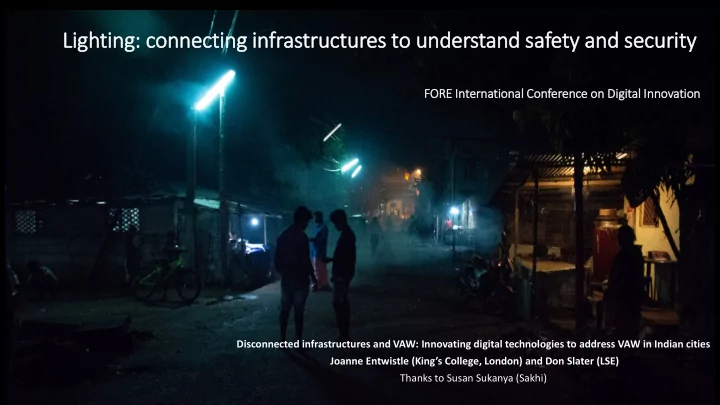
Lighti ting: c : connecting i infrastr tructu tures s to understand s safety ty and security ty FOR ORE Inter ernational C Confer eren ence e on D Digital I Inno novation Disconnected infrastructures and VAW: Innovating digital


slide-1
SLIDE 1

Lighti ting: c : connecting i infrastr tructu tures s to understand s safety ty and security ty

FOR ORE Inter ernational C Confer eren ence e on D Digital I Inno novation

Disconnected infrastructures and VAW: Innovating digital technologies to address VAW in Indian cities Joanne Entwistle (King’s College, London) and Don Slater (LSE) Thanks to Susan Sukanya (Sakhi)

slide-2
SLIDE 2
  • 1. Infrastructures are not gender

neutral

  • 2. Broad definition of infrastructure

to refer to physical infrastructure, digital infrastructure, social infrastructure

  • 3. Scales of analysis: connecting up

international-national-regional to local level knowledge and practice

slide-3
SLIDE 3

Connecting lighting and safety…

  • Lighting is synonymous with safety
  • BUT Professional/academic knowledge base is

poor, sparse, ambiguous and often misused

  • We don’t have accurate data on ‘how lighting

impacts X’ (crime, perception of safety, ‘anti- social behaviour’)

slide-4
SLIDE 4

Methodology:

  • measurement of light levels for both

installed lights and ambient lights (from shops, cars, etc) throughout both enclaves;

  • Photo and video documentation and

analysis of light and shadow on a metre by metre basis throughout the enclaves, including documentation of public gathering spaces and pedestrian routes through the neighbourhoods

  • Observation of night-time practices in

public spaces (both men and women, children

  • Interviews with women in situ about

their use of public space and what they think about the lighting.

  • In Trivandrum some ‘experimentation’

– changing light bulbs in people’s houses to explore light qualities with residents.

slide-5
SLIDE 5
  • Women feel safe in enclave (but very unsafe at home and
  • utside their enclave)
  • Concerned about the safety of their husbands and sons

(alcohol, drugs, fighting, all blamed on outsiders).

  • Tall mast:
  • enables visibility of ‘our’ people and ‘outsiders’
  • women distinguish brightness from colour rendering

(CRI): colour temperature

  • ‘good light’ = clarity = facial recognition
  • Safety - we can police ourselves
  • Lighting infrastructure supports social infrastructure

Trivandrum, Kerala

slide-6
SLIDE 6

Ko Kochi, Kerala

  • Women-light- safety connections reversed
  • Public space of enclave perceived as

dangerous (home and city are less dangerous)

  • Concerned about men, drugs, alcohol and

fighting

  • Strong division between two ethnic communities

who blame the danger on each other.

  • Community self-policing is not an option.

People send girls out of the neighbourhood entirely if possible.

  • Need to light the few places that women go after

dark (public water taps) to publicly support right to be outside

  • Lighting can’t be divorced from social

infrastructure

slide-7
SLIDE 7

Other findings

  • What do we mean by ‘safety’?
  • Safety – falls into road, ditches, rubbish, collisions

with vehicles and people (Trivandrum)

  • Security – direct forms of violence (Kochi)
  • Care and maintenance
  • Repairing lights not just about functionality (safety

and security)

  • Politically symbolic
  • (low value of value oftheir neighbourhood by the

state, marginality, powerlessness as citizens)

slide-8
SLIDE 8

Conclusion

  • Different levels of analysis provide

different lens to examine how infrastructures are lived

  • Standardized measures have to be

localized wherever possible

  • Lighting is not a magic bullet that impacts

safety routinely and predictably. To the contrary, our main finding and recommendation is that cities need better social understanding of how both light and safety